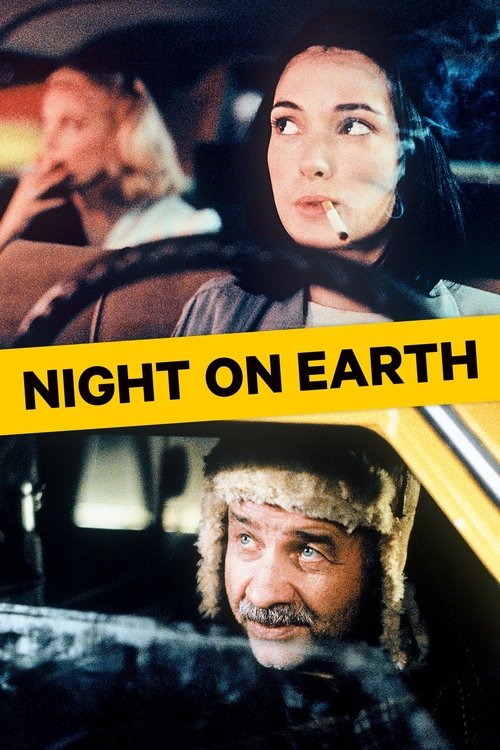
Night on Earth
1991 · Jim Jarmusch
For a late night when you want good company more than plot — when you're in the mood for something wry and humane you can drift through, and feel oddly connected to the whole planet by the end.
What it's about
One night on Earth, five taxis: in five cities — Los Angeles, New York, Paris, Rome, Helsinki — a driver picks up a fare, and for the length of the ride two strangers are stuck with each other. A tomboy mechanic drives a Hollywood casting agent; an East German immigrant who can barely drive gets taken over by his own passenger in Brooklyn; a blind woman upends her Parisian driver's assumptions; a Roman cabbie insists on confessing everything to a priest; and in frozen Helsinki, drunks and driver trade miseries toward dawn.
The experience
Droll, unhurried, and quietly moving — the comedy comes from watching strangers misread each other, and the melancholy sneaks up on you. Each segment has its own temperature, from pure clowning to something close to heartbreak, and the whole thing has the loose, late-night rhythm of an actual cab ride.
Performances
A remarkable roster doing chamber work in the front and back seats: Gena Rowlands and Winona Ryder sparring in Los Angeles, Armin Mueller-Stahl and Giancarlo Esposito finding unlikely warmth in Brooklyn, Béatrice Dalle in Paris, and Roberto Benigni delivering a legendary comic monologue in Rome. Matti Pellonpää anchors the Helsinki finale with devastating stillness.
The craft
Jim Jarmusch commits to a rigorous, playful structure — five cities, one instant of world time, the camera staying inside the cab — and lets each city's light and language change the film's whole character. Tom Waits's growling, ramshackle score ties the night together, and the nocturnal cinematography makes every city look like the edge of the world.
Why it matters
A touchstone of American independent cinema's international turn, and one of the defining anthology films — proof that a strict formal game could hold real emotional range.
Snapshot
Night on Earth is Jim Jarmusch's five-city anthology of taxi rides, all unfolding across a single night — or rather, across one instant of world time refracted through five clocks. The film opens on a row of them: Los Angeles, New York, Paris, Rome, Helsinki, each marked with its local hour, and a spinning globe seen from space. From there Jarmusch descends into five enclosed vehicles and stays there, more or less, for two hours. A young tomboy mechanic drives a casting agent through the sprawl of Los Angeles; an East German émigré who can barely operate his cab is taken over by his own passenger in Brooklyn; a blind woman punctures the assumptions of an Ivorian driver in Paris; a compulsively confessing Roman cabbie talks a priest into cardiac arrest; and in a frozen Helsinki dawn, three drunks and a driver trade miseries until the contest of sorrow is decisively lost.
The film arrived at a hinge point in Jarmusch's career. After Stranger Than Paradise (1984) made him the emblematic figure of American independent cinema and Down by Law (1986) and Mystery Train (1989) consolidated a style — deadpan long takes, foreign visitors adrift in an unglamorous America, black-and-white or saturated near-monochrome, elliptical structure built from discrete blocks — Night on Earth extended the anthology form of Mystery Train outward from Memphis to the globe. It is his most explicitly international film to that date, shot in four languages besides English, financed through the European co-production networks that had sustained him since Down by Law, and structured so that no city is the center.
Critically, it has long been regarded as minor Jarmusch relative to Stranger Than Paradise or Dead Man — a charming set of sketches rather than a major statement. That verdict has softened considerably. What once read as slightness now reads as a formal wager: that the cab is a sufficient theater, that strangers thrown together by commerce produce a more honest intimacy than plot ever could, and that the world can be described by five conversations that go nowhere.
Industry & production
Night on Earth was produced by Jarmusch's own company, JVC Entertainment, with financing assembled from European sources — the pattern he had established with Down by Law, which drew on West German and Italian money, and continued through Mystery Train, backed substantially by Japanese investment. By 1991 Jarmusch occupied an unusual position: an American director whose films were more reliably financed and more warmly received abroad than at home, and who had negotiated ownership of his own negatives, an arrangement almost unheard of for a filmmaker at his budget level. That control shaped the project. An anthology shot in five cities in five languages, with no star vehicle at its center and no throughline of plot, is not a film that survives studio development; it exists because Jarmusch could raise money against his name in Europe and Japan and answer to no one about structure.
Production was distributed across the five locations, with the Helsinki and Paris episodes shot in bitter conditions that are visible on screen. Fine Line Features, the specialty arm New Line had established in 1990 precisely to handle films of this kind, released it in the United States. Its commercial performance was modest, consistent with Jarmusch's other work of the period — these were films that recouped through international sales, festival exposure, and long ancillary life rather than domestic theatrical returns.
The casting is the production's most legible strategy. Winona Ryder, then at a commercial peak, anchors the Los Angeles segment; Gena Rowlands, carrying the full weight of her Cassavetes association, plays opposite her. Roberto Benigni had already worked with Jarmusch on Down by Law and returns here in a segment written to his particular register of verbal avalanche. Armin Mueller-Stahl, Giancarlo Esposito, Rosie Perez, Béatrice Dalle, Isaach De Bankolé, and Matti Pellonpää — the latter a fixture of Aki Kaurismäki's company — form a cast assembled less by market logic than by affinity. Several of these performers had significance within specific national cinemas that a purely American production would have had no reason to draw on.
Technology
The film was shot on 35mm color negative, and the technological story here is chiefly one of low-light capture. Almost the entire film takes place at night inside moving vehicles, which is among the more demanding situations in conventional cinematography: the light sources are practical and passing, the interior is cramped, the camera positions are constrained by the geometry of a car, and the exterior is a continuously changing field of streetlamps, headlights, neon, and dark.
By 1991, faster color stocks made this practicable without the heavy supplementary lighting that would have flattened the interiors a decade or two earlier. The film exploits that latitude: faces are lit by what a taxi would plausibly contain or pass, exteriors read as genuinely dark, and the grain structure of low-light stock contributes to the film's texture rather than being fought.
The five-language sound recording carries its own technical demand — dialogue is the film's entire substance, recorded in vehicles with running engines and road noise, and the subtitled segments require intelligibility for post-synchronization and translation as well as for the audience. There is nothing digitally exotic here; Night on Earth is a film made with mature analog tools deployed under difficult conditions, and its technological interest lies in the discipline rather than the novelty.
Technique
Cinematography
Frederick Elmes shot Night on Earth, having previously worked with Jarmusch on Mystery Train and, most consequentially for his reputation, with David Lynch on Eraserhead and Blue Velvet. His work here is the film's most striking formal element and its least discussed.
The scheme is essentially binary: interiors of extraordinary intimacy, exteriors of considerable abstraction. Inside the cab, the camera holds close on faces in two-shot or in alternating singles, usually from a fixed position dictated by where a camera can physically sit — the dashboard, the passenger seat, the window. The rearview mirror becomes a recurring compositional device, letting driver and passenger occupy the same frame while facing away from each other, a spatial fact the film mines repeatedly for its social meaning. Outside, the cities pass as smeared light. Elmes lets the exteriors go soft and bokeh-heavy, so that Los Angeles, New York, Paris, Rome, and Helsinki become washes of color rather than legible geography.
This is the film's central visual argument, and it is worth stating plainly: the cities are not really depicted. A film that names its five locations so insistently declines to show them in any tourist sense. Rome gets its landmarks glancingly and at speed; Paris is mostly wet asphalt and reflection; Helsinki is a blue-white void. What is depicted, with great precision, is the inside of five cabs. The world outside is weather and light.
Each segment carries its own tonal signature within this scheme. Los Angeles is warm, dusty, sodium-lit. New York is harsher and more contrasty. Paris is cold and reflective. Rome is theatrical, closer to a stage lit for one performer. Helsinki is drained nearly to gray-blue monochrome, the coldest images in the film and the ones that most directly recall the palette of Kaurismäki's Finland.
Editing
Jay Rabinowitz cut the film — the beginning of a long association with Jarmusch that would run through Dead Man, Ghost Dog, and beyond. The editing operates on two scales.
Within segments, cutting is unhurried and conversational, with long takes and a willingness to let exchanges play out in real time. Jarmusch's characteristic patience is intact: a joke is allowed to arrive late, a silence is allowed to sit, a reaction is held past the point where conventional coverage would move on. The rhythm is set by speech and by the car's motion rather than by dramatic beats.
Between segments, the film uses hard structural breaks: the clock face, the globe, the transition to the next city and hour. These are not dissolves or match cuts seeking continuity — they are chapter markers, closer to the blackouts of Stranger Than Paradise than to conventional anthology bridging. The effect is to make each episode a discrete unit while insisting, through the clocks, that they are simultaneous. The film's one genuine formal claim on the viewer is this: you are being shown five things happening at once, in sequence, and you must hold the simultaneity yourself.
Mise-en-scène / staging
The taxi is one of the most constrained playing spaces in cinema, and Jarmusch treats the constraint as the point. The interior offers a fixed set of positions — driver forward, passenger behind or beside, eyes meeting only in the mirror — and the film generates almost all its social meaning from that arrangement. The driver has physical control and no social power; the passenger has money and destination and no control over the route. Each segment tests a different configuration of that asymmetry.
Jarmusch stages the reversals within it. In the New York episode, the passenger takes the wheel, inverting the entire geometry. In the Paris episode, the blind passenger's inability to see becomes, in the driver's hands, an occasion for condescending curiosity that she systematically dismantles — the sighted man is the one operating from ignorance. In Rome, the priest is a captive audience, the confessional inverted so that the driver confesses upward at a hostage. In Helsinki, the cab becomes a mobile wake.
Costume and props are handled with the same economy. Corky's overalls, cap, and cigarette establish her entire refusal of the world Victoria inhabits before either speaks at length. YoYo's clown-ish overcoat, Helmut's incompetence with his own vehicle, the sheer accumulation of Benigni's gesture within a space that cannot contain it — these are staging decisions doing the work of exposition.
Sound
Tom Waits composed the score and, with Kathleen Brennan, wrote the songs that frame the film, including its opening and closing vocal numbers. The music is Waits at his most nocturnal — accordion, brushed percussion, low horns, the junkyard timbres of his Rain Dogs and Frank's Wild Years period. It is used sparingly and mostly between segments, functioning as connective tissue: a single sonic sensibility laid over five cities so that the transitions feel authored rather than arbitrary.
The diegetic soundscape is engine, tire, radio, wiper, and voice. Because the film is almost entirely dialogue, the mix must keep speech forward against a constant bed of vehicular noise, and it does so without the artificial cleanliness that would break the illusion of a real cab.
Language itself is a sound design element. The film moves through English, French, Italian, and Finnish, and Jarmusch — who had built earlier films around the comedy and pathos of non-comprehension — makes accent and fluency dramatic material. Helmut's broken English, Benigni's Italian delivered at a velocity that overwhelms subtitling, the Finnish of the closing segment: the audience's varying access to the words is part of the design.
Performance
The film is a performance anthology, and the registers differ sharply by segment. Ryder plays Corky in a low, unimpressed key, chewing gum and refusing to be impressed by an offer that would change her life. Rowlands, opposite her, does the harder thing — playing a woman of real power gradually recognizing that her power is irrelevant here — largely with her eyes and a phone.
Mueller-Stahl and Esposito operate as a genuine comic duo, the former's bewildered gentleness set against the latter's exasperated street competence, with Rosie Perez arriving as pure velocity. In Paris, Isaach De Bankolé plays wounded pride under a thin professional surface, and Béatrice Dalle gives one of the film's finest performances as a woman who has heard every stupid question before and is not going to be gentle about it.
Benigni's Rome segment is the film's most divisive: a sustained solo aria of escalating confession, performed at a pitch that some viewers find exhilarating and others exhausting. It is deliberately the film's only virtuoso turn, and its excess is structurally motivated — it is the segment that must be funniest so that the last can be saddest.
Which brings the film to Matti Pellonpää, whose Helsinki cabbie delivers the closing monologue in a register of complete stillness. The Finnish segment works because Pellonpää — a Kaurismäki regular, and the emotional center of that filmography — plays grief without a single gesture toward it.
Narrative & dramatic mode
Night on Earth is an anthology of five self-contained episodes with no character, plot, or causal link between them. What connects them is a premise (taxi, night), a time (simultaneous), and a form (two-hander in a moving vehicle). This puts the film in the tradition of the portmanteau or omnibus film, but with an unusually strict constraint: not merely a shared theme, but a shared apparatus.
Dramatically, each episode is a chamber piece. Two people, one enclosed space, a fixed duration bounded by the fare. Nothing is resolved in any conventional sense — Corky turns down the role, Helmut and YoYo part, Angela leaves the cab, the priest dies without the confession being absolved, the drunks stagger off. The taxi ride is a natural dramatic unit precisely because it has a built-in ending that owes nothing to the story: the destination arrives, and the encounter stops whether or not it has concluded.
The film's mode is conversational and anecdotal rather than plotted. It belongs to a strain of cinema — Jarmusch's own, but also Rohmer's, Linklater's, Kaurismäki's — in which talk is not the delivery system for narrative but the substance of the film. The tonal range runs from broad farce (Rome) to something close to tragedy (Helsinki), and the sequencing is deliberate: the film gets funnier as it moves east and then drops, in its final segment, into a story of a dead infant that recontextualizes everything before it. That structural descent is the film's real dramatic architecture.
Genre & cycle
Nominally comedy-drama; more precisely, the film sits at the intersection of several cycles. It is an omnibus film, a form with a long European pedigree — the Italian episode films of the 1960s, the multi-director city portmanteaus, the tradition of Paris vu par… (1965) in which a city is rendered through discrete episodes by different hands. Jarmusch's variation is to write and direct all five himself while keeping the discontinuity of the multi-author form.
It is also a taxi film, a small but real category running from the noir tradition through Taxi Driver (1976), against which Night on Earth is almost a rebuttal: where Scorsese's cab is a sealed vessel of alienation and building violence, Jarmusch's is a site of forced, temporary, and largely benign intimacy. The city seen through a windshield is the shared image; the conclusions drawn are opposite.
Within Jarmusch's own filmography it belongs to the anthology cycle that runs from Mystery Train through the accumulated Coffee and Cigarettes shorts (begun 1986, released as a feature in 2003) — the sustained project of building films from repeated two-person encounters within a fixed situation. Coffee and Cigarettes is essentially the same experiment conducted at a table instead of in a cab.
And it belongs to the American independent cycle of the late 1980s and early 1990s, alongside the emerging work of Hal Hartley, Todd Haynes, and the filmmakers Sundance and the specialty distributors were then consolidating into a recognizable sector.
Authorship & method
Jarmusch wrote and directed all five segments, and the method is well documented in general outline: he wrote each episode with specific actors already in mind, in some cases building the material around performers he knew and had worked with. This is a compositional approach closer to a bandleader writing for particular players than to conventional screenwriting, and it accounts for the film's unevenness of register — the Rome segment exists because Benigni exists.
His authorial signature is fully present. The outsider protagonist; the encounter between people with no shared frame of reference; the refusal of narrative payoff; the deadpan long take; the interest in the unglamorous interstitial spaces of cities; the treatment of America as a place experienced by foreigners. What is new is scale and symmetry — earlier films placed European visitors in an American landscape, while this one distributes the outsider condition across five cities, so that no location is home.
Frederick Elmes (cinematographer) supplies the film's controlled contrast between intimate interior and abstracted exterior, an approach continuous with his work for Lynch in its willingness to let light behave expressively rather than descriptively. Jay Rabinowitz (editor) establishes the patience and block-structure that would define Jarmusch's cutting for the next two decades. Tom Waits (composer, with Kathleen Brennan) provides the single unifying voice across five discontinuous worlds. The collaboration with Waits is the deepest of these — he had acted in Down by Law, and his sensibility, nocturnal and derelict-romantic, is close enough to Jarmusch's that the score reads as co-authorship rather than accompaniment.
Movement / national cinema
Night on Earth is an American independent film with a European center of gravity. Jarmusch emerged from the downtown New York scene of the late 1970s and early 1980s — the No Wave milieu, the overlap of experimental film, punk, and visual art — and his early work bears the marks of that formation: minimal means, non-professional or cross-disciplinary casting, structural rigor, an anti-Hollywood syntax inherited partly from European art cinema and partly from the American avant-garde.
By 1991 the specific national affiliations of the film had multiplied. The Helsinki segment is effectively a dialogue with Aki Kaurismäki, sharing his lead actor, his register of deadpan melancholy, and his palette; it functions almost as a guest chapter in the Finnish director's filmography. The Paris segment engages French cinema's contemporaneous reckoning with immigration and race in a way that connects it to the cinéma de banlieue films soon to follow. The Rome segment draws on the Italian comic tradition of the verbal soloist. The film's most accurate description as a national object is a European art film shot partly in America by an American director.
Era / period
The film sits at the closing of one moment and the opening of another. 1991 is the year the Soviet Union dissolved, two years after the Berlin Wall came down, and the presence of an East German émigré cabbie in Brooklyn — a former clown from a country that no longer exists — is not incidental. The film's globalism is of a specific historical flavor: the early-1990s sense of a world suddenly connected and simultaneously legible, the moment when a spinning globe and five synchronized clocks could serve as a credible opening image.
It is equally a document of American independent film's institutional consolidation. Fine Line, the specialty divisions, the festival circuit that would within two years make Reservoir Dogs and shortly after Pulp Fiction into cultural events — Night on Earth arrives just ahead of that surge, made by the director who had done the most to make it possible and who would decline to participate in its commercial logic.
Themes
The stranger as the only honest interlocutor. Every segment turns on the fact that these people will never meet again. The taxi is a confessional precisely because it is disposable — Gino tells the priest what he could tell no one who would still be there tomorrow.
Failed and partial translation. Between languages, between classes, between the sighted and the blind, between the pious and the profane. The film is a catalog of conversations in which the parties do not fully understand each other and proceed anyway. Comprehension is never complete, and the film does not treat this as tragic.
Work. All five drivers are working. The fare, the meter, the shift, the tip — money structures every encounter, and the film is unusually attentive to the fact that intimacy here is purchased. Corky's refusal of Victoria's offer is the film's clearest statement: she likes her job, which the film treats as a legitimate and complete position rather than a deficiency.
Simultaneity and indifference. The clocks insist that all five nights are the same night. The film draws no consoling conclusion from this. The world is not one place; it is five places that happen to be having the same hour.
Grief arriving without warning. The Helsinki segment reframes the entire film. Three men complain about a bad night; the driver answers with a dead child. The film ends there, on the recognition that everyone in every cab has been carrying something the ride was too short to reach.
Reception, canon & influence
Contemporary critical reception was warm but qualified. The prevailing view held the film to be charming and beautifully performed but slighter than Jarmusch's earlier work — an anthology of sketches whose quality varied, with critics dividing sharply over the Benigni segment (embraced by some as the film's comic peak, dismissed by others as indulgent) and converging on the Helsinki segment as its most powerful passage. The film had a substantial European profile and performed better with foreign audiences and critics than domestically, a pattern established with Jarmusch's earlier work.
Its critical standing has risen. What was read as slightness now reads as a deliberate structural proposition, and the film is regularly cited as one of the most successful anthology features precisely because its constraint is formal rather than thematic. The Criterion Collection's release of the film has contributed to that consolidation, as it has for much of Jarmusch's filmography.
Influences on the film (backward). The European omnibus tradition, particularly the Italian episode film and the city-portrait anthology exemplified by Paris vu par…. The chamber cinema of talk — Rohmer above all, whose films are similarly built from conversations that resolve nothing. Cassavetes, whose presence is invoked directly through Rowlands and whose model of performance-driven, loosely plotted American filmmaking underwrites Jarmusch's entire practice. Ozu, whose static camera and structural patience Jarmusch has repeatedly acknowledged as formative. And Taxi Driver, present as the negative image against which this film's taxi is defined.
Legacy (forward). The film's most traceable influence is on the conversation-driven independent cinema that flourished through the 1990s. Richard Linklater's Slacker appeared in 1991 and Before Sunrise in 1995; the affinity of method — talk as substance, encounter as structure, the city as a field crossed by strangers — is clear even where direct lineage is not documented. The vignette-anthology form recurs across the following decade in films built from discrete encounters rather than continuous plot.
Within Jarmusch's own work, Night on Earth is the direct ancestor of Coffee and Cigarettes, which formalizes its method into its purest version: two people, one table, no story. It also marks the point where his cinema becomes fully transnational, a direction that continues through Ghost Dog: The Way of the Samurai (1999), Broken Flowers (2005), and The Limits of Control (2009).
The film's structural device — simultaneous stories in multiple cities, unified by time rather than causality — anticipates the global-network narratives that became prominent in the 2000s in the work of Alejandro González Iñárritu and others, though those films typically restore the causal links that Jarmusch pointedly withholds. Night on Earth is the purer case: five stories that share nothing but an hour, and are not secretly connected. That refusal is the film's most radical and most durable idea.
A Deleuzian reading
Two people sit in the same frame and face away from each other.
The full Deleuzian reading of Night on Earth →
Reception
In 1991 it was filed as 'minor Jarmusch' — a pleasant, slight anthology after Mystery Train. It's since become one of his most-loved films, a Criterion-canonized comfort watch that Letterboxd treats as the warm, human entry point to his whole deadpan universe.
How Night on Earth was received, from release to now →
How to watch Night on Earth: what to notice on a first viewing
- Watch driver and passenger share the frame only through the rearview mirror. The mirror becomes a recurring device letting the two people occupy one frame while facing away from each other for most of the ride. Two people can be composed together and still never really face each other, which is the whole film's social arrangement.
- Watch the city outside the cab blur into soft, unreadable color. Elmes keeps interiors sharp and close while letting the passing cities go bokeh-heavy and abstract, so five named locations are barely shown as places. What the film actually shows you, with real precision, is the inside of five cabs, not the cities around them.
- Listen for how much of the dialogue you can actually follow. The film moves through English, French, Italian, and Finnish, and lets broken fluency and rapid delivery vary how much access you get to the words. Your own partial understanding is part of the design, matching the imperfect understanding between the characters themselves.
- Watch for a clock face and a spinning globe between cities. These act as hard chapter markers rather than smooth transitions, closing one segment completely before opening the next. The breaks insist all five rides are happening at once, even though you can only watch them one at a time.
- Watch Corky's overalls, cap, and cigarette before she says much of anything. Her look establishes her entire refusal of the glamorous world her passenger represents, doing the work of introduction before a word of dialogue lands. Costume alone tells you who she is before the conversation even starts making its case.
The whole guide to watching Night on Earth, with the keys for a rewatch →
Influences: the films it descends from and the films it influenced
- Paris vu par… (1965) — Establishes the city-anthology's binding constraint as a geographic unit rather than a theme — each episode locked to one named arrondissement, shot on location in 16mm with its own camera grammar — which Jarmusch scales up to one city per segment and swaps for a temporal binding (a single clock hour) instead of a spatial one.
- The Gold of Naples (1954) — The Italian episode film built backward from performers — segments written as vehicles for Totò, Loren, and De Sica himself — is the compositional method Jarmusch adopts wholesale: he writes each city around an actor he already has (Benigni, Rowlands, Pellonpää), which is why the registers refuse to match.
- Tokyo Story (1953) — The 'pillow shot' — an exterior of trains, rooftops, or empty streets held between dramatic blocks, belonging to no character's POV — is the direct model for Jarmusch's spinning-globe and clock-face interstitials, which likewise mark structural joints with unpeopled images rather than transitions.
- My Night at Maud's (1969) — Néstor Almendros shoots an entire night-long conversation off practical lamps in one apartment, and the talk resolves nothing — the chamber-of-talk template Jarmusch transposes into a moving vehicle, keeping both the available-light night interior and the refusal of a conversational payoff.
- Minnie and Moskowitz (1971) — Rowlands paired with a working driver, scenes running well past their dramatic function inside cars and cabs, performance dictating cut point — the model Jarmusch quotes by literally casting Rowlands in the L.A. segment opposite a mechanic-turned-driver.
- Taxi Driver (1976) — Michael Chapman's rearview-mirror inserts and wet-windshield neon bokeh define the taxi's visual grammar, which Jarmusch inherits shot-for-shot while inverting its meaning — the mirror there isolates a man narrating to himself, here it frames two people actually talking.
- One from the Heart (1982) — Waits's first film score treats songs as a hoarse ambient voice keyed to a city's neon rather than as underscore for action — the exact function his cues serve between Jarmusch's segments, carrying tone across cuts no character motivates.
- Stranger Than Paradise (1984) — One locked-off take per scene, each scene separated by black leader — the vignette-block structure that Night on Earth expands from a paragraph device into the film's whole architecture, with the blackouts promoted to full interstitials.
- Down by Law (1986) — Where Jarmusch discovers non-comprehension as a comic engine: Benigni improvising in broken English against deadpan Anglophones, the joke living in the gap between speakers rather than in the lines — the design principle Night on Earth applies to five languages at once.
- Blue Velvet (1986) — Frederick Elmes's method of underexposing to preserve pools of practical and sodium light inside surrounding blackness, with shallow focus dissolving background streetlight into bokeh, is the same lighting practice he brings to shooting five night interiors from streetlamps and dashboard glow.
- Mystery Train (1989) — The immediate structural prototype: three stories in one city over one night, cross-marked by shared time cues (Elvis on the radio, a single gunshot) — Night on Earth keeps the simultaneity device and strips out the causal cross-links that still tied Memphis together.
- Before Sunrise (1995) — Extends the two-stranger encounter into feature length by keeping the same rules — a fixed window of hours, a foreign city, an asymmetry of language and nationality between the pair, and long conversational takes cut for rhythm rather than information.
- Ten (2002) — Takes the taxi-chamber premise to its formal limit: two dashboard-mounted DV cameras give ten fixed driver/passenger two-shots, eliminating coverage entirely so the asymmetry of who steers and who confesses becomes the film's only staging decision.
- Coffee and Cigarettes (2003) — Distills the method to its residue — two people, one table, one overhead-angled fixed setup per episode, several segments shot by Elmes himself — retaining the per-segment cast-as-themselves logic while discarding even the vehicle.
- Lost in Translation (2003) — Builds whole sequences on non-comprehension as design (the director/translator scene, where the mistranslation is the joke and the point), shot by Lance Acord in available Tokyo neon through taxi glass — the bokeh-abstracted night ride as a state of mind.
- Babel (2006) — Adopts the multi-city, multilingual simultaneity structure but restores exactly what Jarmusch withheld — causal links between the strands — turning language barrier from an ambient condition into a plot mechanism, which makes it the instructive inverse of the seed's central refusal.
- A Taxi Driver (2017) — Establishes the taxi interior as a fully sufficient dramatic stage — the confined two-shot space between driver and passenger as a container for a complete emotional arc, the temporary social contract of the fare as a device for class and character revelation; Jang Hoon draws on this staging convention to hold the Man-seob/Hinzpeter relationship through extended road sequences.
- Father Mother Sister Brother (2025) — The explicit anthology-of-vignettes design — discrete, equally weighted episodes that rhyme tonally rather than connect by plot — is the structural ancestor of this triptych.
- Ariel (1988) — Matti Pellonpää's flat frontal delivery, held in static medium shots that let a devastating line land without an emphasizing cut, is the performance register Jarmusch imports by casting him — the Helsinki segment is essentially shot in Kaurismäki's grammar.
- Slacker (1991) — The baton-pass long take, where the camera abandons one conversation mid-sentence to follow a passing stranger into the next, arrives at the same proposition from the opposite direction: talk as substance and the city as a field of unconnected encounters, chained spatially where Jarmusch chains temporally.
Similar films
- Before Sunrise (1995) — influence & lineage · same viewing thread
- Lost in Translation (2003) — influence & lineage · same viewing thread
- Mystery Train (1989) — influence & lineage
- Down by Law (1986) — influence & lineage
- Taxi Driver (1976) — influence & lineage
- Stranger Than Paradise (1984) — influence & lineage
- Before Sunset (2004) — same viewing thread
- Nights of Cabiria (1957) — shared sensibility
All the films related to Night on Earth →
Watch it with: curated runs of related films
- Strangers Who Walk and Talk — Watch these back to back for the particular magic of two people, a city, and a few borrowed hours of talk that may not outlast the night.