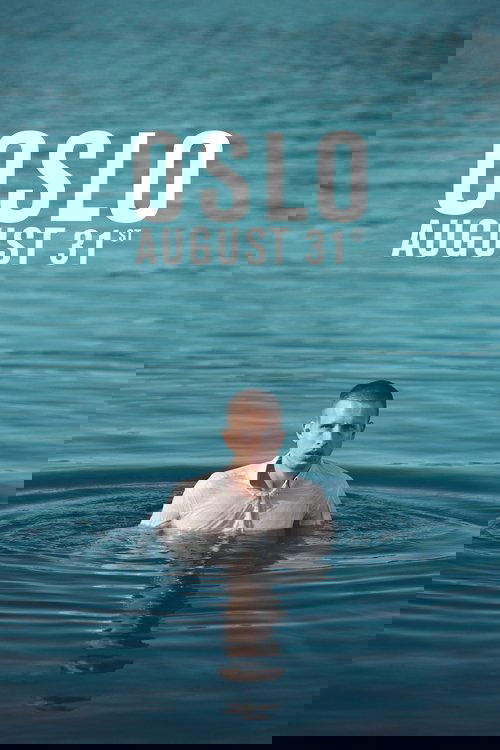
Oslo, August 31st
2011 · Joachim Trier
The Worst Person in the World became the millennial-zeitgeist film people got tattoos about; Sentimental Value's Cannes Grand Prix and 2025 Oscar-frontrunner status made him Scandinavia's biggest crossover since Bergman comparisons became legal again.
For when you want to feel something real and quiet — a film for a solitary evening when you're ready to sit with sadness rather than escape it. Emotionally heavy, but tender; not a pick-me-up, more like a long honest talk with a friend.
What it's about
Anders, a recovering drug addict in his thirties, is given one day's leave from his rural rehab clinic to attend a job interview in Oslo. Instead the day becomes a quiet reckoning: coffee with an old friend who's settled into family life, the interview itself, a party full of people who moved on without him, phone calls that go unanswered. He's weighing whether there's still a place for him in the life he left — and the film walks beside him without judging.
The experience
Gentle on the surface and devastating underneath. It moves at the pace of an ordinary day — conversations, streets, café noise — but every encounter carries the weight of a man deciding whether to stay. It's melancholy without being manipulative, and it lingers for a long time after.
Performances
Anders Danielsen Lie is extraordinary in the lead — intelligent, charming, and hollowed out, letting you see the effort behind every casual smile. Long dialogue scenes rest entirely on his face and never falter.
The craft
Joachim Trier shoots Oslo in late summer with a documentary looseness that makes the city itself a character — one café scene, where Anders simply listens to strangers' overheard hopes and plans, is among the most quietly moving passages in modern film. The naturalistic writing trusts silence and refuses a single false note of melodrama.
Why it matters
It confirmed Joachim Trier as one of Europe's essential filmmakers and became a touchstone for honest screen depictions of depression and addiction — a small film with an outsized reputation among people who've seen it.
Snapshot
A recovering drug addict named Anders is given a single day's leave from a rural rehabilitation clinic. He drives into Oslo, attempts suicide at dawn in a forest lake, fails, and then drifts through the city — through a long conversation with an old friend, a disastrous job interview, a party where he is a ghost among the living, and finally a café where he sits and listens to strangers talk about their lives. The film ends in silence in the family apartment where he grew up. By any summary, Oslo, August 31st sounds schematic — the last day before the end. What distinguishes it is the texture of ambivalence: Anders has not yet decided; every encounter is, provisionally, a reason to stay. The film holds that indeterminacy with extraordinary delicacy and refuses to sentimentalize or condemn its subject.
Industry & production
The film was produced by the Norwegian company Don't Look Now, with backing from the Norwegian Film Institute and Motlys. Joachim Trier and his regular producing partner Andrea Berentsen Ottmar had established the production infrastructure during the making of Reprise (2006), and Oslo, August 31st represents a deepening of that same collaborative model — small crew, tight budget, location shooting in the city that both films treat as a protagonist in its own right. The Norwegian Film Institute's co-investment model, which had been restructured in the mid-2000s to support internationally ambitious art cinema, was central to making the project viable. The film was shot on location across Oslo — a café in Grünerløkka, private apartments, the Akerselva river corridor, the forests of Nordmarka — in summer 2010, lending the finished film an uncomfortable warmth: the city at its most radiant as the protagonist moves through it like a man already half-departed.
Technology
Oslo, August 31st was shot digitally, a choice consistent with both the budgetary realities of Scandinavian art cinema at that moment and with the aesthetic of intimate proximity that cinematographer Jakob Ihre was pursuing. Digital acquisition allowed Ihre and Trier to work quickly and quietly on location, maintaining the impression of a documentary gaze without the weight and noise of film-era equipment. The city feels observed rather than staged. The film's opening montage — a kind of brief city symphony assembled from footage of Oslo across time, including archival images — is assembled in the edit rather than relying on any unified photographic treatment, suggesting a more essayistic approach to the camera's relationship with the historical record of the city.
Technique
Cinematography
Jakob Ihre, who had shot Reprise, maintains the grammar he and Trier developed there: a predominantly handheld camera that tracks Anders with an intimacy that sometimes tips into surveillance, following the small movements of his head and hands and eyes in close-up, and then occasionally withdrawing to place him in the broader city geography. The handheld work is not agitated — it does not code as thriller or social realism in the Dardennes sense — but as a kind of sustained close attention, the camera a companion that watches without interpreting. Ihre's palette for Oslo is warm and slightly overexposed, the city's blonde stone and summer foliage catching a light that is beautiful without being picturesque. This is one of the film's central ironies: the world is gorgeous and the protagonist cannot inhabit it.
Editing
Olivier Bugge Coutté, Trier's editor across multiple projects, constructs a rhythm of accumulation and ellipsis. The film's formal structure is organized around a series of extended real-time or near-real-time scenes — the conversation with Thomas runs very long, the café scene unfolds with minimal cuts — punctuated by jump-cuts and ellipses that skip over the connective tissue of the day. We never see Anders traveling between locations; we arrive with him into the next encounter. This editing creates the impression that only the moments of attempted connection count, that the intervals between are simply dead time. The café scene is the most formally distinctive passage: Bugge Coutté cuts between Anders listening and brief, fragmentary glimpses of the strangers whose conversations he is absorbing, constructing a kind of mosaic of ordinary life that Anders can observe but not enter.
Mise-en-scène / staging
Trier stages the film's scenes with minimal compositional intervention, preferring to arrange actors in naturalistic configurations and then follow the action rather than imposing blocking. The long conversation between Anders and Thomas, set in Thomas's apartment, uses the domestic furniture and the bodies of the two men to trace the shifting power dynamics of their exchange — who sits, who stands, who retreats to the kitchen — without editorial comment. This restraint extends to the family apartment in the film's final sequence, where the accumulation of objects — photographs, furniture, the material record of a life — is registered without underlining. The mise-en-scène is in constant dialogue with absence: what is not in the frame, what Anders cannot say, what the city holds but will not give him.
Sound
The sound design is among the film's most distinguished formal achievements. The opening memory sequence uses overlapping voice-overs — multiple people, their identities never fixed, recalling their experiences of Oslo and their youth — laid over images of the city. This immediately establishes the film's interest in interiority and collective memory as formal rather than merely thematic concerns. The café scene is a tour de force of diegetic sound: fragments of multiple conversations weave around Anders, none completing, the ambient noise of the room becoming a kind of score. The film's use of recorded music is deliberate and sparing; source music is allowed to enter and recede with the plausibility of the locations rather than functioning as emotional underscoring. The effect is a sound world that mirrors Anders's psychological condition — surrounded by language and life that will not cohere into meaning.
Performance
Anders Danielsen Lie, who had appeared in Reprise in a different role, is a practicing physician as well as an actor — a biographical detail that, while anecdotal, feels resonant in a performance of such clinical self-awareness. He plays Anders almost entirely in restraint: small adjustments of posture, a face that registers thought without displaying it, the occasional surfacing of something that might be charm or might be the memory of charm. There are no breakdown scenes in the conventional sense. When Anders suffers, the camera watches his face become still rather than expressive, an inversion of normal screen acting convention. The performance anchors the film's refusal of sentimentality; Danielsen Lie will not ask for sympathy, and this withholding is what makes the film's emotional impact so cumulative and, at the end, so devastating.
Narrative & dramatic mode
The film adapts the one-day structure from its source material — Pierre Drieu La Rochelle's 1931 novel Le feu follet — with rigorous fidelity to the premise's implied argument: that a single day, fully examined, contains all the evidence needed for a life's verdict. The narrative is not quite plotless but it is anti-climactic in a precise sense: each encounter produces not revelation but clarification of what was already true. Thomas cannot rescue Anders because Thomas has made the compromises of adult life that Anders, in his refusal, has been unable or unwilling to make. The job interview fails not because Anders performs badly but because he cannot bring himself to pretend that the work matters. The party is populated by the lives Anders might have had. The dramatic mode is one of accumulating recognition — Aristotelian anagnorisis dispersed across an ordinary day rather than concentrated into a single scene of discovery.
Genre & cycle
Oslo, August 31st belongs to the strand of European art cinema organized around the last day or the final hours — a lineage that includes Malle's Le Feu Follet most directly, but also extends to certain films of Bresson, to aspects of Cassavetes, to the contemporary Italian cinema of mortality and duration. It is not, however, a "day in the life" film in the more optimistic mode (Before Sunrise, Boyhood's diurnal segments): the day is structured retrospectively, as an ending. Within Norwegian and Scandinavian cinema, it participates in a renewed international visibility for the region's art films in the 2000s and early 2010s — a cycle that includes work by Ruben Östlund in Sweden and later the films of Hlynur Pálmason in Iceland — though Trier's filmmaking is more cosmopolitan in reference than most of his regional contemporaries.
Authorship & method
Joachim Trier was born in 1974 in Copenhagen and trained at the National Film School of Denmark, a formative fact: his filmmaking sensibility is in dialogue with the Dogme 95 generation even as it argues against their programmatic naturalism. His collaboration with Eskil Vogt — who co-wrote both Reprise and Oslo, August 31st before becoming a director in his own right (Blind, 2014; The Innocents, 2021) — is one of the defining creative partnerships of contemporary Scandinavian cinema. Vogt's screenwriting tends toward structural rigor and the precise articulation of interiority; Trier's direction is more impressionistic and open to contingency. Together they produce scripts that are architecturally clear but which leave room for the kind of lived, observational detail that makes Oslo feel discovered rather than designed.
Jakob Ihre (cinematography) and Olivier Bugge Coutté (editing) complete the core creative unit that had formed on Reprise. This consistency of collaborators — a small, stable ensemble across multiple projects — is characteristic of Trier's working method and distinguishes his practice from directors who reconstruct their team with each film. The result is a shared visual and rhythmic language that deepens over time.
Movement / national cinema
Norway's film industry has operated at modest scale relative to its European counterparts, sustained by the Norwegian Film Institute's subsidy model and historically oriented toward domestic genres and national narratives. Trier represents a strand of Norwegian filmmaking that is self-consciously European and internationally referenced — more in dialogue with French, Italian, and Danish cinema than with any specifically Norwegian tradition. This is partly biographical (his Danish training, his family background — his grandfather is the critic and filmmaker". Trier's grandfather is Erik Løchen, a Norwegian filmmaker, and his family has connections to Danish filmmaking through his uncle Lars von Trier; this relationship is acknowledged in the record but Joachim Trier has been careful to assert his independent development), and partly a matter of artistic positioning. The film's engagement with Malle and Drieu La Rochelle is not incidental: it explicitly situates Norwegian cinema within a French literary and cinematic tradition, transposing the story rather than replacing it.
Era / period
The film arrives at a moment when digital production has fully normalized for art cinema, when the question of format is aesthetic rather than economic, and when European festival cinema is experiencing a period of renewed international attention via Cannes's Un Certain Regard strand, which had become a reliable platform for the kind of rigorous, mid-budget art cinema that neither fits the auteur prestige slot nor the genre program. 2011 is also, in retrospect, a moment just before the streaming consolidation that would alter the economics and distribution geography of international art cinema substantially. Oslo, August 31st had the last years of a theatrical art-house circuit in which a film like this could find a sustained and serious audience without the mediation of a platform.
Themes
The film's central preoccupation is the impossibility of return — not dramatic, irrevocable return but the small, daily return that recovery requires: the return to a self that can sustain ordinary commitments, friendships, work, the metabolic rhythms of a shared life. Anders is educated, intelligent, from a comfortable family; the film is scrupulous about not making addiction a function of deprivation or trauma in any simple sense. The weight of the past is structural — it determines the shape of every conversation he has, the distance he cannot close — but the film refuses to pathologize or explain it. Alongside this, the film thinks seriously about the relationship between the individual and the city: Oslo is both the site of Anders's former life and an indifferent container of the lives of others, its beauty and ordinariness equally inaccessible to him. The café scene makes this philosophical rather than merely psychological: what Anders cannot reach is not one particular life but life itself, legible in every conversation he overhears and unable to enter.
Reception, canon & influence
Critical reception: Oslo, August 31st premiered at Cannes 2011 in the Un Certain Regard section and won the FIPRESCI Prize from the international critics' jury. Critical response was strong across European and North American art-film press, with particular attention to Danielsen Lie's performance and to the film's formal intelligence. Over the subsequent decade it has accumulated a secondary reputation that exceeds its initial distribution footprint — a film that circulates heavily among film students and cinephiles and that has come to be seen as one of the essential European films of the 2010s.
Influences on the film (backward): The primary literary source is Pierre Drieu La Rochelle's novel Le feu follet (1931), and the primary cinematic antecedent is Louis Malle's adaptation of the same novel, Le Feu Follet (1963), which follows a recovering alcoholic through his last day in Paris. Trier and Vogt are explicit about this inheritance; the transplantation of the story to Oslo and contemporary drug addiction is a deliberate act of adaptation rather than disguise. Behind Malle, the film is in dialogue with Robert Bresson's economy of means and his interest in the face as a register of interior states that resist expression; with Michelangelo Antonioni's treatment of alienation in modern urban environments; and with John Cassavetes's commitment to performance as discovery rather than execution. The opening city-memory montage has an essayistic quality that points toward Chris Marker, though the influence is diffuse rather than direct.
Legacy and forward influence: Oslo, August 31st is the second film in what has come to be understood as a loose Oslo trilogy, completed by The Worst Person in the World (2021), with Reprise (2006) as the first. The trilogy traces different facets of millennial Norwegian experience — artistic ambition and masculine anxiety in Reprise, addiction and irrecoverable loss in Oslo, romantic and vocational self-determination in The Worst Person — using the city as a continuous, accumulating environment. The Worst Person in the World extended the formal vocabulary of Oslo to greater international visibility, winning the screenplay prize at Cannes and an Academy Award nomination, and bringing renewed critical attention back to the earlier films. Eskil Vogt's subsequent career as a director carries forward certain of the thematic preoccupations — interiority, the limits of self-knowledge — developed in these collaborations. Anders Danielsen Lie has become a recurrent figure in European art cinema, appearing in Olivier Assayas's Personal Shopper (2016) among other films, and his performance in Oslo is regularly cited as a benchmark for the kind of restrained, interior screen acting the European festival circuit has come to prize. The film's influence on subsequent Scandinavian filmmaking is difficult to isolate but real; it demonstrated that Norwegian cinema could achieve serious international traction without accommodating its formal ambitions to broader commercial norms.
A Deleuzian reading
He walks into a forest lake at dawn with stones in his coat and lets himself go under.
The full Deleuzian reading of Oslo, August 31st →
Reception
Premiered quietly in Un Certain Regard at Cannes 2011 to strong reviews but a small arthouse footprint; its stature has climbed steadily since, and The Worst Person in the World (2021) sent a wave of new viewers back to it as the devastating middle chapter of Trier's Oslo trilogy.
How Oslo, August 31st was received, from release to now →
Influences: the films it descends from and the films it influenced
- Le Feu Follet (1963) — Trier's entire armature descends from Malle's adaptation — the recovering addict's final day of social visits ending in suicide, the jazz-score-against-observational-silence sound strategy, and the device of structuring each encounter as a further proof of irreversibility.
- Journal d'un curé de campagne (1951) — Bresson's diary narration — an interior voice that documents experience even as the body fails to communicate it — is the formal model for Oslo's voiceover, which registers what Danielsen Lie's evacuated performance refuses to show.
- L'Avventura (1960) — Antonioni's use of architectural dead space — hallways, empty terraces, figures at the far edge of frame — to materialize psychological alienation is directly inherited in Trier's Oslo wandering sequences, where the city becomes a landscape of estrangement rather than backdrop.
- Faces (1968) — Cassavetes's overlapping, halting social dialogue — characters performing ease while registering dread — models Oslo's dinner-party and café sequences, where conversation accumulates as a form of mutual unintelligibility rather than exchange.
- Wild Strawberries (1957) — Bergman's one-day memory-journey structure — a protagonist moving through space while flashback intrusions expose the psychological cost of past choices — directly anticipates Oslo's mosaic of present-tense wandering interrupted by involuntary memory sequences.
- Rosetta (1999) — The Dardennes' handheld camera pressed to the protagonist's back — following rather than preceding, denying access to the face and forcing attention onto breath and body — is the cinematographic ancestor of Trier and Ihre's surveillance-proximity approach throughout Oslo.
- Blind (2014) — Vogt's solo directorial debut carries forward the Oslo collaboration's epistemological preoccupation — what can we know of our own interior states — using a sightless protagonist to literalize the self-knowledge problem at the center of his and Trier's shared screenwriting practice.
- Personal Shopper (2016) — Assayas cast Anders Danielsen Lie partly on the basis of his Oslo performance; the film extends the European art-cinema mode of restrained interior acting — grief and dislocation registered through stillness rather than expression — that Oslo helped establish as a festival-circuit benchmark.
- The Worst Person in the World (2021) — The direct formal extension of Oslo — Trier and Vogt expand the mosaic-chapter structure, continue the warm-overexposed Jakob Ihre palette, and return to the question of irrecoverable choice, now through a female protagonist, bringing retrospective critical attention back to the earlier film's formal solutions.
- Reprise (2006) — The immediate Oslo-trilogy precursor in which Trier and Vogt first developed the mosaic-cutting structure, speculative counterfactual narration, and male-friendship-as-competitive-intimacy that Oslo, August 31st inherits and darkens toward inevitability.
- 4 Months, 3 Weeks and 2 Days (2007) — Mungiu's long-take real-time dinner scene — camera holding on a face during social crisis, refusing cutaways that would release pressure — is a sibling formal solution to Oslo's withholding-performance strategy and commitment to environmental realism over expressionist emphasis.
- Weekend (2011) — Haigh's 48-hour time compression achieves the same accumulating-anagnorisis effect as Oslo's one-day structure — both films use the truncated timeline to make each conversation function as a self-portrait the protagonist cannot fully perceive from inside it.
- Margaret (2011) — Lonergan's layered-sound editing — ambient conversations bleeding simultaneously into the protagonist's consciousness — is a direct cousin to Oslo's coffee-shop sequence, where overheard dialogue saturates the frame as a form of environmental grief rather than narrative information.
- Un amour de jeunesse (2011) — Hansen-Løve's elliptical time-compression — years collapsed into scenes organized by emotional rhythm rather than plot causality — is a sibling practice to Trier's mosaic-cutting, both drawing from Pialat's method of narrative elision as the primary carrier of feeling.
- Two Days, One Night (2014) — The Dardennes' one-weekend social-round structure — a protagonist making serial visits that accumulate into a portrait of social impossibility — is the closest formal parallel to Oslo's day-of-visits architecture, both films using repetition-with-variation across encounters as their central dramatic engine.
- Sentimental Value (2025) — The template for Trier's chamber-scale novelistic realism: behavioral observation built from long rehearsal and Ola Fløttum's restrained piano melancholy scoring interior states rather than action.
Similar films
- The Worst Person in the World (2021) — influence & lineage
- The Fire Within (1963) — influence & lineage
- Sentimental Value (2025) — influence & lineage
- Close (2022) — shared sensibility
- Another Round (2020) — shared sensibility
- Melancholia (2011) — shared sensibility
- Nymphomaniac: Vol. I (2013) — shared sensibility
- Pusher (1996) — shared sensibility