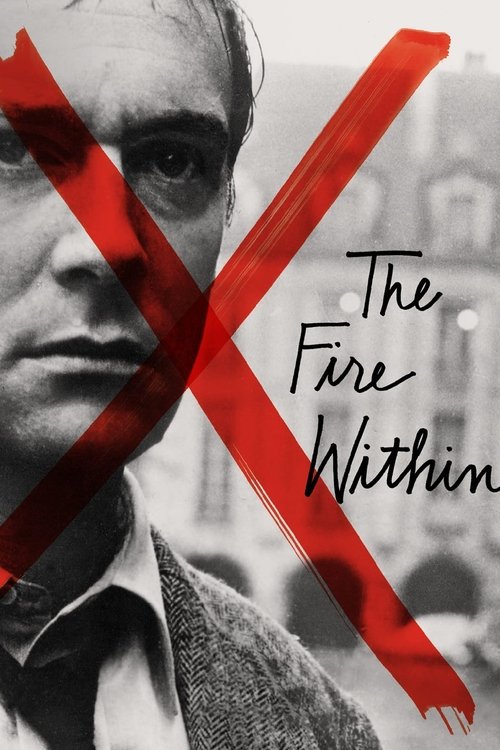
The Fire Within
1963 · Louis Malle
For when you need a film that takes despair seriously — not to be cheered up, but to feel accompanied and understood. Reach for it on a quiet, solitary night; know going in that it's heavy.
What it's about
Alain Leroy, a recovering alcoholic, leaves the quiet clinic outside Paris where he's been drying out and spends two days moving through the city, visiting old friends, former lovers, and drinking companions. Each encounter is a quiet test: he's looking for one good reason to keep going, and the people around him — comfortable, distracted, disappointing — keep failing to provide it.
The experience
Spare, hushed, and piercingly intimate — less a plot than a series of conversations, each one tightening the ache. It's a sad film, but lucid rather than wallowing, and it stays with you like a low note held for days.
Performances
Maurice Ronet is extraordinary as Alain — composed, charming, hollowed out — playing a man performing normalcy for everyone he meets while something else entirely goes on behind his eyes.
The craft
Malle strips everything down: black-and-white Paris, long unhurried scenes, and Erik Satie's sparse piano pieces as almost the only music, their melancholy simplicity doing the work of a whole score. The austerity is the point — nothing distracts from the man at the center.
Why it matters
Widely considered one of cinema's most honest portraits of depression and a turning point that established Malle among the most serious French directors of his generation, it remains the touchstone for films about a soul quietly taking leave of the world.
Snapshot
The Fire Within — released in France as Le Feu follet ("the will-o'-the-wisp," the flickering marsh-light of folklore) — is Louis Malle's fourth feature and, by wide critical consensus, one of the most concentrated portraits of suicidal despair the cinema has produced. Across roughly two days, a recovering alcoholic named Alain Leroy (Maurice Ronet) leaves the discreet clinic outside Paris where he has been drying out and moves through the city visiting old friends, former lovers, and drinking companions, quietly measuring each encounter against a decision he has already made: to shoot himself. The film is adapted from Pierre Drieu la Rochelle's 1931 novel, itself provoked by the 1929 suicide of the Dada poet Jacques Rigaut, and Malle transposes the story to a contemporary, affluent, disenchanted Paris. Its austerity is total — black-and-white photography, a soundtrack drawn entirely from the solo-piano music of Erik Satie, and a performance from Ronet of extraordinary interior stillness. It won a Special Jury Prize at the 1963 Venice Film Festival and has since hardened into a canonical text on despair, addiction, and the exhaustion of a generation.
Industry & production
By 1963 Malle occupied an unusual position in French cinema. He had entered the industry not through the Cahiers du cinéma critical circle but through documentary and co-direction — sharing the Palme d'Or with Jacques-Yves Cousteau for The Silent World (1956) — and had then delivered two commercial and critical successes in a single year, Elevator to the Gallows and The Lovers (both 1958). He was thus, at thirty, an established and bankable director with the leverage to make an uncompromising, deliberately uncommercial film. The Fire Within came after the more elaborate productions Zazie dans le métro (1960) and Vie privée (1962, with Brigitte Bardot), and reads in part as a corrective — a retreat from color, stars, and spectacle toward something spare and personal.
The film was produced through French production companies associated with Malle's work of the period; the exact corporate arrangements I would not want to overstate, but the picture was modestly budgeted and shot largely on location in and around Paris and Versailles, which suited both its economy and its documentary-inflected realism. Malle wrote the adaptation himself. The casting of Maurice Ronet was pointed: Ronet had played the doomed lover-murderer in Elevator to the Gallows, so his reunion with Malle carried an intertextual charge of glamour curdled into fatality. Around him Malle assembled a gallery of supporting players — including Jeanne Moreau and Alexandra Stewart in smaller roles — whose relative familiarity lent the social world its texture without displacing Ronet from the center of every frame.
Technology
Technologically the film is unshowy and of its moment: 35mm black-and-white photography, standard Academy-adjacent framing rather than widescreen, and largely available or naturalistic lighting for the interiors. The most consequential "technology" here is negative choice. Where Malle's Elevator to the Gallows had exploited fast film stock and Henri Decae's mobile, semi-improvised night photography to capture Jeanne Moreau wandering neon-lit boulevards, The Fire Within uses monochrome not for expressionist effect but for a kind of clinical clarity — gray Parisian light, pale walls, the flat surfaces of bourgeois rooms. The refusal of color in 1963, when color was increasingly the commercial default, is itself a statement of register: this is a film that wants to look at a face and a room without decoration.
Technique
Cinematography
The cinematography is by Ghislain Cloquet, and it is a model of restrained observation. Cloquet favors clean, legible compositions and a relatively still camera, holding on Ronet's face for long stretches so that the drama becomes a matter of micro-expression. The imagery is drained of glamour: the clinic's blank walls, the reflective surfaces of mirrors (Alain repeatedly confronts his own reflection, a recurring visual motif of self-scrutiny), the impersonal geometry of hotel rooms and salons. Where the New Wave often celebrated the vitality of the street, Cloquet and Malle use exteriors sparingly and coldly; the city is a place Alain passes through rather than belongs to. The overall visual key is gray and even, an aesthetic of lucidity that matches the protagonist's terrible clear-sightedness.
Editing
The editing, by Suzanne Baron — a longtime Malle collaborator — is patient and rhythmically deliberate. The film is structured as a series of visits, and Baron lets each encounter breathe to its full awkward length, so that the audience feels the accumulating weight of Alain's alienation in real time. There is little of the jump-cut playfulness associated with the contemporaneous New Wave; the cutting is classical, motivated, and unhurried, which paradoxically intensifies the dread. The pacing enacts the protagonist's condition: time is something to be endured, each scene another failed attempt to find a reason to continue.
Mise-en-scène / staging
Malle's staging is built around thresholds and rooms. Alain is perpetually arriving and departing — entering a friend's apartment, a bar, a bourgeois luncheon — and the mise-en-scène organizes each space to isolate him within it. Objects carry great weight: the pistol he has acquired, the bottles he no longer (or barely) touches, and above all the wall on which he has written a date, marking the deadline of his own life. Small gestures of self-presentation — dressing, adjusting his appearance, the careful arrangement of his effects — are staged with a ritual precision that reads, in retrospect, as the ordering of affairs before death. The bourgeois interiors are rendered as comfortable prisons: warm, cultured, and utterly unable to hold him.
Sound
The single most celebrated formal decision is the use of Erik Satie's solo piano music — principally the Gnossiennes and Gymnopédies — as the film's score. This is pre-existing music, composed decades earlier, not written for the film, and Malle deploys it with great discretion: sparse, unresolved, hovering phrases that seem to drift in and out of the drama like Alain's own attention. The effect is one of exquisite melancholy held at arm's length; the music never swells to underline emotion in the conventional way, but instead casts a cool, elegiac wash over the images. Beyond Satie, the sound design leans on quiet — the murmur of conversation, the ambient hush of rooms — so that silence itself becomes expressive of Alain's disconnection.
Performance
Maurice Ronet's performance is the film's foundation and, for many viewers, its glory. He plays Alain with a controlled, almost frictionless surface: courteous, wry, attentive, and beneath it absolutely resolved. Ronet resists any histrionic display of anguish; the despair is legible instead in the eyes, in a beat of hesitation, in the faint irony with which Alain observes people who cannot reach him. It is a performance about a man performing normalcy for others while having already, inwardly, departed. The supporting cast — friends who condescend, comfort, or fail to understand; women who represent roads not taken — function largely as surfaces against which Ronet's isolation registers.
Narrative & dramatic mode
The dramatic mode is that of the "last day(s)" chronicle, a countdown structure in which the ending is effectively foreknown and the suspense is displaced from what will happen to whether anything can change the outcome. Adapted from Drieu la Rochelle's novel, the narrative is episodic and peripatetic: a sequence of visits, each a small dramatic test in which Alain seeks — and fails to find — a reason to live. This is closer to the tradition of the philosophical or existential novel than to conventional plotting; conflict is internal and metaphysical rather than event-driven. The mode is elegiac realism shot through with a documentary attentiveness to social manners. Crucially, Malle refuses both melodrama and redemption: the film neither punishes Alain nor rescues him, but observes, with unsparing calm, a decision arriving at its conclusion.
Genre & cycle
The Fire Within belongs to the loose genre of the psychological character study and to the cycle of European art films of the late 1950s and early 1960s preoccupied with alienation, spiritual malaise, and the anomie of prosperous postwar society — the terrain also worked, in different keys, by Antonioni and Bergman. Within that cycle it is one of the definitive "suicide films," a small and demanding subgenre. It also sits within the broader tradition of adaptations of interwar French literature of disenchantment; Drieu la Rochelle's source belongs to a "lost generation" sensibility of Dada-adjacent nihilism, and Malle's film effectively updates that despair for the consumer society of the Fifth Republic.
Authorship & method
The film is unmistakably Malle's, yet it depends on a tight circle of collaborators. Louis Malle wrote and directed, and the project's austerity reflects his career-long refusal to be pinned to a single style — Malle moved restlessly between documentary, literary adaptation, provocation, and intimate drama, and The Fire Within represents his contemplative, morally serious register at its purest. Maurice Ronet, as noted, is effectively a co-author of the film's meaning through performance. Ghislain Cloquet's cinematography supplies the lucid gray visual world; Cloquet was among the notable French cinematographers of the era, later associated with a range of major directors. Suzanne Baron's editing shapes the film's patient rhythm across her long working relationship with Malle. And the "score" is really a curatorial act: the decision to build the soundtrack from Erik Satie's existing piano music is an authorial signature in itself, a piece of aesthetic judgment as decisive as any staging choice. Malle's method here is one of subtraction — stripping away plot, music-as-underscore, color, and stylistic flourish until only face, room, and time remain.
Movement / national cinema
Malle is conventionally grouped with the French New Wave by chronology, but The Fire Within clarifies how uneasy that fit is. He shared the Wave's early-1960s energy and its embrace of location shooting and contemporary subjects, but he came from outside the Cahiers critics' cohort and never adopted its self-reflexive playfulness. This film's classical editing, literary source, and grave tone place it at a deliberate remove from the ludic experiments of Godard or the essayism of the Left Bank group. It is best understood as French art cinema of the early Fifth Republic — cosmopolitan, literate, and engaged with a European-wide conversation about alienation — rather than as a New Wave manifesto. In national terms it is also a film about a specific French bourgeois milieu: cultured, moneyed, and spiritually hollow.
Era / period
The film is doubly period-marked. Its source belongs to the interwar moment of Dada and the "will to nothingness," and its protagonist retains something of that older dandy-nihilist type. But Malle plants him firmly in the prosperous, consumerist Paris of the early 1960s, and part of the film's power comes from the friction between the two eras: an essentially interwar despair transplanted into an age of comfort that offers Alain every material thing and no reason to live. Made at the height of postwar economic expansion, the film reads as a quiet rebuke to the promises of that prosperity.
Themes
The governing theme is the failure to connect — the inability of another person, a memory, a pleasure, or an idea to furnish a sufficient reason for continuing to exist. Around it cluster addiction and the fragile, provisional nature of "cure"; the film is acutely honest that sobriety alone does not restore a will to live. Other themes include the anomie of the affluent bourgeoisie; the persistence of the past and of an idealized love (the absent wife) that cannot be recovered; time as an unbearable weight; and self-scrutiny, dramatized through Alain's recurring confrontation with mirrors and with the written date that governs his remaining hours. Beneath these runs a stark existential question about whether life requires a justification at all — and what follows when a lucid, intelligent man concludes that, for him, it does not.
Reception, canon & influence
Critically, The Fire Within was received as a serious achievement on release and won a Special Jury Prize at the 1963 Venice Film Festival. Over the following decades its reputation has, if anything, grown; it is frequently cited as one of Malle's finest films and as a benchmark for the honest cinematic treatment of depression and suicide, admired precisely for its refusal of sentimentality or moralizing. (Specific contemporary review quotations and any box-office figures I will not reconstruct from memory; the safe, well-documented facts are the Venice prize and the film's durable place in Malle's critical standing.)
Looking backward, the film's influences are primarily literary and biographical: Drieu la Rochelle's 1931 novel and, behind it, the real suicide of the Dadaist Jacques Rigaut, which supplied both the psychological type and the milieu of aesthetic nihilism. Malle's formal debts run to the observational realism and existential seriousness of contemporary European art cinema rather than to any single antecedent film. Looking forward, its legacy is unusually concrete. The most direct descendant is Joachim Trier's Oslo, August 31st (2011), which openly adapts the same Drieu la Rochelle novel and self-consciously converses with Malle's film, transposing the last-days structure to contemporary Oslo. More broadly, The Fire Within helped establish a template — the lucid, unmelodramatic chronicle of a person moving toward suicide, scored with spare classical music and built on a single restrained central performance — that later filmmakers concerned with depression and addiction have drawn upon. Its influence is thus less a matter of visible stylistic imitation than of demonstrating that despair could be filmed with total gravity, clarity, and respect for its subject.
A Deleuzian reading
Alain Leroy has written a date on the wall of his room at the clinic.
The full Deleuzian reading of The Fire Within →
Reception
Respected on release — it took the Special Jury Prize at Venice in 1963 — but long overshadowed by Malle's flashier work; streaming-era cinephiles have since pushed it to the front of his filmography as maybe his most quietly devastating film.
How The Fire Within was received, from release to now →
How to watch The Fire Within: what to notice on a first viewing
- Watch how long the camera holds on Alain's face. Cloquet keeps a relatively still camera on Ronet for long stretches, so the drama plays out in tiny shifts of expression rather than dialogue. You have to read the film off a face that's working hard not to give anything away.
- Notice every time Alain passes a mirror or window reflection. Malle keeps returning to reflective surfaces, Alain catching his own image again and again as he moves through hotel rooms and apartments. The repetition makes you wonder which version of him you're actually watching.
- Listen for the piano drifting in and then trailing off. The entire score is pre-existing Erik Satie piano music, used sparsely, phrases that hang unresolved rather than swelling to underline a feeling. The music refuses to tell you what to think about him, it just keeps him company.
- Watch Alain constantly arriving at or leaving through a doorway. Malle stages nearly every scene around entrances and exits, apartment, bar, luncheon, so the film becomes a string of thresholds Alain crosses and recrosses. Every room is warm and comfortable and still unable to hold him.
- Watch Ronet stay courteous no matter what anyone says to him. Ronet plays Alain with a controlled, frictionless surface, wry and attentive, letting despair show only in a beat of hesitation rather than any outburst. The performance is a man performing normalcy while something else has already left him.
The whole guide to watching The Fire Within, with the keys for a rewatch →
Influences: the films it descends from and the films it influenced
- The Passion of Joan of Arc (1928) — Establishes the sustained held close-up that isolates a suffering face against neutral, near-empty space — the grammar Malle uses to keep the camera fixed on Ronet's interior stillness rather than on incident.
- Diary of a Country Priest (1951) — Models the austere monochrome first-person drift toward death by subtraction — no dramatic underscore, no plot mechanics, only face, room, and the pressure of time, exactly Malle's method of stripping until only those remain.
- Umberto D. (1952) — Pioneers the unhurried, near-real-time observation of a solitary man moving toward suicide, filmed with clinical tenderness and a refusal of moralizing that Malle inherits wholesale.
- Pickpocket (1959) — Supplies the blank, affect-flattened protagonist whose restraint forces meaning onto gesture and face; the Bresson-Cloquet lineage (Cloquet shot Au Hasard Balthazar and Mouchette) is the direct conduit for The Fire Within's lucid gray surfaces.
- Journey to Italy (1954) — Turns observational realism inward, letting an episodic, peripatetic structure chart an emotional dissolution rather than a plot — the drift-as-narrative that organizes Alain's rounds of visits.
- La Notte (1961) — Codifies bourgeois interiors and modern architecture as visual prisons framing incommunicability, the staging idea Malle borrows to make comfortable rooms register as confinement.
- The Mother and the Whore (1973) — Extends the lucid, unmelodramatic portrait of Parisian bohemian-bourgeois paralysis, anchored in a single self-destructive male performance filmed in long, patient monochrome takes.
- Wanda (1970) — Carries forward the dissociated, drifting protagonist whose despair is observed without dramatization or psychological explanation, the affectless-witness approach Malle used on Alain.
- Taste of Cherry (1997) — Rebuilds the film as a suicide-countdown structured entirely around a man's peripatetic encounters, each visit weighing whether to live, with all melodrama and moralizing withheld.
- Elephant (2003) — Tracks doomed figures in long unhurried takes scored by diegetic solo classical piano (Beethoven's Für Elise/Moonlight), the same use of pre-existing piano music as an authorial refusal of emotional underscore that Malle achieved with Satie.
- Melancholia (2011) — Demonstrates the same wager Malle proved — that clinical depression can be filmed with total gravity and formal beauty, built around a single interior performance and pre-existing classical music rather than plot.
- Oslo, August 31st (2011) — Openly re-adapts the same Drieu la Rochelle novel and self-consciously converses with Malle, transposing the last-day structure of visits to former friends and the fragile-cure-relapse arc to contemporary Oslo.
- Reprise (2006) — Trier's earlier rehearsal of the Malle register — the lucid, unsentimental anatomy of a young man's psychological collapse among an aesthetic-literary milieu, with restrained monochrome-leaning imagery and spare scoring.
- Vincent & Theo (1990) — Applies the same undramatized, patient chronicle of an artist's slide toward self-destruction, letting a single haunted performance and the texture of rooms carry the despair rather than incident.
- On the Count of Three (2022) — The originating 'last day before a planned suicide' structure, in which the doomed man makes a round of visits to people from his past — the errand-run-as-goodbye that the film re-tools into a revenge/reconciliation checklist.
- My Dinner with Andre (1981) — Malle's own precedent for the Satie coda — solo piano (Gymnopédies/Gnossiennes) used as unaccompanied punctuation between scenes and never laid under speech, so music arrives as a withdrawal of the dramatic rather than reinforcement of it.
- A Single Man (2009) — The structural template of a suicide filmed as an itinerary — a man moving through a single day making methodical, undramatized preparations and paying farewell calls on friends who don't know they're farewells — including the deadpan handling of the gun as a prop among props.
- Winter Light (1963) — Contemporaneously builds a whole film on the held close-up of a face in spiritual crisis, using a spare, unadorned monochrome aesthetic that refuses consolation — the same gravity applied to the same subject in the same year.
- Cléo from 5 to 7 (1962) — Shares the last-days-countdown clock and the peripatetic wandering through real Paris while awaiting a verdict of death, treating time itself as the film's structuring principle.
Similar films
- La Notte (1961) — influence & lineage
- Oslo, August 31st (2011) — influence & lineage
- Muriel, or the Time of Return (1963) — same viewing thread
- Umberto D. (1952) — influence & lineage · often watched together
- Journey to Italy (1954) — influence & lineage · often watched together
- Diary of a Country Priest (1951) — influence & lineage · often watched together
- L'Eclisse (1962) — often watched together
- L'Avventura (1960) — often watched together
All the films related to The Fire Within →
Watch it with: curated runs of related films
- Death and the French Auteur — A run of French art films where a sensitive man — an aging poet, a recovering drinker, a screenwriter, a war-haunted soldier — drifts through a world already tilting toward death.