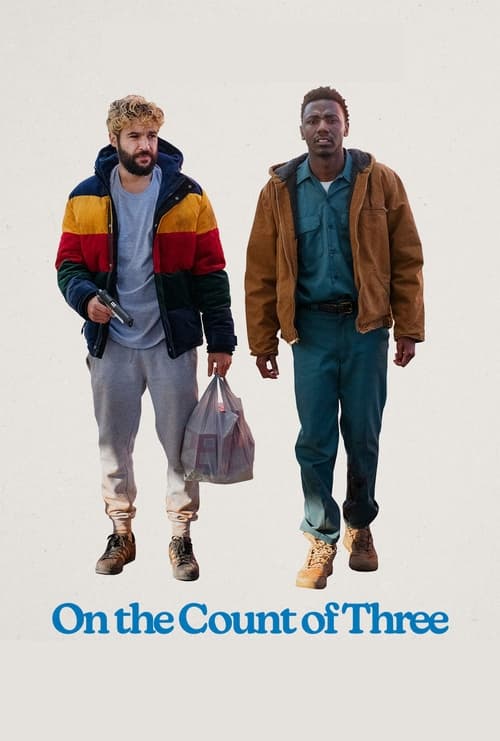
On the Count of Three
2022 · Jerrod Carmichael
For when you want a comedy with real stakes — something short, sharp, and honest about the dark stuff, that makes you laugh and then sit quietly with someone you love. A challenge wrapped in the pace of a caper; skip it if the subject is raw for you right now.
What it's about
Val has decided today is his last day alive, and he wants company: his best friend Kevin, freshly out of the hospital after his own failed attempt, agrees to a pact — but not before the two spend one final day settling scores. What follows is an errand run through mulch yards, dirt-bike tracks, and the doorsteps of men who owe them an apology, two friends with pistols and nothing left to lose.
The experience
Jittery, mordant, and startlingly funny — the jokes never defuse the despair and the despair never swallows the jokes, so you spend the whole film laughing with a knot in your stomach. It moves fast, like a countdown, and it's tender in ways you don't see coming.
Performances
Christopher Abbott plays Kevin as a live wire, volatile and heartbreaking in the same breath, while Jerrod Carmichael counters with an eerie, deadpan stillness — the friction between them is the movie.
The craft
Carmichael's directorial debut runs on tonal control that almost nothing on this subject has managed: Ari Katcher and Ryan Welch's script won the Waldo Salt Screenwriting Award at Sundance, and it earns every laugh without cheapening the pain. The film is lean and handheld-restless, built around two faces and one long day.
Why it matters
It announced Carmichael as a filmmaker as formally daring as his stand-up, and became a touchstone for how comedy can look directly at suicide and depression without flinching or preaching.
A directorial debut that opens with two best friends pointing pistols at each other outside a strip club — a suicide pact sealed like a handshake — and then has the nerve to be funny about it. Jerrod Carmichael, already among the most formally daring stand-up comedians of his generation, gives himself and Christopher Abbott one last day above ground to settle old business, and the film becomes a jittery, mordant errand-run through mulch yards, dirt-bike tracks, and the doorsteps of men who deserve a visit. Ari Katcher and Ryan Welch's script won the Waldo Salt Screenwriting Award at Sundance in 2021, and its achievement is tonal: the jokes never defuse the despair, and the despair never swallows the jokes — a balance almost nothing on this subject has managed. Abbott plays it as a live wire; Carmichael counters with an eerie deadpan stillness he would soon turn on himself in Rothaniel, the confessional special he released the following year.
Reception
Premiered to strong reviews at Sundance 2021, then sat on a shelf for over a year before a blink-and-you-missed-it May 2022 release — since then it's been steadily reclaimed as a hidden gem, especially by people working backwards through Carmichael's filmography after Rothaniel made him the most talked-about comedian in America.
How On the Count of Three was received, from release to now →
Influences: the films it descends from and the films it influenced
- Harold and Maude (1971) — Establishes the template of playing suicide as comic material — its cold open of staged, matter-of-fact suicide attempts is the tonal permission slip for Carmichael's opening gun-in-the-mouth gag.
- The Fire Within (Le Feu Follet) (1963) — The originating 'last day before a planned suicide' structure, in which the doomed man makes a round of visits to people from his past — the errand-run-as-goodbye that the film re-tools into a revenge/reconciliation checklist.
- Mikey and Nicky (1976) — A night-long two-hander pairing a volatile live-wire (Cassavetes) with an anxious foil, crossing the city as loyalty curdles — the exact volatile/deadpan acting contrast and friendship-under-pressure architecture.
- Midnight Cowboy (1969) — Model for the doomed male-friendship duo whose abrasive banter masks tenderness, structured toward a mortality-shadowed downbeat ending rather than reconciliation.
- The Fisher King (1991) — Yokes mental illness and suicidal despair to a redemptive male-friendship comedy, calibrating whiplash swings between clowning and genuine psychic wound — the tonal-balance problem the film inherits.
- Withnail and I (1987) — Two-hander tragicomedy of one manic and one dry-witted man on a shared self-destructive journey, mining despair for verbal comedy without softening the underlying ruin.
- After Hours (1985) — Codifies the single-day errand-run that escalates through a chain of increasingly dark-comic encounters across a city, each stop ratcheting the protagonist deeper into catastrophe.
- Falling Down (1993) — A man treating one terminal-feeling day as license to settle every score, moving station-to-station through confrontations with figures from his life — the grievance-errand spine of the second act.
- In Bruges (2008) — Nearly the same machine: two men, one actively suicidal, guns and guilt between them, achieving comedy and grief in the same breath through banter that keeps detonating into real stakes.
- World's Greatest Dad (2009) — A comedian-turned-director using suicide as the black-comic engine, exercising the tonal control needed to keep an audience laughing at material designed to be unbearable.
- Sightseers (2012) — A deadpan day-out that curdles into a killing spree, balancing cozy banality against sudden violence — the same trick of housing atrocity inside mundane companionable rhythms.
- The Climb (2019) — Male-friendship two-hander built from episodic reunions where affection and betrayal are inseparable, played in a dry register that finds comedy in men failing to say what they mean.
- James White (2015) — Christopher Abbott's live-wire, all-nerves lead performance in a raw American-indie register of caretaking and breakdown — the exact volatile mode he brings as Kevin.
- Uncut Gems (2019) — The anxiety-attack performance style and ticking-clock escalation of a man cornering himself over a single stretch of time, sustaining dread and comic desperation simultaneously.
- Punch-Drunk Love (2002) — Recasts a comedian in a dramatic key, letting live-wire rage and fragility surface through a deadpan-absurd tone — the register shift that lets a comic actor carry mental-illness material.
- Wristcutters: A Love Story (2006) — Deadpan indie that literalizes a suicide pact as premise and mines it for wry comedy, pairing two damaged travelers on an episodic road structure toward a choice about living.
Similar films
- The Banshees of Inisherin (2022) — same viewing thread
- Twinless (2025) — shared sensibility
- Cha Cha Real Smooth (2022) — shared sensibility
- Close (2022) — shared sensibility
- The Cabin in the Woods (2012) — shared sensibility
- Beau Is Afraid (2023) — shared sensibility
- The Last One for the Road (2025) — shared sensibility
- Taste of Cherry (1997) — shared sensibility
All the films related to On the Count of Three →
Watch it with: curated runs of related films
- Gallows Wit, Unraveling Men — A run of darkly funny character studies where a man decides he's done — with a friendship, a life, a self — and the jokes keep landing right up to the edge; watch them together for how each one lets despair and comedy share the same breath.