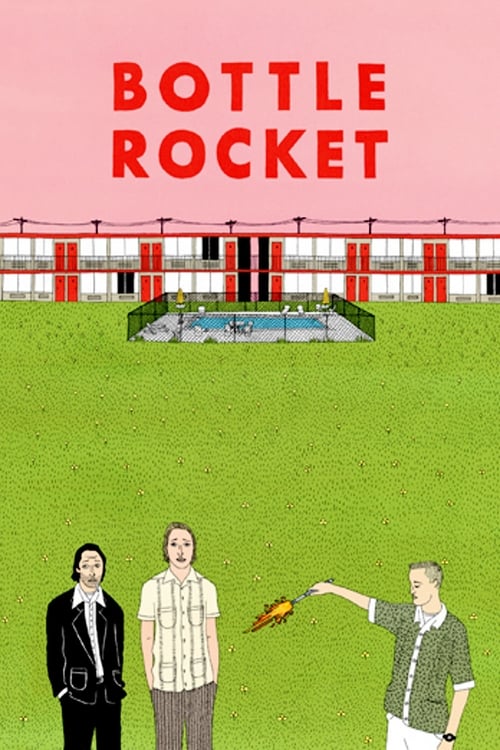
Bottle Rocket
1996 · Wes Anderson
For a low-key evening when you want to root for lovable losers — comfort viewing for anyone who's ever had a friend with a terrible plan and gone along anyway.
What it's about
Anthony has just checked himself out of a psychiatric hospital after a gentle nervous breakdown; his best friend Dignan greets him with a seventy-five-year life plan written in a spiral notebook, most of which involves crime. With their rich, bored friend Bob as getaway driver, the three Texans set out on a robbery spree they have neither the nerve nor the competence to pull off, hiding out at a motel where Anthony falls hard for a housekeeper named Inez.
The experience
Sweet, shaggy, and quietly hilarious — the laughs come from how earnestly these guys believe in their own legend. It ambles rather than races, and somewhere along the way it becomes genuinely touching about friendship and wanting to matter.
Performances
Owen and Luke Wilson in their screen debuts: Owen's Dignan is a perfect creation, a criminal mastermind with the soul of a scout leader, all wounded pride and doomed optimism, and Luke gives the film its calm, tender center.
The craft
Wes Anderson's first feature, made before the symmetrical dollhouse style hardened — looser, sunnier, shot in warm Texas light — but already full of his deadpan timing, precise detail, and affection for delusional dreamers. The heists are staged as comedy of pure incompetence, and every note of it lands.
Why it matters
A commercial flop that became a foundation stone: it launched Anderson and both Wilson brothers, and its fans-first afterlife made it a touchstone for 90s American independent comedy.
Snapshot
A first feature that failed commercially and then quietly became a foundation stone. Bottle Rocket follows Anthony Adams (Luke Wilson), newly released from a voluntary stay in a psychiatric hospital, and his friend Dignan (Owen Wilson), a self-appointed criminal mastermind with a seventy-five-year plan written in a spiral notebook, as they recruit their wealthy, bored friend Bob Mapplethorpe (Robert Musgrave) as a getaway driver and attempt a career in crime that neither their nerve nor their competence can sustain. Along the way Anthony falls in love with Inez (Lumi Cavazos), a housekeeper at the motel where the trio hide out, and the group is eventually drawn into the orbit of Mr. Henry (James Caan), Dignan's former landscaping boss and imagined criminal patron, who turns out to be exactly the small-time operator the boys refuse to see.
The film's animating joke is structural rather than verbal: these are people whose interior lives are conducted at the pitch of a caper picture while their actual circumstances are those of unemployed young men in suburban North Texas. Anderson plays that gap with unusual tenderness. Nothing in the film is punitive toward its characters, and the crimes are so minor that the movie's real subject becomes the friendship straining underneath them.
Industry & production
Bottle Rocket began as a thirteen-minute black-and-white short, shot on 16mm in Texas in 1992 by Anderson and Owen Wilson, who had met as students at the University of Texas at Austin. The short screened at the Sundance Film Festival in 1994 and functioned, as such films often did in that era, as a calling card rather than a work in its own right. By the standard account, the project reached the Texas screenwriter and producer L. M. "Kit" Carson, who brought it to the attention of producer Polly Platt; Platt in turn brought it to James L. Brooks, whose Gracie Films had a production arrangement with Columbia Pictures. Brooks became the film's decisive patron, and the feature was made under the Gracie/Columbia umbrella with Platt producing.
That patronage is worth dwelling on, because it makes Bottle Rocket an anomaly among 1990s American independent debuts. It is not a self-financed film that found a distributor at a festival; it is a studio-financed picture, made through a producer of enormous industry standing, by two men in their mid-twenties with no track record. The budget has generally been reported in the low millions — modest by studio standards, lavish by the standards of the short that preceded it.
The film's release was, by every available measure, a failure. Accounts of the postproduction — most of them originating with Anderson, Wilson, and Brooks in later interviews and in the supplements to the film's Criterion edition — describe disastrous test screenings, walkouts, and a substantial recutting of the picture before its February 1996 release. Columbia gave it a limited release; commonly cited figures put the domestic gross well under a million dollars. Anderson has spoken publicly about the depression that followed. Brooks's continued advocacy is generally credited with keeping Anderson's career viable long enough for Rushmore to be made in 1998.
Shooting took place in Dallas and surrounding North Texas towns, including Hillsboro, where the film's climactic cold-storage robbery was staged. The regional specificity is not incidental: the film's sense of class — the gentility of Bob's family compound, the anonymous motels and strip-mall bookstores — is thoroughly Texan in a way that Anderson's later, more stylized work would abandon.
Technology
Technologically, Bottle Rocket is an ordinary mid-1990s 35mm production, and that ordinariness is part of its historical texture. It was photographed on film and finished photochemically; the digital intermediate, which would arrive at the turn of the millennium and transform how color and contrast were manipulated, was not yet available to a film of this scale. Whatever the release print looks like was achieved in the camera, in the lab, and on the timing bench.
The one meaningful technical distinction to record is the frame. Bottle Rocket was composed for the 1.85:1 spherical ratio, standard for American comedies of the period. Beginning with Rushmore, Anderson moved to anamorphic 2.35:1, and stayed there for the rest of his live-action career. This makes Bottle Rocket the outlier in his filmography, and it explains a good deal about why the film looks less "Andersonian" than everything after it: the wide frame is the container that makes his frontal, planimetric, symmetrical staging legible as a system. Without it, the same instincts read as ordinary coverage with unusual moments.
Technique
Cinematography
Bottle Rocket marks the beginning of Anderson's collaboration with Robert D. Yeoman, who had shot Gus Van Sant's Drugstore Cowboy (1989) and who would go on to photograph every Anderson live-action feature that followed. The look here is warmer and looser than what the pair would later be known for: available-feeling daylight, handheld passages, a naturalistic palette of Texas sun, motel pastel, and the yellow of the crew's jumpsuits.
What is already present, in embryo, is the vocabulary. There are frontal compositions in which characters address the lens's axis directly. There are whip pans used as punctuation rather than as searching movement. There are lateral tracking shots along a line of action, and a slow-motion group walk in the finale that treats these incompetent men with the gravity of a Peckinpah entrance. The difference from Rushmore onward is one of consistency: in Bottle Rocket these devices punctuate an otherwise conventional scheme; later they become the scheme.
Editing
David Moritz cut the film, and would cut Rushmore as well. The editing is the element most visibly shaped by the film's troubled postproduction — the released version is tighter and more forward-driving than what was reportedly screened for test audiences. The rhythm is comic-naturalistic: scenes are allowed to run past the joke into awkwardness, and much of the film's humor depends on holding a beat one count longer than a conventional comedy would. Against that, the heist sequences are cut with genre precision, which is precisely the point — the form takes the boys' fantasy seriously even when the content will not.
Mise-en-scène / staging
David Wasco served as production designer, with Sandy Reynolds-Wasco as set decorator — a team that had recently worked on Quentin Tarantino's early films, which gives the picture an unexpected genealogical tie to the crime cycle it is gently satirizing. Karen Patch's costumes supply the film's most durable image: the matching yellow jumpsuits, Anderson's first uniform, and the direct ancestor of the red caps of The Life Aquatic and the school blazers of Rushmore.
The staging logic is object-driven. Dignan's notebook, with its lists and diagrams, is the film's central prop and its structural conceit; the plan-as-document would recur throughout Anderson's work. Props are handled and displayed rather than merely used — Dignan's taped-up hand, the earpiece, the maps. Bob's family estate is staged as a world of inherited comfort that the boys are running from and toward at once.
Sound
Mark Mothersbaugh's score is the first of four he would write for Anderson, and it establishes a sound the director would use for a decade: small ensembles, plucked and keyboard textures, melodies that are childlike without being ironic. The score treats the characters' self-seriousness as sincere, which is the film's whole ethical stance in miniature.
The needle drops are equally consequential. The film draws on 1960s rock and its adjacent margins — Love and the Rolling Stones among them — with the songs positioned as emotional overlay rather than period marker. This use of pre-existing rock as a lyrical rather than nostalgic device, and the practice of building set pieces around a single track, becomes an Anderson signature; Randall Poster's long tenure as his music supervisor dates to these early features.
Performance
The acting register is the film's least imitated and most difficult achievement. Owen Wilson's Dignan is a performance of unbroken conviction — he never signals to the audience that he knows the plan is absurd — and the comedy arises entirely from the collision between that conviction and the world. Luke Wilson plays Anthony as a genuinely becalmed person, and his scenes with Lumi Cavazos (whose international visibility came from Like Water for Chocolate, 1992) are conducted largely through a language barrier and a translator, which strips the romance of dialogue and leaves gesture.
James Caan's casting as Mr. Henry is a piece of genre semiotics. Caan carried the authority of The Godfather and Michael Mann's Thief; putting a real crime-film icon at the center of the boys' fantasy, and then revealing him as a petty thief who robs his protégé's friend's family, deflates the myth from inside. Kumar Pallana, a Dallas coffee-shop proprietor whom Anderson knew personally, appears as the safecracker Kumar and began a run of appearances across Anderson's films that made him one of the director's most recognizable recurring presences.
Narrative & dramatic mode
The film's mode is picaresque rather than plotted. It proceeds by episodes — the practice robbery, the bookstore job, the flight to the motel, the return, the cold-storage heist — and its through-line is not the criminal enterprise but the friendship between Anthony and Dignan, which the crimes exist to test. The opening sets the terms with unusual economy: Anthony stages an elaborate escape from a hospital he was free to walk out of, and Dignan, waiting below, is thrilled. Both men have agreed to a fiction, and the film's dramatic question is what happens when one of them stops believing it.
Anderson's structural instinct toward chaptering and enumeration is already visible in the notebook's numbered plan, though the explicit title cards and chapter divisions of the later films are absent. The ending is characteristic: Dignan is arrested, visited in prison, and delivers a boast about never being caught as he walks back into custody — a line whose comedy and pathos are inseparable, and which locates the film's sympathy squarely with the delusion rather than against it.
Genre & cycle
Bottle Rocket arrived in the middle of the post-Reservoir Dogs, post-Pulp Fiction American crime cycle, and reads most clearly as a rebuke to it. Where that cycle prized cool, verbal aggression, and stylized violence, Anderson's film offers incompetence, sweetness, and almost no violence at all. The crime picture's iconography is retained — the plan, the crew, the getaway car, the jumpsuits, the veteran mentor — and systematically emptied of consequence. In genre terms it belongs less with Tarantino than with the amateur-caper tradition, and behind it stand the crime comedies in which the heist is a pretext for portraiture.
It is also, importantly, a friendship film and a film about class, and the crime frame is what allows those subjects to be treated without sentimentality.
Authorship & method
Bottle Rocket is the founding document of a method. Anderson co-wrote it with Owen Wilson, and the two would co-write Rushmore and The Royal Tenenbaums as well — a partnership that shaped the emotional grammar of Anderson's first three features. The key collaborators assembled here recur for decades: Yeoman on camera, Mothersbaugh on score through The Life Aquatic, Moritz cutting through Rushmore, the Wascos and Karen Patch on design, and a repertory of performers — the Wilson brothers, Kumar Pallana — who became the nucleus of a stock company.
The working method visible in the film is one of translation from the specific to the formal: real people (Pallana), real places (Hillsboro, Dallas), and real friendships are progressively abstracted into design. Bottle Rocket sits at the beginning of that process, which is why it remains the most naturalistic film Anderson has made and, for many viewers, the most directly moving.
Movement / national cinema
The film belongs to American independent cinema of the 1990s, though as noted it entered that field from the studio side. Its more interesting affiliation is regional: it is a Texas film, made by Texans, in a lineage that runs through The Last Picture Show, Badlands, and the Austin filmmaking culture of Richard Linklater, whose Slacker (1991) and Dazed and Confused (1993) had recently established Texas as a viable site for young, dialogue-driven, low-stakes American filmmaking.
Its aesthetic parentage is French. The debt to the New Wave — Godard's Band of Outsiders above all, with its amateur criminals, its romance, and its treatment of crime as a game played by people who have seen too many movies — is direct, and Truffaut's early features underwrite the film's mixture of comedy and melancholy.
Era / period
The film is set in its own moment and photographed with little period distance, which distinguishes it from nearly everything Anderson made afterward. What dates it, productively, is its economic imagination: young men with educations and no vocation, drifting in a landscape of motels, strip malls, and family money, in a mid-1990s America where the absence of a plan was not yet catastrophic. Dignan's seventy-five-year plan is a joke about the era's vacancy — the only person with a future is the one who has invented an entirely fictional one.
Themes
The dominant theme is arrested development treated with respect rather than contempt: the film takes seriously that adolescence can be a durable and sincere way of organizing a life. Related to it is the theme of the plan — the document that substitutes for a self, an Anderson preoccupation that recurs from Max Fischer's extracurriculars to Steve Zissou's expeditions.
Class is the film's quietest and sharpest subject. Bob's inherited wealth, Anthony's downward drift, and Dignan's service-economy position under Mr. Henry are precisely calibrated, and the betrayal at the climax is a class betrayal as much as a criminal one: the man Dignan has idealized as a mentor treats him as labor.
Finally, there is loyalty and the surrogate family. Anthony's departure with Inez and Dignan's arrest are two versions of the same rupture, and the prison-visit coda is the film's argument that friendship survives the failure of the fantasy that produced it.
Reception, canon & influence
Critical reception in 1996 was mixed to warm, but the film found no audience, and its release was effectively a non-event. Its canonization happened afterward and by two mechanisms. The first was advocacy: Martin Scorsese wrote about the film admiringly, including it among his favorite films of the 1990s in an Esquire piece at the turn of the decade, and singled out Anderson as a filmmaker of real feeling. That endorsement carried disproportionate weight and is widely credited with redirecting the film's reputation. The second was retroactive: once Rushmore (1998) and The Royal Tenenbaums (2001) established Anderson's style, Bottle Rocket was reread as its origin. The Criterion Collection's 2008 edition, which included the original short, formalized that status.
Looking backward, the film's influences are unusually legible. The French New Wave supplies the tone and the crime-as-play conceit. Badlands supplies the Texas landscape, the deadpan, and the romance between two people whose narration exceeds their circumstances. Hal Ashby and Peter Bogdanovich — both filmmakers Anderson has repeatedly named — supply the tolerance for eccentricity within American genre frameworks, and Bogdanovich the Texas setting in particular. The Salinger-derived tradition of the sensitive, verbally elaborate family eccentric is present in outline and would flower in Tenenbaums.
Looking forward, the film's consequences are large. It launched Anderson, whose subsequent work constitutes one of the most fully realized authorial styles in contemporary American cinema. It launched Owen Wilson as both writer and star. It established the collaborative unit — Yeoman, Mothersbaugh, the Wascos, the stock company — that produced the films that followed. And it seeded a broader mode: the American independent comedy of sincere eccentricity, deadpan performance, precise design, and 1960s needle drops, which became a dominant idiom in the 2000s and drew a wave of critical writing about "quirk" as a style. Later filmmakers working in earnest, formally controlled, emotionally exposed comedy — the tradition running through Napoleon Dynamite, Garden State, Juno, and the films of Miranda July and Mike Mills — are working in a register Bottle Rocket helped make available, even where the debt is indirect.
Its most durable legacy may be tonal rather than stylistic. Bottle Rocket demonstrated that a crime film could be built entirely out of affection for people who are bad at crime, and that the resulting picture could be funny without condescension and sad without pathos. That balance is harder to imitate than the symmetry, and it is the reason the film has outlasted its own failure.
A Deleuzian reading
A spiral notebook, and inside it, in Dignan's handwriting, a seventy-five-year plan.
The full Deleuzian reading of Bottle Rocket →
Reception
A genuine flop in 1996 — disastrous test screenings, pulled from theaters almost immediately — it's since been reappraised as the charming, scrappy origin point of the entire Wes Anderson universe, complete with a Criterion edition.
How Bottle Rocket was received, from release to now →
How to watch Bottle Rocket: what to notice on a first viewing
- Notice Dignan's spiral notebook full of numbered plans. Dignan carries a notebook with a seventy-five-year plan written out in phases, and the film keeps returning to it as its central object. The notebook isn't a joke prop. It's the closest thing the film gives him to an actual self.
- Spot characters occasionally facing the camera dead-on. A handful of shots line characters up frontally, addressing the lens's axis directly, and a few whip pans snap between them like punctuation rather than a search. You are watching the vocabulary Anderson would later build his whole style from, showing up here in small, occasional doses.
- Watch Dignan explain the plan without ever winking at you. Owen Wilson plays Dignan with total sincerity, never once signaling that he knows how absurd the seventy-five-year plan actually sounds. The comedy comes entirely from his conviction colliding with the world, not from the film mocking him.
- Follow Anthony and Inez talking through a translator. Anthony and Inez share almost no common language, so their entire courtship happens through gesture, glances, and a third person relaying their words. Stripped of dialogue, the romance becomes pure looking, which is where the film's tenderest scenes actually live.
- Listen for the score's small, plainly sincere melodies. Mothersbaugh scores the film with small ensembles and plucked, childlike melodies that never wink or turn ironic, even during the most absurd scenes. The music takes the characters exactly as seriously as they take themselves.
The whole guide to watching Bottle Rocket, with the keys for a rewatch →
Influences: the films it descends from and the films it influenced
- Bob le flambeur (1956) — Establishes the heist-as-lovingly-drafted-document — Bob's hand-rendered casino schematic rehearsed by amateurs who care more about the plan's elegance than the money — the direct forebear of Dignan's spiral-notebook 75-year plan handled as a sacred prop.
- Shoot the Piano Player (1960) — Runs a crime plot through tender comic digression and sudden tonal swerve, treating its gangsters as gentle incompetents rather than threats — the register Anderson uses to make Dignan's stickups read as play without ever winking at them.
- Bande à part (1964) — Codifies crime-as-play by cinephile amateurs who perform genre gestures learned from movies, staged in long lateral tracking moves that follow the trio abreast — the choreographic template for Bottle Rocket's group-in-a-row blocking and its characters' borrowed criminal vocabulary.
- The Killing (1956) — Makes the timetable itself the narrative object — the recited schedule and assigned-roles briefing — which Bottle Rocket burlesques by giving each crew member a job title and a countdown for a bookstore robbery that requires neither.
- Badlands (1973) — Sets flat Texas horizon lines in wide 1.85 compositions against speech whose formality wildly exceeds the speakers' circumstances — the deadpan-elevated-diction-over-plains combination Yeoman and Anderson reproduce in the motel and roadside sequences.
- The Last Picture Show (1971) — Replaces orchestral underscore with wall-to-wall period source music tied to a specific North Texas milieu, licensing Bottle Rocket's use of sixties rock needle drops as the film's emotional and regional register rather than decoration.
- Paper Moon (1973) — Builds a picaresque out of small-time cons strung as discrete episodes between flat-horizon exteriors, with comedy delivered in unbroken straight-faced conviction — the episodic grammar and performance mode Bottle Rocket adopts wholesale.
- Harold and Maude (1971) — Pairs a continuous pop-song score functioning as emotional narration with frontal, centered compositions of an eccentric the film refuses to mock — the sincerity-toward-oddity contract Anderson signs with Dignan and Anthony.
- Mean Streets (1973) — Introduces the slow-motion entrance walk scored to a rock needle drop and the whip pan as a comic-aggressive punctuation between friends in a room — both lifted intact into Bottle Rocket's crew introductions and argument coverage.
- Reservoir Dogs (1992) — Fixes the matching-uniform crew advancing in slow motion to a period rock cue as a genre signature, which Bottle Rocket deflates by swapping black suits for yellow jumpsuits worn by men whose competence does not survive the shot.
- Thief (1981) — Builds James Caan's coiled professional-criminal persona — procedural authority, sudden menace, paternal recruitment of a younger man — which Bottle Rocket imports as ready-made semiotics so Mr. Henry needs no backstory to be legible.
- Big Deal on Madonna Street (1958) — Inherits the amateur-crooks caper where the heist's failure is entirely a function of the gang's endearing incompetence rather than external opposition.
- Rushmore (1998) — Systematizes everything sketched here — Yeoman's frontal planimetric staging, the whip pan as a scene's connective tissue, Moritz cutting on beats held past the exit point, Mothersbaugh's score against British Invasion drops — with the same Wilson co-writing partnership.
- The Royal Tenenbaums (2001) — Extends the plan-as-document prop into an entire diegesis of hand-made paper artifacts (the book, the dossier, the chapter cards) while retaining Wilson as co-writer, Yeoman's centered doorway tableaux, and Mothersbaugh's music-box instrumentation.
- The Darjeeling Limited (2007) — Re-runs the picaresque of incompetent men in matching costume, closing on the slow-motion lateral group walk cut to a sixties rock drop — the Bottle Rocket jumpsuit sequence rebuilt with a decade's added formal control.
- Napoleon Dynamite (2004) — Pushes the centered planimetric frame and the beat held long past the punchline to their limit, with performers playing absurd behavior in total earnest — the comic timing Bottle Rocket made available, stripped of its melancholy.
- Me and You and Everyone We Know (2005) — Frames its oddities in composed, static, symmetrical setups and lets performers deliver strange lines with unbroken sincerity, inheriting Bottle Rocket's refusal to let the camera's precision curdle into condescension toward the people inside it.
- Kicking and Screaming (1995) — Contemporaneously stages arrested-development men whose verbal elaborateness substitutes for action, cutting comedy on held conversational beats rather than punchlines — the same deadpan-through-overwriting method Anderson and Owen Wilson were developing, and Baumbach would later co-write with Anderson.
- Ghost World (2001) — Shoots eccentrics in flat, frontal, near-static frames and holds shots several beats past the joke so discomfort accumulates — the same trust in unbroken performer conviction over cutting rhythm that Bottle Rocket uses on Dignan.
- Dogma (1999) — Yeoman's other major collaboration of the era, showing the same cinematographer lending compositional seriousness to a dialogue-driven indie comedy whose director can't supply it alone.
Similar films
- Reservoir Dogs (1992) — influence & lineage
- The Royal Tenenbaums (2001) — influence & lineage
- The Darjeeling Limited (2007) — influence & lineage
- Rushmore (1998) — influence & lineage
- The Big Lebowski (1998) — shared sensibility
- The Grand Budapest Hotel (2014) — shared sensibility
- Asteroid City (2023) — shared sensibility
- The Mastermind (2025) — shared sensibility