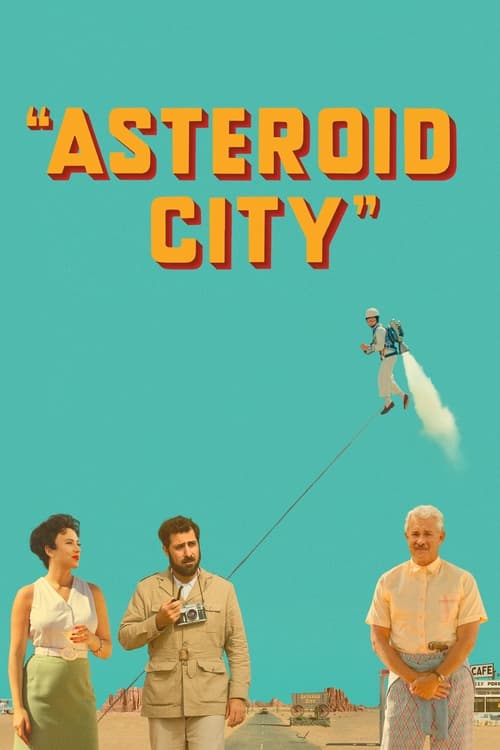
Asteroid City
2023 · Wes Anderson
His style became so recognizable it turned into a TikTok filter trend and AI-parody genre, prompting discourse about whether pastiche had swallowed the artist; Asteroid City and The Phoenician Scheme kept the "self-parody or late-style depth" argument alive. Finally won his first Oscar for a Roald Dahl short.
For when you want something beautiful and melancholy to chew on for days rather than a straight-ahead story — a contemplative-night film, comfort on the surface with a puzzle underneath.
What it's about
A grieving war photographer drives his four kids into a tiny desert town for a junior astronomy convention in 1955, where whiz-kid inventors, a famous actress, soldiers, and assorted parents are all thrown together. Then something lands from the sky, the government slams a quarantine over the town, and everyone is stuck with each other and their unfinished feelings. All of this, meanwhile, is framed as a televised broadcast about the stage play being performed — you watch the story and the people making it at once.
The experience
Deadpan, pastel-pretty, and quietly heartbroken — the jokes land in flat, perfect line readings while grief hums underneath. It's slower and stranger than it looks in stills, the kind of film that seems like a diorama until a scene suddenly catches you in the throat.
Performances
A deep ensemble working in Anderson's precise deadpan register, anchored by Jason Schwartzman as the widowed photographer and Scarlett Johansson as the movie star trading lines through motel windows.
The craft
The film toggles between candy-colored widescreen desert and black-and-white boxy television footage, and the switch is the whole idea — every frame is composed like a postcard, and the production design of the little desert town is a pleasure in itself. It rewards a big, bright screen and a second viewing.
Why it matters
One of the clearest late statements of Wes Anderson's method — artifice stacked on artifice to get at real grief — it split audiences on release and has become a touchstone in the argument about what his style is actually for.
Snapshot
Asteroid City is Wes Anderson's eleventh feature and among his most formally recursive: a film that presents itself not as a story but as the televised account of a stage play about a story. On the surface it depicts a 1955 Junior Stargazer convention in a fictional Southwestern desert town — population 87 — where a widowed war photographer, a movie star, five brainy children, and assorted parents and soldiers are thrown together, then quarantined by government fiat after an extraterrestrial briefly descends to collect (and later return) the meteorite that gives the town its name. But that pastel widescreen "event" is framed as a theatrical production, narrated in black-and-white Academy ratio by a television host and dramatized through the fictional playwright, director, and actors who made it. The result is one of Anderson's most explicit meditations on grief, artifice, and the limits of understanding — a comedy of exact surfaces built around an irreducible mystery. It premiered in competition at the 2023 Cannes Film Festival and was released by Focus Features (North America) and Universal internationally.
Industry & production
The film was produced through Anderson's customary constellation — American Empirical Pictures with Indian Paintbrush (Steven Rales) and Focus Features financing — the arrangement that has underwritten most of his work since The Darjeeling Limited. As with The French Dispatch, Anderson assembled an unusually large ensemble of established stars willing to take small, precisely calibrated roles, a casting economy that has become part of his brand: the promise of a fully realized miniature world draws actors into cameos they would not otherwise accept.
Principal photography took place in Spain in 2022, on a purpose-built desert town constructed near Chinchón, southeast of Madrid — an open-air standing set with painted mesas and forced-perspective backdrops rather than a real location. Building the town whole, rather than assembling it from fragments, is consistent with Anderson's preference for controllable, self-contained environments; it also allowed the ensemble to live communally during the shoot, an approach he has favored since The Grand Budapest Hotel. The record on exact budget and box-office figures is best left to primary trade reporting; I won't assign numbers I can't verify here.
Technology
Asteroid City was photographed on 35mm film, the format Anderson and cinematographer Robert Yeoman have used throughout their live-action collaboration, and it exploits photochemical texture deliberately: the saturated turquoise-and-terracotta desert is a color-timed artifact as much as a designed one. The film's most conspicuous technological choice is its dual-format construction — the "play," rendered in anamorphic widescreen color, versus the "making-of" frame, rendered in near-square black-and-white — a contrast achieved through aspect ratio, stock treatment, and lighting rather than digital trickery. Anderson's effects remain resolutely analog in spirit: the alien is a stop-motion-inflected figure, the atomic mushroom clouds and passing spacecraft read as handmade in-camera or miniature-based elements, and the overall aesthetic prizes the visible seam over seamless illusion. This is a period technology used to depict a period — mid-century Americana rendered in a medium contemporaneous with it.
Technique
Cinematography
Robert Yeoman, Anderson's director of photography on every live-action feature since Bottle Rocket, again organizes the image around the planimetric frontality that defines the house style: characters staged flat to the lens, movement built from lateral tracks and crisp 90-degree whip-pans, symmetrical compositions centered to the millimeter. The desert palette — sun-bleached ochre, sky-pool blue, the pistachio and coral of the motel and diner — is among the most chromatically aggressive in Anderson's catalog. The formal signature here is the modal switch between the widescreen color world of Asteroid City and the boxier monochrome of the framing narrative, a division of visual grammar that lets the camera announce which layer of fiction we occupy at any moment.
Editing
The film was cut by Barney Pilling, who previously edited The Grand Budapest Hotel. Anderson's editorial rhythm is famously metronomic — cuts fall on precise beats, inserts of objects and hands punctuate dialogue, and the montage often behaves like a mechanism. Asteroid City's particular editorial burden is legibility across its nested structure: the film must repeatedly cross between the play, the television documentary about the play, and glimpses of the play's genesis, without losing the audience. Pilling's cutting keeps those transitions clean and rule-bound, so that the movement between fictional strata feels like turning a page rather than falling through a trapdoor.
Mise-en-scène / staging
This is the film's center of gravity. Production designer Adam Stockhausen — an Anderson mainstay and an Academy Award winner for The Grand Budapest Hotel — built a town that is really a diorama: a diner, a twelve-cabin motor court, a gas station, an unfinished highway overpass to nowhere, a vending machine that dispenses land deeds and (in one gag) martinis, all arranged with the tidy legibility of a model railway. Costume designer Milena Canonero dresses the ensemble in period silhouettes turned slightly heightened. Crucially, the "play" is staged with theatrical candor — entrances and exits, a proscenium logic — so that the artificiality is not a flaw to be hidden but the film's explicit subject. The alien's arrival, the recurring atomic tests on the horizon, and the roadrunner that zips through frame all function as staged marvels rather than naturalistic events.
Sound
The film balances Alexandre Desplat's score against a soundtrack of period country and western recordings, a genre choice that grounds the mid-century American setting while lending the desert a wry, lonesome inflection. Anderson's sound design remains clean and foregrounded — dialogue delivered in the deadpan, rapid, affectless register his actors adopt, with sound effects (the ping of the meteorite, the whir of Stargazer gadgets, the wail of a distant test siren) placed with the same precision as his visual inserts. The tonal control of the sound mix is part of how the film sustains comedy and melancholy in the same breath.
Performance
Anderson's ensemble performs in his signature flattened style — emotion held just beneath a still surface, delivered without conventional emphasis. Jason Schwartzman anchors the film as Augie Steenbeck, the recently widowed photographer, and doubles as the actor "Jones Hall" playing him; his central line of grief is the film's emotional through-thread. Scarlett Johansson plays movie star Midge Campbell (and her actor counterpart), Tom Hanks the brusque father-in-law, with Jeffrey Wright, Tilda Swinton, Steve Carell, Maya Hawke, Liev Schreiber, Hope Davis, Stephen Park, Rupert Friend, Jake Ryan (as the son Woodrow), and a large supporting cast filling the town. The framing layer is carried by Bryan Cranston as the television host, Edward Norton as the playwright Conrad Earp, Adrien Brody as the director Schubert Green, with Willem Dafoe, Margot Robbie, and Jeff Goldblum (the alien) in smaller turns. The performances are pitched to serve structure over psychology — a deliberate strategy that some viewers read as coldness and others as a controlled vessel for feeling.
Narrative & dramatic mode
The dramatic mode is metafiction organized as nested frames. The outermost layer is a mid-1950s television broadcast, hosted in black-and-white, purporting to document the creation of a new American play titled Asteroid City. Inside that documentary we watch the play performed — in color and widescreen — as though it were real, while the seams (curtains, act divisions, an actor stepping offstage into the making-of world) keep reminding us it is not. The film's governing thesis is spoken almost as a riddle — the mantra that "you can't wake up if you don't fall asleep" — which reframes the entire artifice as a proposition about how art lets us feel what life won't sit still long enough to explain. The plot's engine (an alien arrives, takes the meteorite, returns it, a quarantine descends) resolves nothing; the mystery is the point, and the emotional resolution belongs to grief, not to plot.
Genre & cycle
Nominally a comedy-drama, Asteroid City is more precisely a hybrid: a 1950s science-fiction pastiche (flying saucers, atomic tests, desert paranoia, Junior Stargazers) fused with backstage theatrical melodrama and Anderson's own auteurist comedy of manners. It arrives in a late-career Anderson cycle — following Isle of Dogs and The French Dispatch — increasingly preoccupied with nested storytelling, framing devices, and the mechanics of authorship itself. Where earlier Anderson films embedded stories in books, chapters, and stage curtains, this one makes the theatrical apparatus the whole architecture.
Authorship & method
The film is directed by Wes Anderson from a screenplay he wrote based on a story he developed with Roman Coppola, his frequent collaborator (The Darjeeling Limited, Moonrise Kingdom, Isle of Dogs). Anderson's method is total design: pre-visualized in animatics, storyboarded shot for shot, and executed on controllable sets with a repertory of trusted craftspeople. The key collaborators recur across his filmography — cinematographer Robert Yeoman, composer Alexandre Desplat (with him since Fantastic Mr. Fox), production designer Adam Stockhausen, costume designer Milena Canonero, and editor Barney Pilling. The authorship question the film itself raises is pointed: by dramatizing a playwright (Norton), a director (Brody), and actors uncertain what their work means, Anderson stages an inquiry into his own practice — how much a director controls, what the collaborators contribute, and whether the maker fully understands the thing he has made. The recurring backstage refrain about not understanding the play is, read one way, Anderson's own self-portrait.
Movement / national cinema
Anderson stands somewhat apart from any national school. An American filmmaker who works largely in Europe, he descends most legibly from a lineage of stylists — the diorama precision often compared to figures like Jacques Tati in its architectural comedy, and to the storybook artifice of earlier studio-era craft — while belonging to the loose post-1990s American independent generation that broke through at Sundance. Asteroid City was shot in Spain with an international crew and premiered at Cannes, reflecting his status as a transnational auteur whose "nationality" is essentially his own designed style. Its subject, however, is emphatically American: mid-century desert Americana, the atomic-age Southwest, and the mythology of the frontier motel and diner.
Era / period
The film is set circa 1955 and steeped in that moment's iconography — the Space Race not yet begun in earnest but imagined, atomic testing normalized to the point of scenic backdrop, Cold War officialdom (the general, the quarantine, the government cover story), and a wholesome science-education culture (the Junior Stargazers/Space Cadets) shadowed by dread. The framing device's television aesthetic locates the "making-of" narrative in the same period's live-drama broadcast tradition. Made in 2022 and released in 2023, the film also reads as a post-pandemic work: its sudden quarantine, its strangers confined together and improvising meaning under confinement, and its preoccupation with grief and isolation resonate unmistakably with the years just preceding its production — though Anderson has been characteristically reticent about pinning it to that reading.
Themes
Grief is the film's bedrock: Augie's inability to tell his children their mother is dead, the ashes in a Tupperware container, the widower's numb persistence. Around it cluster Anderson's abiding preoccupations — fathers and sons, precocious children more composed than the adults, and the consolations of ritual and craft. The alien functions as the theme made literal: the inexplicable, arriving without motive and departing without explanation, a mystery that cannot be solved but only witnessed. Layered above this is the film's inquiry into art itself — whether making something artificial can carry real feeling, whether the actor (or the audience) can "understand" a work they nonetheless inhabit, and the sleep/waking metaphor that positions art as a necessary dream. The atomic and cosmic imagery sets human smallness against vast indifferent scale, while the pervasive artifice insists that surface and depth are not opposites.
Reception, canon & influence
Critical reception, consistent with late Anderson, was admiring and divided. The film drew wide praise for its craft, ambition, and the emotional undertow beneath its lacquered surfaces, alongside a familiar strain of resistance holding that its nesting-doll structure prioritizes formal ingenuity over feeling. It became a touchstone in the ongoing debate over whether Anderson's increasingly hermetic style deepens or diminishes his work — a debate the film seems designed to provoke and even to dramatize. (Specific critical scores and awards tallies should be checked against primary sources rather than asserted here.)
Backward — influences on the film: the picture draws on 1950s American science-fiction B-movies and desert paranoia cinema, on the live television drama and anthology traditions of the same decade, on the metatheatrical device of the play-within-a-play (a lineage running back through Pirandello and Thornton Wilder's Our Town, whose bare-stage Americana it evokes), and on Anderson's own accumulating vocabulary of framing devices from The Grand Budapest Hotel and The French Dispatch.
Forward — what it shaped: released in 2023, its legacy is still forming, and honesty requires saying so. Its most immediate cultural afterlife was the wave of AI-generated and social-media "Wes Anderson–style" pastiche that crested around its release — a phenomenon that made the film a reference point for a whole discourse about style, imitation, and authorship, which is a fitting, if unplanned, echo of the film's own concerns. Within Anderson's career it stands as the fullest statement so far of his metafictional turn, and its long critical standing will be settled by time rather than by first response.
A Deleuzian reading
The town has a highway overpass that ends in mid-air.
The full Deleuzian reading of Asteroid City →
Reception
Premiered at Cannes 2023 to visibly split reviews — 'Anderson disappearing into his own dollhouse' vs. 'his most moving film in years' — and the reappraisal came fast: within a year the defenders' reading of it as his rawest film about grief had largely won the conversation.
How Asteroid City was received, from release to now →
How to watch Asteroid City: what to notice on a first viewing
- Notice when the frame switches from wide color to boxy black-and-white. Anderson uses anamorphic widescreen color for the play and near-square monochrome for the television broadcast about making it. The ratio and color tell you instantly which layer of fiction you are watching.
- Watch how characters stand flat, facing you, symmetrically placed. Yeoman and Anderson keep bodies centered to the frame like figures in a diagram, rarely angled or crowded. The staging reads like a diagram, so the film's few disruptions stand out sharply.
- Listen for the flat, fast, unstressed way everyone talks. The whole ensemble delivers lines at the same level pitch, whether the news is trivial or devastating. Feeling gets held under a still surface instead of performed for you.
- Notice the diner, motel, gas station, laid out like a model railway. Stockhausen's town repeats the same handful of buildings and props, always shot with the same flat legibility. The town stops serving the plot and starts being felt for itself.
- Listen for period country and western songs under Desplat's score. The soundtrack alternates orchestral scoring with period recordings, plus precise sound effects like the meteorite's ping. The sound mix keeps comedy and melancholy audible in the same breath.
The whole guide to watching Asteroid City, with the keys for a rewatch →
Influences: the films it descends from and the films it influenced
- Playtime (1967) — Deep-focus planimetric wide shots that reduce people to small figures moving within geometric architecture, generating comedy from composition and background choreography rather than close-ups — the flat frontal staging Anderson builds his desert town from.
- Sherlock Jr. (1924) — Deadpan stone-faced performance paired with in-camera analog trick effects and a metafictional conceit of a projectionist stepping into the film-within-the-film — the actor-crossing-into-the-fiction gambit Asteroid City stages between play and 'real' broadcast.
- Our Town (1940) — Bare-stage Americana narrated by a Stage Manager who addresses the audience and frames the drama as a constructed theatrical event — the Wilder device Bryan Cranston's television host directly reprises.
- 8½ (1963) — Metafictional self-portrait of an artist paralyzed by not understanding his own work — the 'I don't understand the play' refrain and the playwright/director/actor uncertainty are lifted from this template of creation-as-inquiry.
- It Came from Outer Space (1953) — Arizona-desert alien-arrival B-movie in flat widescreen — the precise 1950s genre texture, roadside setting, and benign-but-unknowable visitor that the film pastiches shot for shot.
- Invasion of the Body Snatchers (1956) — Atomic-age small-town paranoia and government-quarantine dread played straight — the containment/lockdown structure and Cold War unease Asteroid City deadpans.
- The Day the Earth Stood Still (1951) — Benign alien visitation staged as atomic-anxiety allegory with a solemn extraterrestrial gesture — the wonder-and-dread contact scene that Asteroid City's meteorite-collecting alien inverts into comedy.
- Dr. Strangelove (1964) — One-point-perspective symmetrical, centered framing wedded to atomic-age deadpan satire — the Kubrickian frontal compositional grammar from which Anderson's planimetric frontality descends.
- The Grand Budapest Hotel (2014) — Nested-narrator framing with aspect ratios keyed to each narrative level (1.37 / 1.85 / 2.35) — the dual-aspect-ratio storytelling device Asteroid City extends to distinguish black-and-white broadcast from color play.
- The French Dispatch (2021) — Anthology architecture with tableau staging and color/monochrome and aspect-ratio switches used as chapter markers — the accumulated framing vocabulary the film inherits directly.
- Rushmore (1998) — Theatrical proscenium staging with a climactic elaborate play-within-the-film, establishing Anderson's habit of embedding a literal stage production inside the movie.
- Moonrise Kingdom (2012) — Extends the mid-century American period-reconstruction, frontal symmetry, and Britten-like introduce-the-instruments structure into an overt play-within-a-broadcast frame.
- Vanya on 42nd Street (1994) — Actors in street clothes rehearsing a play on a bare stage, dissolving the boundary between rehearsal, performer, and character — the same collapse of actor and role Asteroid City dramatizes in its backstage scenes.
- Synecdoche, New York (2008) — A theater director builds an ever-nesting production that consumes his life while he fails to grasp what he's made — the play-within-a-play metafiction about authorial control taken to its recursive extreme.
- A Pigeon Sat on a Branch Reflecting on Existence (2014) — Static, frontally-composed planimetric tableaux populated by pallid, affectless performers delivering lines into a flattened diorama-like space — the deadpan-frontal aesthetic pursued in a parallel key.
- The Lobster (2015) — Flattened, affectless deadpan line-delivery within rigidly symmetrical framing, using performance drained of naturalism to make artifice legible as content.
- Birdman (2014) — Backstage theater metafiction in which actors interrogate the meaning and worth of their own performances, staging the anxiety of the maker who cannot tell if the work is real or good.
- Isle of Dogs (2018) — Total pre-visualized design executed through animatics and hand-built analog craft with metronomic, beat-precise cutting — the same controllable-set, in-camera methodology applied to a parallel project.
- The Fantastic 4: First Steps (2025) — Parallel commitment to a mid-1950s atomic-age desert Americana rendered in a warm high-key pastel palette with a sincere-but-stylized ensemble, sharing the in-medias-res period-world tactic.
- The Phoenician Scheme (2025) — Runs the same two-stock architecture — boxed monochrome Academy passages bracketing a color widescreen fiction — but uses it as a framing device about authorship, where this film reassigns it to afterlife tribunals inside the plot.
Similar films
- Isle of Dogs (2018) — influence & lineage
- Synecdoche, New York (2008) — influence & lineage
- Rushmore (1998) — influence & lineage
- The Grand Budapest Hotel (2014) — influence & lineage
- 8½ (1963) — influence & lineage · often watched together
- Sherlock Jr. (1924) — influence & lineage · often watched together
- Invasion of the Body Snatchers (1956) — influence & lineage · often watched together
- The Phoenician Scheme (2025) — often watched together
All the films related to Asteroid City →
Watch it with: curated runs of related films
- Sweet Melancholy in Small Towns — A run of deadpan, bittersweet comedies where oddballs chase modest dreams in overlooked backwaters — a Welsh island, a desert junction, a Pennsylvania basement — and the ache underneath keeps showing through the jokes.