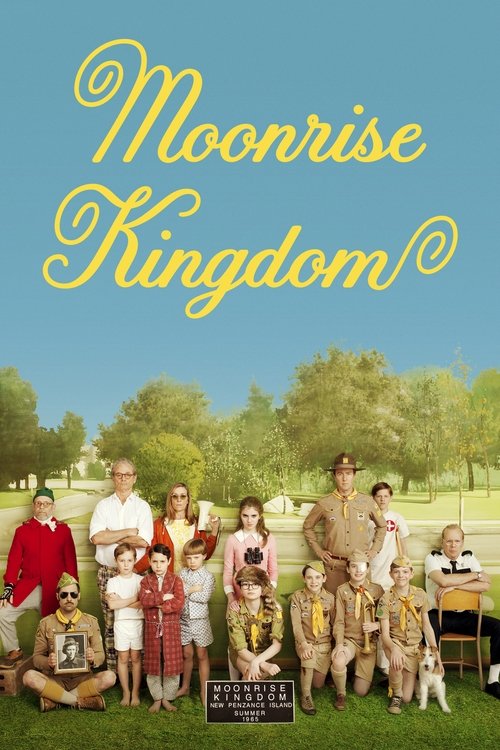
Moonrise Kingdom
2012 · Wes Anderson
His style became so recognizable it turned into a TikTok filter trend and AI-parody genre, prompting discourse about whether pastiche had swallowed the artist; Asteroid City and The Phoenician Scheme kept the "self-parody or late-style depth" argument alive. Finally won his first Oscar for a Roald Dahl short.
When you want something gentle, funny, and beautiful that still makes you feel something — a rainy-afternoon film for anyone nostalgic for the intensity of being twelve. Comfort viewing with a bruise in the middle.
What it's about
On a small New England island in the summer of 1965, two serious twelve-year-olds — a bespectacled orphan scout and a troubled girl with a suitcase of library books — fall in love through letters and run away into the wilderness together. Scoutmasters, parents, a lonely island cop, and social services all mobilize to find them, just as a historic storm bears down on the coast.
The experience
Whimsical on the surface and quietly heartbreaking underneath — it plays like a storybook read aloud, deadpan funny and meticulously arranged, but the kids' seriousness gives it real ache. It leaves you tender toward first love and a little melancholy about the adults who forgot how it felt.
Performances
Newcomers Jared Gilman and Kara Hayward play the runaways with the flat, grave sincerity of real children, while a stacked adult cast — Bruce Willis unusually soft and sad, Edward Norton, Frances McDormand, Bill Murray — plays the grown-ups as the lost ones.
The craft
Every frame is composed like a diorama — hand-lettered signs, symmetrical dollhouse interiors, storybook camera moves — with a score built around Benjamin Britten that turns the whole island into a children's opera. It's dense with visual jokes and detail that reward a close, attentive watch.
Why it matters
It marked the moment Wes Anderson's handmade style fully crystallized into its mature form and became one of the most beloved and imitated films of 2010s American independent cinema.
Snapshot
Moonrise Kingdom is Wes Anderson's seventh feature, a storybook fable of first love set over a few days in September 1965 on the fictional New England island of New Penzance. Sam Shakusky, an orphaned "Khaki Scout," and Suzy Bishop, a troubled reader with a suitcase of library books and a battery-powered record player, correspond by letter, fall in love, and flee into the wilderness together, triggering a comic mobilization of scoutmaster, sheriff, parents, and social services as a historic storm bears down. It is at once Anderson's most self-consciously miniaturist film — a diorama world of hand-lettered signs, cutaway sets, and cartographic precision — and one of his most emotionally direct, using the seriousness of children to reanimate feelings the adults around them have misplaced. Written with Roman Coppola, shot on Super 16mm by Robert Yeoman, scored by Alexandre Desplat around the music of Benjamin Britten, and cast with two unknown twelve-year-olds amid a deep bench of Anderson regulars and newcomers, the film opened the 2012 Cannes Film Festival in competition and became a critical touchstone for the director's mature style.
Industry & production
The film was an independent production associated with Anderson's regular producing partners of the period, released in the United States by Focus Features and internationally through allied distributors. It was mounted on a modest budget by studio standards — Anderson's economics have long depended on efficient, tightly storyboarded shoots and ensembles of actors working for scale out of loyalty to the director — and shot largely on location in Rhode Island, whose coves, lighthouses, and inland woods stand in for New Penzance and its surrounding waters. Anderson's practice of pre-visualizing the entire film through animatics before principal photography allowed a compressed schedule; the controlled, tableau-based aesthetic is partly a production strategy as much as a stylistic one, minimizing coverage and improvisation.
The casting process was a genuine industrial gamble: the two leads, Jared Gilman (Sam) and Kara Hayward (Suzy), were newcomers with no prior feature credits, selected from a wide search. Around them Anderson assembled a marquee adult cast — Bruce Willis as Captain Sharp, Edward Norton as Scout Master Ward, Bill Murray and Frances McDormand as Suzy's parents, Tilda Swinton as the officious "Social Services," Jason Schwartzman as a mercenary older cousin, Harvey Keitel as a senior scout commander, and Bob Balaban as the film's on-screen narrator. The premiere as the opening-night selection at Cannes 2012 was itself a distribution event, positioning a small American film for a festival launch and platform release. Precise budget and box-office figures are a matter of public record but are not reproduced here to avoid inaccuracy; the film is generally understood to have performed strongly relative to its cost.
Technology
Moonrise Kingdom was photographed on Super 16mm film, a deliberately grainier, warmer, and more intimate format than the 35mm of Anderson's earlier live-action work, chosen in part to evoke the texture of period amateur and educational film and the storybook register the movie inhabits. The 16mm gauge also suited the smaller, more mobile production and the film's toy-theater scale. The image was finished at a widescreen aspect ratio, and the softened resolution and visible grain are intrinsic to the film's memory-tinted, mid-1960s look rather than a limitation to be corrected.
Beyond capture format, the film's "technology" is largely the low-tech craft of physical production design: built cutaway sets that allow the camera to travel laterally through a house or tent as though reading a cross-section, practical miniatures and matte-like painted backdrops, and in-camera effects for the climactic storm. Anderson's method here is pointedly analog, and the film's few overtly artificial images — dollhouse interiors, a flood staged at human scale — read as handmade rather than digital. Where visual effects were used they are subordinated to the tactile, constructed surface.
Technique
Cinematography
Robert Yeoman, Anderson's cinematographer since Bottle Rocket, executes the director's by-now-signature grammar in its most systematized form. Compositions are frontal and centered, framing characters in flat, symmetrical planes as if pinned to a corkboard. The camera moves in rigidly geometric ways — precise lateral tracking shots that glide past the cutaway rooms of the Bishop house or along a row of tents, sudden ninety-degree whip pans that snap between characters, and slow push-ins that isolate a face. Overhead insert shots of hands, letters, maps, and objects punctuate the film in the manner of an illustrated book's plates. The Super 16mm stock, keyed to a palette of khaki, ochre, faded red, and forest green, gives the light a nostalgic, late-summer warmth. Yeoman's work is the technical engine of Anderson's picture-book effect: the world is always presented head-on, legibly, as if for a child reader.
Editing
Andrew Weisblum, Anderson's editor across this period, cuts to a metronomic, deadpan rhythm in which timing itself is a source of comedy and feeling. Scenes are frequently built from held, symmetrical setups joined by hard cuts on rigid axes, so that the montage feels charted rather than discovered. The film's chaptered, almost inventory-like progression — organized around the narrator's bulletins, letters read aloud, and a countdown to the storm — depends on editorial control of information and tempo. Weisblum also modulates the film's shifts between comic briskness and sudden tenderness, letting a cut land a joke flatly and then holding on a young face long enough to register genuine hurt.
Mise-en-scène / staging
This is the film's defining stratum. Anderson stages the world as a series of labeled compartments: the Bishop lighthouse-house rendered as a cutaway dollhouse; Camp Ivanhoe laid out like a diagram; the island itself introduced by the narrator with the authority of a survey map. Props are fetishistically specific — Suzy's suitcase of fantasy library books, her binoculars and kitten, Sam's pipe and coonskin cap, the record player, the invented Khaki Scout regalia and merit badges. Hand-lettering, custom typography, and fictional printed matter (maps, letters, field manuals) saturate the frame. The overall effect is of a handmade artifact, a child's diorama endowed with adult melancholy, in which every object is placed with taxonomic deliberateness.
Sound
Sound is organized around two poles. First, the diegetic and near-diegetic use of Benjamin Britten: the film opens with a recording of Britten's The Young Person's Guide to the Orchestra, whose sectional dissection of an ensemble becomes a structuring metaphor; and the church staging of Britten's children's opera Noye's Fludde — in which Suzy performs as a raven — functions as an origin myth for the lovers and a premonition of the flood to come. Second, Bob Balaban's narrator addresses the audience directly, an authorial voice that reports weather, geography, and consequence with almanac dryness. Period songs — Hank Williams heard on Captain Sharp's radio, Françoise Hardy's "Le Temps de l'Amour" for the lovers' beach dance — knit the era's textures into the mix.
Performance
Anderson's flat, affectless delivery style is calibrated here so that the children play their feelings with total sincerity while the adults perform diminishment and resignation. Gilman and Hayward carry the film with a grave, unironic conviction that the surrounding stylization only sharpens. The adult ensemble works in miniature: Norton's earnest, wounded scoutmaster; Willis's quietly lonely sheriff; Murray and McDormand's exhausted, estranged parents; Swinton's bureaucratic abstraction; Schwartzman's fast-talking cameo. The comedy of the performances lies in the mismatch between the children's romantic seriousness and the adults' worn-out competence.
Narrative & dramatic mode
The film operates in the mode of the illustrated fable or adventure book, complete with an omniscient narrator, chaptered escalation, and a climactic deluge that carries clear allegorical weight (the Noye's Fludde motif made literal). Its dramatic engine is a runaway-and-pursuit plot — two children flee, multiple factions give chase — but the emotional argument is that the children's uncompromising love exposes the compromises and quiet despair of the adults. Anderson braids comedy and pathos so that farce (a scout manhunt, a lightning strike, a hasty child-marriage ceremony) coexists with real feeling about loneliness, belonging, and being unloved. The storybook frame — self-consciously artificial, narrated, mapped — is not merely decorative: it enacts the film's claim that childhood imagination imposes order and meaning on a disordered adult world.
Genre & cycle
Moonrise Kingdom sits at the intersection of romance, comedy, and the coming-of-age adventure, but it belongs most fully to the auteur "cycle" of Wes Anderson's own filmography. It shares DNA with the children's-adventure and runaway tradition, with the fantasy of self-sufficient youth escaping an inadequate adult order, and with a nostalgic mode of period Americana filtered through European art-film sensibility. Within Anderson's work it functions as a hinge: it consolidates the picture-book formalism gestured at in Fantastic Mr. Fox (2009) and points forward to the fully diagrammatic, framed-narrative construction of The Grand Budapest Hotel (2014). It is also a "young love" film in a very particular key — earnest rather than salacious about pre-adolescent romance, which some viewers found unsettling and others found the film's central act of tenderness.
Authorship & method
Moonrise Kingdom is a paradigmatic auteur work, but its authorship is genuinely collaborative in ways Anderson has been candid about. The screenplay was co-written with Roman Coppola, a frequent collaborator, and the film draws on Anderson's stated childhood memories and imaginative life more than on any single source. Its most consequential creative debt is to Benjamin Britten: Anderson has repeatedly described the formative impression of Britten's Noye's Fludde and The Young Person's Guide to the Orchestra, and the film is in a real sense built outward from that music, which supplies its structure, its climactic imagery, and its emotional key.
The key craft collaborators are Anderson's long-standing team. Cinematographer Robert Yeoman translates the storyboards into the film's symmetrical, tracking, warmly nostalgic images. Composer Alexandre Desplat, then in an ongoing partnership with Anderson, supplies original cues that dovetail with the Britten and Purcell material — his score self-consciously echoes the "guide to the orchestra" idea of instruments introduced in turn. Editor Andrew Weisblum shapes the deadpan tempo. Production and costume design, hand-lettered graphics, and invented ephemera are central to the authorship as well; in Anderson's cinema the design departments are effectively co-authors of meaning. The method is total pre-visualization, controlled location shooting, and an ensemble working within an exactingly specified world.
Movement / national cinema
The film is an American independent production, but Anderson's sensibility is transnational and cinephilic. His formalism draws openly on European traditions — the tableau and the flat frontal frame, the melancholic whimsy associated with certain strains of French cinema, and a museum-like curatorial impulse — while its content mines a nostalgic mid-century Americana. Anderson is best understood not within a national movement but as a leading figure of a contemporary international art-cinema authorship in which a hyper-legible personal style is the brand. The choice to launch the film at Cannes underlines this positioning: an American picture addressed as much to the festival-and-arthouse world as to the domestic market.
Era / period
Set precisely in September 1965, the film is a work of curated period reconstruction, though its 1965 is a stylized, storybook version rather than a documentary one. The mid-1960s setting lets Anderson deploy a specific material culture — scouting regalia, portable record players, transistor radios, library fantasy novels, mid-century domestic and institutional design — and a soundworld of Hank Williams and Françoise Hardy. Made and released in 2012, the film also belongs to a moment in Anderson's career when his aesthetic had fully crystallized and become widely recognizable (and widely parodied), such that the period setting and the authorial style reinforce each other: both are exercises in nostalgic, meticulously ordered artifice.
Themes
The film's central theme is first love as a serious, ordering force — the children's romance is treated with more gravity and less irony than any adult relationship in the film. Around it cluster: loneliness and the longing to belong (Sam's orphanhood, Suzy's sense of being a "troubled child," Captain Sharp's solitude, the Bishops' estrangement); the inadequacy and quiet sadness of adults, who have surrendered the intensity the children still possess; imagination as world-building, expressed through maps, books, invented institutions, and role-play; and nature as both idyll and threat, culminating in the flood that tests and ultimately consecrates the young couple. The recurring water-and-flood imagery, seeded by Noye's Fludde, binds these themes into a small myth about being saved — literally and emotionally — by choosing another person.
Reception, canon & influence
Moonrise Kingdom was widely and warmly received as one of Anderson's finest and most emotionally resonant films, praised for the poise of its formalism, the freshness of its child performances, and its balance of comedy and feeling; it earned an Academy Award nomination for Best Original Screenplay for Anderson and Coppola. Some dissent focused on the very stylization admirers prized — the charge that Anderson's dollhouse control can hold emotion at arm's length — and on discomfort with the frankness of the pre-adolescent romance. Specific critical quotations and precise award tallies beyond the screenplay nomination are a matter of public record and are not reconstructed here to avoid error.
Looking backward, the film's influences are legible and often acknowledged: Benjamin Britten's music as generative source; a lineage of children's-adventure and runaway stories; European art-cinema formalism and the tableau tradition; and mid-1960s Americana and design. Looking forward, Moonrise Kingdom marks the point at which Anderson's diagrammatic, narrated, chaptered construction became a fully articulated system, feeding directly into The Grand Budapest Hotel and the framed, nested storytelling of his subsequent work. More broadly, it stands as a defining example of the "Wes Anderson aesthetic" that has since saturated popular visual culture — symmetry, centered framing, pastel-and-khaki palettes, hand-lettered whimsy — to the point of becoming a widely imitated and parodied shorthand. Its most durable legacy may be this: it helped fix, for a generation of viewers and image-makers, what a meticulously authored, storybook cinema of feeling could look like.
A Deleuzian reading
The camera slides sideways through the Bishop house as if the front wall had been lifted away.
The full Deleuzian reading of Moonrise Kingdom →
Reception
No flop-to-classic arc needed — it opened Cannes 2012 to warm reviews and an Original Screenplay Oscar nod, then quietly climbed from 'charming mid-career Anderson' to a regular top-three pick in the endless 'rank the Wes filmography' game.
How Moonrise Kingdom was received, from release to now →
How to watch Moonrise Kingdom: what to notice on a first viewing
- Watch the camera slide sideways through the house's open rooms. Robert Yeoman tracks laterally past the Bishop home as though the front wall had been lifted away. Room, hallway, stairs, each compartment presented head-on and complete. The shot admits that it is a shot, so you end up reading the family the way you read a page.
- Look at the maps, letters and badges filling the frame. Hand-lettering, invented field manuals, Khaki Scout regalia, merit badges, a suitcase of library books. Anderson manufactures the customs that make these objects mean anything at all. By the second reel a length of rope or a badge lands as evidence, running on habits the film built itself.
- Listen to the Britten record playing in the opening scene. The Young Person's Guide to the Orchestra takes an ensemble apart and names each section in turn. The camera is doing the same thing to the Bishops. Alexandre Desplat's cues pick the idea up later. The record states the film's method out loud, so the structure is handed to you in the first few minutes.
- Watch the khaki, ochre and faded red across every scene. Super 16mm grain and a tight period palette give the island a late-summer warmth. Nothing in it is cold. The color belongs to remembering a September rather than to any actual one. The warmth is applied evenly, so the entire film sits inside a single remembered season.
- Watch the children play it straight while the adults deflate. Jared Gilman and Kara Hayward deliver with grave conviction. Edward Norton, Bruce Willis, Bill Murray and Frances McDormand play worn-out competence. The comedy lives in the mismatch. The film takes a twelve-year-old's feelings more seriously than any adult relationship in it, and the playing is how it does that.
The whole guide to watching Moonrise Kingdom, with the keys for a rewatch →
Influences: the films it descends from and the films it influenced
- The 400 Blows (1959) — Establishes the tender-but-unsentimental observation of a boy fleeing adult authority that Anderson's runaway-and-pursuit structure and unblinking child-camera directly inherit.
- Small Change (1976) — Truffaut's ensemble of matter-of-fact, affectless children treated as full moral agents is the template for the sincere, non-precocious child performances Anderson coaxes from Gilman and Hayward.
- Jules and Jim (1962) — The brisk, omniscient literary voice-over that races ahead of the images supplies the model for Bob Balaban's direct-address narrator framing events as chapters of a settled tale.
- The Red Balloon (1956) — A nearly wordless storybook fable built from primary-color design and a child's-eye pursuit through a stylized townscape prefigures Anderson's fable-frame and hand-crafted color world.
- The Night of the Hunter (1955) — Laughton's frank storybook-fable frame laid over two children fleeing across an expressionist, tableau-flat Americana landscape is the deep-source for Suzy and Sam's stylized flight.
- Good Morning (1959) — Ozu's low, static, dead-frontal symmetrical compositions and deadpan child comedy are the compositional grammar behind Anderson's centered framing and metronomic tempo.
- A Matter of Life and Death (1946) — The Archers' saturated theatrical tableaux and openly fabricated, chaptered fantasy staging model Anderson's treatment of the frame as a proscenium and design as narration.
- Whistle Down the Wind (1961) — A rural fable told wholly from within a child's earnest belief system, its adults kept peripheral, anticipates Anderson's world governed by children's private codes and ceremonies.
- Melody (1971) — Its pre-adolescent first-love-as-elopement plot, with kids solemnly organizing against baffled adults, is a near-direct antecedent of Suzy and Sam's runaway marriage.
- Rushmore (1998) — Anderson's own earlier film first fixes the deadpan-metronomic cutting, chapter cards, and stage-curtain framing that Moonrise Kingdom perfects into a total system.
- The Royal Tenenbaums (2001) — Introduces the storybook narrator, cutaway dollhouse interiors, and hand-lettered ephemera as authorship that Moonrise Kingdom extends outdoors into a whole invented island.
- Fantastic Mr. Fox (2009) — Its stop-motion cross-section burrows literalize the cutaway-dollhouse set, and its planimetric lateral tracking is carried straight into Moonrise Kingdom's live-action camera moves.
- The Grand Budapest Hotel (2014) — Takes Moonrise's chaptered, narrated fable-frame and multiplies it into fully nested storyteller-within-storyteller boxes with shifting aspect ratios.
- Asteroid City (2023) — Extends the mid-century American period-reconstruction, frontal symmetry, and Britten-like introduce-the-instruments structure into an overt play-within-a-broadcast frame.
- Submarine (2010) — Openly adopts Anderson's chaptered titles, centered symmetrical framing, and deadpan-earnest teenage voice-over to stage its own coming-of-age first romance.
- Jojo Rabbit (2019) — Source of the symmetrical centered framing, dollhouse storybook production design, and child-runaway protagonists that define Jojo's visual grammar.
- Hunt for the Wilderpeople (2016) — The near-structural cousin — a child flees civilization into wilderness, shot in storybook symmetry and divided into titled chapters, the exact formal package Waititi adapts to the New Zealand bush.
- Amélie (2001) — Shares the narrated fabulist whimsy and total production-design control of a saturated, hand-tuned world in which every prop is authored to carry feeling.
Similar films
- Rushmore (1998) — influence & lineage · same viewing thread
- Asteroid City (2023) — influence & lineage
- The Royal Tenenbaums (2001) — influence & lineage
- The Perks of Being a Wallflower (2012) — same viewing thread
- Isle of Dogs (2018) — shared sensibility
- Little Amélie or the Character of Rain (2025) — shared sensibility
- Beasts of the Southern Wild (2012) — shared sensibility
- People We Meet on Vacation (2026) — shared sensibility
All the films related to Moonrise Kingdom →
Watch it with: curated runs of related films
- Restless Youth, Rigid Walls — Watch these as one long walk through the school years — the teachers who crack you open, the friends who pull you off the sidelines, the first loves and the institutions you push against — where a beloved tearjerker and a surreal boarding-school revolt turn out to be cousins.