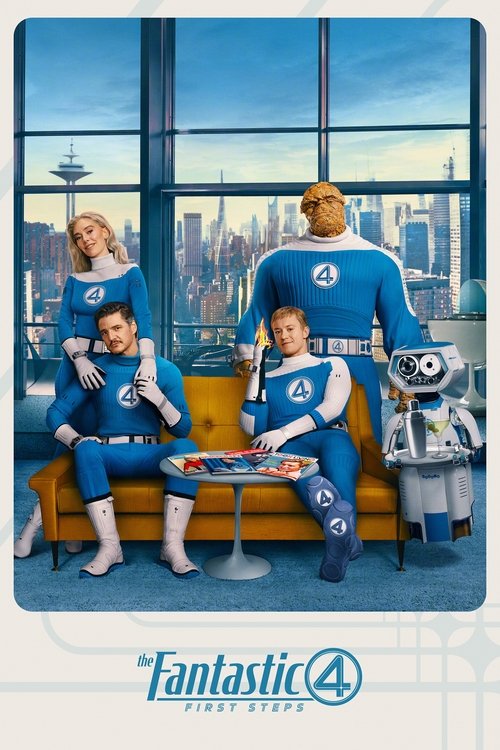
The Fantastic 4: First Steps
2025 · Matt Shakman
For a big, hopeful popcorn night — when you want spectacle that's warm rather than grim, whether that's family viewing or a comfort-food blockbuster after a long week. Firmly on the comfort end of the dial.
What it's about
On a retro-futuristic alternate Earth styled after 1960s Space Age optimism, the Fantastic Four — Reed Richards, Sue Storm, Johnny Storm, and Ben Grimm — are already transformed, already famous, and already a family. Their world is upended when the Silver Surfer arrives heralding Galactus, a ravenous cosmic force that consumes planets, and the team must weigh saving Earth against what it could cost the people they love most.
The experience
Bright, earnest, and sincerely optimistic where most superhero films are quippy — the stakes are cosmic but the emotional register is domestic, a family drama wearing a space-age suit. It moves briskly and aims for awe more than snark.
Performances
Pedro Pascal plays Reed's genius as anxiety rather than arrogance, and Vanessa Kirby gives Sue Storm a steel and maternal ferocity that makes her the film's true center.
The craft
The retro-futurist production design is the star: a fully imagined 1960s-that-never-was, all optimistic architecture, analog gadgets, and period-styled spacecraft, giving the film a visual identity unlike anything else in its franchise. The cosmic sequences are built for a giant screen and a loud room.
Why it matters
Marvel's fourth attempt at its 'First Family' finally landed by skipping the origin story entirely and giving the team a self-contained world, positioning the characters at the center of the studio's next era.
Snapshot
The Fantastic Four: First Steps is Marvel Studios' fourth attempt to bring comics' "First Family" to the screen and its first to strip away the origin story entirely. When the film opens, Reed Richards, Sue Storm, Johnny Storm, and Ben Grimm have already been transformed and are already beloved public figures; the cosmic-ray accident that made them is delivered as backstory rather than plot. Director Matt Shakman sets the whole thing not in the shared Marvel Cinematic Universe of the Avengers films but in a self-contained retro-futuristic world — an alternate Earth (designated Earth-828 in Marvel's cosmology) styled after the Space Age optimism of the early 1960s, the exact moment Stan Lee and Jack Kirby first published the characters in 1961. The engine of the story is the arrival of Galactus, a planet-devouring cosmic entity, heralded by the Silver Surfer, forcing the four to weigh the survival of their family against the survival of Earth. The film functions simultaneously as a superhero adventure, a period-styled design object, and Marvel's argument that its most Kirby-esque property is best served by leaning into that heritage rather than modernizing it away.
Industry & production
The film arrives after a long and troubled screen history for the property: two low-budget 1990s productions (one, Roger Corman's 1994 version, famously never released), Tim Story's two mid-2000s features, and Josh Trank's poorly received 2015 reboot at 20th Century Fox. Disney's acquisition of Fox in 2019 returned the film rights to Marvel Studios, and First Steps represents the first time producer Kevin Feige's studio controlled the characters. It was positioned as a cornerstone of the MCU's "Phase Six" and as setup for subsequent Avengers films, even though the picture itself is walled off in its own universe. Shakman, who had directed Marvel's WandaVision to acclaim, took over after earlier director attachments moved on — the public record notes Jon Watts had been attached before departing, and Shakman came aboard around 2023. Principal photography took place primarily in the United Kingdom at Pinewood Studios, the standard base for large Marvel productions, with a release in the summer of 2025. Precise budget and box-office figures should be treated cautiously; contemporaneous reporting placed it among the year's major studio tentpoles, but I will not assign specific numbers I cannot verify.
Technology
First Steps is a large-format digital production built for IMAX presentation, and its technological story is really the story of reconciling two impulses: photoreal spectacle and hand-built period texture. The film's most demanding technical objects are its powers and its antagonist. Sue Storm's invisibility and force fields, Reed's elastic body, Johnny's full-body combustion, and Ben Grimm's rocky hide are each distinct visual-effects problems handled by the usual constellation of vendors that service Marvel's pipeline. Ben Grimm — the Thing — is the most consequential choice: rather than a practical suit, he is realized as a performance-capture and digital character, allowing the actor's facial performance to drive a fully rendered rock body. Galactus poses a problem of scale, requiring the character to read as genuinely planet-sized against human figures, and the Silver Surfer demands a fully reflective CG surface that convincingly mirrors its surroundings, a classic ray-tracing challenge that the Surfer has posed to filmmakers since the character's previous screen appearance in 2007. Where the film is genuinely distinctive is in marrying these effects to a production design grounded in physically built, analog-looking hardware — a deliberate counter to fully synthetic environments.
Technique
Cinematography
The film was photographed by Jess Hall, who had previously shot WandaVision for Shakman and brought to that project a sophisticated command of period-specific lensing. Hall's work here is organized around the retro-futurist concept: warm, saturated color, clean and confident compositions, and a sense of optimistic brightness that consciously rejects the desaturated grimness common to the superhero cycle. Large-format capture serves the Kirby-derived scale of the cosmic material — Galactus and the Surfer are staged for maximal grandeur — while the domestic scenes favor a stabler, more classical framing appropriate to a story about a family. The Surfer's reflective body and the vintage-futuristic interiors both reward Hall's controlled, high-key approach, in which surfaces and materials are meant to be legible rather than obscured.
Editing
The film's cutting balances two registers — intimate family drama and cosmic action set-pieces — and the general strategy is to let character scenes breathe while reserving accelerated cutting for the powers and the Galactus threat. The specific editorial credits and any account of the cutting-room decisions are not something I can responsibly detail beyond this; the granular record of who cut which sequence is thin in reliable public sources, and I will not invent names or claims about the assembly.
Mise-en-scène / staging
This is the film's signature dimension. The production design — a Space Age, mid-century-modern, Googie-inflected vision of "the future as imagined in 1961" — is the picture's most discussed formal element. Curved plastics, atomic-era ornamentation, tailfins, rocket motifs, and analog dials furnish a world that never happened but feels historically specific. The Baxter Building, the family's headquarters, becomes a stage for domestic staging as much as heroics, and the retro robot H.E.R.B.I.E. reinforces the Jetsons-adjacent register. This choice is authorial: by committing to an alternate-1960s aesthetic, the film gives itself a coherent visual grammar that distinguishes it from every other MCU entry and returns the characters to their Kirby-Lee point of origin.
Sound
The sound design must sell three things: the roar of the Human Torch, the tectonic weight of the Thing, and the vast, almost sacred hum of Galactus. The film pairs these with a period-flavored sonic palette in keeping with its design. Precise technical details of the mix and sound-editorial approach are not well documented in sources I can cite, so I will characterize the intent — grandeur for the cosmic, warmth for the domestic — rather than assert specifics.
Performance
The ensemble is the film's spine. Pedro Pascal plays Reed Richards as a burdened intellect whose brilliance is inseparable from his anxiety about protecting his family; Vanessa Kirby's Sue Storm is written and played as the group's emotional and moral center rather than a secondary figure, with her impending and then realized motherhood (the birth of Franklin Richards) driving the stakes. Joseph Quinn brings a brash levity to Johnny Storm, and Ebon Moss-Bachrach gives Ben Grimm a gruff pathos beneath the digital rock. Julia Garner plays the Silver Surfer — here a version named Shalla-Bal rather than the classic Norrin Radd — bringing an eerie stillness to the herald, while Ralph Ineson lends Galactus a cavernous gravity. The performances are pitched to the film's earnest, un-ironic tone: sincerity over quip.
Narrative & dramatic mode
First Steps is structured as a domestic melodrama wearing the costume of a cosmic epic. Its central dramatic question is not "will they get their powers" — the film pointedly skips that — but "can a family hold together under an extinction-level threat," and more specifically whether Reed and Sue can protect their newborn child when a god demands a terrible bargain. The Galactus plot functions as an externalized version of the ordinary terror of new parenthood: an overwhelming force that arrives whether you are ready or not. Dramatically, the film runs on the ensemble dynamic — the bickering-but-loving family unit that has always distinguished the Fantastic Four from more solitary heroes — and it resolves through collective sacrifice and solidarity rather than a single champion's triumph. This "start in medias res" approach is itself a narrative statement: a wager that audiences no longer need superhero origin mechanics and are ready for these characters as established adults.
Genre & cycle
The film sits inside the long-running superhero cycle but positions itself as a corrective within it. By 2025, the MCU had absorbed persistent commentary about "superhero fatigue," and First Steps responds by narrowing scope (one self-contained world, one family, one threat) and by embracing a bright, sincere, period-inflected register distinct from the multiverse-crossover mode that dominated the preceding phase. It draws on the "cosmic Marvel" sub-genre — the Kirby tradition of space gods and world-eaters — and on the retro-futurist science-fiction tradition more broadly. Within the studio's output it is unusual for being both a franchise cornerstone and a stylistically walled-off standalone, a hybrid the marketing leaned into.
Authorship & method
Matt Shakman's authorship is legible primarily through the film's commitment to a controlling aesthetic idea, a method he had already demonstrated on WandaVision, where each episode meticulously recreated a different era of American television. First Steps applies the same discipline at feature scale: a fully realized alternate-1960s design world, sustained with conviction. Shakman's television background — including extensive work on prestige series and Game of Thrones — shows in his handling of ensemble scenes and his willingness to let a domestic drama carry a blockbuster.
His key collaborators reinforce the approach. Cinematographer Jess Hall brings the period-lensing sensibility from their prior collaboration. Composer Michael Giacchino, a frequent Marvel collaborator (the Spider-Man: Homecoming trilogy, Doctor Strange in the Multiverse of Madness, and the director of Werewolf by Night), scores the film; his melodic, thematically driven idiom suits the earnest tone, and his fondness for retro orchestral coloring aligns with the design. The screenplay is credited to a team of writers — the public record attributes work to Josh Friedman, Eric Pearson, and the writing pair Jeff Kaplan and Ian Springer, reflecting the collaborative, iterative scripting typical of Marvel productions; the precise division of authorial labor among them is not something I can verify in detail. The production design, the film's most authored surface, is the crucial fourth collaborator's contribution, though I will refrain from over-attributing specific credited names where I am not certain of the record.
Movement / national cinema
The picture is a product of the transnational, Hollywood-financed but UK-shot studio-blockbuster system, and it does not belong to any national-cinema movement in the auteurist sense. Its truest affiliation is to an American pop-cultural lineage — the mid-century Space Age futurism of the actual 1960s, filtered through the Lee-Kirby comics that were themselves a response to that era's atomic optimism and space-race anxiety. In that sense the film is a work of American retro-Americana, reconstructing a national mood rather than a national cinema.
Era / period
Two eras are in play. The film was made in the mid-2020s, at a moment of visible strain and self-examination for the superhero blockbuster, and its formal choices read as a response to that industrial context. But the world it depicts is a counterfactual early 1960s — the "world of tomorrow" as dreamed at the dawn of the space age, complete with the period's faith in technology and progress. The film's deepest gesture is to collapse these: to return the Fantastic Four to their 1961 birth moment and ask whether that optimism can still be inhabited sincerely by a 2025 audience. The alternate-universe conceit is what makes this possible, freeing the design from any obligation to match the contemporary MCU.
Themes
The dominant theme is family as both vulnerability and strength — the four are defined by their bonds, and the plot repeatedly tests whether those bonds are a liability or the only thing that can save the world. Closely tied is parenthood and protection: Sue and Reed's child becomes the literal object of Galactus's demand, making the abstract cosmic threat intimately personal. A third theme is sacrifice for the collective, expressed through the group's refusal to trade one life for many. Underneath runs a meta-theme of optimism versus dread — the retro-futurist surface radiates hope while the narrative confronts annihilation, staging the film's design and its stakes as a deliberate dialectic. Finally, the film engages the burden of responsibility that accompanies exceptional gifts, the classic Marvel preoccupation, here distributed across a family rather than shouldered by a lone hero.
Reception, canon & influence
Critical reception was, on the whole, warm, with much of the commentary singling out the production design and the decision to skip the origin story and commit to a self-contained period world; reviewers frequently framed it as a confident, tonally distinct entry that pushed against superhero-fatigue narratives. I will not attach specific aggregate scores or box-office figures I cannot verify, but the general critical posture was that the film's aesthetic conviction and its emphasis on family were its strongest assets.
Influences on the film (backward): The most direct source is the original Lee-Kirby Fantastic Four comics of the 1960s, and specifically the Galactus Trilogy of 1966 that introduced Galactus and the Silver Surfer — the film's central conflict is an adaptation of that landmark storyline. Jack Kirby's visual imagination — his cosmic scale, his machinery, his "Kirby crackle" energy — is the film's aesthetic north star. Beyond the comics, the picture draws on real Space Age industrial and architectural design, mid-century-modern and Googie idioms, and the broader tradition of retro-futurist science fiction. Shakman's own WandaVision is a clear methodological precedent for the period-recreation approach.
Legacy / what it shaped (forward): As a 2025 release, the film's long-term influence is still forming and any claim about its ultimate legacy would be premature. Its most concrete forward function is structural: it was designed to introduce this incarnation of the Fantastic Four into Marvel's larger plans, setting up the characters' role in subsequent Avengers films. Whether its stylistic wager — a walled-off, sincerely optimistic, design-forward standalone — becomes a template that reshapes the superhero cycle, or remains a distinctive one-off, is a question the historical record cannot yet answer, and I decline to predict it as fact.
A Deleuzian reading
A chrome figure stands on a board and doesn't move.
The full Deleuzian reading of The Fantastic 4: First Steps →
Reception
Landed in summer 2025 as the fourth big-screen attempt at Marvel's First Family and the first one critics actually liked — instant 'they finally cracked it' consensus, though its box-office legs softened enough to reopen the superhero-fatigue conversation.
How The Fantastic 4: First Steps was received, from release to now →
How to watch The Fantastic 4: First Steps: what to notice on a first viewing
- Notice the curved plastics, tailfins, and analog dials in every room. The Baxter Building and the robot H.E.R.B.I.E. carry a Space Age 1961 that never actually existed, built after Kirby's original comics. Shakman commits to this vocabulary on every surface, not just the sets seen in trailers. The design gives the film its own visual grammar, distinct from every other superhero movie on screen right now.
- Watch how bright and warm the color stays, even in danger. Jess Hall lights the whole film in high key, refusing the desaturated grimness common to the superhero cycle, even during the Galactus threat. The brightness keeps hope legible on screen instead of letting the stakes curdle into grimness.
- Watch the Silver Surfer's face for any change in expression. Julia Garner's Shalla-Bal barely moves, and her mirrored body reflects only the world around her, never her own feeling. Her stillness makes her read as frightening and sorry at the same time.
- Notice the film never shows the accident that gave them powers. First Steps opens with the four already transformed and famous, skipping the origin story every prior Fantastic Four film told in full. The film treats decades of comics as already known, spending its recovered time on family drama instead.
- Listen for how the family talks to each other without quips. Pascal, Kirby, Quinn, and Moss-Bachrach play every scene earnestly, with no one winking at the audience or undercutting a moment with a joke. The sincerity is a formal choice; the film risks looking naive to keep its unironic tone intact.
The whole guide to watching The Fantastic 4: First Steps, with the keys for a rewatch →
Influences: the films it descends from and the films it influenced
- Metropolis (1927) — Establishes the machine-age retro-futurist production-design idiom — monumental art-deco cityscapes and expressive industrial machinery — that First Steps reworks as its alternate-1961 built world.
- Forbidden Planet (1956) — Codifies mid-century Space Age industrial design and clean-lined optimistic hardware (the Krell technology) that Shakman's set decoration and prop language directly quote.
- 2001: A Space Odyssey (1968) — Model for large-format photography of pristine mid-century-modern spacecraft interiors, and for staging cosmic transcendence (the Star Child) as awe rather than menace — the tonal register the Surfer scenes reach for.
- The Iron Giant (1999) — Filters a cosmic/atomic threat through sincere, un-ironic late-1950s Americana and a domestic-protection lens, the exact optimism-versus-dread balance First Steps sustains.
- The Incredibles (2004) — Blueprint for the superpowered nuclear family as domestic melodrama, staged in atomic-age Googie and mid-century-modern design — and, like First Steps, scored by Michael Giacchino in a retro-orchestral idiom.
- Sky Captain and the World of Tomorrow (2004) — Precedent for committing an entire feature to a single controlling retro-futurist aesthetic — a fully art-directed alternate world sustained without ironic distance, Shakman's own methodological wager.
- Terminator 2: Judgment Day (1991) — The chrome liquid-metal T-1000 pioneered the fully reflective CG surface convincingly integrated into live action, the direct technical lineage of the ray-traced Silver Surfer.
- The Lord of the Rings: The Two Towers (2002) — Serkis/Gollum established performance-capture as a vehicle for an emotionally legible digital character, the method behind the film's performance-captured Thing.
- Guardians of the Galaxy (2014) — First translated Jack Kirby's cosmic-Marvel palette — saturated energy fields and 'Kirby crackle' — into a coherent screen color language that First Steps inherits and period-shifts.
- Interstellar (2014) — Demonstrates large-format IMAX photography carrying a cosmic-scale story on a foundation of warm domestic/parental emotion — family-as-vulnerability driving the spectacle.
- Tomorrowland (2015) — Reconstructs Googie/atomic-age optimistic futurism as 'American retro-Americana,' the same nostalgic-forward Space Age design vocabulary First Steps foregrounds.
- WandaVision (2021) — Shakman's own proof-of-method: meticulous per-era period recreation as a controlling formal discipline, scaled up here from television pastiche to a feature-length 1961 world.
- Werewolf by Night (2022) — Giacchino's directorial exercise in reviving retro genre texture and period orchestral coloring — the same composer's earnest, thematically-driven scoring sensibility applied to First Steps.
- Oppenheimer (2023) — Contemporary demonstration of large-format IMAX capture reconstructing a mid-century period world with tactile physical detail, the same photographic and design conviction.
- Asteroid City (2023) — Parallel commitment to a mid-1950s atomic-age desert Americana rendered in a warm high-key pastel palette with a sincere-but-stylized ensemble, sharing the in-medias-res period-world tactic.
- Barbie (2023) — Sibling wager that a walled-off, saturated, fully-committed stylized design world can be played with total sincerity — an aesthetic-conviction-first blockbuster like First Steps.
Similar films
- Guardians of the Galaxy (2014) — influence & lineage
- The Incredibles (2004) — influence & lineage
- Interstellar (2014) — influence & lineage
- X-Men: Days of Future Past (2014) — shared sensibility
- Deadpool & Wolverine (2024) — shared sensibility
- Guardians of the Galaxy Vol. 2 (2017) — shared sensibility
- Captain America: The First Avenger (2011) — shared sensibility
- Thunderbolts* (2025) — shared sensibility