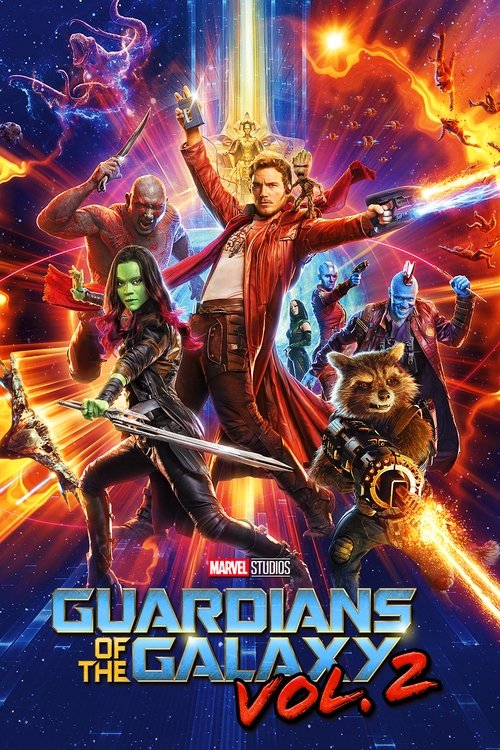
Guardians of the Galaxy Vol. 2
2017 · James Gunn
For a night when you want big candy-colored fun with your friends and don't expect to get misty at a space movie — but you might. Pure comfort viewing with a surprising emotional kick.
What it's about
The misfit crew of thieves, mercenaries, and one foul-mouthed raccoon are barely holding together as a team-for-hire when Peter Quill finally meets his long-lost father — a charismatic cosmic being with an entire planet to his name. What starts as a family reunion among the stars turns into a reckoning over what family actually means: the one you're born to, or the ragtag one that keeps saving your life. Meanwhile old grudges, ravager mutinies, and sibling feuds circle in from every direction.
The experience
Loud, gaudy, and genuinely funny, but with a soft center that sneaks up on you — jokes and neon spectacle one minute, a lump in your throat the next. It moves fast and never stops needling its own heroes, then lands hits of real feeling about lousy dads and found family.
Performances
Kurt Russell brings genuine movie-star warmth and menace to Ego, and Michael Rooker steals the film outright as Yondu, turning a blue-skinned scoundrel into its bruised heart. Dave Bautista's flat-affect line deliveries as Drax are a comic weapon all their own.
The craft
James Gunn writes the funniest, most character-driven scripts in the superhero business, and here he pairs them with an eye-popping palette — living planets, rainbow nebulae, a golden-skinned aristocrat race — that begs for the biggest, brightest screen you can find. The needle-drop soundtrack isn't decoration; the songs carry the film's emotional argument.
Why it matters
It proved the first film's success was no fluke and cemented the idea that a blockbuster franchise entry could be a deeply personal auteur project — a template that shaped how studios handled comic-book directors afterward.
Snapshot
Guardians of the Galaxy Vol. 2 is James Gunn's second entry in the Marvel Cinematic Universe's cosmic corner, arriving in May 2017 as the fifteenth film in that franchise and the follow-up to his surprise 2014 hit. Where the first film had to justify a raccoon and a tree to a skeptical audience, the sequel operates from a position of earned confidence, and Gunn uses that latitude to pursue an unusually intimate register inside a maximalist space opera. The plot ostensibly concerns Peter Quill discovering that his father is Ego, a "Celestial" being who manifests as both Kurt Russell and an entire living planet, but the film's real preoccupation is the reconstitution of family from broken parts — biological fathers who fail, surrogate fathers who redeem themselves, and siblings learning to stop weaponizing their wounds. It is a comedy of overwhelming color and volume that ends, pointedly, at a funeral. Among the mega-budget tentpoles of its era it is notable for how much of its runtime it spends on feeling rather than plot mechanics, and for a technical profile — it was among the first features shot on RED's then-new 8K sensor — that placed it at the leading edge of large-format digital acquisition.
Industry & production
The film was produced by Marvel Studios and distributed by Walt Disney Studios Motion Pictures, part of the industrial machine that Disney's 2009 acquisition of Marvel Entertainment had set in motion and that The Avengers (2012) had proven commercially dominant. By 2017 Marvel Studios under Kevin Feige operated as a serialized content engine, and Vol. 2 sits inside that apparatus: a self-contained adventure engineered also to seed future installments, complete with five credited mid- and post-credits stingers that introduce characters and gags for later payoff. Production took place principally at Pinewood Atlanta Studios in Fayette County, Georgia (later Trilith), reflecting the state's aggressive film tax incentives that made metropolitan Atlanta a hub for franchise production in the 2010s. Gunn wrote the screenplay before the first film had even been released to strong reception, which afforded the sequel unusual authorial coherence — the same writer-director shaping both films with a continuous conception of the ensemble. The commercial stakes were substantial and the film performed as a major worldwide success; I'll avoid citing specific grosses I cannot verify precisely, but its box-office standing among 2017 releases was unambiguously in the top tier and consistent with Marvel's franchise expectations.
Technology
Vol. 2 has a genuine place in cinematography history as one of the earliest features photographed with the RED Weapon camera equipped with the 8K "Dragon/Helium"-generation sensor (marketed around the Weapon 8K VV), a fact that cinematographer Henry Braham and Gunn both foregrounded at the time. The very large sensor and high resolution gave Braham enormous latitude for reframing and for the film's saturated, high-detail imagery, and the compact RED bodies allowed rigging in configurations a bulkier camera could not manage. The production leaned heavily, as all Marvel films of the period did, on extensive visual effects: Rocket and Baby Groot are fully computer-generated performances, Ego's planetary interior and the Celestial "light" material are digital constructions, and Yondu's arrow and the space combat are effects-driven. The dancing-Baby-Groot opening required the VFX-and-camera team to choreograph a photoreal animated character against a live plate of chaotic monster combat. As with its peers, the film reflects the maturation of virtual production pipelines, motion-reference performance capture for the animated leads, and high-resolution digital intermediate finishing.
Technique
Cinematography
Henry Braham replaced Ben Davis (who shot Vol. 1) and gave the sequel a distinct visual identity: enormous, poster-bright color and a willingness to build entire environments out of saturated primaries — the golden Sovereign, the candy-hued surfaces of Ego's planet, the neon of Contraband ports. Braham favored wide vistas and a sense of scale that the 8K acquisition could sustain, and he treated color less as naturalism than as emotional signage, pushing hues past realism into a comic-book palette that recalls Silver Age printing. The camerawork mixes sweeping motion in the action set-pieces with a surprising number of held, performance-forward compositions in the dramatic scenes, particularly the Quill–Ego and Quill–Yondu material.
Editing
Cut by Fred Raskin and Craig Wood, the film's editing is most celebrated in its opening: a single sustained gag in which Baby Groot dances to Electric Light Orchestra's "Mr. Blue Sky" while the rest of the team battles an interdimensional monster in soft focus behind him. The sequence is a thesis statement about the film's priorities — foreground the small, adorable, human-scaled feeling; relegate spectacle to the background. Elsewhere the picture is structurally episodic, dividing the ensemble into parallel threads (Quill on Ego's planet; Rocket, Yondu and Groot escaping the Ravagers; Gamora and Nebula's sororal reckoning) and cross-cutting among them. Some critics found this looser, more digressive shape a step down in momentum from the first film's tighter heist-quest engine, a fair observation about the trade Gunn made for character breathing room.
Mise-en-scène / staging
Gunn stages Vol. 2 as a series of maximalist tableaux keyed to emotional beats. Ego's planet is production-designed as an unsettlingly perfect paradise, its geometric beauty gradually reframed as narcissistic and lifeless — the staging itself performing the argument that Ego's "love" is sterile. The Ravager mutiny and Yondu's arrow-through-the-corridor sequence are choreographed with a gleeful, almost musical rhythm. The film repeatedly juxtaposes cosmic vastness against tiny domestic gestures, and the closing funeral gathers its far-flung Ravager factions into a single valedictory image.
Sound
Sound is inseparable from the film's identity because of "Awesome Mix Vol. 2," the diegetic mixtape conceit inherited from the first film. Needle-drops are deployed structurally rather than decoratively: ELO's "Mr. Blue Sky" scores the opening; Looking Glass's "Brandy (You're a Fine Girl)" is given a genuinely unsettling reinterpretation by Ego as a parable of a man who loves his voyage more than any person; Cat Stevens's "Father and Son" underscores the Yondu material; Fleetwood Mac's "The Chain" tracks the family's fracture and reunion. Tyler Bates's orchestral score threads between these songs. The design uses the songs to carry theme, so that the soundtrack functions as an argument about fatherhood rather than a jukebox.
Performance
The ensemble is the film's true subject. Chris Pratt anchors Quill's yearning for a father with more vulnerability than the first film asked of him; Kurt Russell brings a charismatic, faintly menacing warmth to Ego that makes the eventual betrayal land. The film's emotional center, though, is Michael Rooker's Yondu, whose arc from mercenary to redeemed surrogate father is the picture's most sustained dramatic achievement. Pom Klementieff introduces Mantis as a study in empathic naïveté, her scenes with Dave Bautista's Drax generating the film's gentlest comedy. Zoe Saldana and Karen Gillan give the Gamora–Nebula relationship a genuine, abraded history. Bradley Cooper (voicing Rocket) and Vin Diesel (voicing Baby Groot) complete a company in which vocal and motion-reference performance carry as much weight as on-camera acting.
Narrative & dramatic mode
The dominant mode is tragicomedy — a comic surface over a melodrama of paternity and belonging. Structurally the film is a multi-strand ensemble piece rather than a single-goal quest, and it withholds a conventional villain-driven plot for much of its length, allowing the "conflict" to emerge from character (Ego's revealed nature, the Guardians' internal fractures) before crystallizing into a third-act threat. Its dramatic method is unusually forgiving of sentiment for a blockbuster of its scale: it earns the right to be openly emotional by first disarming the audience with comedy, then converting that goodwill into grief. The recurring formal move is bathos and its inverse — undercutting feeling with a joke, then surprising the audience by letting a joke resolve into feeling.
Genre & cycle
The film belongs to the space-opera adventure tradition and, more specifically, to the superhero franchise cycle of the 2010s. Within the MCU it is the second film of a trilogy and a keystone of the studio's "cosmic" sub-brand, distinct in tone from the earthbound Avengers and the espionage register of the Captain America films. It draws openly on the pop-cultural furniture of 1970s and '80s adventure cinema — the Amblin sensibility, Star Wars' lived-in galaxy, the pulp of Flash Gordon and drive-in science fiction — and filters them through an irreverent, needle-drop-driven comic voice. It is also, unmistakably, an heir to the "cosmic Marvel" comics of Kirby, Jim Starlin and later Dan Abnett and Andy Lanning, whose 2008 relaunch supplied the specific team roster Gunn adapted.
Authorship & method
James Gunn is the decisive authorial presence, credited as sole screenwriter and director. His path to Marvel is unusual: he began at Troma Entertainment (writing Tromeo and Juliet), scripted the Dawn of the Dead remake and the two live-action Scooby-Doo features, and directed the cult horror-comedy Slither and the dark superhero deconstruction Super before Marvel hired him. That lineage — B-movie affection, tonal whiplash between the gross and the sincere, needle-drop instincts — is legible throughout Vol. 2. His key collaborators here form a coherent authorial unit: cinematographer Henry Braham, whose saturated large-format imagery defines the film's look and who would continue with Gunn; composer Tyler Bates, a longtime Gunn collaborator responsible for the orchestral scoring around the licensed songs; editors Fred Raskin and Craig Wood; and the returning ensemble cast whom Gunn writes to their specific comic and dramatic strengths. Gunn's method is authorial in a way not all franchise directors are permitted to be — he selected every song, wrote the family melodrama into the studio template, and imposed a personal sensibility onto industrial product. (The public rupture and reinstatement between Gunn and Disney over resurfaced old social-media posts occurred in 2018, after this film, and is properly part of Vol. 3's production history rather than this one's.)
Movement / national cinema
As a Hollywood studio franchise film it does not belong to an art-cinema movement, but it can be situated within the American blockbuster's "cinematic universe" paradigm that Marvel pioneered and that dominated 2010s commercial filmmaking. Physically it is a product of the runaway-production geography of the period — an American film shot largely in Georgia under state incentives with international VFX labor. Culturally it is thoroughly American in its pop vernacular: its soundtrack, its Amblin-inflected sentimentality, and its ironic-sincere register are specific to a strain of U.S. genre filmmaking.
Era / period
Vol. 2 is a document of the mid-2010s peak of the shared-universe franchise, when Marvel had established a reliable serialized rhythm and audiences had been trained to expect post-credits continuity. It reflects the era's technological inflection point in acquisition (early 8K digital) and its economic model (globalized tentpoles, incentive-driven domestic locations). Its nostalgia is doubly periodized: made in 2017, it is saturated with the 1970s–80s pop culture of Quill's abduction-era childhood, using that retro soundtrack as both character device and audience lure — a strategy the first film had proven and this one deepened.
Themes
The film's governing theme is fatherhood and its failures. Ego is the biological father as pure narcissism — a being who literally cannot love anything outside himself and who murders his own children when they prove human. Against him stands Yondu, the abusive kidnapper who turns out to have been the real father all along, redeemed by sacrifice; the film's most quoted emotional beat draws the distinction between the one who sired Quill and the one who raised him. Radiating from this are the film's other concerns: chosen family over blood, the reconciliation of siblings (Gamora and Nebula) poisoned by a shared abuser, empathy as a moral faculty (Mantis), and the possibility of redemption for the irredeemable. Underneath the neon comedy the film is remarkably preoccupied with grief, abandonment, and the labor of loving imperfect people.
Reception, canon & influence
Critically, Vol. 2 was received warmly though generally regarded as a slight step below its predecessor — praise concentrated on its emotional depth, humor, visual splendor and Rooker's Yondu, while reservations focused on its looser, more episodic plotting and a sense of self-indulgence in its digressions. It was a major commercial success consistent with Marvel's franchise standing. Backward, the film synthesizes Jack Kirby's cosmic Marvel (Ego the Living Planet originated in the Lee/Kirby Thor comics), the Abnett–Lanning Guardians relaunch, the Amblin and Star Wars adventure traditions, and the mixtape-memoir sensibility of Gunn's own low-budget work; its soundtrack strategy also owes an evident debt to needle-drop auteurs like Scorsese and Tarantino, repurposed for a family blockbuster. Forward, its influence is felt most directly within the MCU, where it consolidated the "cosmic" tone that later fed into Avengers: Infinity War and Endgame and set up characters and relationships paid off across the franchise, including Gunn's own Vol. 3 (2023). More broadly it reinforced the industry lesson that a director's idiosyncratic voice — soundtrack, sentiment, tonal risk — could be an asset rather than a liability inside the franchise system, and its cultural footprint (Baby Groot as a merchandising and meme phenomenon) exemplified how a single designed character could become a standalone brand. Gunn's subsequent move to co-lead DC Studios makes Vol. 2 a notable waypoint in the career of one of the era's most consequential franchise authors.
A Deleuzian reading
A baby tree dances to "Mr.
The full Deleuzian reading of Guardians of the Galaxy Vol. 2 →
Reception
Landed in 2017 as 'good but not the first one' — the sequel that traded surprise for sincerity. Since then it's been steadily reappraised as the trilogy's emotional core, with a vocal contingent now calling it the best of the three, and its standing only grew as Gunn's firing-and-rehiring saga turned the whole trilogy into an underdog story.
How Guardians of the Galaxy Vol. 2 was received, from release to now →
How to watch Guardians of the Galaxy Vol. 2: what to notice on a first viewing
- Watch where the camera stays during the opening fight. Baby Groot dances to Mr. Blue Sky in the foreground while the team battles a monster, soft and blurred, far behind him. The camera never once changes its mind about which of them matters. The spectacle is pushed into the background on purpose. Gunn opens by telling you exactly what he cares about.
- Notice how saturated the colors are on Ego's planet. Braham builds whole environments out of primaries: the gold of the Sovereign, the candy surfaces of the planet, the neon of the ports. None of it is lit for naturalism. Color works as signage for feeling. You can read a location's temperament straight off its palette.
- Listen for how each song comments on fathers. The mixtape plays inside the story. Brandy gets retold as a parable about a man who loves his voyage. Father and Son runs under the Yondu material. The songs carry the argument so the scenes never have to state it. You supply what the lyrics mean.
- Look at how perfect and empty Ego's paradise is. The gardens are geometric, spotless and beautifully arranged. Nobody else lives there. Every surface belongs to one being. The set is gorgeous and strangely empty, and the design asks you to look at who it was made for.
- Count how many separate groups the film follows. Quill on the planet, Rocket and Groot and Yondu among the Ravagers, Gamora and Nebula settling a very old account. The film cross-cuts and lets each thread run on character instead of on a mission. No single quest drives this one. The looseness is what buys room for the family material.
The whole guide to watching Guardians of the Galaxy Vol. 2, with the keys for a rewatch →
Influences: the films it descends from and the films it influenced
- The Empire Strikes Back (1980) — The paternity bombshell as tragic third-act pivot — Ego's reveal restructures the finale exactly as Vader's does, weaponizing the space-opera father-reveal for pathos rather than plot.
- Flash Gordon (1980) — A comic-book cosmos rendered in candy-hued primary-color soundstage design and scored to pop-rock (Queen), the direct template for Vol. 2's saturated artificial cosmos and licensed-song space opera.
- American Graffiti (1973) — Wall-to-wall diegetic pop-single soundtrack used as generational memoir — the source model for Quill's Awesome Mix functioning as character, memory, and maternal grief.
- Mean Streets (1973) — Needle-drop scoring in which a licensed record performs emotional and tonal labor a composed cue cannot; Gunn's whole mixtape method descends from this jukebox-as-authorship approach.
- Pulp Fiction (1994) — Upbeat pop songs ironically counterpointed against violence and comedy — the exact tonal juxtaposition of Vol. 2 staging carnage and slapstick to cheerful oldies.
- E.T. the Extra-Terrestrial (1982) — The Amblin move of an unguarded, John-Williams-swelled emotional sincerity and childlike wonder inside genre spectacle — the earnestness Gunn writes under the gags.
- Barbarella (1968) — Psychedelic pop-art space fantasy built from saturated color and cosmic kitsch, an antecedent for Vol. 2's maximalist palette and its embrace of gaudy sci-fi camp as design virtue.
- Slither (2006) — Gunn's own tonal-whiplash grammar — gross-out horror-comedy pivoting without warning into sincere feeling — imported wholesale into the studio template.
- Super (2010) — Gunn's deconstruction of superhero damage and surrogate-family dysfunction, prototyping the wounded-mentor pathos that becomes Yondu's arc.
- Rise of the Planet of the Apes (2011) — Serkis-school performance capture in which a fully CG character (Caesar) carries dramatic lead weight — the motion-reference-plus-vocal method behind Rocket's performance.
- Guardians of the Galaxy (2014) — Directly extends the script-stage song method with 'Awesome Mix Vol. 2' and pays off the Rooker/Yondu surrogate-father thread with a needle-drop-scored funeral, deepening the chosen-family device.
- Avengers: Infinity War (2018) — Absorbed Vol. 2's cosmic register — Gunn's Guardians, their banter, relationships, and celestial scale — into the MCU crossover apparatus as its default space-tone.
- The Suicide Squad (2021) — Gunn re-runs the Vol. 2 architecture in DC: needle-drop montages, a misfit surrogate family, and sincere grief smuggled under gleefully gross comedy.
- Guardians of the Galaxy Vol. 3 (2023) — Direct continuation completing Rocket's origin trauma and the chosen-family payoff with the same Henry Braham large-format saturated look and mixtape structural spine.
- Thor: Ragnarok (2017) — Marvel cosmic comedy in saturated Kirby-primary color anchored by a signature needle-drop (Immigrant Song), extending Vol. 2's proof that a director's idiosyncratic voice belongs inside the franchise machine.
- Baby Driver (2017) — Action and cutting synchronized frame-precise to a diegetic pop-song mix, opening on a music-driven set-piece — a formal cousin to Baby Groot's dance over the title fight.
- Deadpool (2016) — Irreverent needle-drops and fourth-wall tonal risk demonstrating, alongside Vol. 2, that a franchise superhero film could foreground an idiosyncratic authorial sensibility over house style.
Similar films
- Guardians of the Galaxy Vol. 3 (2023) — influence & lineage · same viewing thread
- Avengers: Infinity War (2018) — influence & lineage
- Avatar: The Way of Water (2022) — same viewing thread
- Guardians of the Galaxy (2014) — shared sensibility
- Avengers: Endgame (2019) — shared sensibility
- The Avengers (2012) — shared sensibility
- Thor: Love and Thunder (2022) — shared sensibility
- Iron Man 2 (2010) — shared sensibility
All the films related to Guardians of the Galaxy Vol. 2 →
Watch it with: curated runs of related films
- Worlds Worth Getting Lost In — A run of maximalist, effects-driven pictures that each conjure a whole world from scratch — watch them when you want to be swept somewhere on the biggest screen you can find.