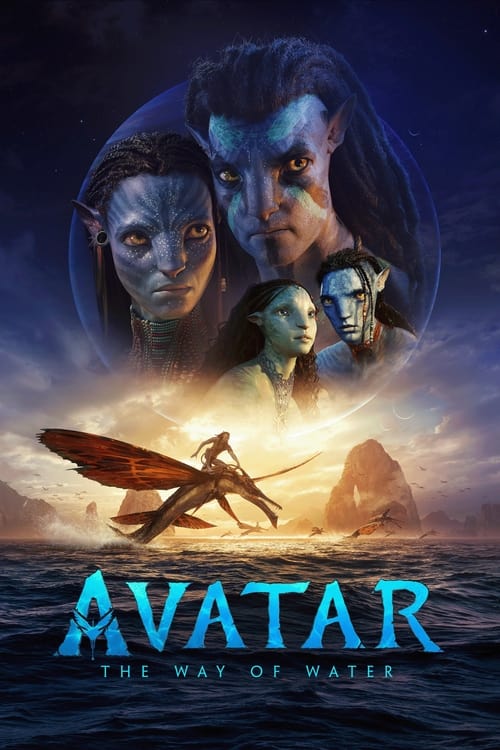
Avatar: The Way of Water
2022 · James Cameron
The permanent "no cultural footprint" joke versus $2.3B reality — the film the internet dunks on and everyone saw, making it the go-to case that memes and box office are different universes.
For when you want to be transported — to hand three hours to pure spectacle and come out the other side having lived somewhere else. Comfort viewing at maximum scale, not a film to half-watch on a laptop.
What it's about
Jake Sully and Neytiri are parents now, raising a family of kids on Pandora — until an old enemy returns in a new Na'vi body and forces them to flee the forest they've always known. They take refuge with the Metkayina, a reef clan whose whole way of life is built around the ocean, and have to learn to breathe, hunt, and belong in the water while the threat that drove them out keeps closing in. It's a chase story wrapped around a family story: parents trying to keep headstrong kids safe in a world that keeps demanding they fight.
The experience
Long, immersive, and unhurried in a way that's part of the point — whole stretches just let you swim around in the world, then Cameron tightens the screws into thunderous, expertly staged action. It's earnest to the core: big feelings about family, loyalty, and loss, played completely straight.
Performances
Sam Worthington and Zoe Saldaña carry the parental weight through motion capture, and Stephen Lang makes a returning villain genuinely menacing in a wholly new form — a performance surviving intact through layers of digital translation.
The craft
This is the state of the art in performance capture and effects, and its signature achievement is water — how bodies move through it, how light falls through it, how creatures breach it. Cameron built new technology to capture actors performing underwater, and the film exists to be seen as big and loud as possible; on a proper screen the reef sequences are some of the most convincing digital environments ever put on film.
Why it matters
It became one of the highest-grossing films ever made, proved the Avatar phenomenon wasn't a one-off, and reignited the argument about whether spectacle on this scale is cinema's future or its distraction.
Snapshot
Avatar: The Way of Water is the long-delayed sequel to James Cameron's 2009 Avatar, the highest-grossing film of its era. Arriving thirteen years later, it extends the Pandora saga from rainforest to reef, relocating Jake Sully (Sam Worthington) and Neytiri (Zoe Saldaña) — now parents — from the forest Omatikaya to the oceanic Metkayina clan as they flee a resurrected Colonel Quaritch (Stephen Lang), whose consciousness has been decanted into a Na'vi "recombinant" body. The film functions less as a conventional plot machine than as a vast technical and immersive proposition: a demonstration of what large-format, high-frame-rate stereoscopic cinema can do with water, faces, and scale. It was a commercial phenomenon and a lightning rod in debates about spectacle versus story, and it re-established Cameron's serial ambitions for a planned five-film cycle.
Industry & production
The production is inseparable from its own mythology of delay. Cameron and 20th Century Fox announced sequels repeatedly across the 2010s; the project's scope, the need to invent capture technology, and the 2019 Disney acquisition of Fox all pushed the release from an originally floated early-2010s window to December 2022. Cameron's Lightstorm Entertainment developed the film in partnership with the effects house Wētā FX (formerly Weta Digital) in New Zealand, where much of the digital work and performance capture were centralized. Cameron has described writing the sequels as a single connected screenplay effort with collaborators before shooting, and the second and third films were photographed largely back-to-back to amortize the enormous cost of building the capture pipeline.
The budget was among the largest in film history, though Cameron and the studio have offered varying and sometimes rhetorical figures; precise accounting is not publicly verified and should be treated cautiously. Cameron stated publicly that the film needed to become one of the highest-grossing releases ever simply to break even — a framing that itself became part of the discourse. The film did go on to gross well over two billion dollars worldwide, entering the upper ranks of all-time box office; exact final tallies vary by source and currency conversion, so specific figures here are left to authoritative trackers rather than asserted. Its success secured continuation of the franchise and validated Cameron's high-risk, high-format theatrical model at a moment when studios were anxious about the durability of the big-screen event.
Technology
Technology is the film's true subject as much as its means. The central engineering problem Cameron set was performance capture underwater — a domain that defeats conventional motion-capture because water scatters and refracts the light that camera-based capture systems depend on, and because floating marker patterns become unreadable. The production built large tanks and developed methods to capture actors performing while submerged, including breath-holding training for the cast (Kate Winslet's extended breath-hold during filming was widely reported), rather than simulating buoyancy on dry stages, because Cameron judged that real underwater human movement could not be faithfully faked. Surface agitation was managed with systems to still or control the water's top layer so capture cameras could see the performers.
The film was also a testbed for high-frame-rate (HFR) exhibition. Cameron shot and finished sequences at 48 frames per second and used variable frame rates within the film, applying HFR selectively — largely to fast motion and action — while allowing other passages to read closer to conventional cadence, a nuanced approach responding to the "video look" criticism that dogged earlier HFR experiments like Peter Jackson's The Hobbit. Stereoscopic 3D was native to the conception rather than a post-conversion afterthought, and Wētā FX rebuilt its water simulation, muscle, and facial pipelines to render the enormous complexity of translucent, moving water interacting with digital characters. The result is frequently cited as a benchmark in computer-generated fluid and subsurface rendering.
Technique
Cinematography
Credited cinematographer Russell Carpenter, a longtime Cameron collaborator dating to True Lies and Titanic, oversaw the live-action photography and the visual grammar that the virtual cinematography then mirrored. Much of what viewers experience, however, is "virtual" camerawork: Cameron operates a simulcam / virtual-camera rig within captured environments, composing shots inside the digital world after performances are recorded. The visual signature favors deep, legible space, sweeping vertical and lateral movement to register scale, and an emphasis on clarity and brightness calibrated for 3D and HFR projection, where dimmer or busier images degrade. The undersea photography aims for a luminous, high-visibility clarity rather than naturalistic murk, prioritizing the readability of faces and creatures.
Editing
The film was edited by a team including Stephen Rivkin, David Brenner, John Refoua, and Cameron himself, reflecting the scale of the material. Its rhythm is deliberately expansive: long immersive passages of world-exploration — children learning to ride and breathe with sea creatures, the tulkun whales, the reef ecosystem — precede a sustained action climax. The three-hour-plus runtime and its patient middle act became central to critical division, some reading the pacing as immersive world-building, others as slack. Cameron has defended the length as intrinsic to the experiential aims.
Mise-en-scène / staging
Production design (Dylan Cole and Ben Procter led the design work) extends the biological-design logic of the first film from the bioluminescent forest to a coral-reef and island culture, with the Metkayina physically differentiated from forest Na'vi — broader tails, more paddle-like limbs — to signal ecological adaptation. The staging repeatedly organizes bodies in three-dimensional volumes of water, exploiting depth for its own sake. The climactic set-piece consciously echoes Titanic: a foundering ship, capsizing geometry, and characters trapped in flooding, tilting spaces, folding Cameron's disaster-film craft back into the science-fiction frame.
Sound
The sound design foregrounds the acoustic difference between above- and below-water worlds, using muffling, pressure, and the transmission of sound through water as both atmosphere and dramatic device, particularly around the tulkun, whose communication is a plot element. The film was engineered for premium large-format and immersive-audio exhibition. As with much of the technical craft, precise crediting of individual sound artists is best confirmed against the official credits rather than paraphrased here.
Performance
Performance is mediated entirely through capture for the Na'vi characters, and the film's advances in facial capture are meant to preserve fine actorly nuance — the argument, made since the first Avatar, that these are performances rather than animations. Returning leads Worthington and Saldaña are joined by Sigourney Weaver in a notable new role as Kiri, a teenage Na'vi, a piece of casting that deliberately foregrounds capture's capacity to decouple performer from rendered body. Stephen Lang returns as the recombinant Quaritch, and Kate Winslet joins as the Metkayina free-diver Ronal. The child and adolescent performers carry much of the emotional through-line.
Narrative & dramatic mode
Dramatically the film shifts from the first film's conversion-and-rebellion arc to a family-in-flight melodrama. Its mode is closer to sustained domestic and generational drama embedded in a survival narrative than to the earlier film's mythic hero's-journey. The Sully children — including the adopted Kiri and the human "Spider" — provide the emotional architecture, and the central movement is one of refuge, assimilation into a new clan, and the eventual failure of flight to guarantee safety. This is a familiar Cameron structure: the reconstituted or embattled family unit under existential threat, tested through catastrophe. The dialogue and thematic statements are broad and declarative rather than ironic, consistent with Cameron's earnest register.
Genre & cycle
The film sits at the intersection of the tentpole science-fiction spectacle, the ecological fable, and the disaster film. It belongs to the franchise cycle of the 2010s–2020s in which a small number of intellectual properties sustain the theatrical event market, yet it is unusual in being an auteur-driven original mythology rather than an adaptation. Within Cameron's own oeuvre it continues his cycle of sequels-as-escalation (Aliens, Terminator 2) and his recurring fusion of cutting-edge effects with human-scaled emotional stakes. Its whaling and eco-violence motifs also connect it to a longer lineage of environmental-message science fiction.
Authorship & method
The Way of Water is a paradigmatic Cameron production: he is director, co-writer, co-editor, and de facto technology impresario, exercising unusually total control across departments. His method is to subordinate schedule and cost to the achievement of a specific perceptual experience, and to invent the tools required rather than accept existing limits — a pattern running from the deep-sea rigs of The Abyss and his documentary diving work to this film's underwater capture. Key collaborators include cinematographer Russell Carpenter; the multi-person editing team led by Stephen Rivkin; production designers Dylan Cole and Ben Procter; and Wētā FX as the effects and virtual-production partner. The score is by Simon Franglen, who takes over the franchise following the 2015 death of James Horner, Cameron's frequent composer, whose Avatar themes Franglen carries forward — a transition marking the end of one of Cameron's longest artistic partnerships. The screenplay is credited to Cameron with collaborators including Rick Jaffa and Amanda Silver and others; exact writing credits should be verified against the film's official attribution.
Movement / national cinema
The film resists national-cinema categorization in the traditional sense. It is a Hollywood studio production, but its center of gravity is the New Zealand digital-effects industry that Peter Jackson and Wētā helped build, making it part of a globalized, capture-and-render mode of filmmaking in which "location" is largely a database. If it belongs to a movement, it is the movement toward virtual production and immersive high-format exhibition — a technological rather than aesthetic or national school — of which Cameron is a leading, and self-conscious, standard-bearer.
Era / period
Released in December 2022, the film arrived at a fraught moment for theatrical cinema, amid post-pandemic anxieties about whether audiences would return to cinemas for anything but a handful of franchise events. Its scale and success were widely read as an argument for the enduring value of the theatrical, big-format experience precisely when streaming was ascendant. It also arrived just as generative and virtual-production technologies were reshaping industry conversation, positioning Cameron's bespoke, capital-intensive craft against cheaper digital shortcuts.
Themes
The film's dominant themes are family, kinship, and belonging — the labor of protecting children, the trauma passed between generations, and the making of chosen family across biological and cultural lines. Ecology is again central: the reef and its sentient tulkun stage an anti-whaling, anti-extraction parable, with the harvesting of the whales for a longevity substance functioning as an unmistakable indictment of industrial exploitation of nature. Colonialism and the return of the aggressor — Quaritch reborn — extend the first film's critique of extractive empire. Water itself is thematized as connective tissue: "the way of water has no beginning and no end," the Metkayina credo, articulates a philosophy of continuity, cycle, and interdependence that the film's form is designed to make felt. Grief and mortality thread through the family drama, giving the spectacle an elegiac undertow.
Reception, canon & influence
Critical reception was broadly positive but pointedly divided along a now-familiar axis: near-universal acclaim for the technical achievement — the water rendering, the immersive 3D, the sheer craft — set against reservations about narrative thinness, length, and dialogue. The film earned major recognition for its effects, winning the Academy Award for Best Visual Effects and receiving further technical nominations, including Best Picture, consolidating its status as a landmark of digital filmmaking even among skeptics of its storytelling. (Specific award tallies should be confirmed against official records.)
Its influences run backward through Cameron's own catalog — the underwater fascination of The Abyss, the disaster staging of Titanic, the ecological and anti-militarist strains of Aliens and the first Avatar — and through a broader tradition of environmental science fiction and undersea documentary, a genre Cameron himself has practiced as an explorer and filmmaker. The Metkayina material draws visibly on real-world Indigenous and Pacific/oceanic cultures, a borrowing that has drawn both admiration and critique regarding representation and the "white savior" framing inherited from the original.
Looking forward, the film's legacy is chiefly technological and industrial. It advanced the state of the art in fluid simulation and underwater capture, influencing effects practice and virtual production, and it reinforced the commercial logic of high-format, premium theatrical exhibition — validating investment in HFR, laser projection, and large-format screens. It secured the continuation of Cameron's multi-film cycle, ensuring the Pandora mythology remains a fixture of the theatrical calendar into the following decade. Whether it exerts lasting influence on film language, as opposed to film technology, remains genuinely open: its most durable mark may be as a proof of what the medium's most expensive tools can render, and as an argument, made at maximum scale, for cinema as an immersive event.
A Deleuzian reading
A child goes under, and the sound changes.
The full Deleuzian reading of Avatar: The Way of Water →
Reception
Written off pre-release as a punchline — 'Avatar has no cultural footprint' was practically a meme genre of its own — it then grossed over $2.3 billion and became one of the highest-grossing films ever, cementing the 'never bet against James Cameron' rule of internet film discourse.
How Avatar: The Way of Water was received, from release to now →
How to watch Avatar: The Way of Water: what to notice on a first viewing
- Listen for the moment a body goes under and sound muffles. Cameron builds two separate acoustic worlds. Above water there is shouting, engines, wind. Below there is pressure, low transmission, and long stretches where you mostly hear breath and distant song. The soundtrack, not the dialogue, tells you which world the film wants you living in.
- Watch bodies move up and down, not just left and right. The camera climbs and dives as easily as it pans. Characters are staged inside volumes of water rather than on flat planes, with creatures passing above and below them in the same shot. Depth here is the subject, not a way to clarify geography.
- Watch the free-divers hold still underwater before they move. The cast performed submerged in tanks. Winslet and the young actors carry real weight, real effort, real breath-holding. You can see a lung working under the rendered skin. In the most synthetic film ever made, the thing you believe is a body running out of air.
- Watch whether fast movement smears or stays razor-sharp. Cameron varies frame rate inside the film, pushing 48 frames per second onto action while quieter passages sit closer to the familiar cadence. Motion blur comes and goes. Frame rate becomes a dial he turns for effect, not a fixed property of the medium.
- Look at the Metkayina tails and forearms beside the Sullys'. The reef clan is built broader, with paddle-like limbs and thicker tails. Cole and Procter carried the first film's biological-design logic from forest to coral, and the difference is visible in every group shot. The bodies tell you these are strangers before anyone says so.
The whole guide to watching Avatar: The Way of Water, with the keys for a rewatch →
Influences: the films it descends from and the films it influenced
- The Abyss (1989) — Cameron's pressurized-tank underwater shoot and ILM's pseudopod — the first convincing CG water surface — are the direct technical seed of Weta's fluid-simulation and wet-capture pipeline here.
- Titanic (1997) — The choreography of a vast ship flooding as a legible three-dimensional volume in real scale is reused wholesale for the capsizing-SeaDragon finale's rising-water staging.
- Avatar (2009) — It invented the simul-cam virtual camera and facial performance-capture rig that Way of Water extends by solving the additional problem of capturing performance submerged.
- Aliens (1986) — The maternal-combat 'family in flight' melodrama built around Ripley protecting Newt is the structural template mapped directly onto Jake and Neytiri shielding their brood.
- Terminator 2: Judgment Day (1991) — The T-1000's morphing liquid-metal CG set Cameron's method of designing an entire production around one previously un-renderable substance — here that substance is water itself.
- The Polar Express (2004) — First feature to drive a whole cast through full-body performance capture, establishing the mocap-stage-to-render workflow Avatar's team refined into believable facial acting.
- The Lord of the Rings: The Two Towers (2002) — Weta and Andy Serkis's Gollum proved emotionally legible facial mocap driving a photoreal CG being — the actor-to-avatar transfer this film wholly depends on.
- Jurassic Park (1993) — It set the deep-legible-space standard of integrating CG creatures under the same lensing and light as live plates, the photoreal-integration rule the tulkun inherit.
- The Silent World (1956) — Its pioneering undersea documentary gaze — a tradition Cameron personally practices as a diver — supplies the reef sequences' ethnographic, drifting camera curiosity.
- Billy Lynn's Long Halftime Walk (2016) — The first narrative feature shot native 120fps, it pioneered the high-frame-rate immersive-clarity format Cameron adopted as variable HFR for the film's action passages.
- Alita: Battle Angel (2019) — Produced by Cameron, it was Weta's test-bed for next-generation eye and facial capture, refining the very photoreal performance-capture tools deployed on the Na'vi.
- The Little Mermaid (2023) — Its post-Way-of-Water underwater CG — hair, buoyancy, and light-through-water fluid interaction — was benchmarked directly against Weta's water-simulation achievement.
- Avatar: Fire and Ash (2025) — Solved underwater performance capture (defeating water-surface marker occlusion) and introduced selective high-frame-rate for motion, the immediate technical predecessor to Fire and Ash's workflow, with Simon Franglen inheriting Horner's musical identity.
- The Jungle Book (2016) — Places a single live actor inside a wholly synthetic photoreal environment via virtual production, the same real-element-in-built-world compositing logic driving Pandora's staging.
- The Lion King (2019) — Extends the virtual camera into a VR game-engine set where operators physically 'shoot' a photoreal CG world — the identical virtual-cinematography method Cameron industrialized.
- Gemini Man (2019) — Pairs native HFR with stereoscopic capture and a fully CG performance-captured human, pushing the same high-frame-rate, photoreal-digital-actor agenda in parallel.
- The Mandalorian (2019) — Its StageCraft LED-volume virtual production is the parallel real-time branch of the virtual-production movement Avatar seeded, solving in-camera what Cameron solved in post.
- Kingdom of the Planet of the Apes (2024) — The contemporary benchmark for Weta capture realism, pushing the same performance-capture toolset Kingdom relies on for sustained emotive non-human faces.
- How to Train Your Dragon: The Hidden World (2019) — Parallel solution to the same problem — bonding-with-a-flying/swimming-creature sequences built on a simulated camera obeying real optics and operator inertia, with the creature's assent conveyed through breath, eye contact and body pressure rather than speech.
Similar films
- Avatar (2009) — influence & lineage
- The Abyss (1989) — influence & lineage
- Aliens (1986) — influence & lineage
- Terminator 2: Judgment Day (1991) — influence & lineage
- Titanic (1997) — influence & lineage
- Jurassic Park (1993) — influence & lineage
- Avatar: Fire and Ash (2025) — same viewing thread
- Jurassic World Rebirth (2025) — same viewing thread
All the films related to Avatar: The Way of Water →
Watch it with: curated runs of related films
- Worlds Worth Getting Lost In — A run of maximalist, effects-driven pictures that each conjure a whole world from scratch — watch them when you want to be swept somewhere on the biggest screen you can find.