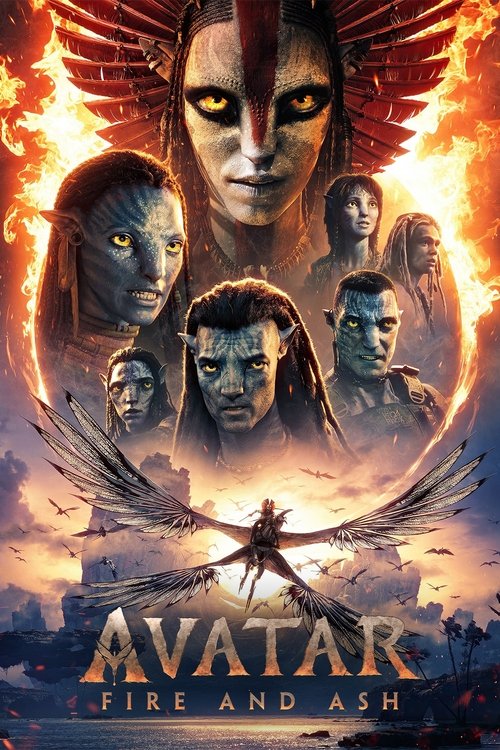
Avatar: Fire and Ash
2025 · James Cameron
Perpetually doubted, perpetually vindicated: Avatar: The Way of Water's $2.3B silenced "no cultural footprint" jokes without ever quite ending them. His pronouncements on AI, streaming, and running times are treated as oracle statements.
For when you want the biggest possible screen experience with real emotional stakes — a full-commitment epic night, not casual background viewing.
What it's about
The war against the human invaders is over, but it has cost Jake Sully and Neytiri terribly, and Pandora offers no peace: a new threat rises from a fire-scarred volcanic region in the form of the Ash People, a hardened Na'vi tribe led by the ruthless Varang. For the first time the saga's central conflict is Na'vi against Na'vi — a family carrying fresh grief into a fight against an enemy who shares their world but none of their beliefs.
The experience
Darker and more bruising than the earlier chapters — still overwhelming spectacle, but driven by grief and rage as much as wonder. It's a long, intense sit that pushes the family you've followed to their emotional limits.
Performances
Oona Chaplin's Varang gives the saga its first truly formidable Na'vi antagonist, played with a ferocity that cuts through the performance-capture.
The craft
Cameron continues to push performance capture, high-frame-rate photography, and stereoscopic 3D to the edge of what the industry can render, this time trading ocean blues for volcanic fire and ash. It is engineered for the largest, loudest presentation you can find, and the shift in palette gives the series a striking new visual identity.
Why it matters
As the third chapter of a projected five-film cycle, it pivots the saga from humans-versus-nature toward conflict within Pandora itself, deepening the franchise's world rather than repeating it.
Snapshot
Avatar: Fire and Ash is the third feature in James Cameron's projected five-film Pandora cycle, following Avatar (2009) and Avatar: The Way of Water (2022). Picking up in the aftermath of the war against the Resources Development Administration (RDA) and the death of the Sullys' eldest son, Neteyam, the film turns from the reef-and-ocean world of the second installment toward a fire-scarred, volcanic region of Pandora and introduces a new Na'vi antagonist: the Ash People, led by the fierce Varang (Oona Chaplin). Its central formal ambition, consistent with Cameron's practice, is technological — high-resolution stereoscopic 3D, high-frame-rate photography, and performance-capture animation executed at the outer edge of what the industry can render. Just as importantly, it marks a thematic pivot: where the first two films positioned the Na'vi collectively as the moral counterweight to human extractive violence, Fire and Ash complicates that binary by placing Na'vi in violent conflict with one another. Given the film's very recent release, portions of the critical and commercial record remain unsettled, and this dossier flags those gaps rather than filling them with speculation.
Industry & production
The film is a production of Cameron's Lightstorm Entertainment, distributed by 20th Century Studios under The Walt Disney Company, with visual effects by Wētā FX (formerly Weta Digital) in Wellington, New Zealand. Like its predecessor, it was shot and finished largely in New Zealand, where Lightstorm consolidated a long production pipeline built around virtual production and performance capture.
The defining industrial fact of the modern Avatar films is that Cameron shot the sequels concurrently. Principal performance-capture photography for The Way of Water and Fire and Ash was carried out back-to-back with the same core ensemble, a strategy meant to preserve continuity in the child actors' performances and to amortize the enormous cost of standing up the capture volume and effects pipeline across multiple pictures. This "shoot two, release sequentially" model means Fire and Ash was substantially performance-captured years before its release, with the long tail of the schedule devoted to effects rendering, editing, and finishing rather than live shooting — an inversion of the normal ratio of production to post that is characteristic of these films.
The budgets involved are widely understood to be among the largest in the industry, and the franchise's economics depend on premium-format exhibition (IMAX, large-format, and high-end 3D) to justify the spend. Because reliable final figures for this specific release are not yet part of the settled record, this dossier does not assign box-office numbers to it.
Technology
Technology is inseparable from authorship in the Avatar project; Cameron treats each film as an occasion to advance the tools of digital cinema. The sequels are built on performance capture rather than motion capture in the older sense — the intent is to record the totality of an actor's facial and bodily performance and transpose it onto a Na'vi character with as little interpretive loss as possible. For The Way of Water, Lightstorm and Wētā FX solved the long-standing problem of capturing performance underwater, developing systems to track actors submerged in a large tank while managing the optical distortion of the water's surface. Fire and Ash, moving to a volcanic and aerial environment, draws on that same capture infrastructure and on Wētā's facial pipeline, which has advanced from the original film's rig-based approach toward muscle- and anatomy-driven facial simulation intended to reproduce subtle expression with greater fidelity.
The films are also a sustained argument for high frame rate. Cameron has used variable frame rate in the sequels — presenting certain high-motion sequences at a higher rate (commonly described as 48 frames per second) while allowing quieter passages to read closer to the traditional 24 — as a way to reduce strobing and judder in stereoscopic 3D without imposing the "hyper-real" look of HFR across an entire film. Exhibition remains central to the design: the films are conceived for 3D and for large-format presentation, and their visual grammar assumes a viewer watching a bright, high-resolution stereo image rather than a compressed home stream.
Technique
Cinematography
Russell Carpenter, who shot the original Titanic (1997) and The Way of Water, returns as cinematographer, though the term must be understood in the hybrid sense the Avatar films demand. Much of the "photography" is virtual — camerawork authored inside a rendered environment via Cameron's virtual camera system, which lets him frame and move within the capture data as if operating a handheld rig on a physical set. Carpenter's role spans the lighting logic of the digital world and the photography of live-action human elements. Where The Way of Water organized its imagery around the refraction and buoyancy of the ocean, Fire and Ash shifts the palette toward fire, ash, and volcanic terrain, implying a harder, higher-contrast light and a different register of atmosphere. Specific stylistic descriptions here should be read against the film's own imagery rather than assumed from the earlier entries.
Editing
The Avatar sequels are edited by a team rather than a single cutter, reflecting the scale of the material; Cameron himself is deeply involved in the edit, as he has been throughout his career. The editorial challenge is distinctive: because the images are rendered over a long horizon, cutting proceeds across evolving levels of visual completion, from gray-shaded previsualization to final render. The films favor extended, immersive sequences — sustained set pieces that let the audience inhabit an environment — over rapid cutting, a rhythm suited to 3D, where too-fast editing fatigues the eye. Fire and Ash, running long in the manner of its predecessors, extends that preference for duration and spatial legibility.
Mise-en-scène / staging
World-building is the film's primary expressive mode. Each Avatar installment is organized around the introduction of a new Pandoran biome and a new Na'vi culture adapted to it: the forest Omaticaya of the first film, the reef-dwelling Metkayina of the second, and now the fire-associated Ash People (the Mangkwan) of the third. Staging is built to make these cultures legible through design — dwelling, ornament, ritual, and relationship to the local ecology — so that the environment itself carries narrative and thematic weight. The volcanic setting signals a departure from the lush, regenerative imagery that has defined Pandora on screen, aligning production design with the film's darker inflection.
Sound
Sound design in these films works to give physical presence to a wholly synthetic world, grounding rendered creatures and environments in tactile, spatialized audio. The franchise has consistently been engineered for immersive theatrical sound. Detailed technical particulars for this specific mix are not part of the settled record here and are left unstated rather than assumed.
Performance
The returning ensemble includes Sam Worthington (Jake Sully), Zoe Saldaña (Neytiri), Sigourney Weaver (now as the Na'vi child Kiri), Stephen Lang (the recombinant Quaritch), Kate Winslet (Ronal), and Jack Champion (Spider), among the Sully children. The signal casting addition is Oona Chaplin as Varang, leader of the Ash People, with David Thewlis also joining the ensemble in a Na'vi role. The performance question that has defined these films persists: whether fully digital characters, driven by captured human performance, can sustain dramatic intimacy at feature length. Saldaña's Neytiri in particular has been the franchise's proof of concept for capture-based acting as genuine performance rather than animation.
Narrative & dramatic mode
The film's dramatic mode is domestic melodrama scaled to epic spectacle — a family under threat, working through grief, set against planetary conflict. The Sullys' loss of Neteyam in The Way of Water supplies the emotional engine: Fire and Ash is a film about a family metabolizing bereavement while facing a new war. Cameron's storytelling remains classical and legible, built on clear stakes, parallel lines of jeopardy, and escalation toward large action climaxes. The introduction of an antagonistic Na'vi tribe adds a tragic dimension the earlier films largely avoided, positioning conflict not only between human and Na'vi but within Na'vi society, and thereby raising questions of faith, loss, and vengeance among the indigenous world itself.
Genre & cycle
Fire and Ash sits at the intersection of science fiction, fantasy, and adventure, and it belongs squarely to the twenty-first-century cycle of the tentpole franchise blockbuster — the mode of serialized, world-expanding, effects-driven event cinema. Within that cycle it is an outlier for being an original property rather than an adaptation, sustained by a single author's vision across more than a decade. It also extends the specific tradition of the eco-conscious science-fiction epic that the first Avatar helped define, and, in its planetary-adventure spectacle, descends from Cameron's own earlier work and from the lineage of large-scale fantasy filmmaking that The Lord of the Rings established as commercially viable at this budget tier.
Authorship & method
The film is unmistakably a James Cameron work, bearing the signatures of his career-long practice: technological pioneering as a precondition of storytelling, immersive world-building, strong-willed protagonists (frequently women and mothers), a suspicion of corporate and military extraction, and a fusion of sentiment with large-scale action. Cameron directs, co-writes, and co-produces, and the writing was developed with a room that has included Rick Jaffa, Amanda Silver, Josh Friedman, and Shane Salerno across the sequel project.
His key collaborators represent significant continuity. Russell Carpenter returns as cinematographer, extending a partnership that runs back to Titanic. The score is by Simon Franglen, who scored The Way of Water and who was closely associated with the late James Horner — composer of the original Avatar and a longtime Cameron collaborator whose death in 2015 makes Franglen's stewardship of the musical identity a matter of both continuation and succession. Editing is handled by Cameron's established sequel team. The through-line across these collaborators is a shared fluency in the hybrid virtual-production workflow, which requires the traditional craft roles to operate inside a digital pipeline rather than alongside it.
Movement / national cinema
The Avatar films do not belong to a national cinema in the conventional sense; they are a product of globalized Hollywood, financed and distributed by a major American studio. But they are materially anchored in New Zealand, whose screen sector — built up around Wētā and Peter Jackson's productions — supplies the visual-effects and virtual-production capacity the films depend on. In that sense the project is part of the emergence of Wellington as a global center of high-end digital effects, and it belongs to the broader "movement," if one can call it that, of digital-effects-driven cinema that has progressively dissolved the boundary between live-action and animation.
Era / period
Released in 2025, the film arrives in a period of acute uncertainty for theatrical exhibition, when the economics of the big-screen event film are under pressure from streaming and shifting audience habits. The Avatar franchise has been positioned — by Cameron explicitly — as an argument for the enduring value of the theatrical, premium-format experience. Fire and Ash thus functions as a period artifact of late-2020s Hollywood's wager that spectacle rendered at the technological frontier can still compel mass audiences into cinemas. It also lands amid intensifying industry debate over the role of computer-generated imagery and, increasingly, generative AI in filmmaking — a debate in which Cameron's labor-intensive, human-performance-driven capture method reads as a pointed alternative.
Themes
The film's thematic core continues the franchise's abiding concerns while darkening them. Family, and specifically parenthood under threat, remains the emotional foundation; grief and its aftermath give this installment its particular weight. Ecology and the sacredness of a living, interconnected world persist as Pandora's governing idea, expressed through the Na'vi bond with Eywa. What is new is the interrogation of the franchise's own moral scheme: by introducing a violent, power-seeking Na'vi tribe, the film pressures the earlier films' tendency toward an idealized indigeneity and asks whether the Na'vi world contains its own capacity for cruelty, faithlessness, and vengeance. Fire and ash, as title and setting, encode a movement from the second film's imagery of water and renewal toward destruction, loss, and hardened conflict — the elemental progression giving the cycle a mythic architecture.
Reception, canon & influence
Because Fire and Ash is a very recent release, its critical and commercial standing remains in formation, and any settled canonical judgment would be premature; this dossier therefore refrains from assigning specific review quotations or box-office totals it cannot ground.
Looking backward, the influences on the film are legible. It descends from Cameron's own body of work — the ecological and anti-corporate science fiction of Aliens and The Abyss, the family-under-siege melodrama and technological maximalism of Titanic — and from the deep tradition of planetary-romance and eco-fable that shaped the first Avatar, with its debts to frontier and colonial-encounter narratives that the film both invokes and attempts to critique. The introduction of a "dark" Na'vi tribe responds, in part, to a longstanding critique of the original Avatar's idealized, "noble" portrayal of its indigenous world, suggesting the franchise absorbing and answering its own reception.
Looking forward, the Avatar sequels' principal legacy is technological and industrial rather than stylistic. Their advances in performance capture, underwater capture, high-frame-rate stereoscopy, and virtual production have already propagated through the effects industry, and Fire and Ash extends that influence. As the third movement of a planned five-film arc, its narrative significance will ultimately be measured by how it sets up the concluding films — a legacy that, by design, cannot yet be assessed. What can be said with confidence is that the film reaffirms Cameron's singular position as a filmmaker who uses the largest commercial canvas in cinema to push its technical limits, and who continues to bet that audiences will follow him to Pandora.
A Deleuzian reading
Picture James Cameron on a stage in Wellington, holding what looks like a camera.
The full Deleuzian reading of Avatar: Fire and Ash →
Reception
Opened soft by Avatar standards — an $88M domestic debut under projections that fueled a fresh round of 'has Cameron's spell broken?' takes — then did the classic never-bet-against-Cameron thing: $1 billion in 18 days and five straight weekends at number one.
How Avatar: Fire and Ash was received, from release to now →
How to watch Avatar: Fire and Ash: what to notice on a first viewing
- Watch the camera move as if someone were holding it. Cameron frames inside rendered environments with his virtual camera, a rig with no lens that lets him walk through the capture data. Russell Carpenter handles the lighting logic and the human elements. The handheld feel was authored months after the acting, and it still reads as photography.
- Notice how the Ash People's design follows their volcanic country. Each film builds a new Pandoran biome and a Na'vi culture fitted to it. Dwelling, ornament, ritual and body design all come down from the ecology of the place they live in. You can read a people's relation to their land off their clothing and their houses.
- Notice how long each set piece runs before the cut. Stereoscopic 3D punishes fast cutting, because the eye needs time to resolve depth. The sequels favor extended immersive sequences and let you occupy a place before it turns dangerous. An ergonomic limit became the tempo of the whole franchise, and you feel it as room to look.
- Look at the harder, high-contrast light on volcanic terrain. The palette moves away from The Way of Water's refraction and buoyancy toward fire, ash and rock. The atmosphere reads drier and sharper than anything earlier in the cycle. The elemental shift is stated in the light before the story gets anywhere near it.
- Watch Saldana's face when Neytiri is not speaking. Weta's facial pipeline moved toward muscle and anatomy simulation, which buys a synthetic face the ability to hold an unspent feeling. Saldana has been the proof of that since 2009. The expense went into a close-up that can survive being looked at, not into the flying.
The whole guide to watching Avatar: Fire and Ash, with the keys for a rewatch →
Influences: the films it descends from and the films it influenced
- Aliens (1986) — Cameron's own template for fusing family-under-siege melodrama with a corporate/military-extraction critique, structured around a mother-protector whose arc is repeated in Neytiri's grief-and-vengeance line.
- The Abyss (1989) — ILM's morphing CG water pseudopod — the first photoreal CG character — established Cameron's working method of developing an effect specifically to enable a shot, and its underwater production rigs seeded the franchise's aquatic capture.
- Titanic (1997) — Begins the Russell Carpenter cinematography partnership that returns on Fire and Ash, and pioneers Cameron's digital crowd-replication and fluid simulation staged inside a catastrophe-melodrama structure.
- Avatar (2009) — Built the performance-capture-to-virtual-camera 'simulcam' pipeline that lets Cameron frame CG Pandora in real time, plus the native stereoscopic 3D that Fire and Ash directly extends.
- Avatar: The Way of Water (2022) — Solved underwater performance capture (defeating water-surface marker occlusion) and introduced selective high-frame-rate for motion, the immediate technical predecessor to Fire and Ash's workflow, with Simon Franglen inheriting Horner's musical identity.
- The Lord of the Rings: The Two Towers (2002) — Gollum proved Andy Serkis's full-body capture could drive a photoreal, emotionally legible CG character — the Weta Wellington technique Cameron scaled up to an entire Na'vi cast.
- King Kong (2005) — Extended Serkis capture to a giant non-human face and advanced Weta's muscle-and-skin simulation pipeline that the franchise's digital-effects house continues to rely on.
- 2001: A Space Odyssey (1968) — Bespoke front-projection and slit-scan built per-shot to serve immersion — the ethos of inventing tools to enable a vision, plus long awe-driven world-building takes, that underwrites Cameron's method.
- Jurassic Park (1993) — ILM and Stan Winston's photoreal CG creatures blended with animatronics set the credibility threshold that any fully synthetic Cameron world had to clear to read as physically present.
- The Polar Express (2004) — First feature built entirely on performance capture with a virtual-camera stage, proving out the full-mocap feature workflow that Cameron industrialized on Avatar.
- Rise of the Planet of the Apes (2011) — Pushed Avatar-era capture out of the volume into daylight, on-location performance capture, with Serkis and Weta advancing facial fidelity as a direct continuation of the Na'vi pipeline.
- Alita: Battle Angel (2019) — Cameron-produced and Weta-rendered application of Avatar's full-face capture to a new photoreal character, including the enlarged CG eyes driven by the same performance-capture toolset.
- The Lion King (2019) — Rebuilt photoreal CG environments as a navigable VR space shot with a virtual camera, a filmmaking-in-the-engine practice traceable to Cameron's simulcam and virtual art department.
- The Mandalorian (2019) — StageCraft's real-time LED-volume virtual production industrialized the in-camera, engine-rendered world-building that Avatar's virtual production pioneered.
- Gemini Man (2019) — A parallel high-frame-rate wager — 120fps stereoscopic 3D paired with a fully digital, capture-driven de-aged lead — betting, as Cameron does, that audiences accept HFR immersion.
- The Hobbit: An Unexpected Journey (2012) — The other major HFR theatrical gamble, releasing at 48fps to test whether audiences would embrace high-frame-rate projection, the same exhibition frontier Fire and Ash contests.
- Dune: Part Two (2024) — A contemporaneous large-format theatrical wager built on IMAX-scale imagery and an immersive theatrical sound mix, betting the same way Cameron does that spectacle draws audiences back to the big screen.
Similar films
- Avatar: The Way of Water (2022) — influence & lineage · same viewing thread
- Avatar (2009) — influence & lineage
- Aliens (1986) — influence & lineage
- Dune: Part Two (2024) — influence & lineage
- King Kong (2005) — influence & lineage
- Rise of the Planet of the Apes (2011) — influence & lineage
- Alita: Battle Angel (2019) — influence & lineage
- Jurassic World Rebirth (2025) — same viewing thread
All the films related to Avatar: Fire and Ash →
Watch it with: curated runs of related films
- Worlds Worth Getting Lost In — A run of maximalist, effects-driven pictures that each conjure a whole world from scratch — watch them when you want to be swept somewhere on the biggest screen you can find.