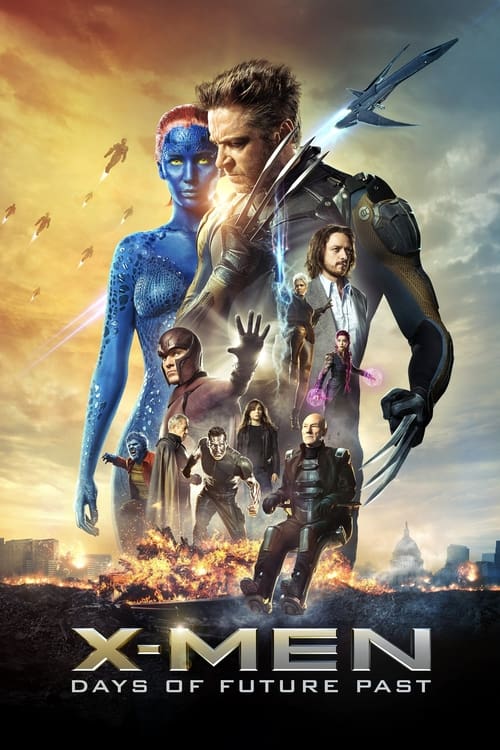
X-Men: Days of Future Past
2014 · Bryan Singer
For when you want a big, smart blockbuster night — stakes you can feel, a plot that trusts you to keep up, and a payoff that rewards anyone who's spent years with these characters. Comfort food with brains.
What it's about
In a ruined future where robotic Sentinels have all but wiped out mutantkind, the last surviving X-Men send Wolverine's mind back to 1973 to stop the single event that set the extinction in motion. He lands in a world of Nixon-era paranoia, where the young Charles Xavier is broken and hiding, Magneto is locked away, and Mystique is on a collision course with history. It's a rescue mission across fifty years, with both generations of X-Men fighting the same war.
The experience
It moves like a thriller with real dread underneath — the future scenes are grim and desperate, the 1970s scenes loose and paranoid, and one show-stopping slow-motion sequence delivers pure giddy delight. For all the spectacle, what keeps you leaning in is watching bitter, damaged people talked back toward hope.
Performances
James McAvoy is the standout as a strung-out, embittered young Xavier who has given up on his own gifts, playing grief and self-loathing inside a superhero movie; his scenes opposite Patrick Stewart and Michael Fassbender give the film its spine, while Hugh Jackman anchors it all with weary, wry authority.
The craft
Bryan Singer juggles two time periods and a dozen leads without dropping the thread, grounding the 1973 half in grainy period texture, news footage and analog paranoia. The Quicksilver kitchen sequence — a prison break rendered in extreme slow motion to a pop song — became an instant reference point for how to visualize super-speed. Big screen and good speakers earn their keep in the Sentinel battles, which have real weight and menace.
Why it matters
It pulled off one of the boldest franchise repairs in blockbuster history, uniting two casts and untangling a decade of continuity, and stood as the critical high-water mark of the X-Men series. Its time-travel reset became a template other long-running franchises would study.
Snapshot
X-Men: Days of Future Past is the seventh film in Fox's X-Men franchise and the most ambitious act of narrative repair in the series' history: a time-travel epic engineered to fuse the original cast of Bryan Singer's foundational X-Men (2000) and X2 (2003) with the 1960s-set younger ensemble introduced by Matthew Vaughn's X-Men: First Class (2011). Adapted loosely from a celebrated 1981 Chris Claremont and John Byrne comic arc, the film sends Wolverine's consciousness back to 1973 to avert a dystopian future in which mutant-hunting Sentinel robots have exterminated mutants and their human sympathizers. It marked Singer's return to the franchise he launched after a decade away, and it functioned strategically as both a crowd-pleasing reunion and a soft reset that dissolved the continuity knots accumulated across earlier sequels and spinoffs. Commercially it was among the highest-grossing entries in the series; critically it was received as a return to form, restoring narrative weight and thematic seriousness to a franchise many felt had drifted after 2006's The Last Stand.
Industry & production
By the early 2010s the X-Men franchise was Fox's most valuable superhero property, but a fragmented one. X-Men: The Last Stand (2006, dir. Brett Ratner) and X-Men Origins: Wolverine (2009) had bruised the brand's prestige, while First Class successfully rebooted the timeline with a younger cast without formally severing the old films. Days of Future Past was conceived as the connective tissue that could reconcile these strands and reset the board. Simon Kinberg, who had co-written The Last Stand, shaped the story and screenplay, with Jane Goldman and Matthew Vaughn credited on the story; Vaughn had been attached to direct before departing, at which point Singer returned to the director's chair.
The production united two generations of stars: Hugh Jackman as Wolverine, alongside Patrick Stewart and Ian McKellen as the older Xavier and Magneto, and James McAvoy, Michael Fassbender, Jennifer Lawrence, and Nicholas Hoult as their younger counterparts, with Lawrence's post-Hunger Games stardom raising the ensemble's profile considerably. Shot largely in Montreal, the film carried one of the largest budgets in the series to that point, reflecting Fox's confidence and the logistical scale of dual-era production design and heavy visual-effects work.
The production was shadowed by a lawsuit filed against Singer in the spring of 2014 alleging sexual misconduct, which surfaced during the promotional cycle; Singer denied the allegations. The controversy affected his public participation in the campaign and is part of the honest record of the film's release context, though it did not derail the theatrical rollout. A longer cut, X-Men: Days of Future Past — The Rogue Cut, was released the following year, restoring a subplot involving Anna Paquin's Rogue that had been trimmed from the theatrical version.
Technology
The film is a showcase for the visual-effects maturity of the early-2010s blockbuster. Two categories of digital work dominate. The first is the Sentinels: the future-set robots were realized as fully digital creatures with adaptive, mutating armor surfaces, their design leaning toward a fluid, metallic menace rather than the boxy purple giants of the comics. The second, and more celebrated, is the "Quicksilver kitchen" sequence, in which the speedster played by Evan Peters disarms guards in a Pentagon kitchen. Achieved with extreme high-speed photography — reportedly using cameras capable of shooting several thousand frames per second — the shot renders time nearly frozen from Quicksilver's perspective, allowing him to reposition bullets, fists, and bodies to a pop soundtrack. It became the film's most discussed set piece and a widely cited example of using frame rate itself as a storytelling device.
The film was released in 3D, with post-conversion and native effects work supporting the format, and its dual-timeline structure demanded extensive digital environment work to distinguish the sun-bleached 1973 sequences from the ashen, war-torn future. As with most claims about specific frame counts or vendor breakdowns, precise technical figures vary across sources and should be treated as approximate rather than definitive.
Technique
Cinematography
Newton Thomas Sigel, Singer's longtime collaborator dating to The Usual Suspects and the first two X-Men films, shot Days of Future Past, and his return is central to the film's sense of restored authorship. Sigel differentiates the two timelines through palette and light: the future is rendered in cold, desaturated grays and blues, a landscape of ruin and refugee shadow, while 1973 carries warmer, period-inflected tones. His camera favors clean, classical coverage in the dialogue-driven Xavier–Magneto confrontations and more kinetic handling in the action, but the compositional instinct throughout is toward legibility and character — a deliberate corrective to the choppier style of some intervening franchise entries.
Editing
John Ottman served as both editor and composer, an unusual dual role he had held on earlier Singer films, giving him rare control over the interplay of cut and score. The editorial challenge was structural: the narrative crosscuts between the collapsing future and the 1973 mission, building toward a climax that intercuts a Sentinel siege on the future X-Men's refuge with Mystique's decision at a public event in the past. Ottman's cutting sustains suspense across the two eras by tightening the parallel as the stakes converge. The Quicksilver sequence is itself an editorial and temporal set piece, its rhythm — real-time chaos suddenly suspended into languid slow motion — dependent on precise control of pace.
Mise-en-scène / staging
Production design cleanly separates the film's worlds: a meticulously reconstructed 1973 of wood-paneled interiors, period Washington, and a Paris peace-conference setting, against the brutalist, ash-choked future sanctuary. Bolivar Trask's laboratory and the early Sentinel prototypes anchor the period's Cold War-era technological anxiety. Staging in the Xavier–Magneto scenes is intimate and theatrical, trusting the actors; the large-scale set pieces — the airborne stadium relocation, the White House lawn climax — are staged for spectacle but keep character choice at their center.
Sound
Ottman's score reprises and reworks his themes from the original films, providing a musical bridge between the timelines that reinforces the narrative's project of reconciliation. The Quicksilver sequence pointedly scores its high-speed action to a period pop needle-drop, using diegetic-feeling music against suspended time for comic and kinetic effect. Sound design contrasts the mechanical, adaptive whir of the Sentinels with the grounded textures of 1973.
Performance
The film is a showcase for its actors as much as its effects. McAvoy carries the emotional arc as a broken, drug-dependent young Xavier who has lost his powers and his faith, and his scenes opposite Fassbender's magnetic, unrepentant Magneto give the film its dramatic spine. The much-noted meeting between old and young Xavier — Stewart and McAvoy — allows the film a moment of direct generational dialogue. Jackman anchors the connective role as Wolverine, functioning as audience surrogate and mentor. Lawrence's Mystique is positioned as the narrative's pivot, the figure whose single choice determines both futures, and her performance shoulders the film's moral weight.
Narrative & dramatic mode
Structurally the film is a race-against-time thriller layered over an ensemble melodrama. The time-travel premise — one consciousness sent back to alter a decision, with the future dying in real time as leverage — creates a ticking-clock urgency familiar from the Terminator tradition, while the emotional core is a redemption drama about a young man recovering his purpose. The dramatic mode oscillates between operatic confrontation and comic relief (Quicksilver), but its governing logic is causal and moral: history turns on individual choice, and the film insists that fate is not fixed. This optimism distinguishes it from bleaker time-travel dystopias; the dystopia exists precisely to be undone.
Genre & cycle
Days of Future Past sits at the intersection of the superhero team film, the science-fiction time-travel narrative, and the period drama. It arrived at a pivotal moment in the superhero cycle: Marvel Studios' shared universe was ascendant, and Fox's X-Men films represented an older, more auteur-driven, less centrally coordinated model of franchise filmmaking. The film's strategy — a large-scale crossover event uniting casts and timelines — can be read as Fox's answer to the connected-universe logic Marvel had popularized, achieved not through parallel solo films but through time travel. It also belongs to a smaller tradition of dystopian-future science fiction that treats robots and technological overreach as existential threat, drawing lineage from The Terminator and Cold War machine-anxiety narratives.
Authorship & method
The film is most productively understood as Bryan Singer's reclamation of a franchise he originated. Singer's authorial signature across the X-Men films is a treatment of mutation as allegory for marginalized identity, a preference for character and moral seriousness over pure spectacle, and a house style built with recurring collaborators. Days of Future Past reassembles that core team: cinematographer Newton Thomas Sigel and editor-composer John Ottman, both essential to the texture of the first two films. Simon Kinberg emerged here as the franchise's principal architect and creative steward, a role he would extend across subsequent entries. The Vaughn–Goldman story credit acknowledges the First Class lineage the film builds upon. The result is a rare case of a blockbuster whose "method" is explicitly restorative — assembling the personnel and sensibility of an earlier, well-regarded chapter to heal what came between.
Movement / national cinema
As a Hollywood studio tentpole produced by Twentieth Century Fox, the film belongs to no art-cinema movement; its idiom is mainstream American blockbuster filmmaking. It is worth noting, however, the transnational character of its making: principal photography was based in Montreal, part of the well-established pattern of major American productions using Canadian locations and infrastructure, and its cast is markedly Anglo-Australian-American, with British actors (McAvoy, Fassbender, McKellen, Stewart, Hoult) prominent alongside Jackman. The film is thus a product of globalized Hollywood production rather than any national cinema in the cultural sense.
Era / period
Released in 2014, the film sits at a high point of superhero-cinema dominance, when the form had become the central engine of Hollywood's blockbuster economy. It reflects the era's characteristic strategies: franchise interconnection, nostalgia mobilized as narrative structure, and the reboot-via-continuity-repair maneuver that would recur across the decade. Its 1973 setting also engages a period-film nostalgia — Nixon-era Washington, the Paris peace talks, Cold War technological dread — using the past as both aesthetic and thematic material. The film's optimism about changing a predetermined fate can be read against an early-2010s appetite for franchise renewal after a period of perceived decline.
Themes
The franchise's foundational theme — mutation as metaphor for otherness, prejudice, and the politics of difference — is here refracted through questions of fate, choice, and historical responsibility. Central is the tension between determinism and agency: whether the future is fixed or can be remade through individual moral decision, dramatized in Mystique's pivotal choice and Xavier's recovery of hope. Coexistence versus extinction structures the mutant-human conflict, with the Sentinels embodying institutional fear weaponized into genocide — an allegory the series has long read against histories of persecution. Xavier's arc adds a theme of despair and its overcoming, of leadership as the choice to believe in others. And the film meditates, self-reflexively, on legacy and repair: the literal rewriting of the past mirrors the production's own project of mending its narrative history.
Reception, canon & influence
Critically, Days of Future Past was widely received as a return to form and is generally counted among the strongest entries in the X-Men series, praised for its ambition, its balancing of a large ensemble, and the seriousness of its central performances, with the Quicksilver kitchen sequence singled out almost universally as a standout. Some critics noted the familiar franchise difficulty of servicing too many characters and the convolutions inherent in time-travel plotting, but the consensus was strongly positive. Commercially it performed among the best in the series; exact figures vary by source and should be checked against box-office records rather than cited from memory.
Looking backward, the film's influences are clear and acknowledged: the Claremont-Byrne comic arc that gave it its title and dystopian premise; the Terminator lineage of time-travel-to-prevent-a-machine-apocalypse; and, within the franchise, the tonal and continuity foundations of Singer's original films and Vaughn's First Class.
Looking forward, its legacy is twofold. Narratively, its continuity reset licensed the subsequent films — X-Men: Apocalypse (2016) and Dark Phoenix (2019) — to proceed with the younger cast in a cleaned-up timeline, and it cemented Simon Kinberg's stewardship of the series through its remaining Fox-era run. Culturally, the Quicksilver sequence became a genuinely influential set piece, frequently imitated and referenced as a benchmark for depicting super-speed on screen; the character's second showcase in Apocalypse was a direct response to its popularity. More broadly, the film stands as a prominent example of the "continuity-repair crossover" as a franchise-management tool — a template of mobilizing time travel or multiverse logic to reconcile divergent installments that would become increasingly common in superhero cinema over the following decade.
A Deleuzian reading
A kid walks through a Pentagon kitchen.
The full Deleuzian reading of X-Men: Days of Future Past →
Reception
A triumph in 2014 — hailed as the franchise's return to form after years of wobbly spin-offs, and Fox's biggest X-Men hit to that point. It's still ranked near the top of the series, but rewatches now come shadowed by Bryan Singer's fall from grace, and fans tend to credit the ensemble rather than the director.
How X-Men: Days of Future Past was received, from release to now →
How to watch X-Men: Days of Future Past: what to notice on a first viewing
- Notice the color change every time the film switches era. Newton Thomas Sigel shoots the future in cold desaturated grays and blues, all ash and shadow. The 1973 material runs warm, with period browns and wood. You always know where you are. One glance at the palette places you in time, which lets the film cut between eras without explaining itself.
- Watch the kitchen scene where the bullets hang still. The cameras reportedly ran at several thousand frames a second. Quicksilver strolls through suspended chaos, moving a fist here and a trajectory there, while a period pop record plays at normal speed. Every ordinary moment becomes a composed pose, and he gets to arrange them by hand before time restarts.
- Watch what the Sentinels do when a mutant attacks them. Their armor reads the power used against them and becomes it. Whatever you throw comes back at you. The future X-Men spend their scenes holding a room rather than winning anything. You cannot fight a thing that turns into your own strength, so the future half is people with nothing to do.
- Notice how plain the camera gets in the talking scenes. Sigel shoots the Xavier and Magneto confrontations with clean classical coverage: faces, eyelines, no restlessness. The action gets more movement, but legibility comes first everywhere in the film. The style steps back so the actors carry the scenes, which is why the quiet confrontations hold against the spectacle.
- Watch McAvoy play a telepath who will not listen. Xavier in 1973 is on a drug that gives him his legs and takes his powers. McAvoy plays him closed, angry and tired. Fassbender stays certain, which makes the contrast do the work. The film's problem is a man who cut down his own perception to survive it, and has to be made to look again.
The whole guide to watching X-Men: Days of Future Past, with the keys for a rewatch →
Influences: the films it descends from and the films it influenced
- La Jetée (1962) — Originates the mental-time-travel repair device the film runs on: a consciousness projected backward into a past body to alter a catastrophe that has already devastated the future, rather than physical machine travel.
- The Terminator (1984) — The template DoFP explicitly borrows — dispatching a protector back through time to stop a machine-led apocalypse (the Sentinel war echoing Skynet), anchored to a single mutable pivot event.
- Terminator 2: Judgment Day (1991) — The Sentinels' power to scan, analyze, and adaptively counter any mutant ability is a direct descendant of the T-1000's morphing-threat design, and 'the future is not set' supplies the determinism-vs-agency spine.
- 12 Monkeys (1995) — Crosscuts a grimy, depopulated dystopian future against a period-textured past, sending an emissary's mind back to a decisive moment — the exact temporal-palette split and structure Sigel reprises.
- The Matrix (1999) — Establishes the visual grammar of the Quicksilver sequence: rendering superhuman speed by freezing the world into navigable, camera-mobile stillness via high-speed photography, so the fast character moves through motionless time.
- X-Men (2000) — Singer's founding house style DoFP restores — mutation as marginalized-identity allegory, restrained blockbuster gravity over spectacle, and the Sigel/Ottman texture the sequel reassembles.
- X2: X-Men United (2003) — Model for the large-ensemble balancing act and Sigel's cool desaturated palette; its cold-blue institutional lighting is quoted in DoFP's future-timeline scenes.
- X-Men: First Class (2011) — Supplies the younger cast, the period-set 1960s-70s production design, and the Xavier/Magneto fracture DoFP builds on directly — Vaughn and Goldman carry a story credit for that continuity.
- Watchmen (2009) — Codifies the superhero slow-motion set piece scored to a period needle-drop, using speed-ramping to lyricize action — the aesthetic playbook behind Quicksilver's kitchen scene cut to 'Time in a Bottle.'
- Star Trek (2009) — Applies the Trek 2009 alternate-timeline mechanism as a franchise-reset tool — time travel used not for adventure but to dissolve prior continuity and grant narrative autonomy, extending the industrial logic Abrams introduced as a licensing strategy into the superhero genre.
- Back to the Future Part II (1989) — Uses an alternate-timeline reset to retcon and re-thread a franchise's continuity, normalizing exactly the branching-continuity storytelling Part II proved a blockbuster audience would follow.
- X-Men: Apocalypse (2016) — Directly extends the craft: its expanded mansion-rescue Quicksilver sequence is a bigger-budget, longer sequel to DoFP's kitchen scene, reusing the high-frame-rate frozen-world POV as an escalated encore.
- Logan (2017) — Proceeds within the cleaned-up timeline DoFP's continuity reset licensed, inheriting the franchise's permission to move the aged characters into a divergent, unburdened future.
- Dark Phoenix (2019) — The direct continuity heir of DoFP's reset, made by the architect (Kinberg) whose franchise stewardship the film cemented, extending the young-cast timeline it cleared.
- Avengers: Endgame (2019) — Scales up the 'continuity-repair crossover' DoFP prototyped — mobilizing time travel across a franchise's installments to revisit prior films' set pieces and reconcile a fractured saga into one corrective timeline.
- Spider-Man: No Way Home (2021) — Extends DoFP's franchise-management method — using cross-timeline logic to reassemble legacy actors from divergent prior series and heal continuity across separate installments.
- The Flash (2023) — Fuses DoFP's two signatures — a speedster altering a fixed catastrophe by running through frozen time, deployed as an explicit multiverse continuity-repair reset of a divided franchise.
- Deadpool & Wolverine (2024) — The endpoint of DoFP's continuity-repair-as-franchise-tool lineage, weaponizing multiverse/timeline logic to resurrect and reconcile the entire Fox-era X-Men roster it once reset.
- Guardians of the Galaxy (2014) — Same-year peak of the diegetic period-pop needle-drop as emotional-comic scoring device, letting a curated older track carry a blockbuster action-and-character beat exactly as DoFP does with Croce.
- Avengers: Age of Ultron (2015) — A rival same-character depiction of super-speed VFX arriving one year later, responding to the identical technical problem of visualizing a speedster's subjective time within a team film.
Similar films
- Logan (2017) — influence & lineage
- Deadpool & Wolverine (2024) — influence & lineage
- Spider-Man: No Way Home (2021) — influence & lineage
- Avengers: Endgame (2019) — influence & lineage
- Terminator 2: Judgment Day (1991) — influence & lineage
- Avengers: Age of Ultron (2015) — influence & lineage
- The Fantastic 4: First Steps (2025) — shared sensibility
- The Avengers (2012) — shared sensibility
All the films related to X-Men: Days of Future Past →
Watch it with: curated runs of related films
- The Set-Piece Machine — A run of hard-charging, forward-driving action cinema — watch these back-to-back when you want mission-structured, physical-stakes spectacle built by people who know exactly how to escalate.