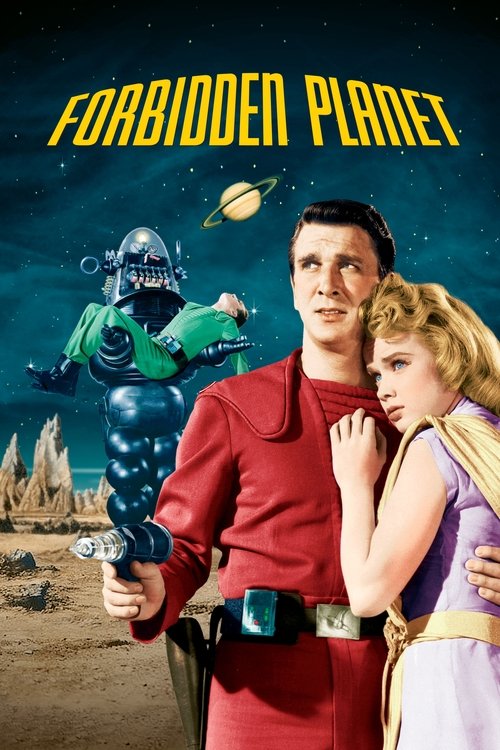
Forbidden Planet
1956 · Fred M. Wilcox
For a night when you want classic-era spectacle with a brain — retro-futurist eye candy that turns into a genuinely unsettling puzzle. Comfort viewing on the surface, with a chill underneath.
What it's about
A starship crew arrives on a distant planet to learn what became of an expedition that vanished twenty years earlier — and finds only two survivors: a brilliant, secretive scientist and his daughter, who has never met another human being. Their household is run by Robby, a courtly robot who can synthesize anything on request, and beneath it lies the buried machinery of a vanished alien civilization. The scientist wants the rescuers gone; the captain refuses to leave, and something invisible on the planet starts killing.
The experience
It plays like a stately, gorgeously colored adventure that keeps darkening into dread — half wonder-tour of an alien world, half locked-room mystery where the room is a planet. The eeriness sneaks up on you, and the ideas underneath the monster stick around after the lights come up.
Performances
Walter Pidgeon gives Morbius real gravity and wounded pride — a scientist whose courtliness barely covers something haunted — and a young Leslie Nielsen, decades before comedy claimed him, plays the commander completely straight.
The craft
This was a major studio throwing its full resources at science fiction for once: widescreen color, vast matte-painted vistas, and the astonishing subterranean alien machinery, rendered at a scale movies had never given the genre. The all-electronic score of throbs, burbles, and shrieks — no orchestra at all — was unprecedented and still sounds alien. It rewards the biggest screen and best speakers you can find.
Why it matters
It lifted American science fiction out of the B-picture ghetto and set the template for the thinking-person's space adventure — the starship crew, the captain, the impossibly advanced lost civilization — that television and film drew on for decades, while Robby the Robot became a pop-culture icon in his own right.
Snapshot
Forbidden Planet is the film in which American science fiction stopped being a B-picture proposition and was handed, briefly and almost accidentally, the full resources of the largest studio in Hollywood. United Planets Cruiser C-57D reaches Altair IV after a year of faster-than-light travel, looking for the Bellerophon expedition, missing twenty years. It finds two survivors — the philologist Dr. Edward Morbius (Walter Pidgeon), his daughter Altaira (Anne Francis), who has never seen another human being besides her father — and a household robot, Robby, who cooks, sews, distills bourbon by the gallon and cannot harm a rational being. Morbius wants the ship gone. Commander J.J. Adams (Leslie Nielsen) will not go. Beneath the house lies the buried machinery of the Krell, a civilization that reached the summit of instrumental reason and was annihilated in a single night by the thing its own perfected technology set free.
The picture is at once the most opulent object of the 1950s science-fiction cycle and its strangest: a CinemaScope color spectacular with no Earth in it, no invaders, no atomic mutation, and a third act that resolves into a Freudian diagnosis delivered as a shout. It is also a genuine hybrid — pulp adventure, Shakespearean chamber drama, psychoanalytic parable, frontier Western with a naval crew — held together by an art department at the peak of its powers and a musical score made by two people in a Greenwich Village apartment out of circuits they built to burn out.
Industry & production
MGM in 1956 was a studio in the last confident years of its own system: Dore Schary running production, Cedric Gibbons still nominally supervising the art department he had run since 1924, a standing effects unit under A. Arnold "Buddy" Gillespie, and a corporate need to offer audiences something television could not. Widescreen and color were the industry's answer to the small monochrome box, and Forbidden Planet is a widescreen argument in almost pure form — a film whose commercial logic depends on the frame being enormous.
What makes it anomalous is the genre. Science fiction in 1956 was Republic serials, independent quickies, and one or two well-funded outliers; the prestige studios largely stayed clear. Forbidden Planet came from a story by Irving Block and Allen Adler, developed into a screenplay by Cyril Hume, a veteran MGM contract writer whose credits ran back through the studio's Tarzan pictures. Producer Nicholas Nayfack shepherded it, and what began as a comparatively modest project escalated into an A-budget production as the demands of the design became clear. Specific negative-cost figures circulate in the literature and are not consistent with one another; what is not in dispute is that the film cost several times what the genre normally commanded, chiefly because every square foot of Altair IV had to be manufactured — there is no location photography in it, and no stock footage doing structural work.
The commercial outcome was respectable rather than triumphant. The film did not launch a studio science-fiction division, and MGM did not repeat the experiment at that scale. Its canonization was retrospective: it accrued authority through reissue, television, and the testimony of the filmmakers it shaped, and was selected for the National Film Registry in 2013. Its single Academy Award nomination, for special effects, lost to The Ten Commandments.
Technology
Technology is the film's subject and its production problem simultaneously, and the two feed each other.
The Krell laboratory sequence — a shaft descending into a cube of machinery twenty miles on a side, self-maintaining for two hundred millennia — is achieved with forced perspective, glass and matte painting, miniature construction, and optical composites executed by Gillespie's unit with Warren Newcombe and Irving Ries. The camera moves along a gantry over an apparent abyss that is a painting; the ranks of gauges recede into a depth that does not exist. It is the most sustained illusion of vast interior scale in a 1950s American film, and it works because the effects are integrated into architecture rather than pasted onto it.
The Id monster is the film's technical landmark. Walt Disney Productions loaned the animator Joshua Meador to MGM, and the creature is hand-drawn cel animation composited into live-action CinemaScope plates — a roaring, red-lit, leonine outline that exists only where the crew's blaster fire and force-field cage make it visible. Rotoscoping and traveling mattes were not new; what is new is the conceptual use, an antagonist defined by the fact that it must be illuminated by the very weapons deployed against it. The animation's stylized, almost cartoon plasticity, often noted as a mismatch, is arguably the correct register: the thing is a projection, and it looks projected.
Robby the Robot, designed principally by Robert Kinoshita within the art and effects departments, is the era's great piece of production hardware — a transparent-domed figure whose spinning gyros and firing solenoids are deliberately visible, so that the audience watches a machine think. He was expensive enough that his cost became studio lore, repeated in the literature with a confidence the surviving accounting does not really support. He was also durable: MGM put him to work again in The Invisible Boy (1957) and rented him out for decades of television.
Technique
Cinematography
George J. Folsey, an MGM cameraman since the silent era with Meet Me in St. Louis, Adam's Rib and Seven Brides for Seven Brothers behind him, photographed the film in Eastmancolor CinemaScope. The approach is emphatically not naturalistic. Altair IV is lit as a stage: a green-tinged sky, two moons, painted mesas, hard colored keys on faces, and a total absence of atmospheric haze. Folsey shoots the planet the way MGM shot its musicals — as a designed space, luminous and closed.
The compositions exploit the anamorphic frame's real strength, which is lateral organization rather than depth. Crew members are arrayed across the width of the C-57D's circular bridge; Morbius's house presents itself as a horizontal band of Krell-derived curves; the shaft sequence turns the wide frame ninety degrees against itself, using vertical vertigo inside a horizontal format. Camera movement is sparing and processional, more often a slow track into a revelation than a shot that follows a body.
Editing
Ferris Webster's cutting is classical and unhurried, and it is where the film's pulp origins are most visible. Sequences are built in clean master-and-coverage patterns, with reaction shots doing the exposition; the film is content to hold on Pidgeon explaining the Krell for minutes at a stretch. Tension is generated by withholding rather than by rhythm — the invisible intruder in the ship, the footprints in the dust, the sabotage discovered after the fact.
The exception is the siege sequence, where Webster accelerates into a rapid alternation of blaster fire, animated outline, force field and screaming faces, and the assembly briefly acquires a modern violence. The film's most economical cut is also its most famous formal gesture: Doc Ostrow's dying line naming the "monsters from the id," dropped into a silence the picture does not immediately fill.
Mise-en-scène / staging
The design, credited to Cedric Gibbons and Arthur Lonergan among Gibbons's final films, is the film's authorial center. Three distinct architectural languages are kept rigorously apart. The C-57D is functional modernism — circular, instrumented, military, its crew of eighteen men arranged in naval hierarchy. Morbius's house is mid-century domestic luxury with Krell curves grafted on: sunken living room, sliding shutters, a study that opens onto an alien technology the way a den opens onto a garage. The Krell interiors are pure abstraction, all triangular apertures and endless repetition, scaled to bodies whose shape the film never shows.
Staging works this hierarchy relentlessly. Morbius commands his own space and is diminished the moment he enters the ship's. Altaira is repeatedly framed in gardens and pools, surrounded by tamed animals, staged as a possession. The crew move in disciplined formations that dissolve into scattering bodies once the Id arrives. And the film's most quietly disturbing staging is domestic: the father, the daughter, the servant machine, arranged in a living room, with an engine of unlimited power humming under the floor.
Sound
Louis and Bebe Barron produced the entire soundtrack — score and much of the sound design alike — using circuits Louis built following the cybernetic principles of Norbert Wiener, driving them to overload, recording the results, and then editing and processing the tape into finished cues. The circuits were destroyed in the process; the sounds were, in a sense, recordings of small deaths. It is the first feature film with a wholly electronic score, and it arrived from the New York avant-garde rather than from Hollywood: the Barrons had worked in experimental film and in the circle around John Cage's tape experiments before MGM engaged them.
The credit reads "Electronic Tonalities," not music, and the standard account attributes this to the American Federation of Musicians — the Barrons were not members, and the studio avoided terminology that would have triggered union jurisdiction. The same anomaly is generally held to have kept the work out of Academy Award consideration.
Its aesthetic consequence is that Forbidden Planet has no reassuring musical commentary. There is no theme, no leitmotif in the Steiner sense, and frequently no boundary between score and effect: the ship's landing, the invisible creature's approach, and the emotional temperature of a scene are all rendered in the same shrieking, bubbling, warbling material. The audience cannot tell what is being heard and what is being felt, which is precisely the film's argument about the id.
Performance
Walter Pidgeon plays Morbius in the register of a distinguished MGM leading man gone slightly cold — courteous, pedantic, condescending, and utterly certain. The performance's achievement is that his monstrousness is never played; Pidgeon gives us a proud man giving a lecture, and lets the film supply the horror underneath. The final reversal works because he has kept the character sympathetic to the last possible moment.
Leslie Nielsen, in a rare early leading role as a straight dramatic hero, plays Adams as a stiff, jawline-forward naval officer, a reading later audiences find difficult to see uncoloured by his subsequent comic career. Anne Francis has the film's most thankless assignment: Altaira must be innocent enough to be plausible and knowing enough to be a romantic lead, and the scenes in which crew members instruct her in kissing sit poorly now — the wardrobe, short and playful by 1956 standards, was itself a point of comment on release. Warren Stevens gives Doc Ostrow a dry, intelligent skepticism that makes his death land, and Earl Holliman's comic Cook, negotiating with Robby over bourbon, supplies the studio-mandated relief. Marvin Miller's voice work for Robby — measured, courteous, faintly amused — did as much to establish the modern screen robot as the costume did.
Narrative & dramatic mode
Structurally this is a mystery in the classical mold, dressed as an expedition: arrival, warning, refusal, escalating violence, investigation, revelation, sacrifice. The dramatic mode is expository to an unusual degree — long passages of the film consist of a learned man explaining a vanished civilization to visitors — and the picture accepts the risk, betting that the ideas will hold the room. Mostly they do, because each explanation deepens the mystery instead of dissolving it.
The Shakespearean armature is unmistakable: Morbius as Prospero, Altaira as Miranda, Robby as Ariel, the Id as Caliban, the shipwrecked visitors as the intruding court, the magic renounced at the end with the island destroyed behind it. How deliberate this was at the story stage is genuinely disputed in the literature, and the honest position is that Hume's screenplay makes the parallel structural whether or not Block and Adler began there. The ship, meanwhile, is named for Bellerophon, the hero who rode Pegasus toward Olympus and fell — a hubris myth planted in the first reel and paid off in the last.
The revelation itself is a piece of narrative engineering of real elegance. The monster is not an alien; it is not a malfunction; it is the plot's own protagonist, and it has been generated every night by the sleeping mind of the man explaining it.
Genre & cycle
The 1950s American science-fiction cycle divides roughly into invasion pictures (The Thing from Another World, Invasion of the Body Snatchers, released the same year), atomic-mutation pictures (Them!), and the smaller strand of sober extrapolative space films descending from Destination Moon (1950). Forbidden Planet belongs to the third and dwarfs it. Universal's This Island Earth (1955) had shown that color and interplanetary scope were possible at scale; MGM's film went further by abandoning Earth entirely — no launch, no government briefing, no scientists at blackboards — and treating faster-than-light travel, an established interstellar polity and a routine military survey mission as unremarkable givens.
That casual worldbuilding is the film's deepest debt to written science fiction. The idiom is Astounding-era pulp — competent men, hard hardware, a puzzle with a scientific solution, a vanished elder race — imported into a studio that had never made such a picture. Its refusal of the cycle's usual paranoia is equally notable: the danger is not the alien Other but the human interior.
Authorship & method
Fred M. Wilcox is the least assertive name in this dossier's credits, and honestly so. An MGM contract director best known for Lassie Come Home (1943) and The Secret Garden (1949), he had no genre background, made few films afterward, and died in 1964 without a body of work that reframes this one. Auteurist criticism has never made a persuasive case for him, and the record does not support inventing one.
Forbidden Planet is instead the clearest available demonstration of studio-system authorship distributed across departments. Its makers are Gibbons and Lonergan's art department; Kinoshita's robot; Gillespie's effects unit with Meador on loan from Disney; Folsey's camera; Webster's cutting; Hume's screenplay, working from Block and Adler; the Barrons' circuits; and Nayfack's producorial willingness to let the budget follow the design. The method is the MGM method — build everything, control everything, shoot it on a stage — applied for once to material the studio had no template for. What looks like a directorial vision is a house style meeting an alien subject and discovering it fits.
Movement / national cinema
The film belongs to no movement. It is Hollywood at its most industrially self-sufficient, made under the widescreen imperative that followed the antitrust decrees and the collapse of the theatrical monopoly. Its one interesting cross-current is institutional: Disney's animation unit and MGM's effects department collaborating, and a pair of New York experimental composers hired onto a Culver City soundstage picture. The most avant-garde soundtrack in American cinema to that date was commissioned by the most conservative studio in Hollywood, which says something durable about how modernism entered mass culture — through the effects budget and the credit-line loophole.
Era / period
1956 is a peak year of Cold War domesticity: Eisenhower's second campaign, suburban expansion, the H-bomb tests of the preceding two years still fresh, and Freud thoroughly naturalized in American middle-class conversation through psychoanalysis's postwar vogue. Forbidden Planet metabolizes all of it. The Krell — who eliminated instrumentality itself, achieved the power to make thought into matter, and were destroyed by their own species-wide unconscious in one night — are an atomic parable so exact it barely needs decoding, and the film's closing warning that humanity is "not God" is spoken over a planet detonated at a safe distance and watched on a viewscreen.
The psychoanalytic frame is equally of its moment: the id as a real thing with a location, the father's repressed desire as the engine of catastrophe, the ship's doctor available to deliver the diagnosis. Few films state the era's two governing anxieties — the bomb and the unconscious — as a single mechanism.
Themes
The organizing theme is that power without self-knowledge destroys its holder. The Krell's fatal error was not building the great machine but forgetting what would use it; Morbius's is the same error at the scale of one household. Knowledge in this film is not neutral: the "plastic educator" that raises intelligence also amplifies whatever the raised intelligence wants.
Underneath runs a subtler, uglier theme the film half-acknowledges. Morbius's monster kills the men who threaten to take his daughter away, and killed the Bellerophon crew when they voted to leave him. The incestuous possessiveness is never named, but it is the engine of every death in the picture, and the film's decision to make the father's love literally murderous is more candid than most 1956 American cinema managed about anything.
The third strand is colonial. Adams arrives with a warrant to survey, a right to land, and a conviction that the planet's secrets are properly his government's business; the extinct natives are treated as an archaeological resource; the surviving woman is a prize contested between men. The film does not critique this so much as enact it, which is part of why it remains available for argument.
Reception, canon & influence
Contemporary notices in 1956 tended toward respectful condescension — impressed by the spectacle, the robot and the design, less willing to take the ideas seriously, since the genre's prestige was low and the film's Shakespearean and Freudian scaffolding was easy to read as pretension. It was not treated on release as a landmark. Its reputation was built afterwards, through revival, television broadcast, and the sustained enthusiasm of a generation of filmmakers who saw it young.
Backward, the lines are clear. The Tempest supplies the structure. Mary Shelley and the Faust tradition supply the moral shape — the maker undone by the made. Written pulp science fiction supplies the furniture. Metropolis (1927) stands behind Robby as the screen's first great humanoid machine, and Destination Moon and This Island Earth immediately precede it in the effort to photograph space soberly and in color.
Forward, its reach is enormous. Robby established the benign, articulate, servant-class robot as a screen type, and the visual and comic lineage runs through Lost in Space — whose B-9 Kinoshita also designed — to C-3PO and R2-D2. Star Trek's basic premises are the C-57D's: a naval-hierarchy starship on a long peacetime survey mission, a captain, a ship's doctor and a science officer forming a deliberative triangle, landing parties beaming down to a planet-of-the-week, and the Prime Directive's anxiety about interference; Roddenberry's debt to the film is routinely acknowledged in the Star Trek literature. 2001: A Space Odyssey (1968) inherits the ambition to treat space travel as procedure and technology as metaphysics, at a level of rigor Forbidden Planet aspired to without reaching. Alien (1979) inherits the buried alien machine and the crew picked apart from inside. Doctor Who's Planet of Evil (1975) is an open homage. The phrase "monsters from the id" entered general use.
The Barrons' soundtrack has had its own separate afterlife, cited across electronic music and sound design as the moment the synthesized and the sonically unrecognisable became legitimate film material — a precedent for everything from THX 1138 to the ambient scoring of the 1980s. And the film's cultural presence extends into camp affection: it is named in the opening song of The Rocky Horror Picture Show, and inspired Return to the Forbidden Planet, the jukebox musical that took the Olivier Award for Best Musical in 1990.
What survives, finally, is not the effects, impressive as they remain, but the shape of the idea: a machine that grants every wish, and a species that discovers, too late, what it actually wishes for.
A Deleuzian reading
The monster is only visible where they shoot at it.
The full Deleuzian reading of Forbidden Planet →
Reception
A rare A-budget, big-studio sci-fi in an era of cheap B-movies, it did respectably in 1956 but its reputation has only climbed since — now routinely called the pinnacle of 1950s science fiction, and it entered the National Film Registry in 2013.
How Forbidden Planet was received, from release to now →
How to watch Forbidden Planet: what to notice on a first viewing
- Listen for where the music stops and the effects begin. Louis and Bebe Barron made every sound on circuits they built and drove to overload. There is no melody and nothing repeats. A landing, an approach and the mood of a scene all arrive in the same warbling material. You cannot separate what you are hearing from what you are feeling. The soundtrack offers no comfort and no guidance.
- Look at the three kinds of architecture: ship, house, machine. Cedric Gibbons and Arthur Lonergan keep them rigorously apart. The cruiser is circular military modernism. Morbius's house is mid-century domestic comfort with alien curves grafted on. Underneath it the Krell plant is pure abstraction. The design does the explaining. Three buildings lay out the whole arrangement of this planet before anyone describes it.
- Notice the green sky, the two moons, the painted mesas. George Folsey lights Altair IV the way MGM lit its musicals: hard colored keys on faces, no haze in the air, the horizon closed off by a painted backdrop. Nothing pretends to be shot outdoors. The planet is a sealed, designed room rather than a location, and that closure works on you for the whole film.
- Look through Robby's clear dome at the spinning gyros. Robert Kinoshita glazed the head so the mechanism shows. Gyros turn, solenoids fire, and Marvin Miller's voice stays courteous and faintly amused while Robby cooks, sews and distills bourbon by the gallon. You are watching a machine think in public. Every polite screen robot after this one is copying it.
- Count how often Altaira is framed with pools and tame animals. Anne Francis is placed in gardens, beside water, among creatures that obey her. Eighteen men arrive and start competing over her within a day. Her father keeps her inside grounds he designed. The framing treats her as property long before any character says anything of the kind.
The whole guide to watching Forbidden Planet, with the keys for a rewatch →
Influences: the films it descends from and the films it influenced
- Metropolis (1927) — Establishes the screen humanoid machine as a sculpted, silhouetted design object rather than a costume gag — Rotwang's Maschinenmensch, revealed in a staged creation sequence of arcing electrical apparatus, is the template Robert Kinoshita answers with Robby's transparent-domed, visibly mechanized build.
- Things to Come (1936) — Menzies' designer-as-author method — arguing the future through set volume, scale and material rather than dialogue — is the procedure behind Forbidden Planet's three distinct architectural languages (naval ship interior, domestic Morbius house, Krell machine sublime) doing the film's exposition for it.
- The Wizard of Oz (1939) — The Cedric Gibbons MGM house method Forbidden Planet inherits wholesale: build the other world entirely on stage, light it anti-naturalistically in saturated color, and close the horizon with a painted cyclorama — Altair IV's green sky is Oz's sky repurposed for a planet.
- Fantasia (1940) — Disney's effects-animation department, where Joshua Meador learned to animate abstract force — fire, water, energy — as character; Meador was loaned to MGM to draw the Id monster cel-by-cel, visible only where blaster fire outlines it, a Disney technique composited into live action.
- Destination Moon (1950) — Chesley Bonestell's astronomical matte paintings and the film's insistence on photographing spaceflight as procedure — checklists, deceleration, hull work — in Technicolor, which Forbidden Planet extends into the C-57D's instrument-heavy bridge business.
- The Day the Earth Stood Still (1951) — Herrmann's scoring for two theremins, electric violin, electric bass and organ makes non-orchestral timbre the legitimate sound of the alien; Gort supplies the other half — an impassive anthropoid servant machine whose menace comes from deliberately slowed movement inside a suit.
- Bells of Atlantis (1952) — Louis and Bebe Barron's first film score, generated from hand-built ring-modulator circuits pushed to failure and then reshaped on tape — the exact method, four years early and at short-film scale, that produces Forbidden Planet's electronic tonalities.
- This Island Earth (1955) — The immediate commercial precedent for the color extrapolative space film: an alien world assembled from matte composites and travelling-matte skies, with a designed piece of impossible technology (the interocitor) built as a practical set piece to be operated on camera.
- 2001: A Space Odyssey (1968) — Takes up the ambition to shoot spaceflight as procedure — docking, EVA, instrument reading in real time — and deploys Ligeti's micropolyphony precisely as the Barrons' tonalities function: an unlocatable sound that the audience cannot classify as score or as effect.
- The Andromeda Strain (1971) — Gil Melle's all-electronic score, realized on instruments he built himself and mixed as though it were sound effects, is the most literal methodological heir to the Barrons — music delivered as the ambient voice of a facility rather than as commentary on it.
- THX 1138 (1971) — Walter Murch's sound montage, in which processed voice, machine noise and musical tone form one continuous fabric with no seam between score and effect, is the doctrine Forbidden Planet arrived at first when the Barrons' circuits played both the Id monster's roar and its theme.
- Solaris (1972) — Rebuilds the central device — a vast alien intelligence that materializes the visitors' unconscious as physical fact, punishing them with their own buried content — and scores it on Eduard Artemiev's ANS photo-electronic synthesizer, electronic timbre again standing in for an unknowable mind.
- Silent Running (1972) — The drones are Robby's direct design descendants: boxy practical shells inhabited by bilateral amputee performers, with character built entirely from gait, pause and gesture because the machine has no face to act with.
- Star Wars (1977) — C-3PO and R2-D2 restate Robby as a comic servant-class double act — the same actor-inside-a-practical-build approach, the same deadpan protocol register in which the robot cites its own operating restrictions, and the same use of the machine as the film's release valve for tone.
- Alien (1979) — Inherits the buried alien machine as architecture — the derelict chamber scaled by forced-perspective miniatures and children in suits, exactly as the Krell plant is scaled — and the structure of a professional crew dismantled from within by what its own instruments invited aboard.
- Star Trek: The Motion Picture (1979) — Formalizes the C-57D template: a naval-hierarchy survey starship, a captain/doctor/science-officer triangle that deliberates decisions on camera, a disc-hulled vessel staged in lateral widescreen compositions, and an encounter with a machine intelligence that grants what its makers actually wished for.
- The Birds (1963) — Louis and Bebe Barron's wholly electronic score — the first in a major Hollywood production — established institutional precedent for replacing the orchestra entirely with synthesized sound, the decision Hitchcock and Oskar Sala radicalized seven years later by making the electronic sound diegetically motivated as the birds themselves.
- Return of the Jedi (1983) — Its all-electronic 'tonalities' soundtrack pioneered building a film's sonic world from synthesized rather than recorded sound — the lineage Ben Burtt extends in his creature and droid vocalizations.
- Altered States (1980) — The 'monsters from the id' conceit: a scientist's expanded mind externalizing the unconscious as a literal lethal force, prefiguring the proto-human the tank releases.
- Escape from New York (1981) — The Barrons' all-electronic 'tonalities' establish score-as-worldbuilding — synthesized sound defining an environment rather than underscoring emotion — which Carpenter/Howarth's synth work extends.
- Invaders from Mars (1953) — Contemporary demonstration that dread can be manufactured from set geometry alone — forced-perspective corridors, oversized doorways and a deliberately unreal sand pit — the same commitment to stage-built, anti-naturalistic space Forbidden Planet uses for the Krell tunnels.
- The Incredible Shrinking Man (1957) — The parallel optical toolkit: oversized props, forced perspective and travelling-matte composites deployed to make scale itself the subject, exactly as Forbidden Planet's Krell power-plant shafts are built from foreground miniatures married to painted extensions and tiny walking figures.
- Tron (1982) — Bebe and Louis Barron's all-electronic 'tonalities' score established that a synthesized sound-world could carry an entire science-fiction film, the precedent Wendy Carlos extends to give Tron's grid its strange grandeur.
- Star Trek II: The Wrath of Khan (1982) — Established the template of transplanting a canonical literary text (The Tempest) into a starship setting, the exact move Meyer extends by grafting Melville and Dickens onto the Enterprise.
- Ikarie XB 1 (1963) — Barron's all-electronic 'tonalities' score and its self-contained crew aboard a saucer prefigure Liška's electronic-orchestral scoring and the film's restrained mission-ensemble.
Similar films
- Alien (1979) — influence & lineage · same viewing thread
- The Andromeda Strain (1971) — influence & lineage · same viewing thread
- The Day the Earth Stood Still (1951) — influence & lineage
- 2001: A Space Odyssey (1968) — influence & lineage
- Metropolis (1927) — influence & lineage
- The Incredible Shrinking Man (1957) — influence & lineage
- Solaris (1972) — influence & lineage
- Star Wars (1977) — influence & lineage
All the films related to Forbidden Planet →
Watch it with: curated runs of related films
- Crossing Into the Zone — A run of crews and expeditions that step across a threshold into a hostile unknown — a derelict, a shimmer, a forbidden Zone — that rewrites biology, sanity, and who comes back; watch them in sequence to feel the same dread deepen from pulp to the sublime.