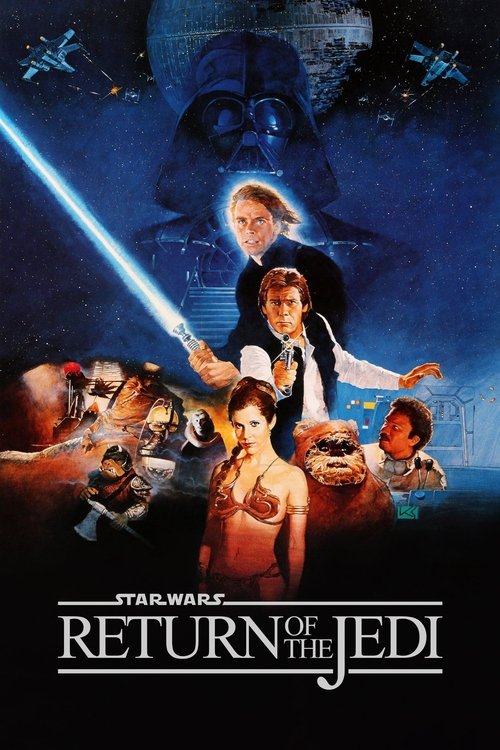
Return of the Jedi
1983 · Richard Marquand
For a comfort rewatch or a family movie night — when you want adventure, catharsis, and an ending that actually ends. The trilogy's warmest, most crowd-pleasing entry.
What it's about
The closing chapter of the original Star Wars trilogy has everything on the table: Han Solo frozen in a gangster's palace, a second and deadlier Death Star nearing completion, and Luke Skywalker returning as a Jedi to face Darth Vader — and the Emperor behind him — one last time. The Rebel fleet stakes everything on a single massive assault while Luke fights a more personal battle over his father's soul.
The experience
Big, warm, and rousing — a victory-lap adventure that swings from monster-pit swashbuckling to forest chases to one of the great three-front climaxes in blockbuster history. The emotional core between Luke and Vader gives the spectacle real stakes.
Performances
Mark Hamill does his most interesting work of the trilogy, playing Luke with a new calm that keeps threatening to tip into his father's darkness, and Ian McDiarmid's Emperor is deliciously venomous.
The craft
Industrial Light & Magic operating at the peak of the pre-digital era: the speeder-bike chase through the redwoods and the swarming space battle are still jaw-dropping feats of practical and optical effects. John Williams ties three films of themes into a grand finale — this one deserves good speakers.
Why it matters
It completed the most influential trilogy in blockbuster history and set the template — for better and worse — for how a franchise sticks its landing, while its creatures and merchandise-friendly instincts previewed where Lucas would take the saga next.
Snapshot
Return of the Jedi is the third film of the original Star Wars trilogy and the picture that closes the arc George Lucas began in 1977. Conceived as the resolution to the cliffhanger of The Empire Strikes Back (1980), it carries the burden of every concluding chapter: it must rescue Han Solo from carbonite, redeem or destroy Darth Vader, and dispatch the Emperor while bringing a galaxy-spanning conflict to rest. Directed by the Welsh filmmaker Richard Marquand under Lucas's close supervision, the film is at once the most commercially calculated and the most openly sentimental of the trilogy — a movie that ends in firelight, embraces, and reconciliation rather than the unresolved darkness of its predecessor. It is also the film in which Lucas's instincts as merchandiser, mythmaker, and technologist are most nakedly fused, most visibly in the Ewoks of the forest moon of Endor. For all the critical ambivalence that has trailed it, Jedi completed the most influential popular-cinema cycle of its era and set the template, narratively and industrially, for the modern blockbuster trilogy.
Industry & production
By 1983 Star Wars was no longer merely a film series but the engine of an independent production empire. Lucas had financed The Empire Strikes Back largely on his own credit and the proceeds of the first film, and he built Jedi the same way — outside the traditional studio system, with 20th Century Fox distributing rather than fully financing. This arrangement, which kept ownership and ancillary rights with Lucasfilm, is one of the most consequential business decisions in modern Hollywood and the foundation of Lucas's later wealth and independence.
The production was vast and deliberately secretive. The film shot under the cover title Blue Harvest, with the tagline "Horror Beyond Imagination," a ruse meant to suppress location fees and unwanted attention. Principal photography combined stage work at Elstree Studios in England with location shooting in the deserts of Yuma, Arizona (standing in for Tatooine) and the redwood forests of northern California near Crescent City (the moon of Endor). The title itself was changed late: Lucas had favored Revenge of the Jedi, and promotional materials were printed under that name, before he concluded that revenge was not an emotion a Jedi would pursue, reverting to Return.
Lucas chose not to direct himself, as he had not directed Empire. He hired Richard Marquand, then known chiefly for the thriller Eye of the Needle (1981), reportedly for his skill with actors and his willingness to work within Lucas's framework. The collaboration was unusually close — Lucas was present throughout and exercised heavy creative authority, and accounts have long noted ambiguity about how much of the film's visual conception originated with the director versus the producer. Marquand, who died in 1987, never made another film of comparable scale, and the question of authorship hangs over the picture.
Technology
Jedi was a showcase for Industrial Light & Magic at a peak of its optical-era capability, before the digital transition the same company would later lead. The film's effects relied on motion-control photography, miniatures, matte paintings, and optical compositing — the mature form of the techniques Star Wars had revitalized in 1977. The space battle over Endor, with its dense fields of capital ships and fighters, represented an enormous increase in the number of moving elements composited in a single frame, pushing the optical printer and the bluescreen pipeline hard.
The film is also remembered as an early venue for what would become digital filmmaking. ILM's computer division — the group that would later spin off as Pixar — contributed pioneering computer-generated imagery, including the wireframe holographic Death Star schematic used in the rebel briefing, an early instance of CGI in a feature. The speeder-bike chase through the Endor forest was achieved through a now-famous low-tech method: a Steadicam operator walking slowly through the redwoods, with the footage radically sped up so that the static trees rushed past at apparent high velocity, the bike and riders added in post.
Jabba the Hutt represented a major practical-creature achievement, a large electronically and manually operated puppet requiring multiple operators, a culmination of the creature-shop tradition that ran through the trilogy. The Sarlacc, the rancor, and the Ewoks similarly combined puppetry, suit performance, and stop-motion in the established ILM idiom.
Technique
Cinematography
The film was photographed by Alan Hume, a veteran British cinematographer also associated with the James Bond series. His work spans extreme tonal registers: the harsh desert glare and the murky, cavernous interiors of Jabba's palace; the cool, hard, metallic light of the second Death Star and the Emperor's throne room, where the geometry of the space and the red glow of the windows isolate the three figures of the final confrontation; and the dappled, naturalistic green light of the Endor forest. The throne-room sequences in particular use deep shadow and pools of hard light to abstract the duel into something close to a chamber drama, in pointed contrast to the kinetic spectacle elsewhere.
Editing
Jedi is built around one of the most ambitious cross-cut climaxes in studio cinema: the film's final movement intercuts three actions — the space battle against the Death Star, the ground assault on the shield generator at Endor, and Luke's confrontation with Vader and the Emperor — sustaining parallel suspense across radically different scales and emotional keys. The editing, credited to Sean Barton, Marcia Lucas, and Duwayne Dunham, sustains this triple structure for an extended stretch, a textbook elaboration of the Griffith-derived last-minute-rescue intercut scaled to space opera. Marcia Lucas's contribution to the trilogy's editing rhythm has been increasingly recognized; Jedi was among her last major collaborations with George Lucas before their divorce.
Mise-en-scène / staging
The film moves through three distinct production-design worlds: the grotesque, organic decadence of Jabba's palace and the desert; the cold industrial geometry of the Imperial spaces; and the soft, organic forest of Endor. The art direction, overseen within the established trilogy aesthetic, sets the "lived-in" used-future texture of the technology against the natural and the monstrous. The Endor village built into the trees and the cathedral-like scale of the Death Star throne room exemplify the design strategy of contrasting the human and rebel with the vast and impersonal Imperial architecture.
Sound
Ben Burtt's sound design continued the trilogy's pioneering approach to synthetic and organic sound construction — the creature vocalizations of Jabba's court, the speeder bikes, the new Imperial hardware. The film, like its predecessors, was a flagship for the high-fidelity multichannel theatrical sound that Star Wars had helped make a commercial expectation; the spatial separation of effects and music in the battle sequences was part of the trilogy's continuing push on theatrical audio standards.
Performance
The principal cast returned: Mark Hamill as Luke Skywalker, now grave and self-possessed in a deliberate maturation from the callow farm boy of 1977; Harrison Ford as Han Solo, thawed from carbonite; Carrie Fisher as Leia, given the much-discussed enslavement-and-escape sequence in Jabba's palace; Billy Dee Williams as Lando; and the recurring physical and vocal performances behind the masks — Anthony Daniels as C-3PO, Kenny Baker as R2-D2, Peter Mayhew as Chewbacca. The film's dramatic center is the Vader-Luke-Emperor triangle, in which David Prowse's physical performance and James Earl Jones's voice combine for Vader, Sebastian Shaw appears as the unmasked Anakin, and Ian McDiarmid gives the Emperor a relishing, insinuating malevolence that would later anchor the prequels.
Narrative & dramatic mode
Jedi operates in the mode of mythic romance and resolution. Where Empire deepened the story into tragedy and deferral, Jedi is structured as a series of rescues and reckonings that pay off the trilogy's open threads. Its dramatic architecture is essentially three-act and tripartite: the Tatooine rescue of Han as a self-contained opening movement; a middle of preparation and revelation; and the triple-stranded climax. The emotional engine is the redemption of the father — Luke's conviction that good remains in Vader, and Vader's final turn against the Emperor to save his son. This is the trilogy's most explicit statement of its underlying theme: that love and mercy, not power, are the measure of the hero. The mode is unabashedly sentimental, ending on familial reunion and communal celebration.
Genre & cycle
The film is the closing entry in the cycle that defined the modern space opera and, more broadly, the effects-driven adventure blockbuster. It synthesizes the serial-adventure idiom (the Flash Gordon and Buck Rogers serials Lucas openly drew on), the Western (the Tatooine sequences), the war film (the assault and dogfight structure), and the mythic quest narrative. As the third part of a trilogy, it also helped codify the commercial and narrative grammar of the blockbuster trilogy as a unit — a form Hollywood would imitate for decades.
Authorship & method
The governing authorial intelligence is George Lucas, who originated the story, co-wrote the screenplay with Lawrence Kasdan, and supervised the production as producer and effective creative head. Kasdan, who had co-written Empire and Raiders of the Lost Ark, brought a sharper sense of character and dialogue; the contrast between his sensibility and Lucas's mythic-structural one runs through the trilogy. Richard Marquand directed the actors and managed the floor, but the film is most honestly understood as a Lucasfilm production under Lucas's overall authorship — the auteur question here is genuinely complicated, and the historical record reflects ongoing ambiguity about the division of creative labor.
The key collaborators form a continuity with the earlier films: composer John Williams, whose score reprises and develops the trilogy's leitmotif system — the Force theme, the Imperial March, and new material including the Emperor's choral menace and the Ewok music — in the late-Romantic, Wagnerian-derived idiom that is itself one of the most influential elements of the whole enterprise; cinematographer Alan Hume; sound designer Ben Burtt; and the ILM effects teams. Williams's leitmotif method, more than any single image, is the film's most studied authorial signature.
Movement / national cinema
Jic is not a product of a film movement in the art-cinema sense; it belongs to the New Hollywood generation's commercial wing, the cohort of Lucas, Spielberg, and their peers who emerged from the early-1970s ferment and redirected American cinema toward the high-concept, effects-driven event film. Though shot largely in Britain at Elstree with substantial British crew and craft talent — part of the long postwar pattern of American-financed runaway production using UK studios and technicians — it is in every meaningful sense an American film, and a central document of the blockbuster turn that the New Hollywood paradoxically produced even as it ended the brief auteur renaissance.
Era / period
The film sits at the high-water mark of the early-1980s blockbuster, in the years after Star Wars and Raiders had remade the industry's economics around the summer tentpole and the merchandising tie-in. Jedi is the most merchandising-conscious of the trilogy, and the Ewoks have long been read as emblematic of the period's fusion of storytelling and toy marketing — a critique leveled at the time and since. It also stands at the threshold of the home-video and franchise era; the trilogy's afterlife on video, and Lucas's later returns to it, belong to a media landscape Jedi helped bring into being.
Themes
The film's controlling theme is redemption through familial love — the salvation of the father by the son, and the rejection of the Emperor's offer of power. Around it cluster the trilogy's recurring concerns: the seductiveness of the dark side and the discipline required to refuse it; mercy and restraint as the marks of the true Jedi (Luke throws away his lightsaber rather than kill); and the triumph of a small, communal, almost pre-industrial band — the Ewoks and the rebels — over a vast technological empire, a populist-pastoral motif with a long lineage in American myth. The Emperor functions as the embodiment of pure will-to-power, and his defeat is moral as much as military. Underneath runs the trilogy's mythic substrate, the hero's-journey and comparative-mythology framework Lucas drew from his reading of Joseph Campbell, here resolved in the return and reconciliation that the monomyth posits as the journey's end.
Reception, canon & influence
Influences on the film (backward). Jedi inherits the whole pedigree of Star Wars: the 1930s adventure serials; Akira Kurosawa's samurai films, whose influence on the saga's structure and visual sense is well documented; the Western and the WWII combat picture; Campbell's comparative mythology; and the Wagnerian symphonic tradition that shaped Williams's scoring. It also builds directly on the technical and design language established across the previous two films and refined at ILM.
Critical reception. Reception was warm but markedly more divided than for Empire. Many reviewers and audiences embraced the film as a satisfying, emotionally generous conclusion; others judged it the weakest of the trilogy, faulting a sense of repetition (a second Death Star), a softening toward the cuddly and commercial in the Ewoks, and the impression that wonder had given way to formula. That split verdict has proved durable: in later critical reassessment Jedi is frequently ranked behind both Star Wars and Empire while still regarded as a strong popular film. I am describing the broad shape of critical opinion rather than citing specific figures or quotations, which I will not invent.
Legacy and influence (forward). The film completed the most commercially and culturally influential trilogy of its era and consolidated the blockbuster franchise as the dominant form of mainstream American cinema. Its triple-cut climax became a model for parallel-action spectacle; Williams's leitmotif scoring shaped decades of film music; and ILM's work, including its early CGI, fed directly into the digital revolution the company would lead. Jedi also became a primary site of the "revision" controversies that followed: Lucas's later Special Edition alterations and home-video changes to the film — among them changes to its closing moments and its musical and effects elements — made it a touchstone in debates over directorial revisionism and the stability of the canonical text. Within the larger Star Wars enterprise, it stood as the saga's conclusion for sixteen years, until the prequels, and its central image — a redeemed father, a son's mercy — remains the trilogy's emotional and thematic keystone, repeatedly echoed and reinterpreted by the sequels and spin-offs that followed.
A Deleuzian reading
Three figures stand in a room lit blood-red, and the one in the middle can't show his face.
The full Deleuzian reading of Return of the Jedi →
Reception
A monster hit in 1983 but always the 'lesser' original-trilogy film for critics, who rolled their eyes at the Ewoks; decades of prequels and sequels have been kind to it, and it now reads to many fans as the trilogy's warm, satisfying capstone rather than its weak link.
How Return of the Jedi was received, from release to now →
Influences: the films it descends from and the films it influenced
- The Hidden Fortress (1958) — Lucas lifts the bickering-low-characters POV and the hard horizontal wipe transitions, both reprised in Jedi's scene-to-scene cutting and its peasant-Ewok ground war told from below.
- The Dam Busters (1955) — Its cockpit-POV bomber-run choreography — tight model shots, target-approach countdown, defensive flak — is the template ILM restages for the fighter assault into the second Death Star's reactor core.
- Jason and the Argonauts (1963) — Harryhausen's Dynamation stop-motion creature animation is the direct craft line to Phil Tippett's go-motion rancor and AT-ST work in Jedi.
- 2001: A Space Odyssey (1968) — Douglas Trumbull's repeatable motion-control rig for locked-off spacecraft passes is the conceptual parent of the Dykstraflex and the multi-pass optical compositing ILM uses for the Endor space battle.
- The Adventures of Robin Hood (1938) — Korngold's character-keyed Wagnerian leitmotif scoring established the symphonic model that Williams extends in Jedi with the Emperor's choral motif and the developed Force/Imperial themes.
- Forbidden Planet (1956) — Its all-electronic 'tonalities' soundtrack pioneered building a film's sonic world from synthesized rather than recorded sound — the lineage Ben Burtt extends in his creature and droid vocalizations.
- Silent Running (1972) — Its lived-in, scuffed spacecraft interiors and waddling practical service-droids prefigure the 'used future' production design and puppet-operated creatures of Jabba's palace.
- Star Wars (1977) — Birthed the in-house ILM motion-control optical-compositing pipeline and the leitmotif/monomyth architecture that Jedi inherits wholesale and scales up.
- The Empire Strikes Back (1980) — Tippett's go-motion (motion-blurred stop-motion) debuted on the AT-ATs here, the exact technique ILM reuses for Jedi's AT-ST chase and rancor.
- Willow (1988) — A Lucas production where ILM's go-motion and the first digital morph extend Jedi's creature pipeline directly toward the digital-effects revolution.
- Jurassic Park (1993) — Tippett's go-motion creature animation crossing into ILM CGI is the literal continuation of the Jedi rancor workflow, with Burtt-trained sound design (Gary Rydstrom) building the dinosaur voices.
- The Lord of the Rings: The Return of the King (2003) — Builds its finale on Jedi's three-front parallel-climax cross-cutting and Howard Shore's leitmotif system, scaling the monomyth-resolution-plus-battlefield structure to trilogy close.
- WALL-E (2008) — Ben Burtt himself designs the title robot's entire vocabulary from synthesized and processed sound, carrying his Jedi-era creature/droid voice method into a wordless lead performance.
- Raiders of the Lost Ark (1981) — Same Lucas-story/Kasdan-script/Williams-score/ILM team reviving the 1930s serial's cliffhanger pacing and matinee-adventure tone in parallel with the Star Wars films.
- Star Trek II: The Wrath of Khan (1982) — ILM's Graphics Group built the Genesis sequence as cinema's first fully computer-generated shot — the early-CGI sibling to Jedi's wireframe Death Star briefing hologram.
- Tron (1982) — A parallel 1982 experiment pushing extended computer-generated imagery into a feature, sharing Jedi's moment of optical-to-digital transition in effects craft.
- The Dark Crystal (1982) — Its full-body animatronic and rod-puppet creature performances are the contemporaneous high-water mark of the practical-puppetry craft Jedi deploys across the Jabba and Ewok scenes.
Similar films
- The Lord of the Rings: The Return of the King (2003) — influence & lineage · same viewing thread
- The Empire Strikes Back (1980) — influence & lineage
- Star Wars (1977) — influence & lineage
- Raiders of the Lost Ark (1981) — influence & lineage
- 2001: A Space Odyssey (1968) — influence & lineage
- Jurassic Park (1993) — influence & lineage
- Jason and the Argonauts (1963) — influence & lineage · same viewing thread
- Star Wars: Episode III - Revenge of the Sith (2005) — same viewing thread
All the films related to Return of the Jedi →
Watch it with: curated runs of related films
- Studio-Sized Mythmaking — A run of blockbuster quest epics — fellowships forged, dark lords faced, and long roads home — that rhyme on scale, world-building, and the pull of a saga you can lose a weekend inside.