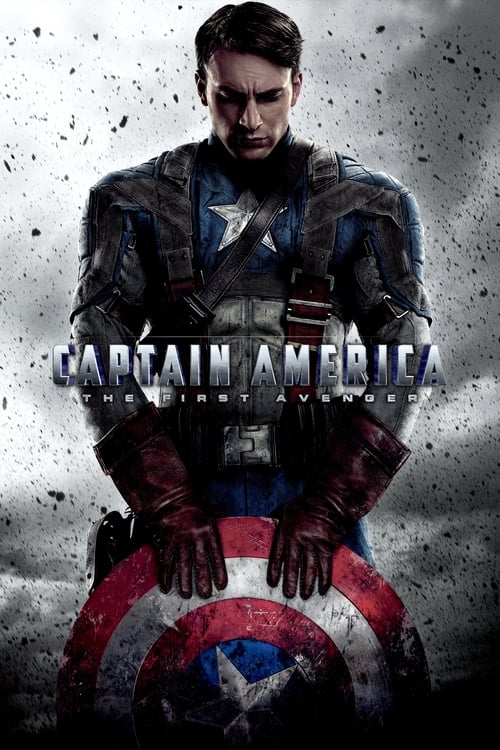
Captain America: The First Avenger
2011 · Joe Johnston
For a crowd-pleasing night when you want straightforward heroism and pulp adventure — comfort viewing with zero cynicism, great with family or as a rainy-Sunday pick.
What it's about
In 1943, Steve Rogers is a scrawny Brooklyn kid rejected by the Army five times over, whose only superpower is refusing to stay down. A secret experiment turns him into the peak-human super-soldier Captain America — first paraded as a war-bonds mascot, then thrown into real combat against the Red Skull, a rogue Nazi scientist wielding a device of terrifying power.
The experience
Warm, sincere, and unabashedly old-fashioned — a matinee adventure with punchy action and a surprisingly tender streak. It moves briskly but takes its time letting you love the little guy before he gets big.
Performances
Chris Evans finds the role of his career by playing the decency first and the muscles second — the skinny Steve scenes sell everything that follows. Hayley Atwell's Peggy Carter gives the film its steel and its heart.
The craft
Joe Johnston stages the 1940s with real affection — burnished period production design, war-bond stage numbers, pulp-serial gadgetry — and the digital effect that grafts Evans's head onto a frail body remains quietly remarkable. It's a handsome, nostalgic-looking blockbuster that plays best big.
Why it matters
The film that had to make a flag-wearing hero work for a modern audience — and did, by leaning into sincerity — it locked the final piece of Marvel's Phase One into place ahead of The Avengers and set the emotional foundation for the series' most acclaimed later chapters.
Snapshot
Captain America: The First Avenger is a period-set superhero adventure that functions simultaneously as an origin story, a wartime propaganda pastiche, and a load-bearing girder in the architecture of Marvel Studios' emerging cinematic universe. Released in July 2011, it was the fifth film in what would later be codified as the Marvel Cinematic Universe (MCU) Phase One, arriving the same summer as Thor and directly setting up The Avengers (2012). Its distinguishing gambit is temporal: rather than a contemporary metropolis, it stages its action in a stylized 1943, drawing on the visual grammar of 1940s serials, war-bond showmanship, and pulp science fiction. Directed by Joe Johnston — a filmmaker with a deep affinity for retro-Americana adventure — the film transforms sickly Brooklyn volunteer Steve Rogers (Chris Evans) into a super-soldier who battles the Nazi splinter organization HYDRA and its disfigured leader, the Red Skull (Hugo Weaving). The result is earnest where much of the genre had turned ironic, and its sincerity is central to both its contemporaneous reception and its durable standing within the franchise.
Industry & production
The film was produced by Marvel Studios and distributed by Paramount Pictures, part of the distribution arrangement that governed Marvel's self-financed slate before The Walt Disney Company absorbed those rights. It represents Marvel Studios mid-experiment: the studio had proven with Iron Man (2008) that it could build tentpoles around second-tier characters, and Captain America was a test of whether audiences would accept a deliberately un-modern, flag-forward hero. Casting Chris Evans was itself a matter of some industry note, since Evans had already played Johnny Storm in Fox's Fantastic Four films; his signing as Rogers marked a bet on his ability to anchor a franchise rather than support one.
Principal photography took place substantially in England, using Shepperton Studios and location work in the North of England — Manchester's Northern Quarter, with its preserved period brickwork, notably doubled for 1940s New York streetscapes, and Liverpool provided additional period exteriors. This transatlantic production pattern — an all-American subject shot largely on British stages and streets — was by then common practice for large VFX-driven tentpoles, driven by crew depth, facilities, and cost. The film was released theatrically in a post-converted 3D format, consistent with the studio-wide 3D push of the early 2010s, though the film was not natively captured in stereo. Where precise budget and grosses are concerned, I will not cite specific figures from memory; the film was a solid commercial success that justified its sequels, but exact numbers should be verified against the financial record rather than asserted here.
Technology
The film's signature technical achievement is the "skinny Steve" effect — the digital reduction of Chris Evans's physique so that pre-serum Rogers appears frail and undersized. This was executed largely by the visual-effects house Lola VFX, which specialized in digital "cosmetic" work, using a combination of body-shrinking manipulation, a body double, and careful compositing rather than the simpler trick of a prosthetic suit or forced-perspective staging alone. The technique built on approaches the same practitioners had applied to age and body alteration in prior films, and it is often cited as a benchmark for convincing full-body digital de-augmentation. Its success is partly why the pre-serum sequences carry dramatic weight: the audience must believe in the smaller man before the transformation means anything.
Beyond that, the film leans on relatively conventional-for-its-era digital compositing for its retro-futurist HYDRA hardware, the Red Skull's facial reveal (a digital/prosthetic hybrid for Weaving's skull-faced Johann Schmidt), and large-scale environment extension for the Alpine fortress and the climactic aircraft, the "Valkyrie." The overall technological posture is characteristic of early-2010s Hollywood: film-based or high-end capture as the imaging base, with heavy but naturalistically intended digital augmentation layered on top.
Technique
Cinematography
Cinematographer Shelly Johnson — a frequent Joe Johnston collaborator — shoots the film in a warm, burnished register that evokes Kodachrome-era Americana and wartime illustration. The palette favors ambers, browns, and muted greens for the Allied and home-front material, reserving colder steel-blues and the eerie glow of Tesseract energy for HYDRA's technologized menace. The camera work is classical rather than kinetic: composed wide masters, clean coverage, and a general avoidance of the shaky handheld idiom that dominated much action filmmaking of the period. This restraint is a stylistic choice keyed to the period setting, aligning the film's look with the studio-era adventure pictures it affectionately imitates.
Editing
The film was edited by Jeffrey Ford and Robert Dalva. Its most discussed structural passage is the USO montage, in which the newly transformed Rogers is put to work as a costumed war-bond mascot — "Captain America" as literal propaganda performer — touring the nation in a sequence that compresses months into minutes through montage, changing backdrops, and a diegetic song-and-dance number. This passage does double narrative duty: it advances time economically and it stages the film's central irony about symbol versus soldier. Elsewhere the cutting is legible and sturdy, prioritizing spatial clarity in action over fragmentation.
Mise-en-scène / staging
Production design is the film's most conspicuous pleasure. The world is built as a heightened 1943 — retro-futurist HYDRA laboratories, brass-and-vacuum-tube weaponry, art-deco signage, and period costuming — that treats the war era as a pulp playground rather than a historical reconstruction. The Red Skull's fortress and HYDRA's energy weapons deliberately fuse Nazi iconography with ray-gun Gothic, situating the film's science fiction in the "weird war" tradition. Rogers's own costume evolves diegetically from a garish stage outfit to a functional combat uniform, a staging decision that lets the film comment on its own imagery.
Sound
Composer Alan Silvestri supplies a robust, brass-forward orchestral score anchored by a march-like Captain America theme — a melody built for heroism in a traditional idiom, in keeping with the film's throwback sensibility. Silvestri's approach here foregrounds a hummable primary motif, a choice that would pay off across the franchise. The sound design balances the crack and hum of HYDRA's exotic energy weapons against more grounded wartime materiel, using the uncanny tonal signature of the Tesseract-powered arms to mark the enemy as technologically alien.
Performance
Chris Evans plays Rogers as fundamentally decent, locating the character's heroism in stubborn moral clarity rather than quips or angst — a performance calibrated to the pre-serum scenes, where the smaller Rogers must establish the courage the larger body will merely amplify. Hugo Weaving's Red Skull is played in an arch, theatrical register with a pronounced Germanic inflection, a deliberately villainous counterweight. Hayley Atwell's Peggy Carter registers as more than a love interest — competent and self-possessed — a performance popular enough to seed her own later television spinoff. Strong supporting turns come from Stanley Tucci as the humane Dr. Erskine, Tommy Lee Jones as the gruff Colonel Phillips, Sebastian Stan as Bucky Barnes, Dominic Cooper as a young Howard Stark, and Toby Jones as the meek scientist Arnim Zola.
Narrative & dramatic mode
Structurally the film is a classical origin story overlaid on a wartime mission narrative. Its dramatic mode is sincere and mythic rather than ironic: the screenplay by Christopher Markus and Stephen McFeely stakes its emotional claim on the idea that the serum "amplifies everything inside," so that the good man becomes a good soldier and the flawed man (Schmidt) becomes a monster. The film's most poignant structural device is its frame: it opens and closes in the present day, revealing that Rogers survives frozen for decades, a temporal displacement that turns the wartime story into an extended flashback and converts its triumphant ending into an elegy. The hero wins the war but loses his world — and his planned dance with Peggy — a bittersweet note unusual for a franchise-opening blockbuster.
Genre & cycle
The film sits at the intersection of the superhero cycle, the WWII adventure, and pulp science fiction. Within the superhero cycle it is an outlier for its period setting, aligning it less with contemporaneous urban superhero films than with the retro-adventure lineage of Spielberg-Lucas serials and their imitators. It belongs recognizably to the "greatest generation" adventure register while smuggling in ray-guns and a cosmic MacGuffin. Crucially, it is also a shared-universe film — a member of the then-novel cycle of interlocking Marvel productions engineered to converge in a crossover event, a structural innovation that reshaped the entire blockbuster landscape of the 2010s.
Authorship & method
Joe Johnston is the authorial key. A veteran of Industrial Light & Magic's art department in the original Star Wars era before turning director, Johnston built a filmography around wonder-tinged Americana and period adventure — Honey, I Shrunk the Kids (1989), The Rocketeer (1991), October Sky (1999), Jurassic Park III (2001), and The Wolfman (2010). The Rocketeer, a 1930s-set pulp adventure about an aviator hero, is the essential precursor: it establishes Johnston's fluency in period design, earnest heroism, and analog-futurist gadgetry, and its DNA is visible throughout Captain America. His visual-effects origins also inform the film's comfort with heavy digital work in service of a hand-crafted-looking world.
His key collaborators reinforce this program: cinematographer Shelly Johnson and composer Alan Silvestri both work in classical, legible idioms suited to the throwback aesthetic; editors Jeffrey Ford and Robert Dalva shape the film's economical time-compressions; and writers Christopher Markus and Stephen McFeely — who would go on to script the Captain America sequels and the two-part Avengers culmination — establish here the sincere moral voice that becomes the character's throughline across the franchise. Authorship in this case is genuinely divided between a distinctive director-for-hire and a studio, Marvel, exercising strong supervisory control over continuity and tone.
Movement / national cinema
The film is a product of the American studio superhero machine and belongs to no art-cinema movement; its "movement," properly understood, is the industrial phenomenon of the shared cinematic universe pioneered by Marvel Studios. Nationally it is emphatically American in subject and iconography — its hero is a living flag — even as its physical production was substantially British, a now-standard globalization of Hollywood tentpole manufacture. Its imagination of nationhood is nostalgic and mid-century, invoking a consensus wartime America as a usable myth.
Era / period
Two eras matter here. The depicted era is a stylized 1943, filtered through wartime poster art, USO showmanship, and pulp science fiction rather than documentary realism. The production era is the early 2010s, the formative moment of the MCU, when Marvel Studios was still assembling its interlocking slate under a Paramount distribution deal and before the full Disney consolidation. The film is thus a period piece made at a hinge point in industry history, and it reads differently in retrospect as the origin of a decade-defining franchise strategy than it did as a standalone summer release.
Themes
The film's governing theme is the relationship between symbol and substance — between "Captain America" as manufactured propaganda mascot and Steve Rogers as an actual moral agent. The USO sequence dramatizes this directly, letting the hero become a literal advertisement before he is allowed to become a soldier. A second theme is the moral neutrality of power: the super-soldier serum amplifies existing character, making Rogers better and Schmidt worse, so that the film locates virtue in the person, not the enhancement. Sacrifice and belatedness form a third cluster — the hero's climactic self-sacrifice and his temporal exile give the film its melancholy undertow, framing heroism as something that costs the hero his own time and place.
Reception, canon & influence
Critically, the film was generally well received, with praise concentrated on its period charm, Evans's grounded lead performance, and Johnston's sincere, un-cynical tone; reservations tended to cluster around a somewhat perfunctory villain and the sense — increasingly common in this cycle — that the film was partly an obligatory setup for The Avengers. I will refrain from quoting specific reviews or scores from memory, but the consensus placed it among the more warmly regarded Phase One entries.
Looking backward, the film's influences are legible: the Simon-and-Kirby Captain America Comics #1 (1941), whose famous cover of Cap punching Hitler establishes the character's propaganda origins; the wartime serials and war-bond culture the film pastiches; and, cinematically, the Lucas-Spielberg adventure idiom and Johnston's own The Rocketeer, with its 1930s-40s pulp heroics and analog-futurist design.
Looking forward, its influence is substantial within its franchise and beyond. It established Steve Rogers as a moral anchor for the MCU and seeded threads — the Tesseract, Bucky Barnes, Howard Stark, HYDRA, Peggy Carter — that pay off across The Avengers (2012), Captain America: The Winter Soldier (2014), Captain America: Civil War (2016), and the Avengers culmination films, as well as the Agent Carter television spinoff built around Atwell's character. More broadly, as a component of Marvel's shared-universe experiment, it contributed to the template of interlocking, serialized blockbuster storytelling that dominated the following decade. Its specific formal legacy — the earnest, period-set superhero film — proved less imitated than its structural one, but the character's sincerity, first crystallized here, became one of the franchise's most durable assets.
A Deleuzian reading
There's a long stretch in the middle of this movie where the hero is a chorus line.
The full Deleuzian reading of Captain America: The First Avenger →
Reception
Received in 2011 as a pleasantly old-fashioned, mid-tier Marvel origin story, it's since been reappraised as one of the MCU's most sincere entries — the retro-pulp WWII period charm that once read as 'quaint' is now exactly what fans miss about early Marvel.
How Captain America: The First Avenger was received, from release to now →
How to watch Captain America: The First Avenger: what to notice on a first viewing
- Notice the warm ambers on Allied scenes against cold steel-blue for HYDRA. Shelly Johnson keeps the home-front glowing amber and brown while HYDRA's labs and weapons stay cold steel-blue and eerie Tesseract green. The palette sorts good from monstrous before any dialogue does, marking virtue and menace as visibly different worlds.
- Watch Rogers's costume go from a garish stage suit to combat gear. The film stages this change once, on screen, letting you see the difference between the propaganda mascot and the soldier underneath. Deleuze's gest names a bodily posture that exposes a social relation; the costume confesses what the state wants from Rogers.
- Notice the camera holds wide, steady masters instead of shaky handheld shots. Johnston and cinematographer Shelly Johnson keep compositions classical and legible throughout, breaking from the fragmented action style common in 2011. The clarity mirrors the film's throwback ambition: an old kind of confident heroism needs an old kind of camera.
- Listen for Alan Silvestri's brass march returning across different scenes. The same hummable heroic theme recurs whenever Rogers acts decisively, growing more familiar as the film proceeds. A theme this simple and repeated tells you the film wants heroism to feel inevitable, not ironic.
The whole guide to watching Captain America: The First Avenger, with the keys for a rewatch →
Influences: the films it descends from and the films it influenced
- The Rocketeer (1991) — Johnston's own prototype for the film: an earnest, un-ironic period hero rendered through analog-futurist gadget design (rocket pack ≈ HYDRA weaponry) and warm, storybook 1930s-40s production design he transplants wholesale.
- Raiders of the Lost Ark (1981) — Codifies the Lucas-Spielberg serial idiom the film pastiches — Nazis chasing an occult super-weapon, propulsive set-piece grammar, and villains staged as pulp menace rather than psychological study.
- Star Wars (1977) — Johnston trained in its ILM art department; its Saturday-matinee serial vocabulary — optical wipes, clean heroic silhouettes, and effects marshaled to sell a lived-in world — is the visual grammar he carries forward.
- Indiana Jones and the Last Crusade (1989) — Direct model for HYDRA's arc: Nazis weaponizing a supernatural relic, plus the father-son/mentor-artifact structure and the treasure-hunt momentum grafted onto WWII iconography.
- The Adventures of Robin Hood (1938) — Establishes the Korngold-lineage heroic brass march that Silvestri revives — a leitmotif-driven, unabashedly noble orchestral idiom — married to saturated Technicolor and classically composed, symmetrical adventure staging.
- Yankee Doodle Dandy (1942) — Template for the USO/war-bond montage sequence — patriotic showmanship, flag-draped stage numbers, and homefront morale spectacle repurposed as the film's self-aware propaganda interlude.
- Flash Gordon (serial) (1936) — The weird-war pulp serial DNA: cliffhanger episodic pacing, ray-gun 'science' as spectacle, and a retro-futurist villain empire (Ming ≈ Red Skull's HYDRA) built from art-deco menace.
- The Curious Case of Benjamin Button (2008) — Pioneered the Lola VFX digital body-replacement technique that produces 'skinny Steve' — seamlessly shrinking/altering an actor's physique across full-motion shots rather than relying on doubles or prosthetics.
- Jurassic Park III (2001) — Later Johnston spectacle that continues his design-led, period-adventure craftsmanship — the same well-made-entertainment authorship applied to a larger canvas.
- The Avengers (2012) — Cashes the shared-universe seeds planted here — the Tesseract as MacGuffin, Steve Rogers as moral anchor — proving the interlocking serialized-blockbuster architecture the film was partly built to service.
- Captain America: The Winter Soldier (2014) — Carries forward Markus & McFeely's sincere moral voice for Rogers while swapping Johnston's period-pulp idiom for 1970s paranoid-thriller grammar, and pays off the Bucky/HYDRA threads seeded here.
- Agent Carter (2015) — Extends the film's 1940s craft package directly — Atwell's Peggy, the warm period palette, retro production design, and postwar spycraft — into a serialized spinoff built from this world's texture.
- Wonder Woman (2017) — Inherits the earnest, period-set wartime origin template — a sincere hero forged in a World War, no-man's-land heroics as moral spectacle — proving the tonal model this film crystallized was exportable across studios.
- The Irishman (2019) — Advances the same digital de-augmentation lineage (ILM/Lola-style facial and body manipulation) that reshaped Evans, here inverted to de-age actors seamlessly across performance rather than shrink them.
- Indiana Jones and the Dial of Destiny (2023) — Combines both inheritances at once — the WWII pulp-serial-with-occult-Nazi-superweapon set-piece and full-scene digital de-aging of the lead — as the late culmination of the idiom this film revived.
- Sky Captain and the World of Tomorrow (2004) — Contemporary experiment in the same retro-futurist register — a sepia/Kodachrome-warm 1940s pulp world built almost entirely digitally yet styled to look hand-crafted and analog.
- X-Men: First Class (2011) — Released the same year, it runs the parallel play of anchoring a superhero origin in a specific mid-century period (1962 Cold War) with era-accurate costume, set design, and geopolitical backdrop as texture.
Similar films
- Captain America: The Winter Soldier (2014) — influence & lineage
- The Avengers (2012) — influence & lineage
- Iron Man (2008) — same viewing thread
- Captain America: Brave New World (2025) — shared sensibility
- Iron Man 2 (2010) — shared sensibility
- Avengers: Endgame (2019) — shared sensibility
- The Fantastic 4: First Steps (2025) — shared sensibility
- Avengers: Infinity War (2018) — shared sensibility
All the films related to Captain America: The First Avenger →
Watch it with: curated runs of related films
- You Are Who You Choose to Be — A run of origin stories where the real transformation isn't the powers but the choice to use them well — watch them together and the same good soul keeps getting reborn in steel and cape.