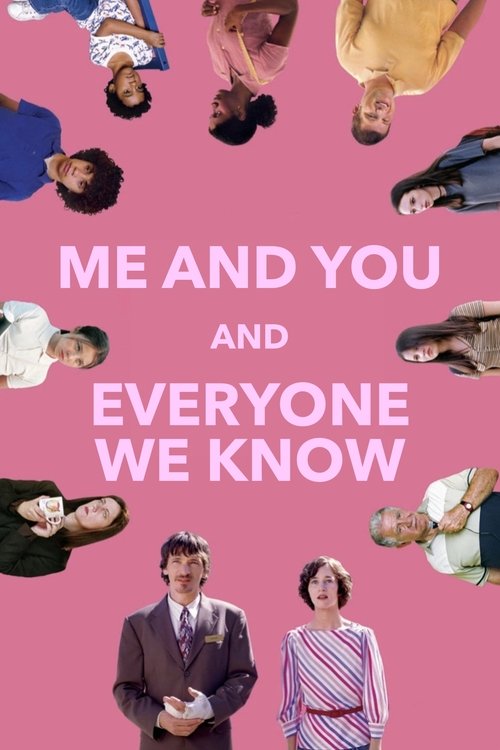
Me and You and Everyone We Know
2005 · Miranda July
For when you're feeling lonely in a hopeful way and want a film that's odd, warm, and a little brave about intimacy — comfort viewing for people who like their comfort slightly off-kilter.
What it's about
A shoe salesman named Richard, freshly separated and raising two sons, crosses paths with Christine, a video artist who pays the bills driving elderly people around town. They circle each other in a halting, hopeful almost-romance while everyone around them — his kids, two teenage girls next door, a lonely art curator — conducts their own clumsy experiments in reaching another person. It's a braid of small stories about people trying to connect in a suburb where nobody quite knows how.
The experience
Deadpan and tender at once, it keeps you suspended between wincing and melting — scenes start awkward, tip toward alarming, then land somewhere unexpectedly sweet. It moves gently, in short episodes, and leaves you feeling strangely open to strangers.
Performances
Miranda July plays Christine with a guileless, art-project earnestness that could be twee but reads as genuinely fearless, and John Hawkes gives Richard a raw, jumpy vulnerability — a man so hurt he flinches at kindness.
The craft
July wrote, directed, and stars, and the film carries her performance-art instincts into fiction: scenes built like little rituals, dialogue that sounds naive until it lands like poetry, pastel suburban light that makes ordinary streets feel enchanted. It's intimate in scale — no spectacle, just precise emotional timing.
Why it matters
A Cannes and Sundance prize-winning debut that became a touchstone of mid-2000s American indie cinema and announced July as a singular multi-hyphenate voice; its mix of whimsy and ache shaped a generation of quirky-sincere indies.
Snapshot
Miranda July's first feature arrived in 2005 already carrying the marks of a career built elsewhere. July had spent the preceding decade as a performance artist, a maker of video works shown in galleries and on the festival circuit, and the organizer of Joanie 4 Jackie, a chain-letter distribution project that circulated videos made by women to other women who made videos. Me and You and Everyone We Know is a feature film made by someone whose native form was the performance piece and the short video, and the film's structure shows it: a set of loosely braided situations involving a shoe salesman recovering from a divorce, a video artist who drives for a service that transports the elderly, two brothers conducting sexual reconnaissance online, two teenage girls testing their power on an adult neighbor, and a small child who has been given a computer and no supervision.
The film is remembered for a handful of images that lodged in the culture — a man setting his own hand on fire in a driveway, a six-year-old typing "))<>((" into a chat window and inventing a metaphor he does not understand, a woman narrating a walk down a block as though the block were a life. It won the Caméra d'Or at Cannes in 2005 and the Special Jury Prize for Originality of Vision at Sundance the same year, an unusual double that marked July as a discovery in both the American independent and the international art-film systems simultaneously. Released by IFC Films, it became one of the defining objects of mid-2000s American independent cinema, and — in a way that has shaped its reception ever since — one of the most argued-about, since the qualities that made it distinctive to some readers made it insufferable to others.
Industry & production
The film was produced by Gina Kwon, with backing that reflects the transnational financing typical of small American art films in the period: IFC Films was the U.S. distributor, and the production drew support from the British and German sides as well, with FilmFour and the German company Gigantic Pictures among the entities associated with the film's financing and production. The precise deal structure has not been widely documented in the scholarly record, and I won't invent numbers for it.
More consequential to the film's existence than any single financier was the Sundance Institute. July developed the screenplay through the Institute's Screenwriters and Directors Labs, the residency system Robert Redford's organization had built through the 1980s and 1990s to move first-time filmmakers from script to shoot. This matters interpretively as well as historically. The Labs system produced a particular kind of American independent feature — modestly budgeted, character-driven, dependent on ensemble rather than star, structurally willing to braid several storylines — and Me and You and Everyone We Know is legible as a Labs film even as it pushes against the format's conventional realism. July has spoken in interviews about the film's long development and about the difficulty of getting a first feature financed by someone known primarily as a performance artist; she cast herself in the lead, which was both an aesthetic decision continuous with her performance work and, practically, a solution to the problem of who could play a role written in her own idiom.
The shoot was short and the budget small by any studio measure. The film premiered at Sundance in January 2005 and then at Cannes in the Directors' Fortnight, where it took the Caméra d'Or for best first feature — an award that carries real weight in the international art-film economy because it addresses debut work specifically. IFC's release was a platform rollout of the sort that mid-2000s specialty distribution had refined: open in New York and Los Angeles, let the reviews and the festival laurels do the marketing, expand into the arthouse chain over subsequent weeks. The film was a modest commercial success in that channel rather than a breakout, and its cultural footprint has always exceeded its ticket sales.
Technology
The film was shot on 35mm, and this is a more interesting fact than it might appear. 2005 sits at the hinge of the digital transition in low-budget American filmmaking. The DV wave of the late 1990s and early 2000s — Dogme 95's international influence, the mini-DV features of the American indie scene, the first prosumer cameras putting features within reach of very small budgets — had already established that a first feature could be made on video. July's own background was in video art, where the medium was the default. Choosing 35mm for the feature was a decision to give the film the compositional stability, color rendition, and formal composure of photochemical cinema rather than the immediacy and grain of DV.
That decision interacts pointedly with the film's subject. Me and You and Everyone We Know is a film about screens: the video work Christine makes on consumer equipment and submits on tape to a museum curator; the chat rooms where the brothers pursue an anonymous correspondent; the digital camera and the computer through which the youngest child, Robby, conducts his half of the film's most famous exchange. The film is about video and internet culture at a moment when both were still novel enough to be treated as a subject rather than an environment, and it renders that subject in the older, statelier medium. The internet in this film is the early-2000s internet of text chat, of the AOL-descended chat room, of an interface where two strangers type into a shared window with no image and no verification. That specificity has aged into a period document. The chat scenes work because the technology permits total anonymity and total sincerity at once: nobody in the exchange knows who anyone is, which is exactly the condition the film wants for its meditation on how people reach each other.
Christine's practice — the video diary, the voice-over narration recorded over footage of her own hand, the tape delivered by hand to an institution — is likewise a portrait of a specific technological moment in the art world, when digital video had democratized production but distribution still ran through curators and physical media.
Technique
Cinematography
Chuy Chávez shot the film. Chávez was, by 2005, a known figure in American independent cinematography, having photographed Miguel Arteta's Star Maps (1997), Chuck & Buck (2000), and The Good Girl (2002) — films with an interest in social awkwardness and suburban Southern California texture that connects legibly to July's project. His work here is notable for restraint. The camera is frequently static or moves in slow, deliberate lateral tracks; compositions are frontal and centered more often than not; the framing is patient with people standing still in rooms.
This formal calm is the film's central technical strategy, because it holds the eccentric material at a fixed distance and refuses to editorialize. When a character does something bizarre, the camera does not lean in, wink, or accelerate. The much-discussed scene in which Christine and Richard walk a block and narrate it as though it were the whole arc of a relationship is shot in extended takes that let the conceit build in real time; the camera walks with them rather than cutting to underline the beats. Similarly, the film's most transgressive material — the teenage girls, the neighbor, the youngest child's chat correspondence — is staged with a flatness that deliberately withholds either titillation or condemnation. The palette leans toward soft, sunlit, slightly desaturated Southern California daylight, with the pinks and mint greens of Christine's world set against the beige of Richard's apartment complex and the fluorescence of the shoe store.
Editing
Charles Ireland edited the film. The cutting is unhurried and holds shots past the point where a conventional comedy would release them — the film's humor is substantially a matter of duration, of letting a moment sit long enough that the awkwardness becomes the content. The braided structure requires the film to move between five or six threads, and the transitions tend to be associative rather than causal: one thread's image or gesture rhymes into the next. The film does not build toward a plot climax so much as toward a convergence of tones, with the various threads resolving into small gestures of contact — the shoe salesman and the artist, the child and the stranger, the girls and the neighbor — that arrive within a short span near the end.
Mise-en-scène / staging
The film's world is a very particular Los Angeles: not the Hollywood city, not the noir city, but the flat residential grid of apartment complexes, strip-mall shoe stores, community art centers, and wide empty sidewalks. This is the Southern California of Arteta's films and of a certain strain of American independent cinema that finds anomie in sunlight. Interiors are cluttered with objects that carry biographical weight — the pink kitten poster, the goldfish in a bag on a car roof, the framed images in Christine's apartment — and the film's props recur as motifs rather than set dressing.
July's staging inherits from performance art the idea of the discrete situation as a unit of meaning. Many scenes are structured like performance pieces: a bounded space, a rule, two people, a duration. The narrated walk is the clearest instance. So is the sequence in which a young child is left with a camera, and the sequence in which two girls conduct an experiment on an adult with the seriousness of researchers. The film is a series of such situations, and the mise-en-scène is organized to make each one legible as a self-contained event.
Sound
Michael Andrews composed the score. Andrews had scored Donnie Darko (2001) and would go on to a substantial career in American comedy scoring; his work here is sparse and toy-like, built on small keyboard and glockenspiel-adjacent timbres, delicate rather than sweeping. The score's restraint is essential — it declines to instruct the audience how to feel about material that could easily curdle. Sound design elsewhere favors ambient quiet: the hum of an apartment, the emptiness of a wide street, the small clicking of a keyboard. The film's most famous "sound" is arguably a silent one, the typed emoticon, which functions as dialogue without voice.
Performance
July's performance as Christine is the film's most divisive element and also its structural keystone. She plays in a register carried directly from her stage and video work: soft-voiced, deliberate, slightly outside ordinary conversational rhythm, alternately childlike and unnervingly direct. The style is not naturalism, and readings of the film tend to divide precisely on whether one accepts it as a considered aesthetic idiom or experiences it as affectation.
Against her, John Hawkes plays Richard in an almost opposite mode — recessive, wounded, physically tentative, a performer of great naturalistic precision. Hawkes had been a working character actor for years and would receive an Academy Award nomination for Winter's Bone five years later; his presence gives the film a floor of realist gravity that July's register plays against rather than matches. The child performances, particularly Brandon Ratcliff as Robby, are handled with an unusual absence of the coached cuteness typical of American film children; Robby's flatness is what makes his chat-room scenes readable as innocence rather than knowingness.
Narrative & dramatic mode
The film uses the multi-strand ensemble structure that had become a signature form of American independent cinema after Robert Altman's Short Cuts (1993) and Paul Thomas Anderson's Magnolia (1999), and which the mid-2000s would push toward the globalized "network narrative" of Crash (2004) and Babel (2006). July's version is smaller and less mechanistic than these. The threads touch but do not lock into a causal chain; nobody's fate depends on another's, and the film declines the moralized convergence that the network film often uses to argue that we are all connected. Its connections are gentler and more provisional: a shoe fitting, a message typed to a stranger, a walk down a block.
The dominant mode is a deadpan tragicomedy in which the comedy and the pathos are not alternated but simultaneous. A gesture is funny because it is desperate and moving because it is absurd. The film's dramatic engine is not conflict but yearning — nearly every character wants contact and lacks a working vocabulary for asking. The narrative accordingly progresses less by escalation than by accumulation, adding situations until the pattern is visible.
Genre & cycle
Nominally comedy-drama; more usefully, the film belongs to the American independent quirk cycle of roughly 2001–2010. The lineage runs through Wes Anderson's Rushmore (1998) and The Royal Tenenbaums (2001), Michel Gondry and Charlie Kaufman's Eternal Sunshine of the Spotless Mind (2004), and forward into Napoleon Dynamite (2004), Little Miss Sunshine (2006), Juno (2007), and the films of the mumblecore adjacency. Critic Michael Hirschorn's 2007 Atlantic essay "Quirked Around" and, more influentially, James MacDowell's academic work theorizing the "quirky" as a distinct tone in American cinema both circulate around this cluster, and Me and You and Everyone We Know is regularly cited as a central case.
The film's position within the cycle is complicated by its art-world provenance. Where Little Miss Sunshine and Juno are studio-specialty products with conventional screenplay architecture and quirk applied as surface, July's film derives its oddness from a performance-art practice with its own history — Fluxus-descended instruction pieces, feminist body and video art of the 1970s, the durational situation. The film is thus both a canonical quirk text and, arguably, the one that least belongs to the cycle, because its strangeness comes from a different tradition than the others'.
Authorship & method
July wrote, directed, and starred, and the film is continuous with a body of work in other media: the video pieces, the performances, the audio compilations, and later the story collection No One Belongs Here More Than You (2007), the novels The First Bad Man (2015) and All Fours (2024), and the participatory web project Learning to Love You More, made with the artist Harrell Fletcher, which invited the public to complete assignments and submit documentation. That project is the key to July's method: an assignment, a rule, a stranger's response. Me and You and Everyone We Know is built the same way. Nearly every scene can be described as an assignment someone has set themselves or been given.
Her collaborators supply the ballast. Chávez's cinematography brings the observational discipline of the Arteta films; Andrews's score supplies emotional restraint; Ireland's editing holds the duration. Producer Gina Kwon shepherded the film through a system that had no obvious slot for it. The pattern that emerges — an artist from outside the film industry bringing a fully formed sensibility and pairing it with experienced independent-film craftspeople — is a recognizable route into first features in this period, and it accounts for the film's odd combination of formal conventionality and tonal singularity.
July's subsequent features, The Future (2011) and Kajillionaire (2020), extend the method: the first more austere and more openly indebted to conceptual art, the second more conventionally structured as a heist-adjacent family drama while retaining the interest in touch, ritual, and inarticulate longing.
Movement / national cinema
The film is an American independent work, festival-circuit-born, and belongs to the Sundance-and-Cannes ecology rather than to any national movement in the strict sense. But its more interesting affiliation is horizontal rather than national: it sits at the crossing point of American independent narrative cinema and the international contemporary art world. July was and remains an artist whose work is collected and exhibited by museums; the film was received by both the film press and the art press, and the latter read it against a lineage of feminist performance and video art — Yvonne Rainer, Chantal Akerman's structural attentiveness, the durational situation — that most of its arthouse audience did not have in view.
Within American independent cinema, the film shares terrain with the mumblecore films emerging in the same years (Funny Ha Ha, 2002; Mutual Appreciation, 2005), which likewise centered inarticulacy, small stakes, and non-professional-seeming performance. July's film is more composed and more deliberately artificial than mumblecore, but the two currents are contemporaneous responses to the same conditions: cheap production, festival access, and a generational subject of thwarted connection.
Era / period
2005 is a specific moment. Broadband was arriving in American homes; social networking as we would come to know it did not yet exist; MySpace was young and Facebook was confined to universities. The film's internet is pre-platform — a text window between strangers, with no profile, no feed, no permanence. This is why the chat-room material reads as it does: the anonymity is total, so what passes between Robby and his correspondent is uncontaminated by identity, and the joke and the tenderness both depend on that.
The film also sits inside a mid-2000s American independent scene at the peak of specialty distribution, before the 2008 financial crisis contracted that business and before streaming reorganized how such films find audiences. Sundance and Cannes could still make a first feature's reputation in a way that translated into a national arthouse release. Me and You and Everyone We Know is one of the last clean examples of that pipeline working exactly as designed.
Themes
The failure and invention of language. Every character in the film is trying to say something they lack words for. Christine narrates a walk to make a relationship sayable. Robby types a symbol he does not understand and it becomes, for his correspondent, profoundly meaningful. The teenage girls conduct their experiment through written notes. The film's argument is that meaning is not carried by language but assembled by two parties in mutual, often mistaken, good faith.
Longing without a script. Richard's damage is the film's emotional center: a man who has been left and no longer knows the procedure for being close to anyone. His self-immolating gesture at the film's opening is a literalization — an attempt to perform a grand romantic act with no idea how one goes.
Childhood and adult sexuality in proximity. This is the film's most contested territory. Children in the film conduct sexual investigations with the affectless curiosity of researchers, and adults conduct theirs with the confusion of children. The film's refusal to dramatize this as menace — its insistence on staging it flatly and letting it be strange, funny, and unresolved — is the source of both its admirers' claims for its honesty and its detractors' discomfort. It is worth stating plainly that the film consistently interrupts the encounters before harm occurs, and that its interest is in the gap between curiosity and understanding rather than in transgression as such.
Art as an attempt at contact. Christine's video work, the curator's institutional gatekeeping, and the film itself are all instances of the same gesture: making something and sending it toward a stranger in the hope it lands.
The ordinary world made strange. The goldfish on the car roof, the block-as-a-life, the pink poster in the window — the film's method is to take an unremarkable Los Angeles and find in it the conditions for small miracles, without ever leaving realism's frame.
Reception, canon & influence
Critical reception in 2005 was strong and immediately polarized in a specific way: broadly enthusiastic reviews from major American critics, paired with a dissenting strain that found the film precious, twee, and self-satisfied. The Caméra d'Or at Cannes and the Sundance Special Jury Prize for Originality of Vision established it institutionally; it also won awards at other festivals and drew an Independent Spirit Award for July's screenplay. The film subsequently became a standing reference point in arguments about "quirk" as an American aesthetic mode, and July herself became a lightning rod — a figure whose persona was debated as vigorously as her work, in a manner that (as several later critics have observed) has often been inflected by the different standards applied to women artists who make their own sensibility the subject.
Backward — what shaped it. The clearest lineages are outside narrative cinema: feminist performance and video art of the 1970s onward; Fluxus-descended instruction and assignment pieces; the tradition of the durational situation. Within cinema, the multi-strand ensemble form descends from Altman and, more proximately, from Magnolia. The observational Southern California register connects to Miguel Arteta's films, a link made concrete by Chávez's presence behind the camera. There are affinities with Hal Hartley's deadpan and with the affectless staging of early Jim Jarmusch, though July has not positioned herself as an inheritor of either. Todd Solondz's suburban discomfort is a frequently cited comparison, usually to mark a contrast: where Solondz's flatness is cruel, July's is tender.
Forward — what it shaped. The film's most measurable influence is on the American independent comedy-drama of the late 2000s and 2010s, where its permission structure — that a small film could be simultaneously funny, sad, formally composed, and sincerely strange — is widely visible. It is a common reference point for the work of filmmakers including Lena Dunham, whose Tiny Furniture (2010) and subsequent television work share the artist-as-performer authorship model, and for a broader turn toward first-person, self-cast independent filmmaking. Its treatment of online communication as an emotional rather than merely plot-functional space anticipated a decade of films working out how to dramatize the internet.
The emoticon itself — "))<>((" — escaped the film entirely and became free-floating internet vernacular, a rare instance of a film's invented sign entering general circulation independent of the film. That afterlife is, fittingly, the exact phenomenon the film is about: a symbol released to strangers who make of it what they will.
July's own subsequent career has retroactively shaped the film's standing. With The Future, Kajillionaire, and the critically prominent novel All Fours (2024), she has been reassessed as a durable multi-disciplinary artist rather than a mid-2000s indie curiosity, and the first feature is now read as the opening statement of a coherent body of work rather than as a one-off. Twenty years on, its reputation has settled: a genuinely singular American debut, a period document of the pre-platform internet, and the film against which the "quirky" cycle it helped define is still measured.
A Deleuzian reading
A man walks into his driveway, soaks one hand, and sets it on fire.
The full Deleuzian reading of Me and You and Everyone We Know →
Reception
Feted on arrival in 2005 — prizes at both Sundance and Cannes for a debut by a performance artist — it later became shorthand for everything the backlash hated about 2000s twee indie, before a Criterion edition and a new generation of July fans swung it back to beloved.
How Me and You and Everyone We Know was received, from release to now →
How to watch Me and You and Everyone We Know: what to notice on a first viewing
- Watch how rarely the camera moves or leans in. Chuy Chávez keeps compositions frontal and centered, patient with people simply standing still in rooms, refusing to punctuate the odd behavior on screen. The stillness keeps the film from telling you whether to laugh or wince.
- Watch a shot last well past the moment it should end. Charles Ireland holds on awkward moments long after a conventional comedy would cut away, so the discomfort itself becomes the joke. Duration is doing the work punchlines usually do in this film.
- Listen for how quiet most scenes are left to stay. Michael Andrews's small, toy-like score stays sparse, and the sound design favors ambient hums over music that would tell you how to feel. The restraint lets material that could turn sentimental or alarming just sit there, unresolved.
- Watch July and Hawkes act in two completely different registers. July plays Christine soft-voiced and slightly outside normal rhythm, while Hawkes plays Richard with recessive, naturalistic precision, and the film never smooths the difference between them. Neither style is allowed to correct the other, which is exactly the awkwardness the film is about.
- Watch Robby type nonsense characters to a total stranger. Robby types ))<>(( to a stranger without understanding it himself, and the exchange carries real feeling with no image and no way to verify who is on the other end. The symbol only means something because two strangers agreed, in the moment, that it would.
The whole guide to watching Me and You and Everyone We Know, with the keys for a rewatch →
Influences: the films it descends from and the films it influenced
- Wanda (1970) — The template for the writer-director-star whose own unactorly body and flat affect are the film's material rather than a performance laid over it — July casts herself as Christine the same way, letting non-professional stiffness read as character.
- Jeanne Dielman, 23 quai du Commerce, 1080 Bruxelles (1975) — Locked-off frontal frames that hold a mundane action in real time until duration itself becomes the dramatic unit; July's contract with the viewer in the shoe-store fitting and the goldfish-on-the-car-roof sequence is the comic inversion of the same held-past-comfort frame.
- Semiotics of the Kitchen (1975) — Direct address to a locked camera organized as an assignment or taxonomy rather than a story — the exact structural grammar July carried from Learning to Love You More into scenes built as instruction-pieces ('type a word,' 'put this in your mouth').
- Stranger Than Paradise (1984) — The scene-as-single-static-take, each situation played out whole in one unmoving frame and then punctuated by blackout, which is precisely July's 'situation as unit' construction — no coverage to rescue a beat that dies.
- Slacker (1991) — Baton-pass associative transitions in which the camera abandons one stranger to follow whoever crosses the frame next; July uses the same logic of proximity-not-plot to hand the film from Richard's block to Nancy's gallery to the two teenagers' window.
- Trust (1990) — Stylized, unnaturally written dialogue delivered frontally and flatly by actors forbidden to editorialize on it — the non-naturalist register July performs against John Hawkes's fully naturalistic playing, so the film runs two acting systems at once.
- Short Cuts (1993) — The sun-flattened Southern California network of strangers whose strands touch through geography and coincidence rather than causality, with no strand promoted to protagonist status.
- Safe (1995) — A woman held small inside wide, static, symmetrically composed frames of bleached San Fernando Valley domestic space, the camera's refusal to move toward her doing the work that close-ups would ordinarily do.
- Happiness (1998) — Frontal, symmetrical suburban framing that presents children's sexual language with total compositional neutrality and no reaction shot to guide judgment — July borrows the framing device wholesale and reverses its cruelty into tenderness.
- Magnolia (1999) — Converging Los Angeles strands bound not by plot mechanics but by a single songwriter's continuous voice on the score (Aimee Mann), the structural model July reproduces with Michael Andrews as the film's connective emotional tissue.
- Chuck & Buck (2000) — Direct collaborator lineage through cinematographer Chuy Chávez: flat digital sunlight, desaturated interiors, and unblinking mid-shots that sit inside socially transgressive intimacy without cutting away to relieve the viewer.
- Donnie Darko (2001) — Direct collaborator lineage through composer Michael Andrews, whose sparse toy-piano, celeste and vibraphone cues are placed as breath between scenes rather than as emotional instruction — the same scoring economy he brings to July's ambient quiet.
- Tiny Furniture (2010) — Adopts the artist-as-performer authorship model outright — writer-director playing a version of herself, casting her actual family, composing static wides of a life that doubles as the art object under discussion.
- The Future (2011) — July's own extension of the method — a wounded cat's voiceover functioning as a Learning to Love You More assignment given to an object, and held tableaux where a character stops time, pushing the first film's static-frame duration into outright formal rupture.
- Her (2013) — Takes up the problem July posed of dramatizing typed intimacy as genuine emotional space — sustaining warm, desaturated close framing on a face receiving text as if it were a lover's body, rather than cutting to screens for plot information.
- Eighth Grade (2018) — Inherits both halves of the debt: online self-presentation staged as direct-address performance (the YouTube monologues) and a camera that holds social humiliation in an unbroken take long enough that the discomfort becomes the scene's content.
- Napoleon Dynamite (2004) — The other 2004–05 festival film built on rigidly frontal, centered compositions and comedy generated by holding a shot several seconds past the point where a conventional cut would land — the shared formal signature of the American quirk cycle both films came to define.
- Beginners (2011) — Extends the permission structure of formally composed sincerity in Los Angeles: graphic interpolations, an animal's inner voice as subtitle, and deadpan tragicomedy played in unhurried takes with a whisper-level score.
Similar films
- Happiness (1998) — influence & lineage
- Tiny Furniture (2010) — influence & lineage
- Juno (2007) — shared sensibility
- Twinless (2025) — shared sensibility
- Dìdi (弟弟) (2024) — shared sensibility
- You Can Count on Me (2000) — shared sensibility
- Nobody Knows (2004) — shared sensibility
- Sorry, Baby (2025) — shared sensibility