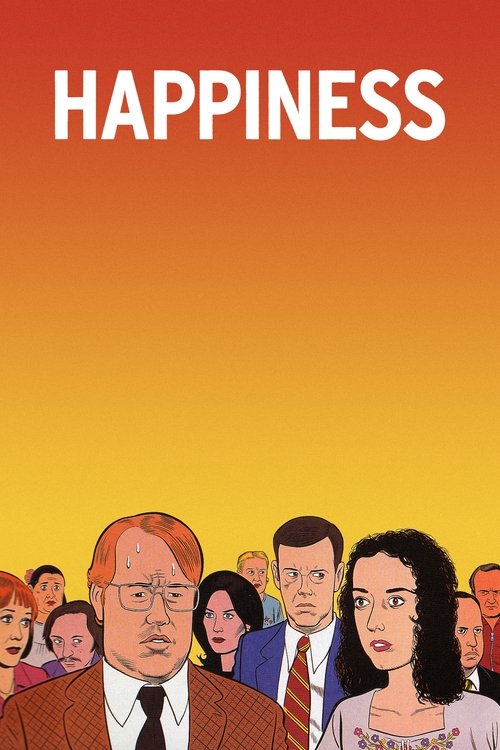
Happiness
1998 · Todd Solondz
For when you want the most challenging thing on the shelf — a film to test your limits and then argue about at length. This is the opposite of comfort viewing; watch it when you're ready to be genuinely disturbed and genuinely engrossed.
What it's about
Three adult sisters in New Jersey — an unlucky aspiring songwriter, a celebrated poet hollowed out by success, and a contented suburban homemaker — anchor a web of neighbors, parents, and strangers, every one of them starving for connection. Around them: an obscene phone caller, a lonely neighbor, retirees quietly ending a marriage, and a respected family man hiding something monstrous.
The experience
Deadpan, squirm-inducing, and blackly funny in ways you'll feel guilty about — it walks you calmly into the most forbidden territory in American suburbia and refuses to flinch or let you off with easy contempt. Days later you're still turning it over.
Performances
Dylan Baker gives one of the bravest performances in American film as the suburban father with an unspeakable secret — horrifying precisely because he plays the man as human. Philip Seymour Hoffman is unforgettable as a sweaty, self-loathing phone creep aching for contact.
The craft
Todd Solondz composes it with eerie, catalog-bright precision — flat suburban frames and polite pastel surfaces that make the darkness underneath land harder. The interlocking-stories structure keeps rhyming loneliness across every household until the title curdles into irony.
Why it matters
So incendiary its own distributor dropped it, it became a cause célèbre of late-'90s independent film and the high-water mark for how far American dark comedy could go.
Snapshot
Happiness is Todd Solondz's mordant, formally precise ensemble film about the chasm between the human craving for connection and the grotesque, often monstrous forms that craving takes when it goes unmet. Structured as an interlocking suite of stories radiating outward from three adult sisters — the chronically unlucky aspiring singer-songwriter Joy (Jane Adams), the glamorous, self-absorbed poet Helen (Lara Flynn Boyle), and the complacent suburban homemaker Trish (Cynthia Stevenson) — the film widens to take in their estranged Florida-retiree parents, an obscene telephone caller (Philip Seymour Hoffman) and his lonely neighbor (Camryn Manheim), a Russian immigrant petty thief, and, most notoriously, Trish's husband Bill Maplewood (Dylan Baker), a suburban psychiatrist and family man who is also a pedophile. Solondz arranges this material with a deadpan, almost clinical evenness of tone that refuses both the easy comfort of satire-as-superiority and the catharsis of melodrama. The film stages acts that "society as a whole might find disturbing" — to borrow the synopsis's careful phrasing — not for shock but as the extreme outer edge of a pervasive condition: an entire social world of people unable to love or be loved, narrating their isolation to themselves in the bland vocabulary of self-help and therapy. Greeted at Cannes with the FIPRESCI International Critics Prize and trailed by a distribution scandal that made it a cause célèbre, Happiness became one of the defining American independent films of the late 1990s and the work that confirmed Solondz as the era's foremost anatomist of suburban shame.
Industry & production
Happiness emerged directly from the success of Solondz's breakthrough, Welcome to the Dollhouse (1995), the junior-high chronicle that had won the Grand Jury Prize at Sundance and rescued a directing career Solondz had nearly abandoned after the unhappy experience of his studio-adjacent debut, Fear, Anxiety & Depression (1989). The new film was produced through the orbit of two of the most important institutions of 1990s American independent cinema: Ted Hope and James Schamus's Good Machine, and Christine Vachon's Killer Films — the producing entities most associated with the transgressive, formally ambitious wing of the period's indie scene. Vachon, who had shepherded the work of Todd Haynes and other queer and provocateur filmmakers, was a natural home for material this confrontational.
The film's production history is inseparable from its distribution scandal, which became a landmark case in the late-1990s collision between independent content and corporate ownership. Happiness had been set for release through October Films, but October was by then partly owned by Universal, itself under the Seagram corporate umbrella, and the parent company — alarmed above all by the film's frank treatment of child sexual abuse — pressured October to drop it. Good Machine ultimately released the film itself, distributing it unrated rather than submit to the commercial death sentence of an NC-17 (or accept cuts). The episode crystallized anxieties about whether genuinely challenging work could survive within an increasingly consolidated media industry, and it gave Happiness an outlaw aura before most audiences had seen a frame. The film premiered in competition at the 1998 Cannes Film Festival, where it took the FIPRESCI critics' prize, and opened in the United States in October 1998.
Technology
Happiness is a conventionally produced late-1990s 35mm production, and it makes no claim to technological innovation; its means are entirely subordinated to its tone. Shot on film in a flat, brightly lit register that deliberately evokes the anonymity of suburban interiors, malls, and chain restaurants, the film draws its power from an almost anti-stylish photographic plainness rather than from any optical or effects apparatus. There is no meaningful sense in which the film advances or depends upon a particular technology, and it would be invention to claim otherwise; what is worth noting is the aesthetic choice to render its disturbing material in the visual idiom of a banal, well-lit normalcy — a technical restraint that is itself a dramatic strategy.
Technique
Cinematography
The cinematography is by Maryse Alberti, a director of photography whose background included significant documentary work and who would shoot a range of distinctive American independent films. Her work on Happiness is a study in calculated blandness: the lighting is even and unsparing, the suburban and Florida-condo interiors rendered in a clean, slightly clinical clarity that withholds the shadow and atmosphere a more conventional treatment of dark material might invite. The camera tends toward static, frontal, symmetrical compositions — characters framed flatly against the wallpaper of their lives — that hold on faces through excruciating exchanges without the relief of cutaways. This visual evenness is the film's central formal gambit: by photographing pedophilia, sexual humiliation, and murder in the same unhurried, well-lit manner as a family dinner or a therapy session, the cinematography refuses to mark the monstrous as visually exceptional, implicating the ordinary world that contains it.
Editing
The editing, by Alan Oxman, manages an unusually large braided ensemble across multiple households and two states, cross-cutting among storylines so that private agonies rhyme and comment on one another. The film's rhythm is patient and scene-driven; Oxman and Solondz characteristically let sequences run past the point of comfort, holding on a conversation until its social surface cracks and the unbearable thing underneath is exposed. The cutting rarely hurries to a punchline or a release, and the film's signature effect — the long, dread-laden dialogue scene that the audience cannot escape — depends on this editorial willingness to deny relief. The interweaving structure also builds the film's thematic argument cumulatively: no single story is the center, and the editing's democratic distribution of attention across pathetic, sympathetic, and horrifying characters alike enforces the film's refusal to sort its people into the redeemable and the damned.
Mise-en-scène / staging
Solondz's staging is rooted in the textures of American middle-class normalcy: the New Jersey suburban home, the Florida retirement condo, the chain restaurant, the bland bedroom. Production design and costuming render this world with a deadpan accuracy that verges on the satirical without tipping into caricature — the comfortable Maplewood household is precisely the picture of unremarkable suburban success, which is the point. The staging repeatedly exploits the gap between placid surface and buried content: the most disturbing conversations occur across kitchen tables and in tucked-in bedrooms, in domestic settings whose ordinariness makes the content more rather than less appalling. Solondz favors a frontal, theatrical arrangement of actors that keeps performances legible and exposed, and he stages the film's queasiest scenes — a father's bedtime talk with his son, a breakfast-table confession — with a stillness that gives the actors nowhere to hide and the audience no visual escape.
Sound
The film's sonic world is dominated by dialogue and by the flat ambient hum of suburban and institutional spaces. The original score is by Robbie Kondor, whose music threads an ironic, sometimes plaintively sweet register beneath the action, occasionally underscoring the characters' yearning with a sincerity the images withhold — a counterpoint that sharpens the film's central tension between sentiment and squalor. Equally important is the film's diegetic use of soft, anodyne pop and easy-listening textures, and of Joy's own earnest, mediocre songwriting, whose banal sincerity ("Happiness," in particular, functioning as a bleakly ironic motif) embodies the film's theme: the language of feeling reduced to greeting-card cliché by people who cannot actually feel their way to one another. The sound design otherwise privileges the agonizing realism of speech — the pauses, evasions, and euphemisms through which these characters fail to communicate.
Performance
Performance is the film's summit, and its ensemble is among the finest assembled in 1990s American independent cinema. Dylan Baker's Bill Maplewood is the film's most extraordinary feat: a performance of complete, terrifying ordinariness that presents the pedophile not as a monster set apart but as a soft-spoken, self-aware suburban father, a characterization that makes the film's refusal of easy moral distance possible. Philip Seymour Hoffman, in one of his early defining roles, plays the obscene phone caller Allen with a raw, sweat-soaked pathos that finds the abject loneliness beneath the transgression. Jane Adams gives Joy a fragile, wincing sweetness; Lara Flynn Boyle and Cynthia Stevenson complete the trio of sisters with brittle vanity and oblivious contentment respectively. Ben Gazzara and Louise Lasser, as the parents whose marriage is quietly dissolving, bring a worn gravity, and the supporting playing — Camryn Manheim's lonely neighbor, Jared Harris's Russian thief, Jon Lovitz's bitter rejected suitor in the film's celebrated opening scene, and the child actor playing Bill's son in the devastating final exchanges — sustains the film's uniform tonal control. The casting against type and the actors' collective commitment to playing this material straight, without winking, are what allow the film to be at once excruciatingly funny and genuinely harrowing.
Narrative & dramatic mode
Happiness operates in a mode of deadpan tragicomedy organized as a mosaic or ensemble braid rather than a single linear plot. It has no protagonist; it has a condition, distributed across a dozen characters whose stories touch and refract. The dramatic engine is not suspense in the conventional sense but a mounting dread, generated by the audience's growing knowledge of what each character conceals and by the film's willingness to follow each concealment to its logical, often catastrophic end. The film's tonal achievement is its sustained doubleness: scenes are constructed so that the comic and the appalling occupy the same instant, the laugh and the recoil indistinguishable. This is comedy of embarrassment pushed to a moral extreme — the cringe escalated until it becomes a confrontation with cruelty and despair. The film withholds redemption and catharsis almost entirely; its closest thing to a climax, the final father-son conversation in which Bill answers his son's questions with an unbearable candor, resolves nothing and offers only the bleakest possible note of frustrated longing. The dramatic mode, in short, is irony sustained past the point where irony usually provides protection, until the viewer is left without the customary defenses.
Genre & cycle
The film sits at the intersection of black comedy and suburban melodrama, and it belongs to a recognizable late-twentieth-century American cycle: the cinema of suburban anomie, films that turn a corrosive eye on the pathologies beneath middle-class normalcy. Its kin include the suburban-gothic strain running from earlier explorations of small-town rot through the contemporaneous wave of late-1990s suburban-malaise pictures, with which Happiness shares a setting and a thematic preoccupation while pushing the material far past their limits. Within American independent cinema of the 1990s it belongs to the provocateur wing — work designed to test the audience's tolerance and to dissolve comfortable moral positions — alongside the Killer Films and Good Machine catalogs. It is also, crucially, a film of the ensemble or "network narrative," part of a 1990s vogue for interwoven multi-character structures, though Solondz bends that form away from feel-good interconnection toward a vision of isolation that no amount of plot-braiding can knit into community. Within Solondz's own filmography it forms part of a continuous project — his career-long anatomy of suburban cruelty, humiliation, and the failure of empathy — that he would revisit explicitly when he returned to these very characters, recast, in Life During Wartime (2009).
Authorship & method
Happiness is unmistakably a Todd Solondz film, and it concentrates the preoccupations that define his authorship: suburban shame, the cruelty ordinary people inflict on one another, the vast gap between the desire for love and the capacity for it, and a flat, frontal, deadpan style that refuses to editorialize. Solondz both wrote and directed, and his screenplay is the film's foundational achievement — its structural daring, its tonal control, and its willingness to grant interiority and even sympathy to a child molester without ever excusing him are all functions of the writing. His method, evident across his work, is to extend scenes past comfort, to write dialogue in the euphemistic register of therapy and self-help, and to hold his actors to a non-ironic sincerity that makes the irony of the whole more devastating.
Among his key collaborators, cinematographer Maryse Alberti supplied the deliberately affectless visual surface; editor Alan Oxman shaped the braided structure and the unbearable durations; and composer Robbie Kondor provided the plaintive, ironic musical counterpoint. The producing alliance of Ted Hope, James Schamus, and Christine Vachon gave the film both its institutional backing and the resolve to release it uncut and unrated when corporate distribution collapsed. But the authorship is, above all, the meeting of Solondz's conception with a cast willing to inhabit it without vanity or hedging — Dylan Baker's performance in particular standing as a kind of co-authored realization of the film's central, almost unbearable argument.
Movement / national cinema
Happiness is a landmark of the American independent cinema of the 1990s — the post-sex, lies, and videotape, Sundance-and-Miramax era in which a generation of writer-directors produced personal, often abrasive features outside (or at the contested edges of) the studio system. It belongs specifically to the more uncompromising, less commercially domesticated wing of that movement, associated with Good Machine and Killer Films, that prized provocation and formal risk over crossover palatability. As an artifact of national cinema it is profoundly American in its subject: the suburb as the characteristic landscape of postwar middle-class life, and the failure of that landscape's promise of contentment. The distribution battle that surrounded it also makes it a documentary case in the history of American independent film — a marker of the precise moment when the consolidation of indie distributors under major-studio ownership began to constrain the very transgression those distributors had been built to enable.
Era / period
The film is a precise artifact of the late 1990s, and its texture is saturated with that decade's particular cultural surfaces: the therapeutic vocabulary, the self-help and recovery idiom, the talk-show confessional mode of public emotion, all of which the film's characters speak fluently and to no avail. Its New Jersey suburbs and Florida retirement condos belong to a specific moment of American middle-class prosperity whose comfort the film reads as a thin membrane over despair. The anxieties it dramatizes — about pedophilia and the safety of children, about sexual dysfunction and loneliness in an ostensibly liberated culture, about the hollowness of suburban achievement — were live concerns of the period, and the film's frankness about child sexual abuse in particular touched a cultural nerve raw enough to make a major corporation flee from it. Happiness registers the gap between the era's optimistic public language of self-fulfillment and the private desolation that language was failing to name.
Themes
The film's governing theme is the title's own bitter irony: happiness as the universally pursued and universally unattainable object, sought by every character and grasped by none. Around this orbit several interlocking concerns. There is the theme of isolation and the failure of connection — a world of people who cannot reach one another, whose every attempt at intimacy curdles into rejection, humiliation, or violation. There is the theme of the monstrous within the ordinary, embodied above all in Bill Maplewood, the loving suburban father who is also a child rapist, a juxtaposition the film uses to dismantle the comforting fiction that evil announces itself and lives elsewhere. There is the theme of shame and concealment — the secret lives behind respectable façades, and the corrosive labor of keeping them hidden. There is a sustained critique of the therapeutic culture, whose language of feeling the characters deploy precisely as a substitute for, and barrier to, actual feeling. And running beneath all of it is the film's refusal of moral hierarchy: by granting its most repellent figures the same flat, unsparing attention as its sympathetic ones, Happiness insists that the longing for love is continuous across the whole spectrum of human behavior, from the pathetic to the unforgivable — a proposition that is the source of both its compassion and its capacity to disturb.
Reception, canon & influence
Happiness was among the most discussed and divisive films of 1998. It drew strong critical admiration — it won the FIPRESCI International Critics Prize at Cannes and was honored by several major American critics' bodies and the National Board of Review, with particular recognition for Solondz's screenplay and for the ensemble, especially Dylan Baker and Philip Seymour Hoffman — even as its subject matter generated revulsion in some quarters and the distribution controversy kept it perpetually in the cultural conversation. The critical consensus that emerged regarded it as a brilliant, formally rigorous, and almost unbearably bleak achievement, and it has since secured a place in the canon of 1990s American independent cinema as one of the decade's defining provocations.
Influences on the film run backward to the tradition of suburban-gothic American storytelling and to the European art-cinema lineage of films that observe human cruelty with a cold, unflinching eye; to the ensemble or network-narrative structures in vogue in 1990s cinema; and, within Solondz's own development, directly to Welcome to the Dollhouse, whose excavation of adolescent humiliation Happiness extends into the adult world. Its deadpan tone and frontal style belong to a broader strain of ironic American filmmaking, but the film pushes that idiom past the protective distance irony usually affords.
Its influence forward is felt most directly in Solondz's own subsequent work, which continued the project of suburban anatomy and which literally returned to these characters — recast — in Life During Wartime (2009). More broadly, Happiness helped license a strain of uncompromising tonal extremity in American independent cinema, demonstrating that a film could hold comedy and atrocity in the same frame and find an audience for the result. For its actors it was career-shaping: it announced Dylan Baker's capacity for fearless work and stands as one of the early showcases of Philip Seymour Hoffman's gift for abject, fully inhabited loneliness. And the saga of its release became a recurring reference point in debates about artistic freedom under corporate media ownership. The film retains a secure, if necessarily uneasy, place in the canon — a touchstone for the proposition that cinema can extend empathy into territory most art declines to enter, without ever pretending that empathy redeems what it finds there.
A Deleuzian reading
A father and his son sit at the breakfast table.
The full Deleuzian reading of Happiness →
Reception
In 1998 it was a scandal object — its own distributor's parent company (Universal) forced October Films to drop it, and it went out unrated — even as critics championed it at Cannes. Now it's canonized as a peak of transgressive 90s American indie cinema, the 'feel-bad masterpiece' against which others get measured.
How Happiness was received, from release to now →
Influences: the films it descends from and the films it influenced
- Welcome to the Dollhouse (1995) — Solondz's own immediate precursor establishes the frontal, flatly-lit, deadpan staging of suburban humiliation that Happiness transposes from the schoolyard into the adult household.
- Nashville (1975) — Originates the multi-strand network-narrative architecture — a dozen disconnected lives braided by cross-cutting toward a shared social diagnosis — that structures Happiness's ensemble.
- Short Cuts (1993) — The proximate model for Happiness's mosaic editing: intercut Southern-California domestic vignettes whose juxtaposition, not causation, supplies the meaning.
- Carnal Knowledge (1971) — Stages sexual failure in static, frontal, clinically composed two-shots that hold characters at conversational deadpan, the blocking grammar Happiness adopts for its scenes of thwarted intimacy.
- The Graduate (1967) — Pioneers the ironic-plaintive pop score laid as counterpoint over suburban anomie, the exact tonal device Robbie Kondor's music and the anodyne diegetic songs reprise.
- Blue Velvet (1986) — The suburban-gothic excavation of perversion festering beneath placid manicured surfaces that licenses Happiness's willingness to look directly at predation in the family home.
- The Seventh Continent (1989) — Models the clinical, static, frontal framing and extended durations that observe bourgeois cruelty without editorial cue, the affectless surface Maryse Alberti's cinematography supplies.
- Ordinary People (1980) — Establishes the euphemistic therapy-and-self-help register of dialogue about repressed suburban families that Solondz writes straight and weaponizes for irony.
- The Discreet Charm of the Bourgeoisie (1972) — The deadpan satirical anatomy of bourgeois propriety that holds comedy and atrocity in one unflinching frame, the European art-cinema precedent for Happiness's tonal fusion.
- The Ice Storm (1997) — Extends the ensemble of repressed suburbanites into deadpan dramatic irony, observing cruelty and longing through static, symmetrical framing without judgment.
- Bleak Moments (1971) — Inherits the 'comedy of embarrassment' — sustained, unrelieved social awkwardness played for simultaneous laughter and pain — that Leigh's model seeded.
- Pink Flamingos (1972) — Plays taboo material in symmetrical static frontal wides with no score, letting the deadpan proscenium framing rather than editing carry the transgression — Waters' composition strategy stripped of camp delivery.
- American Beauty (1999) — Extends the symmetrical-frontal framing and ironic remove over suburban anomie, though it redeems where Happiness pointedly declines to.
- Little Children (2006) — Directly inherits Dylan Baker's achievement — a suburban ensemble granting interiority to a sex offender without exoneration — wrapped in the same deadpan ironic-narration distance.
- Me and You and Everyone We Know (2005) — Carries forward the deadpan staging of cringe-inducing suburban discomfort, including uneasy child-sexuality material played in flat, frontal, non-editorializing frames.
- Life During Wartime (2009) — Literally returns to Happiness's characters with a wholly recast ensemble, continuing the suburban-anatomy project and the durational-discomfort method on the same dramatis personae.
- L.I.E. (2001) — Established the template L.I.E. inherits directly: a suburban pedophile (Dylan Baker's Bill Maplewood) rendered in patient, unflinching close-third without exculpation or sensationalism — the exact register Cuesta and Brian Cox adopt for Big John.
- Mysterious Skin (2005) — Depicts child sexual abuse in suburbia with unbearable clinical empathy and formal restraint rather than sensation — the beauty-and-atrocity register Araki adopts for the abuser's grooming scenes.
- Trick 'r Treat (2007) — Dylan Baker's method of playing a suburban predator with flat, uninflected paternal warmth — the horror carried entirely by the absence of performed menace — is the specific performance Dougherty casts for and reuses in the Steven Wilkins strand.
- Safe (1995) — Contemporary indie kin that renders suburban anomie through flat clinical lighting and static symmetrical compositions, refusing to editorialize over its heroine's hollowing-out.
- Funny Games (1997) — Same-moment experiment in trapping the viewer inside cold frontal frames with atrocity, sharing Happiness's strategy of denying irony its protective distance.
- Magnolia (1999) — Near-simultaneous network-mosaic of cross-cut San Fernando Valley despair, sharing both the braided-ensemble structure and Philip Seymour Hoffman's register of abject loneliness.
Similar films
- The Graduate (1967) — influence & lineage · often watched together
- American Beauty (1999) — influence & lineage
- Me and You and Everyone We Know (2005) — influence & lineage
- Funny Games (1997) — influence & lineage
- The Seventh Continent (1989) — influence & lineage
- Nashville (1975) — influence & lineage · often watched together
- The Idiots (1998) — often watched together
- Synecdoche, New York (2008) — shared sensibility
All the films related to Happiness →