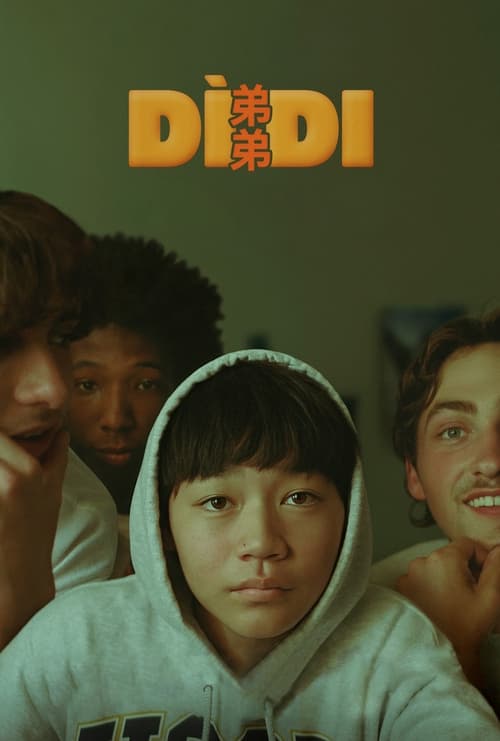
Dìdi (弟弟)
2024 · Sean Wang
Dìdi's Sundance breakout made him the voice of the Asian-American skate-era coming-of-age wave and a "filmed his grandmas into an Oscar nomination" feel-good story.
For when you want to laugh at your own adolescence and then unexpectedly need to text your mom — a warm, easy watch with a soft emotional gut-punch. Perfect for anyone who came of age online.
What it's about
Fremont, California, summer 2008: thirteen-year-old Chris Wang has one month left before high school, and he spends it trying to break into a crew of older skaters, decode his first crush, curate his MySpace self, and survive a house shared with his college-bound sister, his grandmother, and a mother holding the family together alone. It's a coming-of-age story where the hardest lesson is learning to see your mom as a person.
The experience
Funny, cringey, and disarmingly tender — it nails the specific agony of being thirteen and trying on personalities like outfits. The 2008 internet nostalgia is a constant pleasure, but the mother-son scenes are what stay with you.
Performances
Izaac Wang is painfully believable as Chris, and Joan Chen is quietly extraordinary as his mother — a performance of swallowed frustration and stubborn love. The director's own grandmother, Chang Li Hua, adds an irreplaceable authenticity.
The craft
Sean Wang recreates 2008 with obsessive precision — AIM away messages, camcorder skate clips, early YouTube — and weaves those screens into the storytelling rather than using them as set dressing. The semi-autobiographical grounding gives every embarrassment the sting of memory.
Why it matters
It won the Audience Award and a Special Jury Award at Sundance 2024 and stands as a signature entry in the current wave of Asian American filmmaking, announcing Sean Wang as a director to watch.
Snapshot
Dìdi is Sean Wang's semi-autobiographical debut feature, a coming-of-age drama set across the final weeks of summer 2008 in Fremont, California, following Chris "Wang-Wang" Wang, a thirteen-year-old Taiwanese American boy negotiating skate culture, first crushes, online self-invention, and the fraught tenderness between himself and his mother. The film premiered at the Sundance Film Festival in January 2024, where it won the U.S. Dramatic Audience Award and a Special Jury Award recognizing its ensemble cast, and was subsequently released by Focus Features. It arrived as one of the most visible entries in a maturing wave of Asian American filmmaking, distinguished by its hyper-specific period texture — MySpace, AIM away messages, early YouTube, Motorola flip phones, camcorder skate videos — and by casting the director's own grandmother in a central role. Modest in scale and budget, it is best understood as a personal memory-film in the lineage of Eighth Grade, Mid90s, and The Farewell, rather than as a commercial event.
Industry & production
Dìdi was produced largely through Antigravity Academy, the production company Wang founded with collaborators including cinematographer Sam Davis, alongside additional independent financing and production partners; a full, itemized financing breakdown is not publicly detailed, and I won't manufacture figures. It is a low-budget American independent feature — the kind of film that reaches the market through festival validation rather than pre-sold theatrical infrastructure. That pathway is exactly what happened: the film was completed independently, premiered at Sundance, and was acquired there by Focus Features (a Universal specialty label), which handled its U.S. theatrical release in mid-2024.
The production leaned on strategies typical of first features made from lived experience: shooting in and around the Bay Area to preserve the authenticity of place; casting a mix of a professional lead, a veteran star, non-professional and first-time teen actors, and a family member. The most notable industrial fact is continuity of authorship — Wang moved directly from an acclaimed documentary short into a narrative feature with an overlapping creative team, allowing the feature to inherit a settled visual and tonal sensibility rather than assembling one from scratch. Box-office performance was modest and specialty-scaled; I have no reliable exact grosses to cite and will not invent them.
Technology
Dìdi was shot digitally in the contemporary independent manner, but its defining technological gesture is textural rather than infrastructural: the film continually folds in the visual grammar of 2008-era consumer recording. Chris and his friends film skate lines on handheld camcorders, and these low-resolution, motion-smeared, timestamped images are woven into the film's texture, so that the movie is partly about the act of recording adolescence on cheap DV. This creates a deliberate two-tier image system — the polished frame of the film proper against the degraded, compressed look of camcorder and early-web video.
Beyond the diegetic camcorders, the film reconstructs the interface world of the late-2000s internet: MySpace profiles, YouTube video pages, AOL Instant Messenger windows, phone screens. These screen surfaces function as a period technology "set" as important as any physical location, and the film treats the friction of that early social web — the performance of an online self, the vulnerability of a sent message — as central dramatic material. Where the precise camera and codec specifications are not part of the public record, I'm flagging that rather than guessing at them.
Technique
Cinematography
The photography, by Sam Davis, favors an intimate, observational register keyed to a thirteen-year-old's point of view: handheld and shoulder-level framing that stays close to Chris's body and face, shallow-focus attention on small gestures, and a palette that reads as sun-warmed suburban summer without tipping into overt nostalgia kitsch. Davis had already established a shared visual language with Wang on their documentary work, and the feature carries that documentary instinct — patience with faces, willingness to let a scene breathe, an eye for the ordinary geography of strip malls, driveways, and bedrooms. The interpolated camcorder footage is the counterpoint: where the "clean" cinematography observes Chris, the DV footage is what Chris and his friends make, and the contrast between being seen and choosing how to present oneself is built into the image design.
Editing
Editorially the film is structured as an episodic drift through a single summer, a loose-jointed accretion of hangouts, humiliations, and small ruptures rather than a tightly plotted arc. Cutting integrates the screen-life of instant messaging and online video directly into scenes, so that the rhythm of the film absorbs the stop-start tempo of typing, deleting, and waiting for a reply. The editing has to manage tonal whiplash — comedy of adolescent bravado collapsing into shame, warmth curdling into cruelty — and the film's coherence depends on holding those swings without either over-explaining or losing the thread of the mother-son relationship beneath the surface incident.
Mise-en-scène / staging
The production design is the film's most conspicuous craft achievement: a granular reconstruction of 2008 middle-class Asian American suburbia, down to bedroom posters, gadgets, clothing, and the specific look of a family home shared across three generations. Staging repeatedly places Chris between worlds — the domestic interior governed by his mother and grandmother, and the outdoor social arena of skaters and crushes — and the blocking dramatizes his code-switching, the way he carries himself differently at home, with older skaters, and with the girl he likes. The household scenes are staged for friction and proximity, the crowded intimacy of a family in which love is expressed obliquely, through food, correction, and worry rather than declaration.
Sound
The soundscape braids period-specific needle-drops and the ambient audio of the late-2000s internet — notification pings, dial-up-adjacent digital chirps, the tinny audio of streamed video — into the fabric of the film, so that sound does much of the period-locating work. An original score by Giosuè Greco underpins the emotional line, particularly the mother-son thread, working in a restrained register that lets the pop and web-audio textures carry the surface energy while the score reaches for the film's deeper feeling. The sound design treats the digital world as environment rather than gimmick.
Performance
Performance is where the film's Sundance jury citation landed, and rightly so. Izaac Wang carries the film as Chris with an unshowy naturalism that captures adolescent volatility — the swing from swaggering to stricken, the casual cruelties and sudden neediness of a boy who does not yet understand himself. Joan Chen, as his mother Chungsing, gives a performance widely received as a significant return to prominence, playing a woman whose thwarted artistic ambitions and immigrant sacrifice register in restraint and accumulated tenderness rather than in speeches. The most unusual casting is the director's own grandmother, Chang Li Hua, as Chris's Nǎi Nai, whose presence brings a documentary authenticity to the household. The surrounding ensemble of young and largely non-professional actors supplies the film's lived-in social texture.
Narrative & dramatic mode
Dìdi operates in the mode of the episodic memory-film: a low-stakes-on-the-surface, high-stakes-underneath account of a specific person in a specific season, told with autobiographical fidelity and a comic-melancholy tone. Its dramatic engine is not external plot but the daily accumulation of social risk — trying to belong to an older skate crew, trying to be liked by a girl, trying to reinvent himself online — set against the slow-burning central relationship with his mother, which the film withholds and then delivers as its emotional payoff. The comedy is character-based and often cringe-adjacent, mining the specific mortifications of being thirteen, while the drama lives in what goes unspoken between generations. The title itself — dìdi, "little brother" — frames the protagonist through his family position, foregrounding that this is a film about a boy located within a household as much as within his peer world.
Genre & cycle
The film sits squarely in the contemporary American independent coming-of-age cycle, and converses openly with recent touchstones: Bo Burnham's Eighth Grade (adolescent anxiety mediated by screens), Jonah Hill's Mid90s (skate-crew initiation and masculine belonging), and Greta Gerwig's Lady Bird (a semi-autobiographical mother-child drama rooted in a specific California town and year). It also belongs to a more particular sub-cycle — the Asian American family film that reached wide visibility with The Farewell, Minari, and Everything Everywhere All at Once — and it fuses that lineage's intergenerational, immigrant-family concerns with the skate-film and screen-life-of-a-teenager idioms. Its period-specific 2008 setting also places it within a growing body of late-2000s-nostalgia cinema that treats the early social web as historical material.
Authorship & method
Dìdi is a paradigmatic personal debut. Sean Wang grew up in Fremont, and the film is openly semi-autobiographical, drawing on his own adolescence, his family, and the emotional territory of his relationship with his mother and grandmother. Crucially, the feature grew directly out of his documentary short Nǎi Nai & Wài Pó (2023), a portrait of his two grandmothers that earned an Academy Award nomination in the documentary short category; casting his grandmother in the feature extends that project's method — using real family and real place as the ground of fiction.
His key collaborators reinforce that continuity. Cinematographer Sam Davis is a longtime creative partner and co-founder with Wang of Antigravity Academy, and his handheld, observational photography is inseparable from the film's voice. Editor Arielle Zakowski shapes the episodic, screen-inflected rhythm. Composer Giosuè Greco provides the restrained emotional underscore. Wang wrote as well as directed, so the authorship is unusually unified — a single sensibility, developed through documentary practice and a settled collaborative team, translated into first-person fiction. Where individual crew credits beyond these are not something I can verify precisely, I'm leaving them unstated rather than inventing them.
Movement / national cinema
The film is best located within Asian American cinema's second major wave of the late 2010s and 2020s — the movement that followed Crazy Rich Asians, The Farewell, Minari, and Everything Everywhere All at Once into mainstream and specialty visibility. Within that movement, Dìdi represents a shift toward the intimately regional and generationally specific: not diaspora as grand statement but as the ordinary texture of a Taiwanese American boyhood in a particular Bay Area suburb. It is simultaneously a product of the American Sundance-independent ecosystem, which supplied its financing pathway, festival launch, and distribution model. The film thus sits at the intersection of two lineages — the U.S. indie coming-of-age tradition and the ascendant Asian American family film — and its significance lies partly in showing that the latter can be as small, local, and personal as the former.
Era / period
Made and released in 2024, Dìdi is fully a film of the 2020s independent moment in its production and reception, but its imaginative center is 2008 — and the gap between those two dates is the point. The film treats the late-2000s internet (MySpace, AIM, YouTube, flip phones, camcorder skate videos) as a specific, now-vanished technological and cultural era, recent enough to be remembered by its target audience and distant enough to feel like a lost world. It is, in that sense, a film about the first generation to come of age on the social web, made just as that era passed decisively into history.
Themes
The film's central theme is the difficulty of self-invention at thirteen — the labor of assembling an identity across incompatible audiences: family, peers, older kids, and the online self one performs and edits. Running beneath it is the immigrant-family drama of love that cannot be spoken directly, concentrated in the mother-son relationship: Chungsing's sacrificed ambitions and unglamorous devotion against Chris's adolescent shame at his own family. Second-generation identity and belonging thread throughout — the negotiation of being Taiwanese American among white and other-Asian peers, the small betrayals of assimilation, the question of where one fits. The film also examines adolescent masculinity and the desire for acceptance within a male peer group, the cruelty and neediness of that age, and the mediating role of screens in intimacy and humiliation. Finally, it is a film about generational proximity — three generations under one roof — and about the belated recognition of a mother's interior life.
Reception, canon & influence
Dìdi was received warmly at Sundance, where its Audience Award (U.S. Dramatic) signaled unusually strong crowd affection and the Special Jury Award for its ensemble cast recognized its performances; those two honors are the firmest points on its awards record and I'll rest on them rather than overstate the rest. Critical reception was broadly positive, with particular praise directed at Joan Chen's performance as a significant return, at Izaac Wang's naturalism, and at the film's granular period authenticity; some critics situated it admiringly within the Eighth Grade / Lady Bird / Mid90s tradition while noting the freshness its Asian American specificity brought to that form. Where individual publications' verdicts or additional award outcomes are concerned, I'm not going to fabricate quotations or specific citations.
Looking backward, the influences on the film are legible and openly acknowledged in its form: the screen-mediated adolescent anxiety of Eighth Grade, the skate-crew coming-of-age of Mid90s, the autobiographical mother-child California drama of Lady Bird, and the intergenerational Asian American family portraiture of The Farewell — the last especially resonant given both films' use of a grandmother as an emotional anchor. Its more distant ancestor is the observational, place-rooted memory-film tradition of directors who mine their own youth.
Looking forward, the film's legacy is best assessed with appropriate caution given how recent it is. Its clearest significance is as the announcement of Sean Wang as a filmmaker and as further proof that the Asian American family film can succeed at an intimate, hyper-local, low-budget scale rather than only as broad crossover spectacle. It also stands as an early canonical example of late-2000s-internet nostalgia rendered with archival precision, a template other filmmakers of that generation are likely to follow. Whatever longer influence it exerts will become clearer with time; for now its documented impact is the festival success, the critical embrace, and the platform it established for its director and for Joan Chen's renewed visibility.
Reception
A Sundance 2024 darling — it took both the U.S. Dramatic Audience Award and a Special Jury Award for its ensemble — that made modest money in theaters but almost immediately settled into Letterboxd life as a comfort-watch coming-of-age staple.
How Dìdi (弟弟) was received, from release to now →
How to watch Dìdi (弟弟): what to notice on a first viewing
- Watch the handheld camera stay close to Chris's face and body. Sam Davis shoots at shoulder level, close and observational, keeping the frame tied to a thirteen-year-old's physical point of view rather than a wider, adult vantage. The closeness puts you inside his exact height and distance from everything happening around him.
- Notice the MySpace pages, AIM windows, and flip phones everywhere. Bedroom posters, gadgets, and clothing reconstruct 2008 suburbia in granular detail, right down to the specific interfaces of an internet that no longer exists in this form. The period detail is so exact it works less as nostalgia than as documentation.
- Notice the grainy camcorder footage cut into the clean image. Skate videos Chris and his friends film themselves are woven into the film at a visibly lower resolution than the polished cinematography surrounding them. The contrast marks the difference between being watched and choosing how you present yourself.
- Watch how differently Chris carries himself at home versus outside. The blocking shifts his posture and manner between the crowded family interior and the outdoor world of skaters and crushes, a visible code-switch scene to scene. You can read exactly which version of himself he's performing just from how he stands in a room.
- Watch Joan Chen's restraint in even the smallest scenes. As the mother Chungsing, she registers thwarted ambition and quiet sacrifice through small, accumulated gestures rather than through any speech explaining her feelings. Her restraint is doing the emotional work the script deliberately leaves unspoken.
The whole guide to watching Dìdi (弟弟), with the keys for a rewatch →
Influences: the films it descends from and the films it influenced
- Nǎi Nai & Wài Pó (2023) — Wang's own Oscar-nominated documentary short about his two grandmothers established the real-family/real-place method the feature extends by casting his actual grandmother, turning documentary observation into fiction's ground.
- The 400 Blows (1959) — Founds the semi-autobiographical debut built from a director's own adolescence, using a naturalistic child lead and observational location shooting rather than plot machinery — the template Dìdi's episodic memory-film follows.
- American Graffiti (1973) — Model for a single-summer, single-locale youth ensemble drifting between vignettes, its era fixed through wall-to-wall period needle-drops — the nostalgia-through-precise-soundtrack device Dìdi ports to late-2000s web audio.
- Yi Yi (2000) — Yang's patient, restrained multigenerational family staging — holding wide on domestic rooms so a grandmother, parents and child share the same frame — informs Dìdi's intergenerational blocking and unhurried observational tempo.
- Fish Tank (2009) — Handheld, close-following observational camera bonded to a volatile non-professional teenage lead, mining behavior over dialogue — the naturalistic performance-capture method Dìdi's cinematography adopts.
- Lady Bird (2017) — Autobiographical California mother-child drama structured as episodic drift across a school year, where the parent conflict is the true emotional spine — the shape and register Dìdi mirrors with a mother instead of daughter.
- The Florida Project (2017) — Extracts loose, improvisatory naturalism from non-professional child actors within a hyper-specific real location, letting kid-logic scenes run — the casting-and-directing approach behind Izaac Wang's lead.
- Mid90s (2018) — Skate/BMX crew coming-of-age with non-professional friend-group casting and obsessive period production design, structured as hangout vignettes — the direct genre-and-texture precursor Dìdi's summer crew descends from.
- Eighth Grade (2018) — Pioneers screen-life integration for adolescent anxiety, cutting phone/YouTube/social-feed interfaces into the drama as diegetic emotional text — the exact device Dìdi extends with MySpace-era browser and IM screens.
- The Farewell (2019) — Anchors an Asian American family film on a beloved grandmother and choreographs bilingual code-switching blocking — English among the young, Mandarin with elders — the intergenerational staging grammar Dìdi reuses.
- Minari (2020) — Semi-autobiographical Asian American family portrait told from a child's eye level with restrained naturalism and a grandmother's disruptive warmth, proving the hyper-local immigrant family drama at intimate scale.
- American Honey (2016) — Plotless, episodic-drift structure following a youth collective through handheld, present-tense observation with non-professional casting — the loose editorial rhythm Dìdi's summer wandering echoes.
- Aftersun (2022) — Builds an autobiographical memory-film on a two-tier image system, cutting diegetic camcorder/DV footage against the primary image so the recording device becomes the film's mnemonic texture — the same period-format layering Dìdi uses.
- We the Animals (2018) — Renders a semi-autobiographical boyhood through intimate handheld observation and interpolated non-fiction-textured imagery, treating memory as a shifting image-register — a parallel translation of documentary sensibility into first-person fiction.
- Skate Kitchen (2018) — Grows a fiction directly out of documentary practice by casting a real skate crew playing near-versions of themselves — the documentary-to-fiction, real-community casting method Dìdi shares.
- Turning Red (2022) — Roots an Asian-diaspora adolescence in exacting early-internet-era production design and the intergenerational mother/grandmother pressure of a specific milieu — the period-nostalgia-plus-family-code-switching pairing Dìdi renders in live action.
- Past Lives (2023) — An Asian American debut built on restraint — long, quiet naturalistic takes and bilingual code-switching carrying subtext the dialogue withholds — extending the same understated diaspora performance register.
- Rotting in the Sun (2023) — Cut by Sofía Subercaseaux, Silva's longtime editor, it shares her handling of screen-mediated adolescent life and tonal modulation — the same cutting sensibility that executes Rotting in the Sun's midpoint hairpin.
Similar films
- mid90s (2018) — influence & lineage
- Lady Bird (2017) — influence & lineage
- Yi Yi (2000) — influence & lineage
- Riceboy Sleeps (2023) — same viewing thread
- 18x2 Beyond Youthful Days (2024) — same viewing thread
- Big World (2024) — same viewing thread
- Happyend (2024) — same viewing thread
- Girls Like Girls (2026) — same viewing thread
All the films related to Dìdi (弟弟) →
Watch it with: curated runs of related films
- The Long Ache of Growing Up — A run of tender films about first love, self-discovery, and the pull of home — watch them close together and the years, cultures, and heartbreaks start to rhyme.