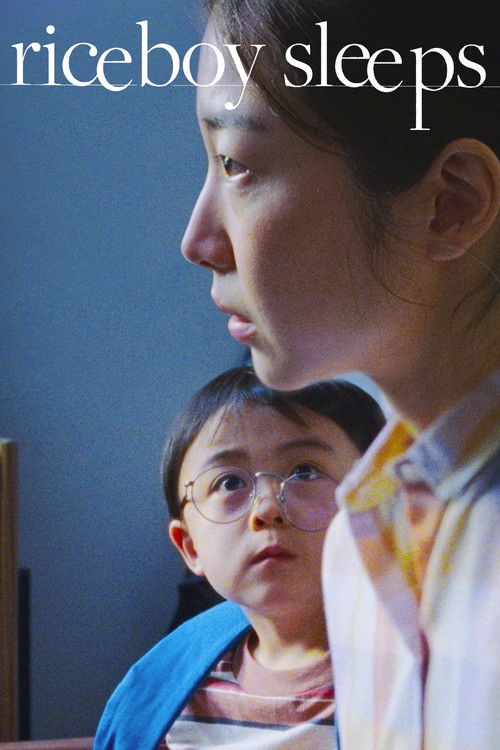
Riceboy Sleeps
2023 · Anthony Shim
For when you want a good cry that feels earned, or a film about family you'll be thinking about when you call your mother the next day. Gentle in pace, heavy in feeling.
What it's about
A Korean single mother raises her son alone in the suburbs of 1990s Canada, working a factory job and holding the line against a country that keeps making them feel foreign. As the boy grows into a teenager who wants nothing more than to blend in, the film follows the widening distance between them across a decade — and the grief from their old life that neither of them can quite say out loud.
The experience
Quiet, patient, and quietly gutting — it accumulates small moments of casual cruelty and fierce, practical love until the ending lands with real weight. It doesn't beg for your tears, which is exactly why it gets them.
Performances
Choi Seung-yoon, a dancer in her first screen role, is extraordinary as the mother — contained, proud, and wounded all at once, one of the most striking screen debuts in recent memory.
The craft
Shot on 16mm in long handheld takes that drift through kitchens, factory floors, and schoolyards like a family member trailing behind, the grain giving the '90s scenes the texture of actual memory rather than nostalgia-kit pastiche. Anthony Shim directs from his own semi-autobiographical material with striking restraint.
Why it matters
A breakout of the recent wave of Asian-diaspora filmmaking, sweeping Canadian film honors and marking Anthony Shim as a director to watch.
A Korean single mother and her son build a life in 1990s suburban Canada, and the film watches the ground shift between them across a decade — the boy assimilating, the mother holding fast, both carrying a grief neither can fully name. Anthony Shim's second feature is semi-autobiographical, and it belongs to the remarkable wave of Asian-diaspora cinema alongside Minari and Past Lives, though its temperament is its own: patient, unsentimental, alert to casual cruelty and to the fierce practicality of immigrant love. Shot on 16mm, it moves in long handheld takes that drift through kitchens, factory floors, and schoolyards like a family member trailing behind, the grain lending the '90s scenes the texture of memory rather than pastiche. Choi Seung-yoon, a dancer in her first screen role, gives one of the great recent debut performances as So-young — spine-straight, wry, quietly volcanic. The film won the Platform Prize at Toronto, announcing Shim (who also appears onscreen as the mother's suitor) as a filmmaker of unusual tact. Its final movement, back across the Pacific, earns every tear it draws.
Reception
No redemption arc needed — it arrived a winner, taking TIFF's 2022 Platform Prize and sweeping Canadian critics' awards. Since then it's traveled almost entirely by Letterboxd word-of-mouth, the acclaimed film most people still haven't gotten around to being wrecked by.
How Riceboy Sleeps was received, from release to now →
Influences: the films it descends from and the films it influenced
- Minari (2020) — Semi-autobiographical Korean-immigrant family drama filtered through a child's eye, using ethnographic domestic realism and restrained naturalistic performance rather than melodramatic underscoring — the explicit template Shim's film extends.
- Ratcatcher (1999) — Establishes the 16mm-grain childhood-observational poetic: elliptical, patient framing of a working-class boy where texture and long looks carry meaning instead of plot mechanics.
- The 400 Blows (1959) — Founding semi-autobiographical child-protagonist film whose handheld mobility and observational looseness license the naturalistic, non-judgmental gaze on a boy's inner life.
- Killer of Sheep (1978) — 16mm black-and-white ethnographic neighborhood realism cast with non-professionals, prioritizing textured everyday duration over dramatic incident.
- Yi Yi (2000) — Generation- and time-spanning family portrait told through patient long-take observation of domestic space, a structural model for the decade-spanning, quietly-accreting family drama.
- Still Walking (2008) — Grief-saturated family drama that stages a mother's emotional undercurrents through restrained performance and patient domestic observation rather than confrontation.
- Secret Sunshine (2007) — Korean grief drama anchored by a restrained lead performance and long observational takes that let anguish surface gradually within unbroken duration.
- Fish Tank (2009) — Handheld 16mm intimacy shadowing a first-time nonprofessional lead in tight, boxy frames, using grain and proximity to bind us to an adolescent's restless subjectivity.
- Wendy and Lucy (2008) — 16mm minimalist realism of economic precarity built on patient observational stillness and a pared-down, restrained central performance.
- The Namesake (2006) — Decade-spanning immigrant family saga hinged on transnational return and an evolving mother-child bond across two countries and generations.
- The Son (2002) — Codifies the handheld long-take following-shot as an ethical device — the camera trailing a body in unbroken real time to build restrained emotional tension without score.
- Past Lives (2023) — Diaspora narrative built on transnational return and decade-spanning ellipses, holding emotion in patient two-shots and withheld reaction rather than expository dialogue.
- The Farewell (2019) — Structures its drama around a diaspora protagonist's return to the homeland, balancing grief with restraint through composed observational framing of family gatherings.
- Gook (2017) — Korean-American semi-autobiographical realism shot in grainy monochrome with handheld intimacy, foregrounding non-professional/first-time leads in close, unglamorized frames.
- Blue Bayou (2021) — Uses film-grain texture and handheld proximity to render immigrant/adoptee precarity, tying an intimate parent-child bond to the threat of forced transnational removal.
- Aftersun (2022) — Semi-autobiographical memory film built from grainy, low-fi textures and elliptical patient observation of a parent-child relationship, trusting the audience to assemble grief from withheld information.
Similar films
- Still Walking (2008) — influence & lineage
- Past Lives (2023) — influence & lineage
- Dìdi (弟弟) (2024) — same viewing thread
- Minari (2021) — shared sensibility
- Blue Heron (2026) — shared sensibility
- House of Hummingbird (2019) — shared sensibility
- Mother (2009) — shared sensibility
- So Long, My Son (2019) — shared sensibility
All the films related to Riceboy Sleeps →
Watch it with: curated runs of related films
- The Long Ache of Growing Up — A run of tender films about first love, self-discovery, and the pull of home — watch them close together and the years, cultures, and heartbreaks start to rhyme.