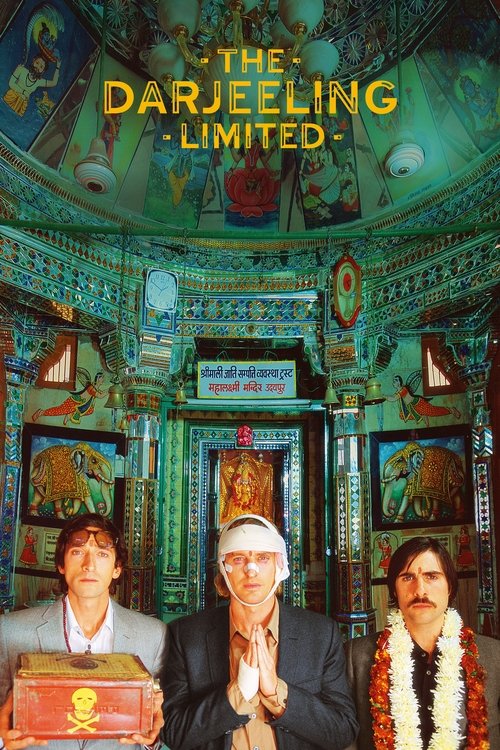
The Darjeeling Limited
2007 · Wes Anderson
For a wistful evening when you want something bittersweet and beautiful — comfort viewing for anyone who's ever had complicated family, or just wants to ride a gorgeous train for ninety minutes.
What it's about
Three American brothers who haven't spoken in the year since their father's funeral reunite on a gaudily beautiful train crossing India, armed with a laminated itinerary for the 'spiritual journey' the eldest has planned. The pilgrimage derails almost immediately — via painkillers, cough syrup, pepper spray, and a runaway snake — and the trip becomes the thing it was always secretly about: grief, and learning to be brothers again.
The experience
Droll and melancholy in the same breath — deadpan sibling bickering laid over a real undertow of loss, with bursts of color and music that make the sadness glow. It's funny in a quiet, wincing way, and it sneaks real emotion past your defenses.
Performances
Owen Wilson, Adrien Brody, and Jason Schwartzman genuinely feel like brothers — Wilson's bandaged, controlling optimist is a performance of surprising ache, and Brody, new to Anderson's world, fits it like he was born there.
The craft
Anderson shot on real Indian locations and a real moving train, and the collision of his meticulous, symmetrical style with the color and unpredictability of Rajasthan gives the film a warmth his more built worlds sometimes lack. The soundtrack leans on vintage Indian film music to gorgeous effect, and the whole thing is a procession of frames you could hang on a wall.
Why it matters
The hinge film in Anderson's career — his loosest, most openly emotional road movie, and the last before he turned toward fully fabricated worlds; time has been kind to its reputation.
Snapshot
Wes Anderson's fifth feature sends three estranged American brothers — Francis, Peter and Jack Whitman — across Rajasthan on a garishly beautiful train, ostensibly on a spiritual pilgrimage, actually on an unacknowledged errand of grief for a father dead a year and a mother who has fled to a Himalayan convent. It is Anderson's most openly picaresque film and his least architecturally symmetrical: a road movie laid on rails, in which the itinerary is laminated, the schedule collapses, and the transformation the characters have booked in advance refuses to arrive on cue. Released by Fox Searchlight after opening the Venice Film Festival in September 2007, and preceded by the thirteen-minute short Hotel Chevalier, the film sits at a hinge in Anderson's career — the last of his live-action films made in the loosely realist register of Rushmore and The Royal Tenenbaums before the full-blown fabulism of Fantastic Mr. Fox and The Grand Budapest Hotel. It was also the film that made the ethics of his style a mainstream critical question rather than a specialist one.
Industry & production
The Darjeeling Limited was produced by Anderson's American Empirical Pictures with Scott Rudin, Roman Coppola and Lydia Dean Pilcher, and distributed by Fox Searchlight — Anderson's first collaboration with the specialty label that would later release The Grand Budapest Hotel, Isle of Dogs and The French Dispatch. The move followed The Life Aquatic with Steve Zissou (2004), a large, expensive Touchstone production whose commercial disappointment made a leaner, location-based film the sensible next step. Pilcher's involvement mattered practically: she was Mira Nair's longtime producer (Monsoon Wedding, The Namesake) and brought working knowledge of production in India to a director who had never shot outside a controlled environment on that scale.
The signature production fact is the train itself. Rather than build a soundstage carriage, the production leased a working train from Indian Railways, repainted it in the film's blue-and-cream livery, dressed the carriages as sets, and shot aboard it while it moved on live track through Rajasthan. Cast and crew effectively lived on the vehicle. The consequence is visible in almost every interior: the light shifts because the sun is really moving past the windows, and the landscape sliding behind the actors is not a plate. It is an unusual reversal for Anderson, whose method normally runs toward total control — here he bought control of one object (the train) and accepted contingency everywhere outside it.
Principal photography took place largely in and around Jodhpur and the Rajasthani desert in late 2006 and early 2007. The screenplay was written by Anderson with Roman Coppola and Jason Schwartzman — the first Anderson feature not co-written with Owen Wilson, and the beginning of a writing partnership with Coppola that continued through Moonrise Kingdom, The French Dispatch and Asteroid City. The three writers traveled through India together during the writing, absorbing incidents and textures directly into the script, a working method closer to a notebook than to a conventional development process.
Hotel Chevalier, starring Schwartzman and Natalie Portman in a Paris hotel room, was shot separately and small, initially conceived as a standalone piece before being folded into the project as a prologue. Its release was genuinely novel for 2007: Anderson made it available free through iTunes ahead of the feature's opening, then had it attached to prints in theaters. A director using a digital storefront to seed a feature with a free companion short was, at the time, an experiment rather than a norm.
Technology
Technologically the film is deliberately conservative, and its interest lies in that conservatism. Robert Yeoman shot on 35mm in anamorphic Panavision at roughly 2.40:1, continuing the widescreen practice Anderson adopted with The Royal Tenenbaums. There is very little visual effects work; the film's gags and transitions are executed in camera or in the cut. Where The Life Aquatic had leaned on stop-motion sea creatures and a cutaway ship set, Darjeeling returns to photographic capture of real places, with the artifice supplied by design, costume and framing rather than by post-production.
The film's most consequential technical choices are logistical rather than digital. Shooting inside a narrow, moving carriage constrains lens choice, lighting and camera support in ways that shaped the grammar: lateral dolly moves along the corridor, frontal tableaux in compartments barely wider than the actors, and a general reliance on available and practical light through windows. The train is an apparatus as much as a set.
The second technological gesture is distributive. Hotel Chevalier's free digital release used the emerging infrastructure of online film delivery as a formal extension of the feature — the short is not a trailer or a supplement but a first act available in a different medium. Anderson's later short-form work, from the Prada films to the Roald Dahl adaptations made for Netflix, descends from this experiment.
Technique
Cinematography
Yeoman's work here is the loosest of his Anderson collaborations to that point. The planimetric frontal compositions and 90-degree camera geometry are all present — characters addressed head-on, walls parallel to the sensor, action turning in right angles — but the film adds an unusual amount of handheld and semi-handheld movement, particularly in the village sequences and the flashback to the father's funeral. Color is keyed to a narrow palette: the train's saturated blues, the ochres and dust of the desert, the brothers' gray suits like a uniform of inherited privilege.
Two shots carry disproportionate weight. The first is the whip-panning, slow-motion opening in which Peter overtakes a businessman (Bill Murray) sprinting for the train — a pure statement of the film's grammar and its generational joke, with Anderson's most familiar star literally left behind. The second is the late lateral tracking shot that glides past the train's compartments, discovering each character in turn — the mother, the ex-girlfriend, the steward, the businessman — arranged like a doll's house in cross-section, scored to The Kinks' "Strangers." It is the film's thesis in a single move: separate boxes, one vehicle, the illusion of connection produced by the camera rather than by the people.
Editing
The Darjeeling Limited marked Andrew Weisblum's arrival as Anderson's principal editor, a partnership that has continued across every subsequent feature. Weisblum's cutting here is brisker and more elliptical than David Moritz's on the earlier films. Scenes end early; the film jumps between incidents with the abruptness of a travel diary rather than the chaptered formality of The Royal Tenenbaums. The great exception is the funeral flashback, which arrives as a single, structurally isolated block — the film's one moment of sustained temporal retreat, and the emotional key it has been withholding.
Mise-en-scène / staging
The film is a catalog of objects that stand in for a dead man: eleven matching pieces of monogrammed luggage (designed by Marc Jacobs for Louis Vuitton, with animal illustrations by Anderson's brother Eric Chase Anderson), the father's sunglasses, his razor, his car keys, his Porsche. Mark Friedberg's production design and Milena Canonero's costumes build a closed system in which everything the brothers carry is either inherited or bought as a souvenir. The luggage-as-baggage metaphor is so unsubtle that the film finally makes it literal: the brothers drop the bags to run for a train. Anderson stages this as a joke about how obvious it is, which is the only way the image survives.
Sound
There is no original score. Anderson and music supervisor Randall Poster assembled the soundtrack from two archives that never quite fuse: Anglo-American rock of the late 1960s and early 1970s (The Kinks, The Rolling Stones' "Play with Fire," Peter Sarstedt's "Where Do You Go To (My Lovely)?" in Hotel Chevalier, Joe Dassin's "Les Champs-Élysées") and Indian film music — cues composed by Satyajit Ray for his own films, Shankar-Jaikishan's music from the Merchant Ivory production Bombay Talkie, and Ray's scores for early Merchant Ivory features. The juxtaposition is the point: the Whitmans travel with their own soundtrack, and the film's Indian music mostly comes from Indian cinema, not from India — a mediated inheritance, exactly like everything else they carry.
Ambient sound does real work too. The train's mechanical bed, the corridor acoustics, the crowd noise of markets and villages give the film a density of location audio unusual in Anderson, whose interiors are often acoustically sealed.
Performance
Owen Wilson's Francis is the film's motor: bandaged from a motorcycle crash later revealed as a suicide attempt, compulsively managing his brothers through laminated itineraries prepared by an assistant. Wilson plays the mania flat, which makes the collapse land. Adrien Brody — new to Anderson's company, and later a fixture from The Grand Budapest Hotel onward — gives Peter a hunched, hoarding physicality; he is stealing his father's possessions and dreading his own imminent fatherhood. Schwartzman's Jack is the writer who converts the family into fiction while insisting the characters are invented, Anderson's sly acknowledgement of his own procedure.
The supporting work is more than decorative. Amara Karan's Rita, the train stewardess who has an affair with Jack, is written with enough interiority to puncture the brothers' fantasy of India as a setting. Waris Ahluwalia's chief steward supplies the film's bureaucratic comedy. Irrfan Khan, in a nearly wordless role as the father of a drowned boy, anchors the sequence in which the film's tourism briefly meets an actual death. Anjelica Huston appears only in the last movement, her absence having structured everything before it.
Narrative & dramatic mode
The film's mode is picaresque comedy that keeps failing into melodrama. Its ostensible structure — a sequence of scheduled spiritual stops — is a machine for producing disappointment, and the plot's real motion is the slow leak of information the brothers are withholding from each other and from us: the father's death, Francis's suicide attempt, the mother's disappearance, Peter's marriage. Everything private surfaces sideways, in a joke or an aside.
The turn comes when the brothers, thrown off the train, fail to save one of three boys from a river. That the boys are three, like the brothers, is the film's most legible rhyme; that the death is real while the brothers' grief has been performance is its most brutal one. The village funeral triggers the flashback to their father's funeral in New York, and the film's dramatic argument arrives: ritual works when it is not booked in advance.
Genre & cycle
It belongs to the road movie and, more specifically, to the small tradition of the rail film, where the vehicle supplies both a corridor for staging and an enforced deadline. It is also a family melodrama in the mode of The Royal Tenenbaums, a comedy of American manners abroad, and a satire of the spiritual-tourism cycle — the Westerner-finds-enlightenment-in-India narrative that runs from the counterculture through popular self-help memoir. The film is not innocent of that genre; it is a parody of it that is also, sometimes uncomfortably, an instance of it.
Authorship & method
The film is a good index of how Anderson's authorship actually operates: as a stable repertory of collaborators applied to shifting material. Yeoman had shot every Anderson feature since Bottle Rocket and would continue through the live-action films; Canonero and Friedberg carried over from The Life Aquatic; Poster had supervised the music since Rushmore; Douglas Aibel cast. The significant new hire was Weisblum, and the significant new writers were Coppola and Schwartzman.
The method itself was atypical: a research journey through India that became the script, then a production that lived on its principal location. Anderson has been consistent in interviews that the film's India is a foreigner's India, filtered through cinema, and the film's dedication to the memory of Satyajit Ray declares the filter openly. Whether that declaration constitutes self-awareness or alibi is the central critical dispute the film has generated.
Movement / national cinema
The Darjeeling Limited is an American independent film — Sundance-generation in lineage, studio-specialty in financing — made in dialogue with two other national traditions. The first is Bengali art cinema: Ray, whose music the film borrows and to whom it is dedicated, and behind Ray, the humanist realism that Anderson's high stylization is constitutionally incapable of practicing. The second is the tradition of European and American filmmakers filming India: Jean Renoir's The River (1951), Louis Malle's documentaries Calcutta and Phantom India (1969), and the Merchant Ivory films that made an entire career out of the Anglo-Indian encounter. Anderson has cited Renoir and Malle among his references, and the film is best read as an entry in that outsider tradition rather than as any kind of Indian film.
Era / period
Made and set in the mid-2000s, the film registers its moment through what its characters carry: consumer luxury as mourning object, self-optimisation vocabulary applied to bereavement, itineraries as substitutes for intention. It arrived at the end of the first great wave of American indie-auteur assimilation into studio specialty divisions, and at the beginning of a decade in which Anderson's visual signature would become so widely imitated in advertising and online pastiche that the style detached from the films. In Anderson's own chronology it is transitional: the last live-action feature before Fantastic Mr. Fox reoriented his work toward miniature, animation and nested artifice.
Themes
Grief that cannot be scheduled. Patrimony as literal freight — the film's inheritance is a set of suitcases, a car, a razor, a pair of glasses. Brotherhood as a contract of mutual surveillance and mutual theft. The gap between tourism and pilgrimage, and the suspicion that for these characters there is none. Control as a symptom: Francis's laminated plans, Peter's hoarding, Jack's conversion of pain into publishable fiction are three defenses against the same absence. Maternal abandonment, treated less as wound than as inherited technique — the mother vanishes at dawn exactly as her sons have vanished on each other. And, running underneath, the question of whether style can hold feeling, which the film answers by letting an actual child's death break the frame.
Reception, canon & influence
Critical reception was positive but notably more divided than for The Royal Tenenbaums. Admirers found it Anderson's most emotionally direct film since Rushmore, praising the funeral flashback and the final compartment tracking shot; detractors found the mannerism unmoored from the material and the India of the film a set of textures. The most durable critical intervention was Jonah Weiner's 2007 Slate essay "Unbearable Whiteness," which used Darjeeling to argue that Anderson's films persistently deploy non-white characters as decor for white protagonists' inner lives. The charge has followed Anderson since, resurfacing around Isle of Dogs, and it made Darjeeling a standing case study in debates about style, Orientalism and authorship. Defenses of the film generally argue that the brothers' fatuous spiritual shopping is precisely the object of satire; the strongest counter-argument is that satire and indulgence are not always separable at the level of the image.
The film's release was shadowed by Owen Wilson's hospitalization after a suicide attempt in August 2007, weeks before the Venice premiere. He withdrew from promotion, and the coincidence with Francis's bandaged face and revealed suicide attempt made a private crisis unavoidably part of the film's public reception — a circumstance no critic could ignore and few handled well.
Backward, the film's influences are explicit and well documented: Ray, to whom it is dedicated and whose music it uses; Renoir's The River; Malle's Indian documentaries; Merchant Ivory. Beneath the Indian references sits a more familiar Anderson lineage — the Salinger family of gifted, damaged siblings, and the melancholic comedies of Hal Ashby and Bill Melendez-adjacent deadpan that shaped his earlier films.
Forward, its legacy is threefold. Institutionally, the Criterion Collection edition (2010) secured its canonical standing and packaged Hotel Chevalier as an integral part of the work. Formally, it consolidated the mobile, whip-panning, pop-scored grammar and the Weisblum partnership that define the later Anderson films, and its compartment cross-section anticipates the nested-boxes construction of The Grand Budapest Hotel, The French Dispatch and Asteroid City. Industrially, Hotel Chevalier's free digital release was an early demonstration that a director could use online distribution to extend a feature's text rather than merely market it — a model that has since become routine. And critically, it remains the film through which the standing argument about Wes Anderson — that his surfaces are either a precise instrument for grief or a way of avoiding it — is most often conducted.
A Deleuzian reading
A man in a suit is running for a train, and he is going to miss it.
The full Deleuzian reading of The Darjeeling Limited →
Reception
Greeted in 2007 as 'minor Wes Anderson' — critics fatigued by the twee after The Life Aquatic gave it a shrug — it's since become the Anderson film fans most love to call underrated, with a steady reappraisal as one of his most emotionally direct works.
How The Darjeeling Limited was received, from release to now →
How to watch The Darjeeling Limited: what to notice on a first viewing
- Watch the brothers sit still while India moves past the window. Anderson leased a working Indian Railways train and shot on live track through Rajasthan. The light in the compartments shifts because the sun really is going by, and the country behind the actors is not a plate. They are not traveling so much as being conveyed, which is the joke underneath their whole pilgrimage.
- Watch the walls sit flat and parallel behind the actors. Robert Yeoman frames dead frontal, walls parallel to the sensor, action turning in right angles. The compartments are barely wider than the men inside them and nothing in the frame is accidental. Anderson closes a frame harder than almost anyone, and here that closedness is the subject rather than the manner.
- Count the pieces of monogrammed luggage the brothers drag around. Eleven matching cases, plus their father's sunglasses, his razor, his car keys. Everything they carry is either inherited or bought as a souvenir. Peter wears the glasses and nobody says why. The inheritance is literal freight, and the joke about baggage is so obvious the film eventually makes it physical.
- Listen for music from Indian movies rather than from India. There is no original score. Randall Poster sets late-sixties Anglo-American rock beside cues Satyajit Ray wrote for his own films and a number lifted from Merchant Ivory's Bombay Talkie. Even the soundtrack is a mediated inheritance, filtered through cinema exactly like everything else these men brought with them.
- Watch Owen Wilson manage his brothers off a laminated schedule. Francis hands out itineraries prepared by an assistant and announces when the spiritual part will happen. Wilson plays the mania completely flat, so nobody in the scene ever reacts to it. He has booked his own transformation in advance, which is precisely what the film declines to deliver on time.
The whole guide to watching The Darjeeling Limited, with the keys for a rewatch →
Influences: the films it descends from and the films it influenced
- The River (1951) — Renoir's template for the Westerner-in-Bengal film — a foreign family's private grief staged in frontal, tableau-flat color set-ups with ritual river life running as a moving backdrop, and a retrospective voice-over supplying the meaning the images withhold — is the compositional and ethical model Anderson works inside (and is accused of failing to escape).
- Charulata (1964) — Anderson dedicates the film to Ray and scores the brothers' train reveries with Ray's own cues (Charu's theme among them), importing Ray's method of carrying an interior state on a single-instrument motif laid over lateral movement through a sectioned domestic interior.
- Days and Nights in the Forest (1970) — The structural ancestor: city men decamp to the 'authentic' countryside for self-improvement and produce only vanity, bickering and a memory game — Anderson borrows both the picaresque-of-fatuous-seekers architecture and cues from Ray's score for it.
- Shakespeare Wallah (1965) — Ray composed its score and Anderson reuses that music directly; the film's touring-troupe-by-rail structure and Subrata Mitra's bounce-lit interiors establish the Anglophone-in-India shooting register — location-lived production, Western performers framed against Indian architecture — that Darjeeling adopts wholesale.
- Bombay Talkie (1970) — Darjeeling drops in its 'Typewriter, Tip, Tip, Tip' number as a needle drop, and with it Merchant Ivory's device of cutting a Hindi-cinema production number against Western characters' emotional stalemate so the borrowed song does the feeling the dialogue refuses.
- Phantom India (1969) — The handheld observational passages and unmixed location ambience of Malle's Indian documentaries are the source of Darjeeling's roving village and market inserts — including the funeral sequence's shift from locked-off symmetry to shoulder-carried camera and raw ambient track.
- A Hard Day's Night (1964) — Lester invented comedy staged inside a moving train — gags built on compartment doors, corridor sight lines and handheld whip-pans, cut to pre-existing pop records rather than underscore — which is precisely the grammar of Darjeeling's Kinks-scored carriage slapstick.
- Harold and Maude (1971) — Ashby's compiled single-artist source score carrying the entire emotional register, welded to deadpan comedy about suicide attempts and funerals, is the direct precedent for Anderson's needle-drop scoring and for playing Francis's bandaged head and revealed suicide attempt as flat comedy.
- The Last Detail (1973) — Three men locked into enforced transit on a deadline, the journey chaptered into episodic stops, with profane fraternal bickering doing the narrative work that plot would otherwise do — the road-movie engine Darjeeling runs on a rail timetable.
- The Ladies Man (1961) — Lewis's cutaway dollhouse set — a facade removed so the camera can track laterally past a rank of simultaneously occupied rooms — is the construction Anderson had already borrowed for the Belafonte and here applies to a vehicle, building the Darjeeling as a sectioned row of compartments in a single tracked pass.
- The Life Aquatic with Steve Zissou (2004) — The immediate precursor in the workshop: Yeoman's anamorphic cross-section tracking, the compiled cover-version score, Canonero's costume-as-uniform and Friedberg's props-as-inventory, and the surrogate-family expedition — Darjeeling strips the scale and keeps the grammar intact.
- The General (1926) — Lifts Keaton's frontal, planimetric full-shot staging and deadpan performance, choreographing action across the connected compartments of a real moving train.
- Fantastic Mr. Fox (2009) — The first film after Darjeeling and the first to transpose the newly consolidated Weisblum grammar — whip-pan, snap-frontal cut-in, lateral tracking past a cutaway cross-section — into stop-motion, where the burrow-in-section is the compartment row rebuilt vertically.
- The Grand Budapest Hotel (2014) — The nested-boxes construction the compartment cross-section anticipated, taken to its formal limit with a frame-within-frame narration scheme and shifting aspect ratios; its two train-checkpoint sequences are direct restagings of Darjeeling's compartment blocking with the comedy inverted into menace.
- Isle of Dogs (2018) — Extends Darjeeling's method of building a film from a declared foreign-cinema filter — Kurosawa and Japanese graphic design standing where Ray and Merchant Ivory stood, complete with borrowed score cues — and revived, near-verbatim, the 'Unbearable Whiteness' critique Darjeeling first attracted.
- Hunt for the Wilderpeople (2016) — Takes the post-Darjeeling package downstream: chapter-carded picaresque through landscape, symmetrical frontal comic tableaux broken by whip-pans, and a compiled source score doing the emotional lifting for a mismatched surrogate family that never states its feelings aloud.
- The Phoenician Scheme (2025) — First film built on the Roman Coppola story method of picaresque episodes pegged to objects, and the first to make the cross-section a corridor: a train interior built straight so the camera can track the length of it laterally past sectioned compartments.
- Lost in Translation (2003) — The expatriate hotel-room two-hander in which tourism functions as an alibi for private paralysis, and in which the film's key line is structurally withheld from the audience — the same device Hotel Chevalier runs by never explaining the affair it depicts.
- CQ (2001) — Darjeeling's co-writer's own feature, already committed to nested film-within-film construction, frontal deadpan staging and a period pop compilation used as a diegetic-adjacent score — the shared house style that the Coppola-Schwartzman-Anderson writing trip formalized.
- Napoleon Dynamite (2004) — The other pole of the planimetric school: perpendicular-to-the-wall frontal framing with characters centered and squared to the lens, held long enough that flat, affectless line readings become the joke — the same compositional-comic system Anderson uses on the brothers.
Similar films
- The Grand Budapest Hotel (2014) — influence & lineage
- Fantastic Mr. Fox (2009) — influence & lineage
- Isle of Dogs (2018) — influence & lineage
- Father Mother Sister Brother (2025) — shared sensibility
- Hit the Road (2021) — shared sensibility
- The Big Lebowski (1998) — shared sensibility
- The Motorcycle Diaries (2004) — shared sensibility
- Train Dreams (2025) — shared sensibility