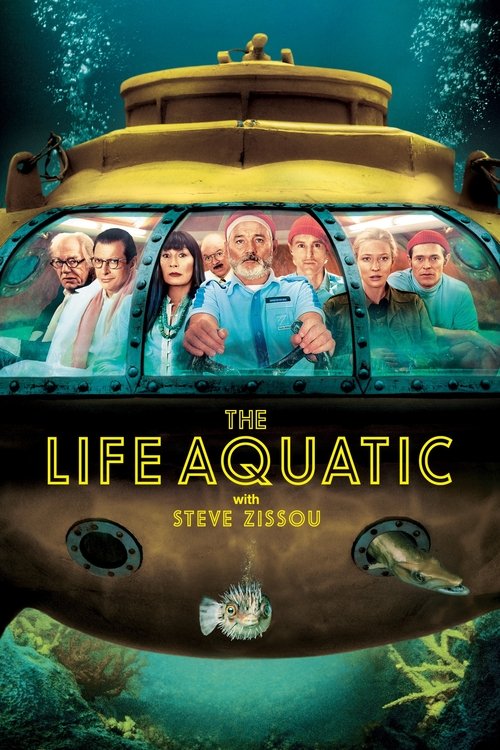
The Life Aquatic with Steve Zissou
2004 · Wes Anderson
His style became so recognizable it turned into a TikTok filter trend and AI-parody genre, prompting discourse about whether pastiche had swallowed the artist; Asteroid City and The Phoenician Scheme kept the "self-parody or late-style depth" argument alive. Finally won his first Oscar for a Roald Dahl short.
For when you want to live inside a handmade world for two hours — whimsical on the surface, quietly heartbroken underneath. Comfort viewing for anyone who likes their comedy tinged with loss.
What it's about
Steve Zissou is a fading celebrity oceanographer — half explorer, half washed-up showman — who mounts one last expedition to hunt the rare shark that ate his partner. Crowding onto his aging research vessel: a polite young man who may be his son, a pregnant journalist writing his profile, a loyal but mutinous crew, and assorted pirates and rivals from his past. It's a revenge quest, a family drama, and a deadpan sea adventure all at once.
The experience
Droll, melancholy, and gorgeously strange — the jokes land dry and the sadness lands sideways. It drifts more than it drives, and it rewards viewers who settle into its odd, wistful rhythm rather than waiting for the plot to hurry.
Performances
Bill Murray gives one of his great sad-clown performances: Zissou's vanity, grief, and exhaustion all visible under the red cap, often in a single look. Willem Dafoe is a scene-stealing delight as the neediest member of the crew.
The craft
The production design is the star — a research ship shot in literal cross-section like a dollhouse, stop-motion sea creatures in impossible candy colors, matching uniforms down to the trainers. The soundtrack, threaded with Portuguese-language David Bowie covers, is one of the most beloved of its era. Absolutely worth a big screen.
Why it matters
Divisive and commercially disappointing on release, it has since become a cult favorite and a key document of Anderson pushing his handcrafted style to its most ambitious scale.
Snapshot
The Life Aquatic with Steve Zissou is Wes Anderson's fourth feature, an oceanographic adventure-comedy built around a fading celebrity documentarian, Steve Zissou (Bill Murray), who mounts an expedition to hunt the "jaguar shark" that killed his partner. It is at once the most logistically ambitious and the most emotionally diffuse of Anderson's early films — a deliberate homage to Jacques-Yves Cousteau filtered through Anderson's signature artificiality, deadpan melancholy, and obsessive production design. Released by Touchstone Pictures (a Disney label) at the close of 2004, it followed the breakout success of The Royal Tenenbaums (2001) and represented a substantial scaling-up of budget and scope. The film divided critics on release and underperformed commercially, but it has since become a touchstone of mid-2000s auteur comedy and one of Anderson's most beloved works among devotees. Its central technical landmark — a giant cross-section set of Zissou's research vessel, the Belafonte — is among the most discussed practical sets of its era and crystallizes Anderson's lifelong attraction to the dollhouse and the diorama.
Industry & production
The film was produced by Touchstone Pictures with Anderson's regular producing partners Barry Mendel and Scott Rudin, and Anderson himself. It was, by widely reported accounts, Anderson's most expensive production to that point — roughly $50 million, a significant jump from the comparatively modest budgets of Rushmore and Bottle Rocket. The leap reflected the studio confidence generated by The Royal Tenenbaums, which had been both a critical success and Anderson's strongest commercial performer.
Principal photography took place largely at Cinecittà Studios in Rome, with location work along the Italian coast (including the Naples region and the Mediterranean). The choice of Cinecittà — the storied studio of Fellini and the Italian postwar industry — is itself telling: Anderson sought controlled, soundstage-built environments where he could construct the film's elaborate vessels and interiors rather than chase realism on the open ocean. The Italian setting also gave the film its slightly displaced, pan-Mediterranean unreality, where geography is gestural rather than literal.
Commercially, the film is generally regarded as an underperformer relative to its budget, taking in substantially less than Tenenbaums and falling short of recouping its cost in theaters; precise figures vary across sources, so the safest characterization is that it was a box-office disappointment that nonetheless found a durable afterlife on home video. Within Anderson's career arc, Life Aquatic marks a hinge point: a film whose mixed reception arguably pushed Anderson toward the tighter, more controlled storytelling of The Darjeeling Limited (2007) and Fantastic Mr. Fox (2009), even as it deepened the maximalist worldbuilding he would later perfect.
Technology
The film was shot photochemically on 35mm in anamorphic widescreen (2.35:1), a format Anderson and cinematographer Robert Yeoman favored for its breadth and its capacity to hold Anderson's frieze-like, frontal compositions. The most distinctive technological element, however, is the film's marine life. Rather than pursue photorealistic CGI creatures, Anderson commissioned stop-motion animation from Henry Selick (director of The Nightmare Before Christmas and later Coraline), who supervised the creation of the film's fantastical sea fauna — including the climactic jaguar shark, the "sugar crabs," and various luminous invented species. The deliberately handmade, faintly artificial quality of these creatures is a thematic choice as much as a budgetary one: the animals belong to Zissou's romantic, slightly fraudulent vision of the sea, and their stylization reinforces the film's running interrogation of documentary truth.
This commitment to tangible, fabricated artifice — practical sets, stop-motion, in-camera effects — situates the film against the prevailing early-2000s drift toward digital spectacle, and it prefigures Anderson's full embrace of stop-motion as a primary medium in Fantastic Mr. Fox and Isle of Dogs.
Technique
Cinematography
Robert Yeoman, Anderson's cinematographer since Bottle Rocket, shot the film in anamorphic. The visual grammar is quintessential Anderson: rigorously centered, symmetrical compositions; planimetric staging in which actors face the camera against flattened backgrounds; crisp lateral tracking shots and whip pans; and the recurring deployment of slow motion choreographed to music. The palette mixes the saturated reds of the Team Zissou uniforms (the crew's red watch caps, an explicit nod to Cousteau's crew) with the aquamarine and teal of the sea and the warm interiors of the Belafonte. Yeoman's lighting tends toward the even and legible rather than the dramatic, in keeping with Anderson's storybook clarity.
Editing
David Moritz edited the film, as he had Anderson's previous features. The cutting is precise and rhythmic, often built around the held tableau punctuated by sudden movement, and around set-piece sequences synchronized to music. The film's most celebrated single shot — a continuous camera move gliding through the cutaway Belafonte, revealing each compartment and its inhabitants as if leafing through a cross-section diagram — depends as much on the choreography of staging as on editing, but the surrounding montage of Zissou's documentary footage, expedition logs, and onboard life is shaped by Moritz's brisk, deadpan assembly.
Mise-en-scène / staging
This is the film's signal achievement. Production designer Mark Friedberg oversaw the construction of the Belafonte's extraordinary cross-section set — a multi-level cutaway of the entire ship, built so the camera could travel through it in a single move, exposing engine room, lab, sauna, editing suite, and crew quarters at once. The set is the purest expression of Anderson's diorama impulse: the ship as dollhouse, the crew as figurines arranged in their compartments. Friedberg, with costume designer Milena Canonero (a celebrated Kubrick collaborator), built a complete visual world for Team Zissou — matching powder-blue uniforms, custom sneakers, the red caps, the branded equipment — a self-contained design ecology that treats a fictional research operation with the totalizing detail of a corporate identity. The mise-en-scène insists at every turn on its own constructedness; nothing pretends to be found rather than made.
Sound
The score is by Mark Mothersbaugh, the former Devo frontman who had scored Anderson's earlier films, here working in his characteristic register of vintage synthesizer textures, Casio and Moog tones, and toy-like melodic figures. The film's most famous musical element, however, is the presence of Seu Jorge, who appears as crew member Pelé dos Santos and performs acoustic Portuguese-language covers of David Bowie songs — "Rebel Rebel," "Life on Mars?," "Ziggy Stardust," "Starman," and others — strummed on deck throughout the film. These performances function diegetically and become a recurring emotional refrain; the use of Sigur Rós's "Starálfur" over the climactic encounter with the jaguar shark is among the most affecting music cues in Anderson's body of work. The Bowie covers were later released as the album The Life Aquatic Studio Sessions, and Bowie himself is reported to have praised them.
Performance
Bill Murray gives one of his definitive late-career performances as Zissou — a study in vanity, grief, and exhausted charisma, played in Anderson's signature flat affect but shaded with genuine sorrow. The ensemble around him is deliberately deadpan: Owen Wilson as Ned Plimpton, the soft-spoken Air Kentucky pilot who believes Zissou is his father; Cate Blanchett as the pregnant journalist Jane Winslett-Richardson; Anjelica Huston as Eleanor Zissou, the "brains" of the operation; Willem Dafoe as the touchingly needy German engineer Klaus Daimler; Jeff Goldblum as Zissou's smoother rival Alistair Hennessey; and Michael Gambon, Bud Cort, and Noah Taylor in supporting roles. The performances run on a current of suppressed feeling beneath comic understatement — the house style Anderson had refined across his first three films, here stretched to accommodate a more melancholic register.
Narrative & dramatic mode
The film operates as a picaresque quest comedy with an undertow of midlife elegy. Its surface is episodic — the expedition encounters pirates, a hostage rescue, bond-company interference, and assorted figures from Zissou's past — but its spine is the relationship between Zissou and Ned, a father-son bond that the film both sentimentalizes and refuses to resolve consolingly. Anderson layers the diegesis with metafiction: Zissou is himself making a documentary, so we watch a film about the making of a film, and the question of whether Zissou's adventures are authentic or staged for the camera runs throughout. The dramatic mode is deadpan tragicomedy — losses (including a major late one) are absorbed with the same affectless calm as triumphs — and the film resists the catharsis its adventure framework promises, ending instead on a note of quiet, ambiguous grace.
Genre & cycle
Life Aquatic sits at the intersection of the adventure film, the deadpan auteur comedy, and the family melodrama. It belongs to the early-2000s cycle of stylized, idiosyncratic American comedies released through studio specialty arms — the so-called "quirk" or "twee" sensibility with which Anderson became synonymous, alongside contemporaries working in adjacent registers. As an oceanographic adventure it is also a knowing pastiche of the Cousteau documentary tradition and of mid-century expedition cinema, repurposing that genre's iconography (the research vessel, the crew, the narrated dive) as comic and emotional architecture.
Authorship & method
The film is the work of a fully formed auteur surrounded by a stable repertory company of collaborators. Anderson co-wrote the screenplay with Noah Baumbach — their first collaboration, predating their later co-writing of Fantastic Mr. Fox — and Baumbach's sharper, more acerbic sensibility is often credited with inflecting the film's melancholy. Cinematographer Robert Yeoman, composer Mark Mothersbaugh, and editor David Moritz were all longtime Anderson collaborators, lending the film continuity with his earlier work. Production designer Mark Friedberg and costume designer Milena Canonero were central to realizing the film's totalizing designed world. The casting of Murray, Wilson, Huston, and others continued Anderson's practice of building an ensemble family across films. Anderson's method here — soundstage construction, exhaustive design control, music-driven set pieces, frontal symmetry — is recognizably the system he had been developing since Rushmore, now applied at unprecedented scale.
Movement / national cinema
The film is a product of American auteur cinema, specifically the lineage of director-driven specialty filmmaking that flourished under studio boutique labels in the late 1990s and 2000s. Anderson is a defining figure of this tendency. Yet the production is transnational in texture: shot in Italy at Cinecittà, scored partly through a Brazilian musician's Portuguese Bowie covers, and set in a deliberately unplaceable Mediterranean nowhere. The film thus reads less as a national portrait than as a personal, cosmopolitan style-world — an early instance of the "Andersonian" as a kind of stateless aesthetic nation unto itself.
Era / period
Life Aquatic is firmly a film of the mid-2000s, the high-water moment of auteur comedy within the studio specialty system. It arrived when Anderson's style was crystallizing into something widely imitated and, soon, widely parodied. The era's appetite for handmade, analog-feeling craft amid encroaching digital spectacle is legible in the film's choices — practical sets, stop-motion creatures, photochemical capture. It also belongs to a moment of cultural reckoning with the legacy of figures like Cousteau, refracting mid-century scientific-celebrity romanticism through ironic, affectionate distance.
Themes
The film's governing themes are grief, fatherhood, obsolescence, and the unstable border between authenticity and performance. Zissou is a man whose public persona has outlived its relevance and possibly its truth; the hunt for the jaguar shark is at once a quest for vengeance, a bid for renewed celebrity, and a displaced reckoning with mortality and loss. Surrogate and uncertain parenthood runs through the film — Ned's possible sonship, Jane's pregnancy, Eleanor's maternal stewardship of the whole enterprise. Underlying all of it is a meditation on the documentary image: whether the wonders Zissou films are discovered or manufactured, and whether genuine feeling can survive its own staging. The climactic submersible encounter with the shark — beautiful, non-vengeful, wordless — resolves these tensions not through plot but through awe, suggesting that wonder itself may be the only authentic thing left.
Reception, canon & influence
On release, The Life Aquatic received markedly divided reviews — warmer than hostile in places, but distinctly more mixed than the near-consensus acclaim of The Royal Tenenbaums. Admirers praised its design, Murray's performance, and its emotional undertow; detractors found it cold, self-indulgent, or emotionally inert beneath its elaborate surface. Combined with its commercial underperformance, this reception positioned the film at the time as a stumble in Anderson's ascent.
The backward lines of influence are explicit and well documented: above all Jacques-Yves Cousteau and his expedition documentaries (the red caps, the research vessel, the celebrity-naturalist persona), with the ship's name, the Belafonte, functioning as an affectionate counterpart to Cousteau's Calypso (and a nod to Harry Belafonte's calypso recordings). The film also draws on the dollhouse and diorama traditions in design and on Anderson's own established storybook idiom.
The forward legacy has proven substantial. The cutaway-ship set became a reference point for discussions of cross-section staging and influenced later filmmakers' use of the device. Seu Jorge's Bowie covers took on an independent life as a celebrated album. More broadly, the film has been steadily reappraised: once seen as Anderson's misfire, it is now widely regarded as a cult favorite and, by many, as one of his richest and most personal works — its melancholy more legible in hindsight, its craft more clearly a precursor to the maximalist designed worlds of The Grand Budapest Hotel and beyond. Within Anderson's oeuvre it stands as the bridge between the grounded human comedies of his early period and the fully realized artifice of his maturity. Where the historical record on its exact commercial figures and internal production decisions remains thinner than for his later films, the safest summary is that Life Aquatic was a divisive, costly, beautiful experiment whose reputation has risen markedly with time.
A Deleuzian reading
Start with the shot everyone remembers: the camera lifts away and the *Belafonte* opens like a doll's house.
The full Deleuzian reading of The Life Aquatic with Steve Zissou →
Reception
Landed with a thud in 2004 — mixed reviews, a box-office flop, and a wave of 'Anderson has disappeared into his own dollhouse' takes after The Royal Tenenbaums. Two decades on it's the consensus pick for his most unfairly maligned film, warmly reclaimed as a melancholy cult favorite.
How The Life Aquatic with Steve Zissou was received, from release to now →
Influences: the films it descends from and the films it influenced
- The Silent World (1956) — Supplies the literal template Zissou parodies — the research vessel, red watch-caps, and the celebrity-oceanographer narrating his own expedition footage as a first-person undersea documentary.
- Playtime (1967) — Models the flat frontal planimetric staging in which deadpan human figures are arranged as small components inside a vast, obsessively designed soundstage architecture.
- Day for Night (1973) — Establishes the metafictional structure of a film documenting its own troubled making, with the harried director-auteur as a melancholy on-screen protagonist.
- 8½ (1963) — Provides the portrait of a blocked, self-mythologizing artist surrounded by a circus-like entourage, blurring his fantasies and failures into the production itself.
- The 7th Voyage of Sinbad (1958) — Furnishes the Harryhausen tradition of deliberately handmade stop-motion sea creatures composited into live-action adventure, which Anderson revives as the crayon-bright jaguar shark.
- L'Atalante (1934) — Pioneers the boat-as-enclosed-melancholy-world, treating the crewed vessel as a poetic, lyrically aquatic microcosm of longing and loss.
- The Red Shoes (1948) — Demonstrates the totalizing, saturated designed-Technicolor world where every set, costume, and color is subordinated to a single artificial palette.
- Harold and Maude (1971) — Pairs deadpan tragicomedy with a single curated pop catalog (Cat Stevens) used as emotional connective tissue — the precursor to Anderson's music-driven tableaux, here the Seu Jorge Bowie covers.
- Rushmore (1998) — Anderson's own prototype for the music-cued montage set piece, the repertory ensemble, and Bill Murray's wounded deadpan, all scaled up here.
- The Royal Tenenbaums (2001) — Introduces the storybook chaptering and the dollhouse cross-section interior (the Tenenbaum house) that the Belafonte's cutaway hull explicitly expands into a full diorama.
- Mon Oncle (1958) — The cross-sectioned Belafonte, filmed head-on in a single lateral move so a vessel reads as a facade of lit compartments, is Anderson's most explicit debt to the Arpel house's frontal, dollhouse framing in which windows behave as eyes.
- The Darjeeling Limited (2007) — Extends the cross-section/tableau staging onto a moving train, repeating the grief-driven expedition aboard a meticulously dressed vessel-as-set.
- Fantastic Mr. Fox (2009) — Converts the film's handcrafted stop-motion creature work into a wholly stop-animated feature, and reunites Anderson with co-writer Noah Baumbach for the second time.
- The Grand Budapest Hotel (2014) — Realizes the maximalist designed-world and cutaway cross-section staging that Life Aquatic first attempted, treating the entire hotel as a doll's-house set seen in symmetrical frontal planes.
- Isle of Dogs (2018) — Carries forward the deliberately tactile stop-motion creature aesthetic and music-driven percussive scoring into another fully animated, diorama-built world.
- The French Dispatch of the Liberty, Kansas Evening Sun (2021) — The full-ship cross-section cutaway of the Belafonte, tracked laterally room-to-room, is Anderson's own prototype for the cross-section tableau staging used throughout Ennui-sur-Blasé.
- The Phoenician Scheme (2025) — The Belafonte reveal — a full-scale cutaway ship on a Cinecittà stage traversed in a single lateral dolly — is the prototype of the lateral-dolly cutaway set the film uses for its office, train and villa interiors.
- Submarine (2010) — Directly inherits Anderson's symmetrical framing, chaptered storybook narration, and a single-artist curated soundtrack to score adolescent deadpan tragicomedy.
- Greenberg (2010) — Shows Baumbach independently pursuing the acerbic, arrested-male melancholy he is credited with inflecting into Zissou, again starring a deadpan-to-prickly lead in midlife crisis.
Similar films
- Fantastic Mr. Fox (2009) — influence & lineage
- Isle of Dogs (2018) — influence & lineage
- Rushmore (1998) — influence & lineage
- The Royal Tenenbaums (2001) — influence & lineage
- The Grand Budapest Hotel (2014) — influence & lineage
- Finding Nemo (2003) — shared sensibility
- Asteroid City (2023) — shared sensibility
- The Wild Robot (2024) — shared sensibility
All the films related to The Life Aquatic with Steve Zissou →