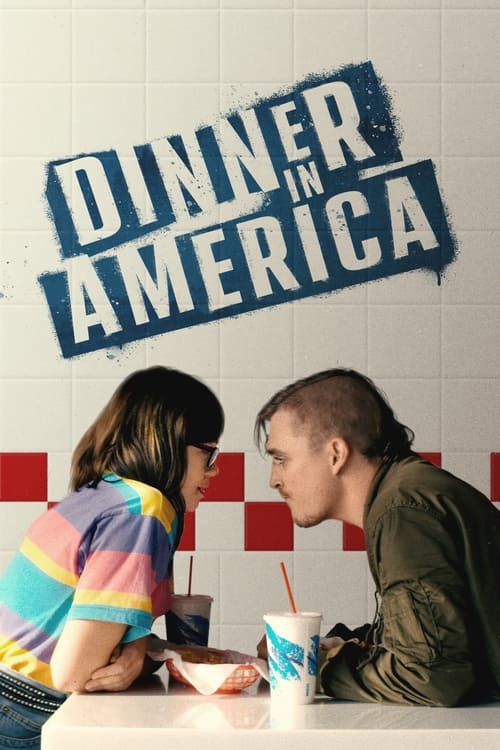
Dinner in America
2020 · Adam Rehmeier
For when you want a love story with teeth — a cult-movie night in, best for viewers who can ride out an obnoxious first act to reach something genuinely tender. If sanitized rom-coms leave you cold, this is your antidote.
What it's about
Simon is a fugitive punk frontman with a taste for arson; Patty is an ostracized young woman stuck in a dead-end pet-store job who worships an anonymous masked singer through fan letters. When their paths collide in the decaying suburbs of the Midwest, they hit the road together — and the audience knows something Patty doesn't: her idol and this snarling delinquent are the same person.
The experience
It starts abrasive — cruel families, casual humiliation, real bite — and then, almost without your noticing, turns into one of the most sincere and protective love stories in recent memory. By the end the sweetness hits harder because of how mean the road there was.
Performances
Kyle Gallner and Emily Skeggs are a combustible, oddly perfect pair — his coiled hostility and her guileless openness make the romance feel earned rather than written, and their musical moments together are the film's beating heart.
The craft
Rehmeier writes and shoots the Midwest's beige kitchens and strip malls with satirical precision, then lets real warmth bleed into the frame as the pair bond. The punk songs are performed for real and matter to the plot; one living-room song sequence has become the film's calling card.
Why it matters
A Sundance discovery that found its audience slowly through word of mouth, it's become a genuine cult favorite — the kind of scrappy romance people press on friends with a 'trust me.'
Snapshot
Dinner in America is a punk-rock love story disguised as an anti-social provocation — a film that opens in the register of transgressive shock cinema and slowly, almost surreptitiously, curdles into one of the most sincere romances of its moment. Adam Rehmeier's second narrative feature follows Simon (Kyle Gallner), a fugitive arsonist and hardcore frontman, and Patty (Emily Skeggs), a socially ostracized young woman who works at a pet store and privately worships an anonymous masked punk singer she knows only through fan letters. The joke, revealed to the audience before Patty herself grasps it, is that the idol and the delinquent are the same person. What begins as scabrous suburban satire — cruel families, casual humiliations, a cocktail of pills and pyromania — resolves into a fierce, protective tenderness between two misfits. The film premiered at the Sundance Film Festival in January 2020 and became a slow-burning cult object, championed for the raw chemistry of its leads and its refusal to sand down its abrasive edges in service of the love story it ultimately embraces.
Industry & production
Dinner in America is an American independent production made outside the studio system, shot in and around Michigan's decaying exurban landscape that the film treats as both setting and antagonist. Its most consequential industrial fact is the involvement of Ben Stiller, who is credited as an executive producer through his Red Hour banner; the association lent an otherwise defiantly uncommercial project a measure of visibility and industry credibility it might not otherwise have attracted. Beyond that top-line credit, the granular production financing record is comparatively thin in the public domain, and I will not invent budget figures or a full financier list where reliable documentation is scarce.
The film's distribution history is inseparable from its timing. It premiered at Sundance in late January 2020, weeks before the COVID-19 pandemic collapsed the theatrical marketplace and scrambled the festival-to-release pipeline that a small acquisition title depends on. The consequence was a protracted delay: rather than a swift post-Sundance rollout, Dinner in America lingered in distribution limbo and did not reach a wide audience through theatrical and video-on-demand release until 2022. This lag is a meaningful part of the film's reception story — it built its following retroactively, through streaming discovery and word of mouth, rather than through a conventional festival-buzz-to-release arc.
Technology
The film was shot digitally, consistent with the economics of contemporary low-budget independent production, where digital acquisition permits the long takes, available-light interiors, and improvisational latitude that a project of this scale requires. Rehmeier's approach does not foreground technological novelty; there is no ostentatious use of drones, virtual production, or format gimmickry. The relevant technical story is instead one of restraint and control — a workflow calibrated to make modest suburban locations, cramped domestic interiors, and night exteriors read as heightened without tipping into the glossy. The precise camera and lens package is not something I can confirm with authority, so I will not attribute specific hardware.
Technique
Cinematography
The cinematography, credited to Jean-Philippe Bernier, is the film's most quietly sophisticated department. Its governing strategy is a controlled friction between subject and style: the material is grimy, but the images are composed with a symmetry and color discipline that recalls the deadpan formalism of the American suburban-grotesque tradition. Frontal, centered compositions turn dinner tables and living rooms into little proscenium stages for cruelty and farce. As the romance deepens, the palette warms and the framing loosens, so that the visual grammar itself charts the movement from satire toward feeling. The camera tends to hold — letting performances breathe within the frame rather than chopping reactions into coverage — which is essential to a film built on the slow accretion of intimacy between two people the world has written off.
Editing
The editing governs the film's most audacious tonal maneuver: the migration from provocation to sincerity without a visible seam. Early sequences cut with an aggressive, almost punk rhythm — abrupt, confrontational, refusing the audience comfortable footing — matching Simon's volatility. As Patty becomes the emotional center, the cutting slows and softens, granting scenes the duration required for tenderness to register. The set-piece in which the two write and record the song "Watermelon" is the pivot on which the whole structure turns, and its handling — musical, patient, allowing performance to build in real time — is where editorial rhythm and emotional design fuse. I have not been able to confirm a definitive editing credit with certainty and so decline to attribute it firmly.
Mise-en-scène / staging
Rehmeier stages Dinner in America around the American dinner table as a theater of humiliation. The family meal — with its enforced pleasantries, its passive aggression, its scripted normalcy — is the film's recurring unit of mise-en-scène, and its title announces as much. Production design leans into a lived-in, slightly time-warped suburban vernacular: wood paneling, floral wallpaper, bedroom shrines to bands, the specific texture of lower-middle-class Midwestern interiors. Patty's bedroom, papered with her devotions, functions as a physical externalization of an inner life no one around her acknowledges. The staging repeatedly traps characters within domestic frames and then lets the two leads break out of them — literally into cars, backyards, and the open road — so that space itself dramatizes escape.
Sound
Sound is arguably the film's beating heart, because Dinner in America is finally a movie about music as a lifeline. The original songs — most centrally "Watermelon," performed within the film by Gallner and Skeggs — are not incidental but load-bearing; the act of making the song together is the act of falling in love. Rehmeier, who has a background rooted in punk sensibility, treats the hardcore idiom with insider fluency rather than tourist condescension, and the sound design toggles between the assaultive (Simon's performances, the sonic aggression of his world) and the hushed intimacy of two voices working out a melody in a bedroom. The specific music-supervision and score credits are not something I can enumerate with confidence, and I will not fabricate them.
Performance
The performances are the consensus reason the film works. Kyle Gallner, an actor long associated with horror and genre supporting roles, delivers a career-recalibrating lead as Simon — feral, funny, and dangerous, yet gradually disclosing a wounded gentleness that never reads as a cheat. Emily Skeggs, with a background in theater, gives Patty a fragile, guileless conviction that resists the condescension such "outcast" roles usually invite; she plays sincerity as strength rather than deficit. The chemistry between them is the film's true special effect, and the surrounding ensemble — the grotesque, oblivious families and authority figures — is pitched at a broad satirical register precisely so the central pair can feel real by contrast.
Narrative & dramatic mode
Structurally the film is a two-hander road-adjacent romance welded to a satire of suburban conformity. Its dramatic engine is dramatic irony: the audience knows Simon is Patty's masked idol long before she does, which transmutes what could be a manipulation into a courtship and charges every scene with anticipatory tenderness. The mode shifts deliberately across the runtime — from transgressive comedy of cruelty toward earnest romance — and the film's coherence depends on the audience's willingness to be led across that gap. It is, at bottom, a fairy tale for outcasts: two people the world treats as disposable recognize each other's worth, and the plot exists to defend that recognition against every force arrayed against it.
Genre & cycle
Dinner in America sits at the intersection of the American independent romance and the punk film, with strong inheritances from the suburban-satire and outsider-couple-on-the-run traditions. It belongs to a lineage of movies about damaged pairs fleeing a hostile normalcy, and to the smaller cycle of films that take punk and hardcore seriously as culture rather than costume. Critics reaching for coordinates have repeatedly invoked touchstones from transgressive comedy and lo-fi indie romance — the John Waters strain of gleeful bad taste, the deadpan suburban absurdism associated with films like Napoleon Dynamite, and the doomed-lovers energy of True Romance — not as sources Rehmeier necessarily cites but as the constellation viewers use to locate his tone.
Authorship & method
The film is a thoroughgoing auteur project: Rehmeier wrote and directed it, and its voice is unmistakably singular. The most illuminating authorship fact is the contrast with his previous feature, The Bunny Game (2010), a black-and-white, near-plotless work of extreme cinema notorious for its punishing content. That Dinner in America emerged from the same filmmaker reframes it as a deliberate act of tonal reinvention — the same appetite for confrontation and abjection, redirected toward romance. The through-line is a fascination with people at society's margins and a refusal of good taste as a governing value.
Among collaborators, cinematographer Jean-Philippe Bernier is the most identifiable creative partner, responsible for the disciplined visual scheme that keeps the material from curdling into mere ugliness. Executive producer Ben Stiller's contribution is industrial rather than artistic — a mark of confidence that helped the film exist and find visibility. On the crucial questions of composer, editor, and music supervision, the public credit record as I can reliably reconstruct it is thin, and I decline to name individuals I cannot verify. What is not in doubt is that Rehmeier's authorship extends into the film's music, which he shaped as an integral expression of the story rather than a decorative layer.
Movement / national cinema
The film is a product of American independent cinema in its post-mumblecore, festival-circuit configuration — low-budget, personal, actor-driven, and reliant on Sundance and its peers as both launch pad and gatekeeper. It participates in a distinctly American vein of suburban self-critique, using the iconography of the Midwest — strip malls, tract housing, the dinner table — as a national symbolic vocabulary. It is not affiliated with any organized movement or manifesto; its lineage is one of sensibility, running through the American underground and the punk DIY ethos more than through any school of filmmaking.
Era / period
Dinner in America is a contemporary-set film that nonetheless feels temporally unstuck, its suburban textures carrying a faintly retro, analog-punk charge that resists precise dating. Its truest period marker is extrinsic: it is a Sundance-2020 film, and thus a casualty and artifact of the pandemic rupture. Conceived and premiered on one side of a historical break and released on the other, it belongs to a small cohort of festival titles whose lives were reshaped by COVID — films that found their audiences late, through streaming and delayed release, and whose reputations were built in the strange, decentered exhibition landscape of the early 2020s.
Themes
The film's central theme is the dignity of the outcast — the insistence that people dismissed as freaks, failures, or delinquents possess inner lives of full weight. Around that core it braids several concerns: the suffocating violence of enforced normalcy, dramatized through the family dinner and its rituals; music and creative collaboration as instruments of recognition and love; and the redemptive power of being truly seen by another person. Anger and tenderness are not opposites here but the same energy in different keys — Simon's rage and his devotion spring from one source. The film argues, finally, that sincerity is the most punk gesture available in a culture of cruelty and performance, and it stakes its whole design on making that argument land.
Reception, canon & influence
Critical reception was broadly warm and grew warmer over time. The film emerged from Sundance 2020 with strong notices and collected festival honors, including audience recognition on the circuit, and the belated 2022 release converted early enthusiasm into a durable cult following. Reviewers repeatedly singled out the Gallner–Skeggs pairing and the film's improbable tonal alchemy — the way it earns sincerity from a foundation of provocation. It has since accrued the profile of a modern cult favorite, the kind of title passed along as a personal recommendation.
Looking backward, its influences are matters of shared sensibility rather than documented citation: the transgressive comedy tradition, the punk film, the deadpan suburban absurdism and doomed-outsider-couple strains that critics invoke as reference points. Looking forward, the film's most concrete legacy to date is its effect on its principals — a significant elevation of Kyle Gallner's stock as a leading man capable of range beyond genre, and a showcase for Emily Skeggs — and its consolidation of Rehmeier as a distinctive independent voice. Because the film is recent and its wide release only came in 2022, any claim about a broader downstream influence on other filmmakers would be premature; its canonization is still in progress, carried for now by the cult audience that continues to discover it.
A Deleuzian reading
The camera sits at the head of the dinner table, square to it.
The full Deleuzian reading of Dinner in America →
Reception
Premiered at Sundance 2020 to warm buzz, then COVID buried it — it sat without a proper release for two years while word of mouth quietly built, so by its 2022 arrival it was already a cult object fans felt they'd personally rescued.
How Dinner in America was received, from release to now →
How to watch Dinner in America: what to notice on a first viewing
- Watch how the dinner table scenes are framed straight on. Rehmeier shoots the family meals frontal and centered, squared to the table like a small proscenium stage, and the composition holds still through the cruelty. The family becomes an arrangement of people performing normalcy, not just people eating a meal together.
- Notice how much longer scenes run as the film continues. Early scenes cut in an abrupt, confrontational punk rhythm matching Simon's volatility, then slow and soften as Patty becomes the emotional center. The editing rhythm itself tells you the film is shifting from provocation toward tenderness.
- Listen for the shift from harsh noise to a quiet melody. The sound design toggles between the assaultive aggression of Simon's hardcore performances and the hushed intimacy of two voices working out a song. Music carries the film's real emotional information before the characters can say any of it out loud.
- Watch what covers the walls of Patty's bedroom. Her room is papered with band devotions and fan-letter material, a shrine that externalizes an inner life nobody around her acknowledges. The room says who she really is before she gets a chance to say it herself.
- Watch Simon's face for what breaks through the anger. Gallner plays him feral and dangerous at first, then gradually discloses a wounded gentleness underneath, without the shift ever reading as a cheat. The gentleness was there the whole time, waiting for someone willing to look for it.
The whole guide to watching Dinner in America, with the keys for a rewatch →
Influences: the films it descends from and the films it influenced
- Badlands (1973) — Establishes the doomed-young-couple-on-the-run template that Dinner in America inherits — affectless outsiders drifting through flat American nowhere, their violence narrated with a naive, deadpan calm that refuses moral framing.
- Wild at Heart (1990) — Fuses the lovers-on-the-run road picture with whiplash tonal violence and rock-idiom sincerity, licensing the pivot Rehmeier makes between abjection and swooning tenderness within a single scene.
- True Romance (1993) — Model for the outsider couple whose cartoonish, escalating violence coexists with an utterly earnest romance — the film asks you to take the love seriously precisely because everything around it is lurid.
- Repo Man (1984) — Punk not as subject but as structuring aesthetic — deadpan suburban/LA absurdism scored to an authentic hardcore idiom, the template for treating scene culture as the film's native grammar rather than costume.
- Suburbia (1983) — Grounds runaway outcasts in a documentary-accurate hardcore-punk milieu, insisting on the dignity and authenticity of the scene — the milieu-fidelity Dinner in America extends to its basement shows and homemade tapes.
- Welcome to the Dollhouse (1995) — Renders suburban cruelty in flat, symmetrical, deadpan compositions while granting the bullied outcast a fierce interior dignity — the tonal recipe of comedy-from-humiliation without contempt for the victim.
- Gummo (1997) — The transgressive-abjection strain of American-margins cinema — a refusal of good taste as governing value, staging squalor and provocation without apology, the same appetite Rehmeier redirects toward romance.
- Ghost World (2001) — Two misfits bonded by shared disgust for a phony mainstream, their deadpan alienation softened by an offbeat record-collector romanticism — the outsider-pair chemistry and music-as-identity that Dinner in America mirrors.
- Napoleon Dynamite (2004) — Codifies the deadpan-symmetry framing of suburban vernacular — dead-center compositions of tract houses and awkward bodies played for absurdist stillness, a direct antecedent of Bernier's disciplined visual scheme.
- Rushmore (1998) — Source of the precise, centered, storybook-symmetrical cinematography that keeps volatile emotional material formally contained — the visual discipline that stops abjection from curdling into mere ugliness.
- Punch-Drunk Love (2002) — The nearest sibling in tonal engineering — an abrasive, rage-prone protagonist redeemed by an improbable love, executing a warming migration from harsh dissonance to tenderness carried by an expressive, integral score.
- Once (2007) — Makes diegetic original songs performed by the characters the film's emotional engine — the courtship advances through the writing and playing of music, exactly the device Dinner in America builds its climax around.
Similar films
- Hedwig and the Angry Inch (2001) — shared sensibility
- Bones and All (2022) — shared sensibility
- A Real Pain (2024) — shared sensibility
- Cha Cha Real Smooth (2022) — shared sensibility
- Twinless (2025) — shared sensibility
- Palm Springs (2020) — shared sensibility
- The Big Sick (2017) — shared sensibility
- Ghostlight (2024) — shared sensibility