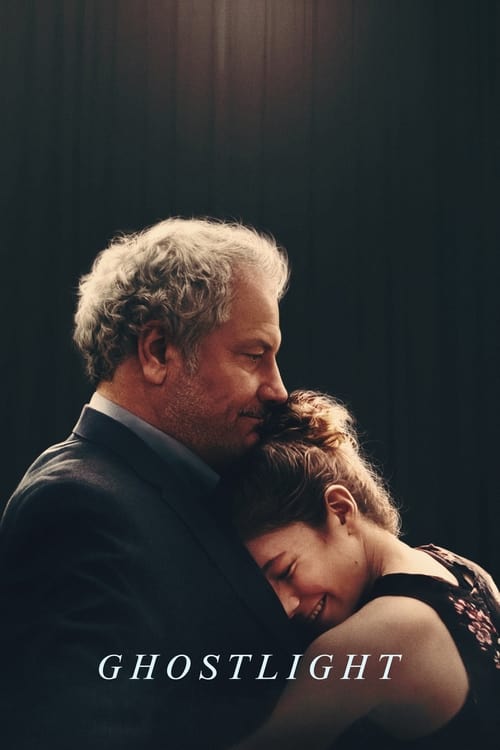
Ghostlight
2024 · Alex Thompson
For when you need a good cry that leaves you feeling mended rather than wrecked — a warm, humane film about grief that believes in second chances and community. Comfort with a real ache inside it.
What it's about
A gruff Chicago construction worker, numb with a grief the film reveals only gradually, stumbles into a storefront theater's amateur production of Romeo and Juliet — with his estranged teenage daughter caught up in the same orbit. As rehearsals go on, Shakespeare's play about impulsive young love and loss starts reading his own life back to him, and a man who can't talk about his pain finds himself performing it.
The experience
Tender, funny, and quietly devastating — it earns its emotion scene by scene, sneaking up on you through small kindnesses and awkward rehearsals until it lands with real force. Bring tissues; you'll laugh on the way there.
Performances
An actual family — Keith Kupferer, Tara Mallen, and their daughter Katherine Mallen Kupferer — plays the fractured family onscreen, and the lived-in friction and love between them is something no rehearsal could counterfeit. Kupferer's slow thaw is the film's engine.
The craft
Kelly O'Sullivan and Alex Thompson work at a deliberately modest scale, drawing on Chicago's deep bench of theater actors and letting emotion accumulate rather than announcing itself. The film honors community theater without a trace of condescension — the folding-chair production carries as much weight as anything on a big stage.
Why it matters
One of the breakout American independents of 2024 and confirmation of O'Sullivan and Thompson as leading voices in small-scale, big-hearted regional filmmaking after Saint Frances.
A gruff Chicago construction worker, sleepwalking through a grief the film discloses only gradually, stumbles into a storefront theater's amateur production of Romeo and Juliet — and Shakespeare's play about impulsive young death begins reading his own life back to him. Kelly O'Sullivan and Alex Thompson, the partners behind Saint Frances, work in a distinctly Chicago register of American independent film: modest scale, deep bench of theater actors, emotion earned scene by scene rather than announced. Their masterstroke is casting an actual family — Keith Kupferer, Tara Mallen, and their daughter Katherine Mallen Kupferer — as the fractured family onscreen, and the lived-in friction between them is something no rehearsal process could counterfeit. The film honors community theater without condescension, treating a folding-chair rehearsal room as a place where ordinary people are permitted to feel enormous things out loud. A Sundance premiere in 2024, it became that year's word-of-mouth heartbreaker, the small film people pressed on friends with a warning to bring tissues. The title is the theater term for the single bulb left burning on an empty stage overnight.
Reception
Premiered at Sundance 2024 to instant acclaim and a near-perfect Rotten Tomatoes score, but its small IFC release meant almost nobody saw it in theaters — since then it's been climbing steadily on pure word-of-mouth as 2024's designated hidden gem.
How Ghostlight was received, from release to now →
Influences: the films it descends from and the films it influenced
- Saint Frances (2019) — The directors' own prior feature establishes their house method — grief and reconciliation earned scene-by-scene through low-key Chicago-regional naturalism rather than plot machinery — which Ghostlight extends directly.
- Opening Night (1977) — A stage production haunted by an actual death, where rehearsal and raw private feeling bleed into each other until performance becomes the only way to metabolize loss — the exact play-as-grief-work device Ghostlight inherits.
- A Woman Under the Influence (1974) — Working-class domestic melodrama built from unbearably sustained, near-documentary performances, proving family pain can carry a film without genre scaffolding — the naturalist-melodrama register Ghostlight works in.
- Vanya on 42nd Street (1994) — Working actors rehearse a classic text in street clothes until the line between the play and their own lives dissolves — the play-within-a-film mirroring device that lets Ghostlight's Romeo and Juliet voice what its characters cannot say.
- Synecdoche, New York (2008) — Theater-making staged as a literal vehicle for processing mortality and grief, with the production itself operating as the film's central metaphor — kindred to Ghostlight's title-as-metaphor and play-within-a-film logic.
- Secrets & Lies (1996) — Buried family grief surfaced through gradual disclosure and an ensemble devised over months of actor-led rehearsal, the naturalist-ensemble method that underwrites Ghostlight's slow emotional reveals.
- Topsy-Turvy (1999) — The unglamorous labor of mounting a stage production — casting, blocking, backstage friction — rendered through Leigh's improvisation-built characters, the same fascination with the mechanics of amateur/working theater Ghostlight foregrounds.
- Ordinary People (1980) — A family quietly imploding around a child's death, its central wound withheld and disclosed piece by piece — the parallel-tragedy and gradual-disclosure structure Ghostlight maps onto Romeo and Juliet.
- Shakespeare Wallah (1965) — An amateur-scale troupe performing Shakespeare where the staged text keeps rhyming with the players' offstage losses — an early model of Shakespeare-as-mirror for non-grand performers.
- The Quiet Girl (2022) — Contemporary festival melodrama that withholds a family's central grief and lets it surface through accumulated quiet detail and a nonprofessional child performance, extending Ghostlight's earned-scene-by-scene, gradual-disclosure grammar.
- Manchester by the Sea (2016) — A playwright-director withholds a self-implicated death and doles grief out in restrained, understated increments, refusing catharsis until a single scene earns it — the same disclosure discipline and theater-trained restraint Ghostlight uses.
- Rachel Getting Married (2008) — A family forced to reckon with a death one of them caused, staged as handheld, overlapping-dialogue ensemble intimacy around a communal ritual — the parallel-tragedy-within-a-gathering structure Ghostlight shares.
- The Florida Project (2017) — Emotional authenticity sourced from nonprofessional and first-time performers cast for their rootedness in a specific place, the same casting instinct behind Ghostlight's real-family leads.
- Support the Girls (2018) — Warm regional-American naturalism that treats a workplace as found family, letting an ensemble accrue feeling through small, unhurried behavioral beats rather than dramatic events — Ghostlight's community register.
- Waiting for Guffman (1996) — Amateurs mounting a storefront/community-theater production far beyond their means, mining the specific texture of small-town stagecraft — the same amateur-theater milieu Ghostlight inhabits, in a comic inversion.
- Looking for Richard (1996) — Ordinary, untrained speakers wrestle a Shakespeare text into their own plain emotional idiom, demystifying the verse by making it a working-class tool — the democratizing approach to Shakespeare Ghostlight dramatizes.
Similar films
- Manchester by the Sea (2016) — influence & lineage
- Synecdoche, New York (2008) — influence & lineage
- Ordinary People (1980) — influence & lineage
- The Quiet Girl (2022) — influence & lineage
- All of Us Strangers (2023) — same viewing thread
- Twinless (2025) — same viewing thread
- Blue Heron (2026) — same viewing thread
- Rental Family (2025) — same viewing thread
All the films related to Ghostlight →
Watch it with: curated runs of related films
- Funny Because It Aches — A run of tender, deadpan dramedies where love, grief, and the panic of becoming yourself all get metabolized through jokes — watch these when you want to laugh and cry in the same scene.