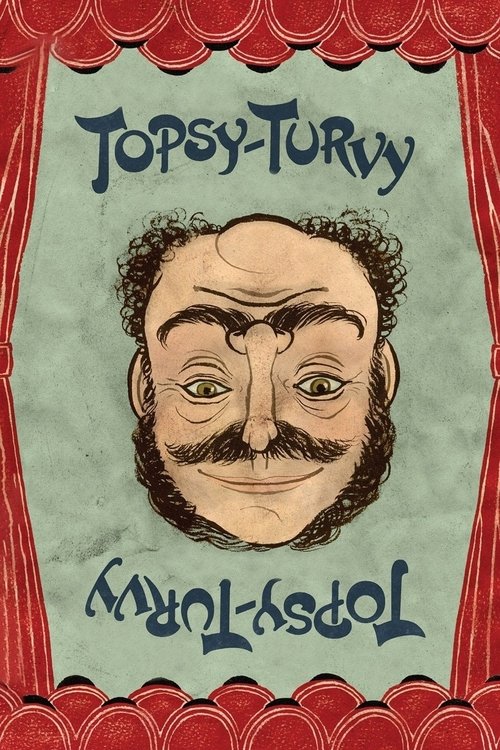
Topsy-Turvy
1999 · Mike Leigh
For when you want to sink into something rich and unhurried — a film about work, collaboration, and putting on a show that rewards patience with warmth. Comfort viewing for anyone who loves theater, process, or watching prickly people make something beautiful together.
What it's about
London, 1884. Gilbert and Sullivan — the most successful partnership in English theater — are barely on speaking terms: their latest comic opera has landed flat, a heat wave is emptying the stalls, and Sullivan wants to quit writing what he considers trivial entertainments. Out of the stalemate, and a chance encounter with a Japanese exhibition, comes the making of The Mikado, and the film follows everyone it takes to get it on stage: the two authors, the actors, the wives, the dressers, the theater owner.
The experience
Long, unhurried, and quietly funny, it works by accumulation — backstage squabbles, rehearsal-room fussing, and full musical numbers performed at length — until you realize you've come to care about a dozen people at once. There's real melancholy under the greasepaint; it sneaks up on you.
Performances
Jim Broadbent's Gilbert is a marvel of buttoned-up gruffness hiding hurt, and Allan Corduner makes Sullivan's charm and restlessness equally believable; the deep ensemble around them — actors playing actors, each with their own private troubles — is uniformly superb.
The craft
Mike Leigh brought his famous method — months of improvisation with actors building characters from scratch — to a lavishly detailed Victorian setting, and the result feels lived-in rather than embalmed. The costumes, sets, and staged Gilbert and Sullivan numbers are gorgeous and performed complete, so it plays wonderfully on a big screen with good sound.
Why it matters
It stunned people who thought they knew what a Mike Leigh film was, proved his improvisational approach could conquer period drama, and became one of the most acclaimed films about the working life of artists ever made.
Snapshot
Mike Leigh's ninth feature is the strangest turn in a strange career: the great chronicler of contemporary English disappointment — Salford-born, RADA-trained, made famous by Abigail's Party, Naked and Secrets & Lies — abruptly relocated to 1884, put on bustles and stage paint, and made a two-and-a-half-hour film about two middle-aged men failing to get along at work. The men are W. S. Gilbert (Jim Broadbent) and Arthur Sullivan (Allan Corduner), a decade into the most successful partnership in the English-speaking theater, and the film covers the fourteen or so months between the lukewarm reception of Princess Ida and the opening night of The Mikado at the Savoy in March 1885.
What makes Topsy-Turvy extraordinary is what it refuses. It is a biopic that declines to explain anybody, an artist film that treats inspiration as an embarrassment and labor as the only real subject, and a period picture that has almost no interest in the pleasures of period. Its second half is essentially a rehearsal procedural: read-throughs, blocking, costume fittings, a cut song restored after a delegation from the company, a choreographer counting time. Its climax is not the triumph but the aftermath — a woman singing alone on a stage, and a marriage that cannot say what it means. Roughly 160 minutes long, it won Academy Awards for costume design and makeup and was named the year's best film by the New York Film Critics Circle, and it opened a late-career strand of period work — Vera Drake, Mr. Turner, Peterloo — that has arguably become Leigh's most durable achievement.
Industry & production
Topsy-Turvy was produced through Thin Man Films, the company Leigh ran with producer Simon Channing-Williams, the vehicle for all of his features since Life Is Sweet. It was by a wide margin the most expensive film he had made — published budget figures vary and none should be treated as authoritative, but the scale is visible on screen: full-dress Savoy stagings with orchestra and chorus, period London exteriors, an enormous costume and wig operation. That anyone financed it is a function of the moment. Leigh had won the Palme d'Or for Secrets & Lies in 1996 and been Oscar-nominated for it; British production was in a boom fed by National Lottery money and by the international success of a run of mid-1990s British films; and period English subjects had commercial credibility after Sense and Sensibility, Mrs Brown, Elizabeth and Shakespeare in Love.
The paradox is that Leigh took that credibility and spent it on a film structurally hostile to the genre it appeared to be joining. There is no romance plot, no invented villain, no arc of vindication. The financing came in on the strength of a director who works without a screenplay — Leigh famously does not have one to show at the point money is committed — which remains one of the odder facts of late-1990s British film economics.
The production also carried an unusual second infrastructure: a musical one. Carl Davis served as music director, conducting and supervising the Gilbert and Sullivan material, and the cast underwent extended musical preparation. Leigh cast for singing as well as acting, and the numbers are performed by the actors themselves rather than dubbed by opera voices — a decision that shapes everything about how the stage sequences read.
Technology
The film sits on the last shelf of the wholly photochemical era. Shot on 35mm by Dick Pope and finished by conventional optical and laboratory means, it predates the digital intermediate's arrival in mainstream feature finishing by roughly a year; the color of Topsy-Turvy — its ambers, its sooty greens, the specific density of its blacks — is print-timed color, not graded pixels. There is no significant visual-effects component. Crowds are crowds; the Savoy auditorium is built and dressed and lit.
The more interesting technology is inside the story. The film is set at the precise moment the modern entertainment industry is being assembled, and it notices. Richard D'Oyly Carte (Ron Cook) had opened the Savoy in 1881 as the first theater in the world lit by electricity, and the film's business scenes are full of the period's new apparatus of management — telephones, contracts, touring companies, the transatlantic copyright problem that made American piracy of the Savoy operas a standing commercial wound. Gilbert's dramaturgy of inverted logic is being manufactured inside a rationalized, capitalized, technologically current enterprise. The film's sharpest structural joke is that the "magic lozenge" — Gilbert's beloved absurdist plot device, which Sullivan refuses — is rejected not on aesthetic grounds alone but because the firm cannot afford another failure.
Technique
Cinematography
Dick Pope, Leigh's cinematographer since 1990, works here in a register of restrained observation that runs directly counter to heritage-film convention. There are few of the sweeping establishing gestures the genre trades in — no drone-eye estates, minimal picturesque London. Instead: patient, often static framings; long lenses used sparingly; two-shots that hold both parties in a negotiation rather than cutting between them; and lighting keyed to visible period sources — gas, lamp, limelight, the Savoy's electric footlights — so that faces frequently sit in the half-dark that Victorian interiors actually produced.
Pope's key structural decision concerns the proscenium. The stage sequences are shot from multiple positions that are all someone's position: from the stalls, from the wings, from the pit, from behind the performers looking out into the house. The film never resolves into a neutral, impossible "best seat" view of the operas. You are always somewhere in the building, and the building's geography — front of house, backstage, dressing room, rehearsal room, office — is the film's real map.
Editing
Robin Sales cuts the film in long scenes with minimal coverage, letting exchanges run to their natural exhaustion rather than to their dramatic point. Between scenes, the film uses hard, unsentimental transitions: episodes are set down beside one another without connective tissue, more like chapters in a novel than beats in a screenplay. This produces the film's characteristic rhythm — dense, slow-building, occasionally bewildering in the first hour, then cumulatively overwhelming.
The musical numbers are the crucial editorial test, and the film passes it by respecting theatrical time. Numbers are given room, often in sustained takes, so that the pleasure of the performance is allowed to be the pleasure of the performance rather than an assemblage. It is the anti-Moulin Rouge approach, and it is what makes the film's late turn to the stage feel earned rather than decorative.
Mise-en-scène / staging
Eve Stewart's production design — Oscar-nominated — and Lindy Hemming's costumes and Christine Blundell's makeup, both of which won Academy Awards, constitute the most rigorous element of the film's realism, and they are rigorous in an unusual direction. The costumes are not there to be admired; they are there to be fitted, adjusted, complained about, sweated in. One of the film's most quietly radical sequences is a costume fitting played as labor negotiation. Similarly, the makeup is not glamour but occupational: paint that cracks, wigs that itch, the visible apparatus of stage illusion seen from three feet away.
Spaces are consistently over-furnished and under-lit in the Victorian manner, and Leigh stages within them in depth, with characters occupying different planes of a cluttered room. The one place the film opens up chromatically is the stage itself, where the Mikado designs blaze against everything around them — a deliberate contrast between the drabness of making and the brilliance of the made thing.
Sound
The soundscape is organized around the difference between a rehearsal room and a full house: piano versus orchestra, unwarmed voices versus projected ones, the specific acoustic of an empty auditorium. Leigh is attentive to the physical noise of theater — the shift of scenery, the rustle of an audience, the pit tuning — and to the street outside, hooves and traffic and the heavy, airless quiet of the 1884 heat wave that opens the film's crisis.
Because the actors sing live rather than lip-syncing to opera dubs, the numbers carry the small imperfections of theatrical performance, which is precisely the point: these are working singers of the 1880s, not recording artists. The exact technical arrangements Leigh and Davis used for capturing the musical performances are not well documented in the accessible record, and I won't guess at them; the audible result, though, is unmistakably human-scaled.
Performance
The ensemble is asked to do something almost no other film requires: to act naturalistically as people whose profession is broad, artificial, presentational acting, and to make both registers convincing. Broadbent's Gilbert is a blocked, brusque, faintly bullying man of terrifying competence, tender only sideways; his scenes with his senile, abusive father and his baffled mother locate the whole personality without a word of explanation. Corduner's Sullivan is his opposite in every physical particular — sensual, socially fluent, chronically ill, morphine-treated, ambitious for a "grand opera" he will never satisfactorily write.
Around them Leigh assembles one of the great British ensembles: Lesley Manville as Kitty Gilbert, whose two late scenes carry the film's deepest wound; Timothy Spall as Richard Temple, whose cut song and its restoration form the film's most moving passage about craft and dignity; Martin Savage as George Grossmith, jittery and needle-marked; Shirley Henderson as Leonora Braham; Dorothy Atkinson as Jessie Bond; Kevin McKidd as Durward Lely; Wendy Nottingham as Helen Lenoir; Eleanor David as Fanny Ronalds; Alison Steadman as the costumier Madame Leon; Andy Serkis as the choreographer John D'Auban. Broadbent's performance took the Volpi Cup for best actor at the Venice premiere.
Narrative & dramatic mode
Topsy-Turvy is a process film. Its plot is: a partnership stalls; a solution is found; the work is made; the work opens. There is no antagonist, no reversal, no resolution of the underlying incompatibility between the two men — the film ends with that incompatibility exactly where it started, merely postponed by success.
Leigh's most pointed formal choice concerns inspiration. The film acknowledges the famous anecdote Gilbert himself circulated, in which a Japanese sword falling from the wall of his study supplied the idea for The Mikado — a story historians have long treated with skepticism. Leigh gives the myth its moment and then spends the next ninety minutes demonstrating that the idea was worth nothing until roughly forty people worked for months to realize it. The Japanese Native Village exhibition at Knightsbridge, and the coaching of the actresses in movement and fan technique by a woman from it, are given far more screen weight than the sword. That is the film's argument in structural form.
The ending refuses the shape the genre demands. Instead of curtain calls and vindication, Leigh gives us Kitty trying and failing to tell her husband about an idea of her own, and then Leonora Braham alone under the lights, singing "The sun whose rays are all ablaze" — beauty produced by an exhausted, compromised, chemically-propped-up institution, and none the less beautiful for it.
Genre & cycle
The film belongs to the backstage tradition and to the artist biopic, and it is in dialogue with both mostly by contradiction. Its immediate cycle context is the late-1990s wave of English period showbusiness pictures — Wilde, Mrs Brown, Shakespeare in Love, An Ideal Husband — and it reads, from one angle, as a rebuke to all of them: no wit-as-wallpaper, no romantic key to the work, no reassurance that genius is charming.
The deeper generic lineage runs through Renoir's French Cancan, with its unsentimental account of a show being assembled out of money and bodies; through Powell and Pressburger's The Red Shoes, which Topsy-Turvy inverts by removing the demonic and leaving only the rehearsal; and through Bergman's theater films. Its most useful negative reference is Amadeus: Forman's film is built entirely on the metaphysics of genius, and Leigh's is built on the proposition that there is no such thing to film — only rooms, contracts, voices, and time.
Authorship & method
The film is the clearest statement of Leigh's method precisely because the method and the subject are the same thing. Leigh begins without a screenplay, casts, then works with each actor individually for months to construct a character from the ground up — biography, class, body, habits — before bringing characters into improvised encounters and gradually distilling those encounters into fixed, rehearsed, written scenes. The finished film is credited to him as writer, and it received an Academy Award nomination for original screenplay, which is a category oddity given how it was produced.
For Topsy-Turvy he added a historical layer: actors researched their real counterparts, most of whom left documentary traces, and the company underwent genuine musical rehearsal. The result is a film about a collaborative company that was itself made by a collaborative company using a rehearsal process — the actors' experience of learning numbers under Carl Davis maps directly onto what we watch the D'Oyly Carte company do.
The key collaborators are long-standing. Dick Pope had shot Leigh's features since 1990 and would shoot every one after this, earning Oscar nominations for The Illusionist and Mr. Turner. Robin Sales edited. Eve Stewart's design work here established the visual approach Leigh's later period films would refine. Lindy Hemming, a designer with deep theater roots, won the Oscar for costume; Christine Blundell and Trefor Proud won for makeup. Carl Davis's contribution is unusual in that he composed almost nothing — his work is arrangement, conducting, and the musical training of a cast, which is to say the film's musical authenticity is largely his.
Movement / national cinema
Leigh's roots are in the British realist tradition that runs from Free Cinema and the kitchen-sink films through the great period of the BBC single play, where he made his reputation in the 1970s and 1980s. Topsy-Turvy is best understood as that tradition's raid on the heritage film — the genre that dominated Britain's international film identity in the 1980s and 1990s and that critics like Andrew Higson analyzed as a nostalgic, museum-like mode organized around surfaces and property.
Leigh takes the heritage film's materials and applies social-realist procedure: he treats the Savoy as a workplace, its performers as wage labor with insecure contracts and untreated illnesses, and its art as a product. That is the film's national-cinema significance. It demonstrated that the English past could be filmed as a site of work rather than a site of longing, and it did so without irony or debunking — Leigh plainly loves the operas, which is what saves the film from the smugness such projects usually acquire.
Era / period
Two eras matter. The film's own moment — 1999 — was the final full year of a purely analog mainstream cinema and a high point of publicly-supported British production; it is also, incidentally, a year now routinely cited as one of the strongest in modern film history, in which Topsy-Turvy competed for attention against far noisier objects.
The depicted period is mid-1880s London at the confluence of several forces the film keeps in view: the height of empire, and the Japonisme that empire's trade routes produced; the Aesthetic movement that the Savoy operas had already satirized in Patience; the professionalisation of theater into a rationalized industry with intellectual property, branding and touring capital; and a medical culture in which morphine, cocaine preparations and unanaesthetised dentistry were ordinary facts of a performer's working life. Leigh's late Victorians are neither quaint nor secretly modern. They are people in pain, on deadline.
Themes
The governing theme is labor — specifically, the invisibility of the labor that produces delight. Everything the film shows is the substrate of two hours' entertainment for people who will never think about it. Adjacent to this sits the film's account of collaboration: not harmony but productive friction between two men whose values genuinely diverge, one wanting to be taken seriously and the other wanting the machine to keep working.
The high/low hierarchy runs through everything. Sullivan's conviction that he is squandering himself on comic opera is treated with sympathy and without endorsement; the film's own form — a serious art film about a popular art form — quietly settles the argument.
Empire and orientalism are handled with unusual care. The Mikado is English satire wearing Japanese dress, and Leigh neither prosecutes nor excuses it: he simply shows the exhibition, the borrowed gestures, the coaching, the transaction. Meanwhile the body is everywhere — Sullivan's kidney disease, Grossmith's injections, Jessie Bond's abscess, Gilbert's father's dementia, the heat.
Finally there is the sorrow underneath: childless marriages, the constrained lives of women whose talent and ideas find no outlet, and the loneliness of two men who can make The Mikado together and not much else.
Reception, canon & influence
Reception was strong and, importantly, argumentative. The film premiered at Venice, where Broadbent won the best actor prize, and drew serious critical advocacy — the New York Film Critics Circle named it the best film of 1999, and it featured prominently on American and British year-end lists. It won Academy Awards for costume design and makeup and was nominated for original screenplay and art direction. Commercially it performed as an arthouse release: a limited run, respectable rather than remarkable, and no meaningful crossover. Some resistance was real — the first hour asks considerable patience, and viewers arriving for a Gilbert and Sullivan celebration found instead a film about workplace attrition.
The influences running into the film are the backstage tradition (Renoir, Powell and Pressburger), the composer biopic that Leigh sets out to contradict, and the British television-play realism of his own training. Behind those sits an unusual amount of primary research; the Savoy operas are among the best-documented theatrical enterprises of the nineteenth century, and the film's texture is built on that record rather than on invention.
Running forward, the clearest legacy is Leigh's own. Topsy-Turvy invented the mode he would return to in Vera Drake (2004), Mr. Turner (2014) and Peterloo (2018) — period films built from process, class detail and ensemble labor rather than plot machinery, all photographed by Dick Pope. Mr. Turner in particular is unimaginable without it: the same refusal to explain an artist, the same insistence that the work is the paint and the walking and the grunting, not the vision.
Beyond Leigh, the film's influence is diffuse but real. It has become a standing reference point in arguments about how to film artistic creation without mystification, and about what the period film can be if it declines nostalgia. Its inclusion in the Criterion Collection consolidated a reputation that has grown steadily since release. Among filmmakers and critics it functions less as a stylistic template than as a permission structure — evidence that a director can film two and a half hours of rehearsal and produce something that ends, unanswerably, with a woman singing alone on a stage.
A Deleuzian reading
A sword falls off the wall of a study in Kensington.
The full Deleuzian reading of Topsy-Turvy →
Reception
A box-office underperformer in 1999 despite winning two Oscars and the National Society of Film Critics' best film prize, it has steadily climbed to 'one of Mike Leigh's best' status — now a Criterion title and a fixture on lists of the greatest films about the creative process.
How Topsy-Turvy was received, from release to now →
How to watch Topsy-Turvy: what to notice on a first viewing
- Watch how a costume fitting scene is staged. A performer gets measured, pinned, and adjusted while the conversation is entirely about money, hours, and complaints, with nobody naming the negotiation out loud. Costume here is never about admiring the clothes. It's about the work of wearing them.
- Notice you always watch the stage from someone's actual seat. Shots come from the stalls, the wings, the pit, or from behind the performers looking out, and the film never settles into an impossible best view of the opera. You are always somewhere specific in the building, never floating free of it.
- Listen for small imperfections in the sung numbers. The cast sings live rather than lip-syncing to a studio recording, so the performances carry the roughness of working singers rather than a polished soundtrack. The sound insists these are 1880s working singers, not modern recording artists dubbed in.
- Watch how long a conversation runs before the film cuts. Scenes are allowed to run to their natural exhaustion rather than to their dramatic point, with hard, unconnected transitions between episodes instead of a smooth build. Nothing here is arranged into suspense. What accumulates instead is weight.
The whole guide to watching Topsy-Turvy, with the keys for a rewatch →
Influences: the films it descends from and the films it influenced
- Children of Paradise (1945) — Establishes the backstage film's spatial grammar that Leigh reuses wholesale — the Funambules rendered as a working plant with dressing rooms, wings, flies and auditorium held in continuous geography, so performance is always shot as labor occurring in a building rather than as a floating spectacle.
- The Red Shoes (1948) — The company-procedural template — rehearsal-room drudgery, orchestra calls, the impresario as employer negotiating temperament — which Leigh inherits structurally in the Carte/Gilbert/Sullivan management triangle while stripping out the ballet's transcendent dream sequence.
- French Cancan (1955) — Renoir's impresario-as-producer construction: the film ends not with the artist but with Danglard alone in the wings while the show runs without him, the exact deflated-climax logic Leigh applies to Gilbert vanishing from his own triumph.
- Song of Summer (1968) — The BBC composer film shot as clerical labor — Delius dictating note-by-note to Fenby, the music arriving through transcription and argument — the British television-play realism Leigh trained in and the one composer portrait that refuses the inspiration montage.
- Cabaret (1972) — Confines every musical number to the actual stage of the Kit Kat Klub, shot from fixed audience and wing positions; Leigh adopts the same rule for the Savoy, so all singing is diegetic performance framed within a real proscenium, never an internal emotional state.
- Nashville (1975) — Direct on-set vocal recording with performers singing live to a working band, and an ensemble in which the sound mix itself distributes attention across a company — the technical precedent for Leigh's live-sung Savoy numbers and overlapping company chatter.
- Opening Night (1977) — Long-take coverage of actors rehearsing material derived from months of pre-shoot character work, with the camera holding sustained two-shots through the awkward duration of a scene failing — the improvisation-to-fixed-text pipeline Leigh formalized.
- Amadeus (1984) — The composer biopic Leigh builds against, though he borrows its one honest device — staging real opera excerpts on reconstructed period machinery in full — while discarding Salieri's framing narration and the notion that the manuscript arrives finished from God.
- Vanya on 42nd Street (1994) — Films rehearsal as the finished object: no costumes, working lights, actors in a decaying theater, cuts made only where the rehearsal itself breaks — the respect for theatrical time and the acoustic difference between an empty house and a full one that Leigh puts to work at the Savoy.
- Secrets & Lies (1996) — Where the method is proven in modern dress — months of individual character construction distilled into fixed scenes, then shot by Dick Pope in unbroken two-shots like the café sequence, which Topsy-Turvy simply extends to a company of forty and a documented historical record.
- Vera Drake (2004) — The mode Topsy-Turvy invented, applied to 1950 — period built from procedure and class detail (the kettle, the syringe, the tea round) rather than plot, with Pope again lighting interiors to practical sources and Leigh withholding any explanatory interiority.
- Mr. Turner (2014) — Unimaginable without Topsy-Turvy: the artist reduced to physical process — pigment ground, canvas spat at, the Academy varnishing day as a workplace — with Pope grading each interior to a single window or candle and the performance built from grunts rather than declarations.
- A Quiet Passion (2016) — The anti-biopic taken to formal extremity: static, frontally composed tableaux held past comfort, the Dickinson household staged as a proscenium the camera declines to enter, poems spoken as voiceover over stillness rather than illustrated.
- Peterloo (2018) — Extends the ensemble-labor method to political rhetoric — long unbroken takes of committee meetings and speech-drafting, oratory treated as a rehearsed craft with technique and failure modes, Pope lighting cottage interiors by hearth and rushlight.
- Portrait of a Lady on Fire (2019) — Shows the portrait accruing across timed sittings, underpainting and a canvas destroyed and restarted, all in daylight and firelight with no score — creation as accumulated hours of looking and mixing, the mystification refused as deliberately as Leigh refuses it.
- Tár (2022) — Sustains rehearsal in near-real time — the Mahler Fifth worked bar by bar with an orchestra correcting bowings — and locates the conductor's authority in labor management and podium politics rather than genius, the backstage procedural applied to a living institution.
- The Illusionist (2006) — Dick Pope's own prior exercise in immersive antiqued period reconstruction of proscenium theatrical spectacle, lit warm and footlight-low, is the proximate template for his Illusionist lighting.
- Ghostlight (2024) — The unglamorous labor of mounting a stage production — casting, blocking, backstage friction — rendered through Leigh's improvisation-built characters, the same fascination with the mechanics of amateur/working theater Ghostlight foregrounds.
- Bright Star (2009) — Refuses to dramatize the writing of the odes, cutting instead to Fanny Brawne's sewing and pattern-cutting as the film's visible craft — the same substitution of demonstrable labor for the unfilmable moment of inspiration.
- Phantom Thread (2017) — An atelier procedural in which the seamstresses' morning ascent of the staircase, the fittings and the hand-stitching carry more screen time than any creative epiphany — art as an industry with payroll, deadlines and difficult clients, exactly Leigh's Savoy.
Similar films
- Secrets & Lies (1996) — influence & lineage
- Cabaret (1972) — influence & lineage
- Life Is Sweet (1991) — shared sensibility
- Another Year (2010) — shared sensibility
- Day for Night (1973) — shared sensibility
- Irma Vep (1996) — shared sensibility
- The Remains of the Day (1993) — shared sensibility
- Bleak Moments (1971) — shared sensibility