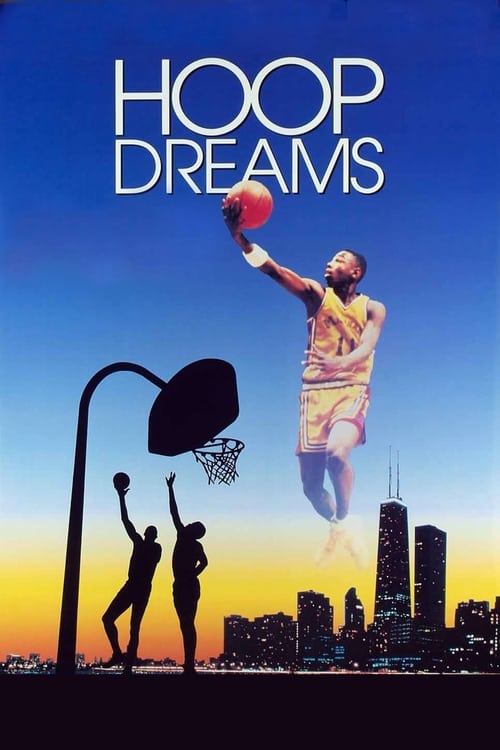
Hoop Dreams
1994 · Steve James
When you want a true story with real stakes — something to get completely invested in, cheer for, and argue about afterward. It asks for an evening, and it earns every minute.
What it's about
Two Black teenagers from Chicago's West Side, William Gates and Arthur Agee, get spotted on playground courts at fourteen and recruited into a suburban Catholic school with a famous basketball program. The cameras follow them for five years — through practices, injuries, tuition bills, family struggles, and the long commute between two worlds — as the dream of the NBA collides with everything it costs to chase it.
The experience
It plays like a great novel you can't put down: three hours that fly by because you're rooting so hard for these kids. It's suspenseful in the way real life is suspenseful — every game, every report card, every phone call from a recruiter matters — and it will break your heart and put it back together more than once.
The craft
Shot over five years and cut down from roughly 250 hours of footage, it's a landmark of patient, embedded filmmaking — the editing finds a novelistic shape in raw life, with rhymes and reversals between the two boys' paths no screenwriter would dare invent. The grainy on-the-ground footage isn't pretty, but the accumulated intimacy is the whole point.
Why it matters
Widely held up as one of the greatest American documentaries ever made, and its famous snub for the documentary Oscar caused an outcry that helped push the Academy to reform how that category was judged. It set the template for the modern longform sports documentary.
Snapshot
Hoop Dreams follows two Black teenagers from Chicago's West Side, William Gates and Arthur Agee, from the summer before their freshman year of high school through their first year of college, as the promise of basketball recruits them into an economy that will use them and, in the end, mostly discard them. Recruited at fourteen by a scout who spots them on public courts, both are enrolled at St. Joseph High School in Westchester, a predominantly white suburban Catholic school forty-five minutes and a whole social order away, whose basketball program had produced Isiah Thomas. What begins as a story about talent becomes a story about tuition, transportation, injury, family, and the arithmetic of who gets to keep dreaming.
At 170 minutes, assembled from something on the order of 250 hours of material shot across five years, the film is the most widely seen and most consequential American documentary of its decade. It arrived in 1994 as a shock to two adjacent assumptions: that documentaries could not sustain feature length in theaters, and that nonfiction could not achieve the narrative density of the novel. Roger Ebert and Gene Siskel each named it the best film of 1994 — not the best documentary, the best film — and Ebert would later place it atop his list for the 1990s. It was added to the National Film Registry in 2005.
Its enduring subject is not basketball. It is the way an institution extracts value from children while describing the transaction as opportunity.
Industry & production
The film is a Kartemquin Films production, and that lineage explains nearly everything about how it was made. Kartemquin, founded in Chicago in 1966 and long guided by Gordon Quinn (executive producer here), had spent decades building a house practice of patient, socially engaged observational filmmaking rooted in the city's neighborhoods and labor politics. It was a collective with an institutional memory for the long shoot — the kind of place where a film that takes five years is a scheduling problem rather than an impossibility.
The project began small. Steve James, Frederick Marx, and Peter Gilbert conceived it as a short film — roughly half an hour — about playground basketball, pitched toward public television. The subjects proved more compelling than the premise, the shooting kept extending, and the funding had to be reassembled repeatedly from public-broadcasting and foundation sources over the life of the production. This is the ordinary condition of American independent documentary: no single financier commits to five years of an unresolved story, so the film is financed in fragments, each one contingent on what the previous year yielded. That the filmmakers kept returning — through Arthur's expulsion for unpaid tuition, through William's knee surgeries, through years when nothing photographable seemed to be happening — is the production's central fact.
Its commercial life began at Sundance in 1994, where it won the Audience Award for documentary and where Fine Line Features, New Line's specialty arm, acquired it. Fine Line's decision to release a nearly three-hour nonfiction film theatrically was genuinely unusual for the period, and the run that followed was one of the most successful for a documentary to that point — a result that helped establish theatrical documentary as a viable category rather than a loss leader for eventual broadcast. (Precise grosses circulate in several versions; the reliable claim is that it stood among the highest-earning documentaries of its era.)
The film also produced litigation: the coach and school depicted in it pursued claims against the production concerning the film's use of their participation, a dispute that was resolved out of court. Reporting on the settlement's terms is thin, and it is worth naming as a permanent feature of long-form vérité — consent obtained from institutions in year one may look very different to them in year five.
The Academy Award episode became its own chapter in industry history. Hoop Dreams received a single nomination, for Film Editing, and was passed over entirely by the documentary branch. The resulting outcry — amplified by the film's critical standing and by reporting on the branch's idiosyncratic screening and voting practices — forced a reform of how documentary features were nominated. It is one of the rare instances in which a single film's exclusion changed the rules that excluded it.
Technology
Hoop Dreams is, technically, a video film that became a theatrical film, and it sits at a specific hinge in that transition. It was shot on standard-definition analog video with broadcast-grade portable equipment of the late 1980s and early 1990s, then blown up to 35mm for theatrical exhibition. The economics were decisive: at five years and hundreds of hours, film stock and processing would have been prohibitive, while videotape was cheap enough that the crew could keep rolling through scenes whose significance was not yet apparent.
Two consequences follow. First, duration: a videotape load runs far longer than a 16mm magazine's ten or eleven minutes, which means the camera can stay inside a scene — a family argument, a living-room negotiation with a recruiter, the long wait for exam results — without the interruption that reloading imposes. Much of the film's celebrated intimacy is an artifact of not having to stop. Second, texture: the blowup carries video's softness, its smeared low-light response, its slightly unstable blacks. Rather than reading as deficiency, this grain of the image became legible in 1994 as evidence — the visual signature of material captured rather than composed.
The film's later restoration history is bound to those origins; Criterion's editions, first on DVD in the mid-2000s and later on Blu-ray, worked from the video source rather than the theatrical blowup, which is why the film now looks cleaner in the home than it ever did in cinemas. The available public documentation of exactly which camera bodies and tape formats were used across the five years is inconsistent, and it would be false precision to name a single rig for a shoot that spanned several equipment generations.
Technique
Cinematography
Peter Gilbert's camerawork is the film's ethical instrument. It is handheld, close, and almost entirely reactive — it finds the person speaking a beat after they begin, which registers as honesty rather than clumsiness. Gilbert works from inside domestic space: kitchen tables, front steps, cramped bedrooms, hallways. The framing is rarely composed for beauty and often composed for access, taking whatever position the room allows.
Two visual registers alternate. The domestic footage is soft, low-lit, and physically near. The basketball footage, by contrast, is shot from the sidelines and the stands with the grammar of broadcast sport — wider, brighter, more legible, occasionally with the actual scoreboard graphics of local television. The film thereby stages the difference between how these boys are seen when they are commodities and how they are seen when they are sons. The recurring aerial and street views of Chicago — the West Side, the expressway, the suburban campus at the far end of the commute — do quiet cartographic work, insisting that the distance the boys travel each morning is a distance across an entire racial geography.
Editing
The editing, credited to Steve James, Frederick Marx, and William Haugse, is the film's greatest formal achievement and the source of its lone Oscar nomination. The task was to reduce roughly 250 hours to under three, and to do so without imposing a shape the material could not honestly bear.
The solution was architectural: title cards mark each school year, giving the film a serial, chaptered rhythm that mirrors both the academic calendar and the season structure of the sport. Within that chassis, the film cross-cuts between William and Arthur with steadily increasing irony. Early on they are near-twins — same neighborhood, same scout, same school. Then their trajectories separate and, crucially, invert: William, the anointed one, is worn down by injury and expectation; Arthur, discarded by St. Joseph when his family cannot pay, finds his footing at a public school and delivers the film's most exhilarating athletic sequence. Neither arc is the redemption story the other was supposed to supply.
The editors also demonstrate that a game can be cut for narrative rather than highlight. Extended late sequences preserve real duration and real reversals, and they place the families in the stands within the same sequence, so that the outcome on the court is always shot through with what it means to the people watching.
Mise-en-scène / staging
Nothing is staged, but a great deal is arranged by the world and merely noticed by the film. The mise-en-scène is a study in contrasted institutions: the gleaming, banner-hung St. Joseph gymnasium against the Agee apartment where the electricity has been shut off; the recruiting office against the public court where the whole thing started. The film repeatedly places the boys' bodies in institutional frames — locker rooms, admissions offices, summer-camp registration lines at a Nike-sponsored showcase — and lets the incongruity speak.
That Nike camp sequence is the closest the film comes to editorial argument, and it does not need narration to make it, because Spike Lee, addressing the assembled players, states the transaction aloud: they are there because they are worth money to other people.
Sound
Location sound is the film's spine — overlapping family talk, television audio bleeding under conversation, gym noise, the specific acoustic of a small apartment. It is imperfect and unsweetened, and the imperfection functions as authentication.
Ben Sidran's score works in a jazz and R&B idiom, used sparingly and mostly as connective tissue between chapters rather than as emotional instruction. Steve James's narration is similarly restrained: it supplies dates, outcomes, and logistical facts the images cannot carry, and it consistently declines to tell the viewer how to feel. The most affecting sound in the film is often silence around a small announcement — a test result, a phone call, a number read aloud.
Performance
The subjects are not performing, but they are unmistakably aware of the camera, and the film's five-year span converts that awareness into something like the development of screen presence. William Gates grows guarded and articulate about his own instrumentalization; Arthur Agee grows funnier and more self-possessed. Around them, the adults deliver the film's most indelible moments: Sheila Agee holding a household together and then passing her nursing assistant examination; Emma Gates naming the arithmetic of survival; Curtis Gates, William's older brother, whose own collapsed career hangs over every conversation about William's; Bo Agee, whose addiction and later return are filmed without either condemnation or absolution. Coach Gene Pingatore is neither villain nor mentor but something more disquieting — a man doing his job inside a system whose terms he did not write and does not question.
Narrative & dramatic mode
The film's mode is novelistic realism executed in nonfiction — specifically, the bildungsroman doubled and set against itself. Its dramatic engine is the classical sports question ("will he make it?"), which it raises honestly and then systematically re-scopes: making it comes to mean tuition paid, a diploma earned, a family intact, a father returned. By the end, the NBA is no longer the stake; it is the lure that organized everyone's exploitation.
Structurally, it works by parallel montage across five years, with the two protagonists functioning as controls on each other's experiment. The mode is observational rather than argumentative — there is no interviewed expert explaining the political economy of amateur athletics — but the accumulation of observed detail delivers an argument more durable than any thesis statement could.
Genre & cycle
It belongs to observational documentary and to the sports film simultaneously, and its power comes from the collision. Sports cinema is a genre of engineered uplift; direct cinema is a practice suspicious of engineering. Hoop Dreams takes the shape of the former and the ethics of the latter, and the friction produces its final effect: a film with all the pleasures of a great game and none of the consolations of a great game story.
Within documentary, it belongs to the longitudinal cycle — films that make time itself the subject by outlasting their subjects' circumstances — and it is the American work that made that cycle commercially legible.
Authorship & method
Authorship here is genuinely collective, and the credits reflect it: Steve James directs, produces, narrates, and shares the editing credit; Frederick Marx produces, writes, and edits; Peter Gilbert shoots and produces; William Haugse joins the editing team; Gordon Quinn executive produces from Kartemquin. Ben Sidran scores.
The method is long-duration embedded observation, sustained through relationships rather than contracts. The filmmakers were present in these households for years, which is the only way certain scenes could exist — a family does not admit a stranger to the moment the power is cut off. That closeness has always drawn the obvious objection: three white filmmakers documenting two Black families, over a period long enough that the crew inevitably affected what it filmed. The film does not fully resolve this, and its honest defense is procedural rather than theoretical — the length of the commitment, the refusal to editorialize, the willingness to let subjects contradict the filmmakers' expectations, and the ongoing relationships between the filmmakers and the Gates and Agee families in the decades since.
James's subsequent career extends the method: Stevie (2002) turns the camera on his own past relationship with its subject; The Interrupters (2011) returns to Chicago violence with the same patience; Abacus: Small Enough to Jail (2016) applies it to a family under legal siege; America to Me (2018) applies it to a school across a full academic year.
Movement / national cinema
The film descends directly from American direct cinema — the Drew Associates lineage, the Maysles brothers, D. A. Pennebaker, and, for institutional analysis, Frederick Wiseman, whose High School (1968) is a clear ancestor in its refusal to editorialize about a system it thoroughly indicts. It is equally a product of a specifically Chicago documentary culture: Kartemquin's decades of neighborhood-scale, class-conscious filmmaking, which supplied both the aesthetic patience and the political framing.
Era / period
Its period is precise and inseparable from its meaning. The shooting years span the late 1980s into the early 1990s: the crack epidemic's effect on Chicago's West Side, the disinvestment of public housing including Cabrini-Green, the collapse of the manufacturing employment that had underwritten Black working-class Chicago, and — simultaneously — the peak of Michael Jordan's Bulls a few miles away, broadcasting an image of basketball as an exit. The film captures the exact moment when athletic-shoe marketing, televised amateur showcases, and college recruiting fused into a machine for identifying and monetizing teenagers. Released in 1994, it also lands amid a national argument about urban Black families conducted almost entirely without their participation, and its rebuttal is simply to film them at length.
Themes
The governing theme is the seduction and cost of a single narrow exit. Others follow: the pricing of education, dramatized with brutal clarity when a fourteen-year-old is removed from school over an unpaid balance while a benefactor's check keeps another enrolled; the transfer of parents' deferred ambitions onto children; the physical fragility of the asset, since a knee is the whole capital structure; race and spatial segregation rendered as a daily commute; and the quiet, unglamorous heroism of mothers, which the film treats as the actual subject once the basketball recedes. Underneath all of it is a question about American mythology — whether "opportunity" describes a real door or a lottery whose losers are told they simply wanted it less.
Reception, canon & influence
Critical reception was close to unanimous and unusually intense. Siskel and Ebert's placement of it atop their 1994 lists, and Ebert's later elevation of it to best of the decade, gave a documentary a rank normally reserved for fiction features and were instrumental in driving general audiences to a three-hour nonfiction film. The Oscar snub, rather than diminishing it, converted the film into a cause and produced structural reform at the Academy. The National Film Registry followed in 2005, and Criterion's editions secured its place in the home-video canon.
Looking backward, the film's debts are legible: direct cinema's handheld proximity; Wiseman's institutional gaze; Barbara Kopple's Harlan County USA (1976) for the model of the filmmaker who stays for years and accepts the risk that comes with it; and Michael Apted's Up series for the proposition that filming the same people across time is itself a dramatic form. Kartemquin's own catalog of Chicago working-class portraiture supplied the immediate template.
Looking forward, its influence is broad enough to be nearly invisible. It made the feature-length theatrical documentary commercially thinkable, clearing ground for the nonfiction boom of the late 1990s and 2000s. It established the multi-year, character-driven vérité portrait as a dominant contemporary documentary form, visible in later work as varied as Undefeated, Minding the Gap — itself a Kartemquin production, and a direct descendant in both method and geography — and the long-form sports series that networks and streamers now commission by the dozen, including ESPN's 30 for 30 franchise and the Last Chance U model. Its influence also runs sideways into fiction: any film that stakes its meaning on watching real people age across years, Linklater's Boyhood included, works in territory Hoop Dreams mapped first.
Its afterlife is also a matter of consequences rather than aesthetics. Neither William nor Arthur reached the NBA; both completed the arcs the film began off-camera, William eventually entering the ministry, Arthur building a public life partly around the film itself. The subsequent violent deaths of Curtis Gates and of Bo Agee — the latter after his hard-won return to his family — retroactively darken the film's final act and confirm its refusal of uplift. The most cited fact about Hoop Dreams is that it is a documentary that plays like an epic. The more important one is that it was right.
A Deleuzian reading
The lights go out in the Agee living room and the camera is already there.
The full Deleuzian reading of Hoop Dreams →
Reception
It arrived a sensation — Sundance Audience Award, Siskel & Ebert crusading for it, near-universal raves — and the Oscars' failure to even nominate it for Best Documentary became one of the most infamous snubs in Academy history. Three decades on it's not reappraised so much as enshrined: routinely called the greatest documentary ever made.
How Hoop Dreams was received, from release to now →
How to watch Hoop Dreams: what to notice on a first viewing
- Notice how different home footage looks from game footage. Domestic scenes are shot close, soft, and low-lit, while basketball games are shot wide and bright with broadcast-style camera grammar, sometimes with real scoreboard graphics. The two looks stage the difference between being seen as a son and being seen as an asset.
- Watch the camera find each speaker a beat late. Peter Gilbert's handheld work is close and reactive, arriving on a face just after someone starts talking rather than anticipating them. The lag reads as honesty. Nothing here was set up for the camera to catch.
- Notice the title cards marking each new school year. The film breaks five years of footage into chapters this way, giving the whole thing the rhythm of an academic calendar and a season structure at once. You always know exactly how much time has passed and how much is left to go.
- Listen for the television bleeding under family conversation. The location audio is imperfect on purpose: overlapping talk, small-apartment acoustics, background noise left in rather than cleaned up. The rough sound is doing a job: convincing you that nobody staged what you're hearing.
The whole guide to watching Hoop Dreams, with the keys for a rewatch →
Influences: the films it descends from and the films it influenced
- Primary (1960) — Drew Associates' portable sync-sound rig let a handheld camera walk backward ahead of a subject through a crowd, and its cross-cutting between two rivals running the same race is the literal structural template for Hoop Dreams' parallel montage of William and Arthur.
- Seven Up! (1964) — Established the longitudinal contract — return to the same children at fixed intervals and let the class system reveal itself through the gap between an early stated ambition and the later footage — which Hoop Dreams converts from an interval series into a continuous four-year shoot marked by chaptered title cards.
- High School (1968) — Wiseman's narration-free, interview-free assembly of corridor, office and disciplinary-meeting blocks supplies the grammar for the St. Joseph's material, where a coach's or administrator's speech is left to indict itself without commentary.
- Salesman (1969) — The Maysles model of following a small set of named individuals across territory with unsweetened location audio, then editing toward deflation rather than triumph, is what lets Hoop Dreams end on unpaid tuition and a junior-college gym instead of a draft.
- Now We Live on Clifton (1974) — Kartemquin's in-house method — a Chicago working-class household filmed over months by a collectively credited crew, with the children's own speech carrying the analysis of their neighborhood — is the direct production template Quinn later executive-produced Hoop Dreams under.
- Harlan County USA (1976) — Kopple proved that a crew that stays for years and keeps rolling through the moment of danger earns access no negotiated shoot can buy; Hoop Dreams inherits that procedural ethic in scenes like the Agees' electricity being cut, which only a camera already long resident in the house could record.
- Pumping Iron (1977) — Imported fiction's rivalry-and-final-contest architecture into vérité sports shooting, building a documentary toward a scored competition climax — the structure Hoop Dreams reuses for the state tournament run while withholding the win the shape promises.
- Seventeen (1983) — Single-operator, sync-sound long takes inside Midwestern high-school and kitchen-table life, with overlapping unmixed room tone and no narration, established the reactive handheld proximity to teenagers under pressure that Peter Gilbert's camera adopts.
- Streetwise (1984) — Bell's embedded observation of adolescents in crisis pairs a stills-photographer's compositional eye with unmediated handheld coverage — the dual visual register Hoop Dreams runs between lyrical playground basketball and rough domestic footage.
- American Dream (1990) — Direct transmission via cinematographer Peter Gilbert, who shot American Dream: the multi-year embedded shoot with title-card chronology marking elapsed seasons, and an ending that declines both triumph and despair.
- On the Ropes (1999) — Takes the parallel-arc construction wholesale — three young Brooklyn boxers followed simultaneously over years, cross-cut so that one subject's collapse lands against another's advancement, with the trainer occupying the coach's structural role.
- Stevie (2002) — James turns the same multi-year embedded method reflexive, filming his own prior relationship with the subject and putting the filmmaker's presence — the unresolved objection Hoop Dreams left procedural — inside the frame as the film's subject.
- Undefeated (2011) — A single season of embedded high-school football vérité cut into parallel player arcs against a coach's institutional authority, using the same withheld-outcome sports structure and unnarrated locker-room audio.
- The Interrupters (2011) — Kartemquin production applying the year-long Chicago residency method to violence interruption, chaptered by seasonal title cards and built from an extreme shooting-to-finished ratio compressed by a small editing team.
- American Promise (2013) — Thirteen years following two Black boys through an elite private school, cross-cut between institutional and domestic space exactly as Hoop Dreams alternates St. Joseph's with Cabrini-Green — the staging of institutional contrast as the film's central argument.
- Boyhood (2014) — Carries the longitudinal principle into fiction: the meaning is produced by the same actors' bodies visibly aging across a twelve-year shooting schedule, with narrative elision at each time jump doing the work of Hoop Dreams' chaptered compression.
- Last Chance U (2016) — Serializes the model for streaming — a full season embedded at a junior college, with academic-eligibility and tuition pressure treated as the real drama and multiple players' arcs intercut across episodes.
- Minding the Gap (2018) — A Kartemquin production built from a decade of Rockford footage, running two visual registers — fluid skate-follow camerawork against static domestic observation — and cutting three friends' trajectories in parallel toward divergent adult outcomes.
- Coach Carter (2005) — The documentary reference point for athletic-dream-versus-reality among Black inner-city players, supplying the sociological 'hoops-as-only-exit' frame Carter's education argument explicitly rebuts.
- He Got Game (1998) — The documentary that crystallized the recruitment machine preying on Black teenage athletes; Lee dramatizes its exposé of coaches, agents, and hangers-on circling a schoolboy phenom.
- Love & Basketball (2000) — Observational vérité grammar of youth recruitment: handheld court coverage held wide and long enough for real play to occur in-frame, and the campus visit / letter-of-intent beats treated as procedure rather than triumph.
- Crumb (1994) — Shot over years of accumulated familiarity so that family members forget to perform, and released into the same 1994 theatrical moment that made a feature-length nonfiction film commercially viable at the box office.
- When We Were Kings (1996) — James's sustained direct cinema tracking of Black athletic aspiration through a political-economic frame — extended observational footage accumulated over years, the underdog arc emerging from contingency rather than scripted drama — is the 1990s documentary renaissance sibling that shares WWWK's grammar of witnessing sports as social text.
Similar films
- Boyhood (2014) — influence & lineage
- Minding the Gap (2018) — influence & lineage
- He Got Game (1998) — shared sensibility
- Love & Basketball (2000) — shared sensibility
- Boyz n the Hood (1991) — shared sensibility
- GoodFellas (1990) — shared sensibility
- King Richard (2021) — shared sensibility
- Nickel Boys (2024) — shared sensibility