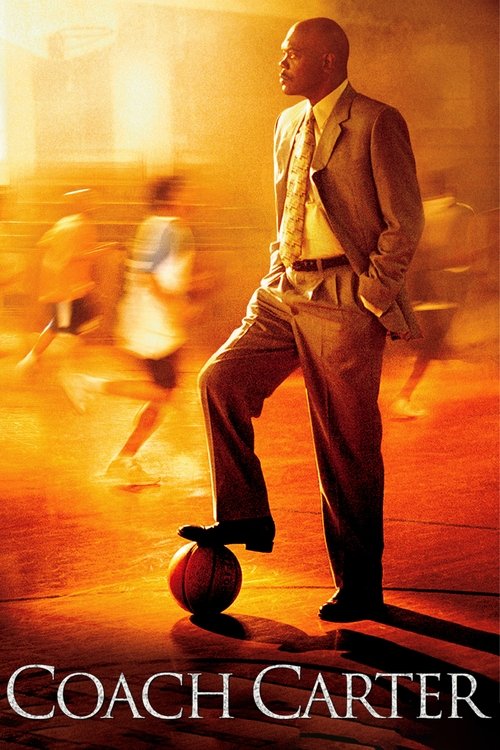
Coach Carter
2005 · Thomas Carter
For when you want to feel fired up and believed-in — a motivational crowd-pleaser for a night when you need conviction more than surprise. Comfort viewing with a spine.
What it's about
In 1999, Ken Carter takes over the basketball program at Richmond High, a struggling school in a working-class California city, and makes his undefeated players sign a contract: keep your grades up or you don't play. When they don't, he padlocks the gym and forfeits games, igniting a standoff with players, parents, and a town that sees basketball as the only way out. It's drawn from the real headline-making story.
The experience
Rousing and sincere, with the full pleasure of the underdog sports movie — big games, locker-room speeches, hard-won respect — but its sharpest tension is off the court, in the argument over what these kids' futures are actually worth. It earns its lump-in-the-throat moments.
Performances
Samuel L. Jackson anchors the film with commanding, no-nonsense authority — he makes Carter's rigidity feel like love under pressure, and his speeches land without tipping into sermon.
The craft
Thomas Carter directs the basketball with pace and clarity, but the film's real craft is structural: it keeps flipping the sports-movie formula so that report cards, not scoreboards, carry the suspense. The ensemble of young players gets enough individual texture that the stakes feel personal rather than generic.
Why it matters
A staple of the inspirational-teacher-and-coach canon, endlessly rewatched and quoted, and a case study in how a local news story about academics and athletics became a national conversation piece.
Snapshot
Coach Carter is a based-on-fact sports drama that turns a local news story into a broad-canvas parable about discipline, race, and the economics of hope. In 1999, Ken Carter, the newly hired head basketball coach at Richmond High School in the working-class city of Richmond, California, locked his gymnasium and forfeited games — benching an undefeated team — because his players had failed to meet the academic terms of a contract he had asked them to sign. The film, directed by Thomas Carter (no relation) and anchored by Samuel L. Jackson in the title role, dramatizes that stand-off and its aftermath. Released by Paramount Pictures in January 2005, it belongs to the durable lineage of the inspirational-coach picture, but it distinguishes itself by insisting that winning games is the film's least important stake. Its true subject is the statistic Carter recites throughout: the gap between the athletic dreams sold to young Black men and the graduation and incarceration realities that await most of them. The result is a commercially polished studio drama with an unusually pointed civic argument at its center.
Industry & production
The film was produced under the Paramount Pictures umbrella with MTV Films and the production company Tollin/Robbins among the credited entities — a lineage that connects it to a run of youth-oriented, music-forward studio pictures of the era. It was a mid-budget star vehicle built around Samuel L. Jackson, then one of the most reliably bankable actors in Hollywood, and it was positioned for a January release, a slot studios frequently use for uplift-minded, word-of-mouth dramas aimed at broad and family-inclusive audiences over a holiday-adjacent window. The screenplay is credited to Mark Schwahn and John Gatins, writers with strong footprints in youth and sports material — Schwahn would go on to create the teen series One Tree Hill, and Gatins built a career in sports and inspirational drama. The picture was a clear commercial success and opened strongly at the domestic box office; I will not cite specific grosses here, as I cannot verify exact figures, but its performance was strong enough to reaffirm the viability of the earnest, socially minded sports drama as a studio product. As with any dramatization of living people, the production negotiated the usual compression-and-composite compromises of the "based on a true story" form, and the real Ken Carter was publicly associated with the film's promotion.
Technology
Coach Carter is a conventional mid-2000s studio production shot photochemically on 35mm film and finished for standard theatrical exhibition; it does not foreground technological novelty, and the honest scholarly position is that its innovations are aesthetic and rhythmic rather than technical. Its most distinctive "technology" is arguably its sound and music infrastructure — a soundtrack-driven approach, typical of MTV Films projects, that integrates contemporary hip-hop and R&B into the fabric of the film and treats the commercial soundtrack album as part of the release strategy. The basketball sequences rely on the era's standard toolkit for filming sport — multiple cameras, long lenses, and editorial assembly — rather than on any new capture system. Where the film shows real craft is in staging and cutting the game action legibly, a perennial technical challenge of the genre, rather than in any camera or post-production breakthrough.
Technique
Cinematography
The photography is by Sharone Meir, a cinematographer whose later collaboration with Damien Chazelle on Whiplash (2014) makes his work here retrospectively interesting: both films are studies of an authoritarian mentor and the young people he pushes, and both depend on the camera's ability to make a confined, high-pressure room — a gym, a rehearsal hall — feel like an arena of moral combat. In Coach Carter, Meir contrasts the burnished, controlled interiors of the gymnasium and locker room with the flatter, harder light of Richmond's streets and homes, using the visual gap between institutional space and neighborhood to underline the film's argument about what school can and cannot protect. The game sequences favor kinetic coverage and shallow focus that isolate players in motion, while the dramatic scenes settle into steadier, more classical framing built around Jackson's stillness.
Editing
The editing (credited to Peter Berger) carries much of the film's genre payload. The basketball montages compress a season into rhythmic bursts scored to music, the standard grammar of the sports film, while the dramatic scenes are cut for performance and rhetorical build — holding on Jackson as he delivers the film's set-piece speeches. The film's length is notable: it is a long entry for its genre, and part of the editorial project is managing a large ensemble of players' subplots (academic struggle, a pregnancy, gang violence) alongside the central lock-out narrative. The cutting has to keep the civic thesis legible without letting the individual stories dissolve into a blur, and it leans on parallel construction — a game here, a classroom or a street there — to keep the two registers in dialogue.
Mise-en-scène / staging
The production design roots the film in a specific, unglamorous Northern California milieu, and the locked gymnasium becomes the film's central image and staging problem: an empty court, chained doors, players sent to the library. Director Thomas Carter repeatedly stages Carter as a solitary figure of authority against groups — one man facing a team, a gym full of angry parents, a school board — a blocking strategy that visualizes the film's theme of individual moral will against institutional and community pressure. The costume and property detail (uniforms, the signed contracts, textbooks) is used pointedly: the contract is a recurring physical object, and the transition of the players from street clothes to disciplined uniformity is part of the film's visual argument about self-respect.
Sound
Sound and music are central to the film's identity. Beyond Trevor Rabin's score, the film deploys a contemporary hip-hop and R&B soundtrack as a running commentary and mood engine, in keeping with the MTV Films house style; the single "Hope" by Twista featuring Faith Evans is associated with the film's release. Sonically, the game sequences balance crowd, sneaker-squeak, and music, while the dramatic scenes strip the sound back to let dialogue — and Jackson's voice in particular — dominate.
Performance
Samuel L. Jackson's performance is the film's spine. He plays Ken Carter as a controlled, almost military presence whose authority derives from restraint rather than volume — a deliberate counterpoint to Jackson's better-known register of explosive intensity. The film surrounds him with a young ensemble that includes Rob Brown, Robert Ri'chard, Rick González, Antwon Tanner, and Nana Gbewonyo as the players, with the singer Ashanti in a supporting role; the film is also frequently cited for featuring Channing Tatum in an early screen appearance. The ensemble performances are calibrated to the genre's demands — the arc from resistance to buy-in — but the film gives several of the young actors room for genuine vulnerability, particularly around the subplots of academic failure and neighborhood danger.
Narrative & dramatic mode
The film operates in the inspirational true-story mode, structured around a central provocation (the lock-out) rather than a conventional win-the-championship climax. Its dramatic engine is inverted from the usual sports template: the season's undefeated streak is presented not as triumph but as a distraction from the real contest, which is academic and existential survival. The screenplay uses Carter's contract as its structuring device — a promise made, tested, and either kept or broken — and threads multiple ensemble subplots through the main line so that the stakes are diffused across the team rather than concentrated in a single star athlete. The mode is rhetorical and didactic by design: the film wants to persuade, and it builds toward speeches and moral confrontations rather than toward suspense. Its climax is deliberately anti-climactic in genre terms, subordinating the outcome on the court to the outcome in the classroom.
Genre & cycle
Coach Carter sits squarely in the sports-drama genre and, more specifically, in the inspirational-coach/teacher cycle — the tradition of Hoosiers (1986), Stand and Deliver (1988), Remember the Titans (2000), and Friday Night Lights (2004). Within that cycle it belongs to the subset of based-on-true-story films that use sport as a vehicle for social argument, and it is closely kin to the earnest, racially conscious high-school and coaching dramas of the early 2000s. What differentiates it is its skepticism toward the very genre it inhabits: it repeatedly questions the myth of athletic salvation that most sports films celebrate, making it something of a critique from within the cycle.
Authorship & method
Director Thomas Carter brings a biographically apt sensibility to the material: he began as an actor and is well known for his role on the basketball-centered television series The White Shadow, a show about a coach mentoring an inner-city high-school team — a lineage that makes him an unusually fitting choice for this project. As a director he had already worked in youth-and-music-driven drama, most prominently Save the Last Dance (2001), and Coach Carter extends his interest in stories of young people, discipline, and self-betterment. His method here favors performance and clear moral staging over stylistic flourish.
Among the key collaborators: cinematographer Sharone Meir, whose control of confined, pressurized interior space anticipates his later work on Whiplash; composer Trevor Rabin, the former Yes guitarist who became a prolific film composer associated with Jerry Bruckheimer productions, supplying a propulsive, accessible score; editor Peter Berger, tasked with balancing genre montage against a sprawling ensemble; and writers Mark Schwahn and John Gatins, whose scripts across their careers gravitate toward youth, sport, and uplift. The animating authorial choice shared across these hands is restraint in service of message — a film built to land its argument cleanly rather than to call attention to its own making.
Movement / national cinema
The film belongs to mainstream American studio cinema and does not participate in any avant-garde or art-cinema movement. Its most meaningful cultural placement is within a strand of American popular cinema concerned with Black urban experience and education — a commercial, uplift-oriented counterpart to the more critical urban dramas of the 1990s. It is best understood as Hollywood social-problem filmmaking in the classical mold: a studio using the reach of a star vehicle to deliver a civic message to a mass audience.
Era / period
Produced and released in the mid-2000s, the film reflects that moment's studio appetite for soundtrack-driven, youth-oriented inspirational dramas and its comfort with the "based on a true story" prestige-lite format. It dramatizes events of 1999 and thus also functions as a near-contemporary period piece, capturing a turn-of-the-millennium anxiety about public education, opportunity gaps, and the pipeline from underfunded schools to prison — themes that were prominent in American public discourse of the era.
Themes
The film's dominant theme is the tension between athletic aspiration and educational reality — the seductive but statistically improbable dream of a professional sports career set against the near-certainty that education is the surer route out. Related themes include discipline and self-respect as forms of liberation; the responsibility of authority and mentorship; race, class, and the structural constraints on Richmond's young Black men; and the idea of the "student-athlete" as a contested category. The film's most quoted moment — a player reciting the passage that begins "Our deepest fear is not that we are inadequate" — is worth a scholarly note: that passage is drawn from Marianne Williamson's A Return to Love (1992) and is frequently and wrongly attributed to Nelson Mandela; the film's use of it exemplifies its earnest, self-consciously inspirational register.
Reception, canon & influence
Critical reception was mixed-to-positive: reviewers widely praised Jackson's performance and the sincerity of the film's message while noting its length and its adherence to the familiar beats of the inspirational-sports formula. It was a solid commercial success and has enjoyed a long, durable afterlife on television, streaming, and in classroom and coaching contexts, where it circulates as a motivational text well beyond its life as a theatrical release.
Looking backward, the film draws on the established inspirational-coach/teacher tradition (Hoosiers, Stand and Deliver, Remember the Titans), on the documentary-adjacent basketball realism popularized by Hoop Dreams (1994) as a cultural reference point for the athletic-dream-versus-reality theme, and on Thomas Carter's own grounding in the basketball-mentor narrative through The White Shadow. Its "based on a true story" framing is enabled by the real Ken Carter's national visibility in 1999.
Looking forward, its clearest legacy is as a widely referenced motivational and educational touchstone rather than as a film that spawned direct imitators. Its afterlife is unusual in that its influence is at least as much civic and pedagogical as cinematic — the phrase "Coach Carter" became shorthand for the ideal of the demanding mentor who prioritizes education over athletics. In film-historical terms, its most intriguing thread is the retrospective link between Sharone Meir's chamber-drama photography here and his work on Whiplash a decade later, connecting Coach Carter to a broader cinematic conversation about the ethics of the tough mentor. The honest summary is that its lasting importance rests less on formal innovation than on the clarity and persistence of its argument.
Reception
Critics in 2005 filed it under 'formulaic inspirational sports movie, but Samuel L. Jackson elevates it' — it opened #1 anyway, and two decades on it's outgrown the reviews to become a genuine comfort-watch staple, quoted in actual locker rooms far more than most 'better' films.
How Coach Carter was received, from release to now →
How to watch Coach Carter: what to notice on a first viewing
- Watch Carter face the team, then the parents, then the school board alone. Thomas Carter keeps blocking one man against a group: a team, angry parents, a board. The framing repeats until authority itself looks like a physical position. The staging argues that moral will is a stance you take against a crowd, not a speech you give it.
- Notice the signed contract reappear in Carter's hands. The paper the players signed keeps surfacing at moments of conflict, waved, read from, or referenced, long after the scene where they signed it. A piece of paper becomes the film's real stakes, heavier than any game on the schedule.
- Watch how the gym looks different from the streets outside it. Sharone Meir shoots the gymnasium and locker room burnished and controlled, then cuts to flatter, harder light in Richmond's homes and streets. The light gap shows you what the school can protect and what it cannot reach.
- Listen for the dialogue-only quiet under Jackson's big speeches. The game scenes stack crowd noise, sneakers, and music, but whenever Carter addresses the team the sound strips back to just his voice. Stripping the sound down makes Jackson's restraint, not volume, the source of his authority.
- Track the players' clothes moving from street wear to matching uniforms. Costume shifts the team from individual street clothes into disciplined uniformity as the season and the contract take hold. The wardrobe change visualizes self-respect as something built, piece by piece, not felt all at once.
The whole guide to watching Coach Carter, with the keys for a rewatch →
Influences: the films it descends from and the films it influenced
- Hoosiers (1986) — The template for the redemptive-basketball film: a disciplinarian imposing a rigid, non-negotiable system on a resistant small-community team, structured around the drills-to-tournament montage arc Coach Carter inherits wholesale.
- Rocky (1976) — Codified the score-driven training-montage grammar — escalating physical drills cut to propulsive music — that the film's conditioning/'suicides' sequences replicate beat for beat.
- Stand and Deliver (1988) — Supplies the based-on-true-story didactic-mentor mode where a demanding educator holds minority students to elevated academic standards, framing 'high expectations as respect' — Carter's exact rhetorical stance transposed to sport.
- Lean on Me (1989) — Morgan Freeman's Joe Clark prototypes Jackson's Carter: the singular authoritarian reformer, drawn from a real public figure, staged as one man against an entire community and institution.
- Dangerous Minds (1995) — Modeled the pairing of inner-city classroom uplift with a hip-hop-forward soundtrack as both mood engine and marketing hook — the sound-design and needle-drop strategy Coach Carter adopts.
- Hoop Dreams (1994) — The documentary reference point for athletic-dream-versus-reality among Black inner-city players, supplying the sociological 'hoops-as-only-exit' frame Carter's education argument explicitly rebuts.
- The White Shadow (1978) — Thomas Carter's own formative acting ground: a coach-mentoring-an-inner-city-team series whose mentorship narrative DNA he carries directly into his direction here.
- Remember the Titans (2000) — Contemporary studio true-story sports drama built on the identical disciplinarian-coach-transforms-ensemble structure and slow-motion-plus-pop-needle-drop game coverage.
- Gridiron Gang (2006) — Directly extends the school-to-prison-pipeline theme, transplanting the didactic mentor-redemption argument into a juvenile detention facility with sport as intervention.
- The Blind Side (2009) — Based-on-true-story sports uplift that foregrounds the same education-over-athletics thesis and mentorship-as-rescue from the identical socioeconomic trap.
- Whiplash (2014) — Sharone Meir reprises his confined, pressurized-interior chamber photography and shallow-focus coverage of drilling bodies, extending the tough-mentor-ethics conversation and Meir's own Coach Carter aesthetic.
- The Way Back (2020) — Late entry in the redemptive-high-school-basketball-coach subgenre, inheriting the disciplinarian-transforms-a-losing-team structure in a more somber, grief-inflected register.
- King Richard (2021) — Model of the uncompromising Black mentor who withholds competition to enforce a life-first ethic — Richard's 'no juniors' refusal is the same authority-as-love gesture.
- Save the Last Dance (2001) — Carter's own prior youth drama establishing his method of scoring urban-teen self-betterment stories to a contemporary R&B/hip-hop track list, refined again here.
- Friday Night Lights (2004) — Same-year turn toward handheld, shallow-focus, documentary-texture game coverage that privileges on-court immediacy over classical wide masters — the naturalistic sports photography Sharone Meir also works in.
- Glory Road (2006) — Bruckheimer-adjacent based-on-true-story college-basketball film extending the demanding-coach-plus-racial-uplift formula with the same propulsive, accessible scoring register.
- We Are Marshall (2006) — True-story football-community drama sharing the Trevor Rabin-style propulsive uplift scoring and the mid-2000s studio inspirational-sports packaging.
Similar films
- Remember the Titans (2000) — influence & lineage
- Hoop Dreams (1994) — influence & lineage
- Whiplash (2014) — influence & lineage
- He Got Game (1998) — shared sensibility
- King Richard (2021) — shared sensibility
- Creed (2015) — shared sensibility
- 42 (2013) — shared sensibility
- The Hurricane (1999) — shared sensibility