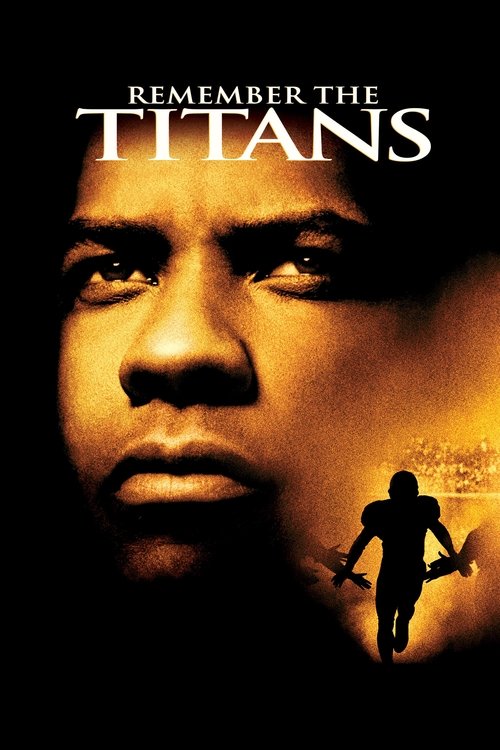
Remember the Titans
2000 · Boaz Yakin
For when you want to feel good and mean it — a fire-you-up, maybe-cry-a-little night that leaves you warmer than it found you. Pure comfort viewing with a conscience.
What it's about
Virginia, 1971: a court-ordered school integration puts a Black head coach, Herman Boone, in charge of a newly merged high-school football team — over the beloved white coach, Bill Yoast, he's just displaced. Black and white players who don't want to share a locker room, let alone a huddle, get hauled off to training camp and told to become a team. One championship season carries the whole weight of a town learning to live with itself.
The experience
A big-hearted crowd-pleaser that runs on locker-room speeches, hard-hitting game nights and songs on the bus — it earns its lump-in-the-throat moments honestly, even when you can see them coming. Rousing more than subtle, and completely committed to it.
Performances
Denzel Washington gives Coach Boone real steel and wit — commanding without ever tipping into caricature — and Will Patton matches him quietly as Yoast, the rival who becomes a partner.
The craft
Jerry Bruckheimer production polish applied to a true story: punchy football sequences, a wall-to-wall soul and Motown soundtrack, and a script that moves like a well-run drive. It's built for a living-room crowd — the music and the game-day sound do a lot of the lifting.
Why it matters
One of the most enduring sports films of its era — a staple of team bus rides, classrooms and cable reruns, and among the most beloved crowd-pleasers of Denzel Washington's career.
Snapshot
Remember the Titans is a Walt Disney Pictures sports drama produced by Jerry Bruckheimer, directed by Boaz Yakin, and headlined by Denzel Washington as Herman Boone, the Black head coach appointed to lead a newly integrated high-school football program in Alexandria, Virginia, in 1971. Adapted by screenwriter Gregory Allen Howard from the actual history of the T.C. Williams High School Titans, the film uses a single championship season as a controlled laboratory for observing the friction, negotiation, and eventual solidarity of a forcibly desegregated community. It sits at the confluence of two durable American genres — the inspirational sports picture and the civil-rights-era social drama — and it became one of the most commercially successful and culturally persistent examples of both. Its reputation rests less on formal daring than on the efficiency of its emotional engineering, the charisma of its lead, and a curated period soundtrack that fixed it firmly in the memory of a generation of viewers.
Industry & production
The film is a characteristic product of the Bruckheimer-Disney partnership at the turn of the millennium. After the high-octane blockbusters of the 1990s (Bruckheimer's output with the late Don Simpson and then solo), Bruckheimer's move into a mid-budget, PG-rated, based-on-a-true-story drama reflected a studio strategy of packaging uplift for a broad family audience while retaining the producer's signature gloss. Disney positioned it as a fall release; it opened in late September 2000 and proved a substantial box-office success, comfortably outperforming its budget — though precise figures are best confirmed against a primary source rather than asserted from memory here.
The choice of Boaz Yakin as director is notable. Yakin had emerged from independent film with Fresh (1994) and A Price Above Rubies (1998), work far removed in scale and tone from a Bruckheimer studio vehicle. His hiring signals the producer's habit of recruiting directors with a sharper authorial pedigree to lend texture to commercial material, while the machinery of the production — the marketing, the music supervision, the four-quadrant accessibility — remained firmly a studio and producer function. The screenplay by Gregory Allen Howard was the fruit of extended research into the real Alexandria story; the historical record is clear that Howard fictionalized, compressed, and reordered events for dramatic economy, a point later raised by commentators and by some of the real participants. As with most "based on a true story" studio pictures, the film should be read as a dramatization rather than documentary.
Technology
Remember the Titans was shot and finished on photochemical film using conventional late-1990s production technology; it does not represent a technological milestone. Its interest on this axis is modest: the football sequences were staged and covered with the multi-camera, tightly edited coverage typical of the era's sports filmmaking, favoring the impact aesthetics of contact — helmets, dust, slow-motion collisions — over any single innovation in capture. There is no significant use of digital effects as a storytelling instrument; the spectacle is practical, achieved through choreography, camera placement, and cutting rather than computer-generated augmentation. In this sense the film is a conservative, well-resourced example of turn-of-the-millennium studio craft rather than a technical marker.
Technique
Cinematography
The film was photographed by Philippe Rousselot, a cinematographer of the first rank whose credits include his Academy Award–winning work on A River Runs Through It and a long association with prestige filmmaking. His presence lends the picture a warmth and legibility above the genre norm. The palette leans into a nostalgic, sunlit Americana — autumnal fields, burnished interiors, the golden haze of period recollection — that reinforces the film's memory-play framing. Rousselot's handling of the football is functional and kinetic rather than experimental: long lenses compress the field, handheld and slow-motion inserts heighten the violence of the line, and the coverage privileges faces and reactions so that every play reads as a beat of character rather than pure athletics. The craftsmanship is high; the visual strategy is unobtrusive, subordinated throughout to clarity and feeling.
Editing
The editing, credited to Michael Tronick, is the film's most consequential formal system. The picture is built for propulsion and emotional cueing: montage sequences compress the arc of the season and the team's growing cohesion, training and bonding are elided into rhythmic passages set to music, and the game footage is cut for maximum visceral impact and suspense. The pacing is disciplined — the film moves briskly through a large ensemble and a substantial time span without stalling — and the cutting frequently does the ideological work of the film, juxtaposing Black and white players across the frame line and then, progressively, uniting them within it. This is classical continuity editing deployed with commercial precision.
Mise-en-scène / staging
Yakin and his team stage the film around a small set of charged locations — the locker room, the practice field, the team bus, the training camp at Gettysburg, and the domestic and civic spaces of a divided town. The Gettysburg sequence is the film's most self-conscious staging: the historical battlefield is made to literalize the film's thesis about a nation's unresolved racial wound, a deliberately didactic bit of geography. Period production and costume design establish 1971 through cars, clothing, and hairstyles without tipping into pastiche. The blocking consistently dramatizes integration spatially — bodies that begin the film segregated by frame and grouping are, by its end, physically intermingled — so that the staging carries the argument even when the dialogue does not.
Sound
Sound is central to the film's identity, and here the record is unambiguous: the soundtrack of period soul, Motown, and rock functions as a second narrative voice. Musical needle-drops mark the passage of the season, underline moments of unity (the team's synchronized chants and dance-infused warmups are staged around music), and anchor the film in the sensory texture of the early 1970s. The score proper was composed by Trevor Rabin, whose orchestral cues supply the swelling, emotive undercurrent the genre demands. The blend of curated source music and original scoring is the film's most influential sonic quality, and it is inseparable from why the picture lodged so durably in popular memory.
Performance
Denzel Washington's Herman Boone is the film's center of gravity: a performance of controlled authority, moral certitude, and carefully rationed vulnerability that gives the schematic material genuine gravitas. Will Patton, as the demoted white coach Bill Yoast, provides the essential counterweight — a study in wounded pride slowly reoriented toward respect and partnership — and the Boone/Yoast dynamic is the true dramatic engine, more than any single game. The ensemble of young actors (several of whom went on to substantial careers) delivers the archetypal team roster with enough individuation to sustain the film's many subplots; the friendship between the two team leaders across the racial divide is the emotional payload the film builds toward. The performances are pitched for accessibility and clarity, consistent with the film's four-quadrant intentions.
Narrative & dramatic mode
The film operates in the mode of the redemptive ensemble melodrama, structured as a season-long sports narrative with a strongly teleological shape: adversity, forced proximity, conflict, breakthrough, testing, and triumph. It is framed as memory — bracketed material positions the story as recollection, lending the whole an elegiac, commemorative register signaled by the title itself. Dramatically it fuses two conventional arcs: the underdog-team-wins narrative and the enemies-become-brothers reconciliation narrative, and it resolves both in the same climactic movement. The mode is unabashedly sentimental and morally legible; ambiguity is minimized, antagonists are largely external (a hostile town, a corrupt refereeing subplot, individual bigots), and the film's confidence in the possibility of reconciliation is its governing tone.
Genre & cycle
Remember the Titans belongs squarely to the American inspirational sports film, a genre with deep roots (from Knute Rockne through Rocky, Hoosiers, and Rudy) and it stands within a distinct turn-of-the-millennium cycle of true-story sports dramas that studios produced with regularity in the late 1990s and 2000s. It is equally a member of the racial-reconciliation drama, a cycle in which sport or another institution becomes the arena for working through American racial history. Its particular achievement was to weld these two cycles so seamlessly that it became a template: the based-on-a-true-story, music-driven, ensemble sports movie about overcoming division. It is frequently discussed alongside later Disney/true-story sports films as part of the same commercial lineage.
Authorship & method
Authorship here is genuinely distributed, and honesty requires acknowledging that the producer's hand is as legible as the director's. Boaz Yakin brought an indie sensibility and an interest in character to material that could have been purely formulaic, but the film bears the strong imprint of producer Jerry Bruckheimer's house style — polish, pace, emotional maximalism, and mass accessibility. Screenwriter Gregory Allen Howard originated and shaped the material from historical research, making the foundational choices about compression and emphasis. Cinematographer Philippe Rousselot supplied prestige-grade imagery; composer Trevor Rabin supplied the orchestral emotional spine; editor Michael Tronick organized the whole into its propulsive, montage-driven rhythm; and the film's music supervision — its deployment of period source music — is arguably as decisive an authorial act as any camera choice. The most accurate account of the film's "method" is that it is a well-oiled collaboration in which studio craft and a strong lead performance do the heavy lifting, with directorial personality present but not dominant.
Movement / national cinema
The film does not belong to any avant-garde or art-cinema movement; it is a mainstream product of the Hollywood studio system, specifically the Disney/Bruckheimer commercial apparatus. As a work of national cinema it is deeply, self-consciously American — not only in its industrial provenance but in its subject, which is the United States' foundational and unresolved conflict over race. Its use of a Virginia town on the historical fault line of the Civil War, and its Gettysburg set piece, position it as a film explicitly about American identity and reconciliation. It is best understood as popular American cinema addressing a national mythology of progress.
Era / period
Two time frames matter. The film depicts 1971, the moment of court-ordered school integration, and it renders that period with affectionate specificity through music, design, and social texture. But it is equally a document of its own production moment, 2000 — a turn-of-the-millennium American culture inclined toward optimistic, reconciliatory narratives about racial progress, and a studio economy in which mid-budget, star-driven true stories still occupied a healthy commercial niche that has since contracted. Read across both eras, the film is a 2000 artifact looking back at 1971 with a hopeful, arguably consoling, retrospective gaze.
Themes
The film's central theme is reconciliation across racial division through shared endeavor: the proposition that forced proximity, common purpose, and mutual respect can dissolve inherited prejudice. Around this cluster related concerns — leadership and moral authority (Boone's demanding, uncompromising method), the negotiation of pride and dignity between the two coaches, the tension between individual and collective, and the relationship between sport and community identity. The film also engages, more implicitly, the theme of memory and commemoration — the act of "remembering" as itself an ethical stance. Critical discussion has long noted the film's optimism about reconciliation, and the degree to which its uplift smooths over the harder, more intractable realities of desegregation is a legitimate interpretive question the film's design largely declines to dwell on.
Reception, canon & influence
Remember the Titans was a strong commercial success and was received by audiences with lasting affection; critical reception was more mixed, with reviewers frequently praising Washington's performance and the film's emotional effectiveness while noting its formulaic structure and its softening of historical complexity. (Readers wanting exact critical aggregates or box-office totals should consult primary sources rather than rely on figures reconstructed here.)
Looking backward, the film draws on a long tradition of the underdog sports narrative (Hoosiers, Rocky, Rudy) and of the racial-reconciliation drama, and on Denzel Washington's own established authority as a screen embodiment of moral seriousness. Its method of using curated period music to build feeling belongs to a well-established practice of the music-driven Hollywood soundtrack.
Looking forward, the film's influence is substantial within its lane: it helped consolidate a template for the studio true-story sports drama that recurs across the following two decades, and it became a fixture of popular culture — widely rewatched, quoted, and referenced, and frequently invoked in discussions of the inspirational sports genre and of Denzel Washington's star career. Its music and its most emotive set pieces have had a long afterlife in the culture. At the same time, it has become a recurring object of critical reassessment regarding the "feel-good" reconciliation narrative and how such films represent civil-rights history — a debate in which Remember the Titans is often the leading example. Its dual legacy, then, is as one of the most beloved sports films of its era and as a touchstone in the ongoing conversation about how popular cinema mythologizes American racial progress.
Reception
A big crowd-pleasing hit in 2000 that critics treated as formulaic Disney uplift, it has since settled into beloved comfort-classic status — even as later reappraisals note how heavily it sands down the real 1971 history it's based on.
How Remember the Titans was received, from release to now →
How to watch Remember the Titans: what to notice on a first viewing
- Notice how the cutting places Black and white players in frame. Michael Tronick's editing juxtaposes players across the frame line early on, then gradually unites them within the same shot as the season goes on. The cutting itself is quietly doing the film's argument about integration.
- Listen for the period soul and Motown tracks marking time. Needle-drops of early-1970s soul and Motown mark the passage of the season and underline moments when the team moves as one. The soundtrack functions almost as a second narrator of the story.
- Watch where players stand relative to each other at practice. Bodies that begin the film grouped by race are, scene by scene, physically intermingled by blocking, so the staging argues even when dialogue stays quiet. You can track the team's integration just by watching where people stand.
- Notice the warm, golden light in almost every scene. Philippe Rousselot lights the film in a nostalgic, sunlit Americana of autumnal fields and burnished interiors that frames the whole story as a memory. The glow tells you this is being remembered, not just shown.
The whole guide to watching Remember the Titans, with the keys for a rewatch →
Influences: the films it descends from and the films it influenced
- Glory (1989) — Establishes Denzel Washington's screen persona as the moral center of a racial-integration-through-shared-endeavor ensemble, the exact gravitas Titans casts him to reprise.
- Hoosiers (1986) — Codifies the small-town underdog-team ensemble structure in which a swelling orchestral score is cued to game-clock beats — the emotional-spine method Trevor Rabin's score inherits.
- Rocky (1976) — Invents the training/preparation montage set to a crescendoing theme as the genre's narrative engine, the device Michael Tronick's cutting compresses a season into.
- Rudy (1993) — Angelo Pizzo's screenplay perfected the based-on-a-true-story football uplift built by compressing and simplifying documented events toward a single cathartic win.
- American Graffiti (1973) — Pioneers the wall-to-wall period needle-drop soundtrack as temporal and emotional architecture, the music-supervision-as-authorship model Titans deploys with its Motown/soul cues.
- The Big Chill (1983) — Uses a curated Motown source-music soundtrack as the film's primary emotional spine and nostalgic period signifier rather than as background — Titans' exact music strategy.
- Top Gun (1986) — Defines the Bruckheimer house style — backlit glossy imagery, needle-drop montage sequences, and emotional maximalism engineered for mass accessibility — that shapes Titans' polish and pace.
- A River Runs Through It (1992) — Philippe Rousselot's golden-hour, sunlit-Americana lighting scheme wrapped in a retrospective memory-frame narration is the identical cinematographic and framing package he brings to Titans.
- Stand By Me (1986) — Frames a period coming-of-age through an adult narrator's elegiac memory-voice over pop needle drops — the graveside-flashback memory frame Titans opens and closes on.
- Glory Road (2006) — A direct Jerry Bruckheimer production that replicates the racial-integration-sports true-story formula beat-for-beat, down to the period needle-drop montages and reconciliation-through-team arc.
- Coach Carter (2005) — Extends the montage-driven discipline-and-transformation arc anchored by a morally authoritative Black coach, with a curated soundtrack carrying the emotional beats.
- The Blind Side (2009) — Carries forward the studio true-story feel-good football template of softened racial-reconciliation uplift engineered for maximum audience catharsis.
- Invictus (2009) — Rebuilds the racial-reconciliation-through-sport true story around Morgan Freeman's moral-authority casting, the Denzel-gravitas-as-emotional-anchor strategy Titans established.
- Miracle (2004) — Applies the Disney true-story-sports template of coach-as-moral-center plus season-compression montage building to a single climactic, historically documented victory.
- 42 (2013) — Continues the period racial-integration sports biopic with prestige nostalgic cinematography and hagiographic compression of civil-rights history into an uplifting individual triumph.
- The Express (2008) — Directly extends the racial-integration college-football true story, staging the same reconciliation-through-shared-gridiron-endeavor arc against a period civil-rights backdrop.
- King Richard (2021) — Codifies the coach-mentor uplift subtype — training montage, threshold speeches, race-and-class-in-sport as backdrop — whose beats King Richard inherits and inverts by making the coach the parent.
- Friday Night Lights (2004) — Extends the based-on-a-true-story football drama but reacts against the gloss with handheld naturalism and desaturated grain, defining itself against Titans' polished montage rhythm.
Similar films
- Coach Carter (2005) — influence & lineage
- 42 (2013) — influence & lineage
- Glory (1989) — influence & lineage
- He Got Game (1998) — shared sensibility
- The Hurricane (1999) — shared sensibility
- Nickel Boys (2024) — shared sensibility
- The Help (2011) — shared sensibility
- The First Slam Dunk (2022) — shared sensibility