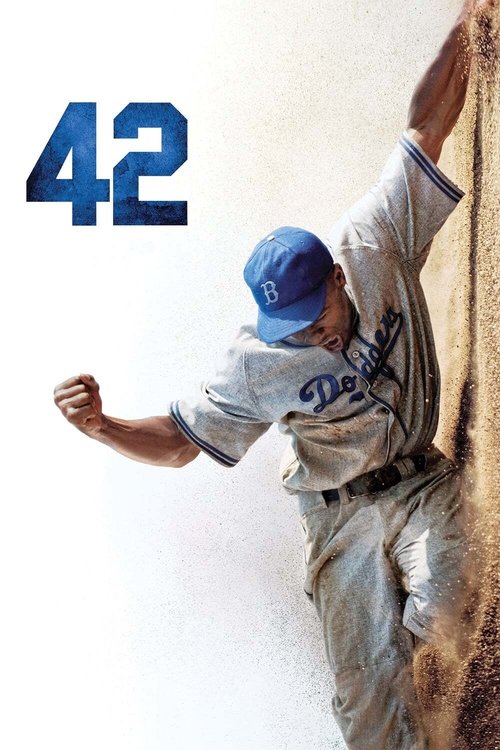
42
2013 · Brian Helgeland
For when you want an inspiring true story played straight — family-friendly enough for a night with teenagers, stirring enough to leave you a little taller. Comfort viewing with a spine.
What it's about
In 1945, Brooklyn Dodgers boss Branch Rickey decides to break Major League Baseball's color line, and picks Jackie Robinson — a fiercely proud Negro Leagues star — to do it. The film follows Robinson through two seasons of open hostility from crowds, the press, opposing teams, and his own clubhouse, under Rickey's brutal condition: he must have the guts not to fight back. His wife Rachel and the Black sportswriter traveling with him carry the weight alongside him.
The experience
A rousing, square-shouldered sports drama that doesn't flinch from the ugliness Robinson absorbed — some scenes of racial abuse are hard to sit through by design — but it builds to the swelling, stand-up-and-cheer beats the story deserves.
Performances
Chadwick Boseman, in his breakout role, gives Robinson coiled dignity — you can see the fury he's contractually forbidden to release working under the skin. Harrison Ford, gravel-voiced and buried in eyebrows, is having more fun than he'd had in years as Branch Rickey.
The craft
Brian Helgeland writes and directs in a deliberately classical Hollywood register — burnished period light, lovingly recreated 1940s ballparks, big clean emotional beats. The baseball itself is staged with real snap, and Robinson's baserunning becomes a kind of defiance you can watch.
Why it matters
It introduced Chadwick Boseman to film audiences and launched his run of American-icon roles, while renewing mainstream attention on Robinson's legacy — the number 42 remains retired across all of baseball.
Snapshot
42 is a Warner Bros. release, produced by Thomas Tull's Legendary Pictures, that dramatizes roughly two years — 1945 to the end of the 1947 season — in the life of Jackie Robinson, the man who broke Major League Baseball's color line. Written and directed by Brian Helgeland, it stars Chadwick Boseman, then largely unknown to film audiences, as Robinson, and Harrison Ford, buried under eyebrows and cigar smoke, as Brooklyn Dodgers president and general manager Branch Rickey. Nicole Beharie plays Rachel Robinson; André Holland plays Wendell Smith, the Pittsburgh Courier sportswriter who traveled with Robinson and here doubles as the film's chronicler-witness.
The title is the number, and the number is the point. Robinson's 42 was retired across all of Major League Baseball in 1997, the first such league-wide retirement in American professional sport; every player wears it once a year on Jackie Robinson Day. The film arrives already inside that ritual, and its release in mid-April 2013 was timed to sit alongside it. This is a movie about a canonization that had already happened, made for an audience presumed to know the ending.
What 42 does well it does with real conviction: the physical fact of a man absorbing abuse and converting it into performance. What it declines to do — complicate its own heroism, follow Robinson past 1947 into the decades when he became a difficult and politically inconvenient public figure — is a choice with consequences that critics registered immediately and that the film's afterlife has only sharpened.
Industry & production
Robinson's story had been circling Hollywood for decades. Robinson himself starred in The Jackie Robinson Story (1950), a cheap, fast, oddly moving programmer directed by Alfred E. Green and shot while its subject was still an active player. After that, the property went quiet at feature scale. Spike Lee developed a Robinson film in the 1990s and could not get it financed; the difficulty of clearing the story with Robinson's estate, and specifically with Rachel Robinson, who has guarded her husband's legacy with care since his death in 1972, was part of the obstacle for everyone who tried.
Helgeland's version got made because Legendary Pictures wanted it made. Thomas Tull, a baseball enthusiast, backed the project through Legendary's Warner Bros. arrangement at a budget widely reported in the neighborhood of $40 million — modest for a studio period picture requiring the reconstruction of five demolished ballparks, and possible only because so much of that reconstruction was digital. Rachel Robinson consented and consulted. Her approval is legible in the film: the marriage is treated with unusual seriousness for a sports biopic, and Robinson's private conduct is never in question.
Casting was the film's largest gamble and its largest return. Boseman was a working television actor and playwright with no feature lead behind him; the role of Robinson made him a star and set the template for the rest of his career. Ford, conversely, was a star taking a character part — a late-career pivot that critics treated as the film's second story.
Production was based in the American South, where surviving pre-war ballparks and Georgia's production incentives could be had together. Rickwood Field in Birmingham, opened in 1910 and the oldest surviving professional ballpark in the United States, carried much of the load, along with Engel Stadium in Chattanooga and Luther Williams Field in Macon. The irony is not incidental: a film about integration was shot in parks built under segregation, several of which had hosted Negro Leagues baseball.
Commercially, the film worked. It opened at number one domestically, and its opening was reported at the time as the strongest ever recorded for a baseball picture — a genre that had spent the previous two decades being pronounced dead at the box office. It went on to a domestic gross well in excess of its budget, and it has had an unusually long institutional life in schools, in MLB's own outreach programming, and in April television scheduling.
Technology
The technological substance of 42 is archaeological. Ebbets Field was demolished in 1960; Philadelphia's Shibe Park, Cincinnati's Crosley Field, Pittsburgh's Forbes Field, and the Polo Grounds followed within roughly fifteen years. None of the film's principal locations exist. The production's method was to shoot practical foreground on surviving period parks — the dirt, the dugout railings, the low grandstand geometry, the quality of light on a real infield — and to complete the upper decks, outfield walls, signage, light towers, and surrounding city with digital extension. Crowds were similarly built: modest numbers of costumed extras tiled and multiplied to fill stands that would otherwise read as empty.
This is unglamorous, thoroughly conventional 2013 visual-effects work, and its conventionality is the interesting part. By the early 2010s, digital set extension had become cheap and reliable enough that a mid-budget drama could casually resurrect five vanished stadiums — something that in 1990 would have required a blockbuster budget in matte paintings and miniatures, and in 1950 was simply impossible, which is why The Jackie Robinson Story shot on whatever field it could borrow. The technology quietly determines the film's form: because the ballparks could be rebuilt, the film could be a chronicle, moving city to city through the 1947 schedule, rather than a chamber drama confined to one home field.
The film was released in a 2.39:1 widescreen frame, which is itself a period-inflected choice — scope was the format of the studio prestige picture, not of 1947 newsreels — and signals the register the film wants: memorial, expansive, classical.
Technique
Cinematography
Don Burgess shot the film. Burgess's formation is Robert Zemeckis's — Forrest Gump, Contact, Cast Away — and with it comes a particular American house style: clean, legible, warm, unafraid of beauty, organized around the actor's face. 42 is lit for iconography. Sunlight on the diamond is honeyed and slightly overexposed at the edges; interiors, particularly Rickey's office, are darker, wood-toned, cluttered with the paraphernalia of the front office. The visual argument is straightforward — the field is where the truth is, the office is where the deal is — and Burgess executes it without irony.
The camera favors long lenses for baseball action, compressing pitcher and batter into a shallow, tense plane, and it repeatedly isolates Robinson within the frame: alone in the batter's box, alone in a hotel lobby, alone on a base with the entire stadium's attention converging on him. Isolation is the film's central compositional idea, and it is applied consistently enough to become an argument rather than a mannerism.
Editing
Helgeland cut with Peter McNulty and Kevin Stitt. The film's rhythm is episodic by design: it advances by discrete incidents — a signing, a hotel refusal, a beanball, a teammates' petition, a game — rather than by continuous dramatic pressure. Baseball sequences are assembled in the modern sports-film grammar of short, hard cuts synchronized to impact, with occasional ramping into slow motion at the moment of contact. The most disciplined editorial choice in the film is a refusal: during the sequence in which Phillies manager Ben Chapman (Alan Tudyk) subjects Robinson to a sustained torrent of racial abuse from the dugout, the cutting slows and lengthens rather than accelerating, holding on Boseman's face and on Tudyk's until the scene becomes genuinely unpleasant to sit through. It is the film's best-directed passage precisely because it stops moving.
Mise-en-scène / staging
Richard Hoover's production design and Caroline Harris's costumes reconstruct 1947 with a slight lacquer — flannels, fedoras, Pullman cars, the particular ugly grandeur of a segregated Southern train station. The staging is organized around thresholds: doorways Robinson is not permitted through, showers he enters after the others leave, a clubhouse whose seating chart is a map of the film's politics. Helgeland stages the dugout as a jury box. The recurring visual figure is the crowd looking down and inward at a single man, which the digital stadium extensions exist principally to make possible.
Sound
The sound design does honest work in a genre where it is often decorative. The crack of the bat, the specific slap of a ball into a mitt, and above all the sound of a crowd changing its mind — the tonal shift from hostile roar to grudging noise to applause — carry more of the film's dramatic information than the dialogue in several sequences. Mark Isham's score is symphonic, restrained by the standards of the American uplift biopic, and generally content to hold long strings under scenes rather than instruct the audience. Period source music and radio broadcast — John C. McGinley's affectionate impersonation of Red Barber's Southern play-by-play — supply the era's texture and also its ambivalence: Barber's voice is warm, folksy, and Southern, which is exactly the point.
Performance
Boseman's Robinson is built on containment. He plays a man performing restraint as a form of labor, and lets the cost show in small physical leakages — a jaw, a grip on a bat, a walk down a tunnel that becomes a controlled explosion once no one is watching. Because Robinson's public conduct in 1947 was itself a performance of forbearance, Boseman is playing an actor, and he finds the double consciousness in it. Ford's Rickey is a broad, enjoyable, deliberately theatrical construction — a growl, a moral-theatrical rhetoric, a shrewdness the film never fully lets curdle. Beharie's Rachel Robinson is the film's necessary counterweight, a private audience before whom Robinson need not perform. Holland's Wendell Smith is saddled with narrative-device duty and quietly transcends it in one scene where he names his own exclusion from the press box. Tudyk's Chapman is the year's most thankless piece of casting, played without a shred of mitigation.
Narrative & dramatic mode
42 is a chronicle, not a tragedy. It runs from Rickey's decision through the Montreal season, compressed almost to montage, into the 1947 rookie year, and closes on Robinson's pennant-clinching home run in Pittsburgh in September — before the World Series, which Brooklyn lost, and long before the rest of Robinson's life. The structure is that of a trial: an accusation is entered against Robinson's right to exist in this space, evidence accumulates, and a verdict of acceptance is delivered by teammates and crowd.
The mode is hagiographic in the precise sense — the life of a saint, organized by ordeals. Its dramatic engine is Rickey's paradoxical instruction that Robinson must have "the guts not to fight back," which converts the protagonist's agency into endurance and leaves the film's forward motion to be supplied by antagonists and by white characters undergoing conversion. This is the structural root of the "white savior" critique the film attracted: not that Rickey is fictionalized as a hero, but that the drama's arc of change belongs to the people around Robinson rather than to Robinson himself.
Helgeland does hedge. Rickey's motives are staged as genuinely mixed — the box office and the moral account are kept in the same ledger for most of the film, until a late confession supplies a personal origin for his conviction. The moment when Pee Wee Reese (Lucas Black) puts an arm around Robinson before a Cincinnati crowd is presented as the film's emotional summit; it should be said plainly that historians have long disputed whether that embrace happened as legend records it, with accounts differing on the year, the city, and whether it occurred at all. The film treats the legend as fact. The family of pitcher Fritz Ostermueller, portrayed as the man who beans Robinson and then serves up the pennant-clinching home run, publicly objected to his characterization.
Genre & cycle
The film sits at the intersection of two cycles. The first is the baseball picture, an American genre with a long memorial streak running from The Pride of the Yankees (1942) through The Jackie Robinson Story (1950), The Natural (1984), Eight Men Out and Field of Dreams (1988–89), A League of Their Own (1992), and — immediately upstream of 42 — Moneyball (2011), whose commercial success reopened studio interest in baseball drama for adults. 42 borrows The Natural's golden mythic light while rejecting its fabulism.
The second is the racial-integration sports film: Remember the Titans (2000), Glory Road (2006), The Express (2008), and later Race (2016). These films share a structure — a Black athlete's excellence compels white institutions to reform — and a reliably uplifting terminus. 42 is among the more formally accomplished entries and does not escape the formula.
It also belongs to a specific moment in American historical cinema. Within roughly eighteen months, audiences received Lincoln, Django Unchained, Fruitvale Station, Lee Daniels' The Butler, and 12 Years a Slave. 42 is the most institutionally comfortable film in that group, and its reception was inevitably shaped by proximity to 12 Years a Slave, which offered a violently opposed answer to the question of how American racial history should be filmed.
Authorship & method
Helgeland came to directing from screenwriting, and 42 is a writer's film in its virtues and its limits. He shared the Academy Award for the L.A. Confidential adaptation and wrote Mystic River, Man on Fire, and Green Zone; as a director — Payback, A Knight's Tale, and later Legend (2015) — he has favored mid-budget genre with a strong central performance and a firm classical sense of scene construction. His authorial signature here is dialogue: Rickey's rhetoric, the clubhouse's needling, the newspaper offices. His limitation is a reluctance to let structure carry irony; the film says complicated things in individual scenes and simple things overall.
His collaborators are studio-classical rather than avant-garde by design. Burgess supplies the Zemeckis-school legibility; Isham, whose credits range from A River Runs Through It to Crash, supplies a score that treats the material with more reserve than the genre norm; Hoover's design and Harris's costumes prioritize period accuracy over stylization. Nobody on the crew is trying to make the film strange. The method throughout is to trust the events and the faces.
Boseman deserves to be counted among the authors. He would go on to play James Brown in Get on Up (2014) and Thurgood Marshall in Marshall (2017), completing an unofficial trilogy of twentieth-century Black American figures before Black Panther made him a global star, and his approach to Robinson — interiority under pressure, dignity as active labor rather than passive nobility — established the method he brought to all of them.
Movement / national cinema
42 belongs to no movement. It is mainstream American studio filmmaking in its most consciously classical register, and its aesthetic lineage runs through the Hollywood historical biopic — a form the studios have used since the 1930s to negotiate national self-image. What it does participate in is a national memory project: the American civic canonization of the civil rights era, in which specific individuals are elevated as exemplary so that the underlying structures need not be examined. Robinson's induction into that canon was complete long before this film; 42 is a monument's caretaker rather than its builder.
Era / period
Two eras are in play. The depicted period — 1945–47 — is the immediate postwar moment when Black servicemen returned from a war against a racial state to a country that still segregated its ballparks, its trains, and its hotels. The film registers this without dwelling on it: Robinson's own wartime court-martial, arising from his refusal to move to the back of an Army bus, is alluded to in Rickey's office rather than dramatized.
The production period — 2013 — is Barack Obama's second term, a year in which the Zimmerman verdict and the Supreme Court's Shelby County decision made the question of whether American racial progress was linear an urgently live one. 42's answer is untroubled, and that untroubledness is itself a period artifact. Industrially, 2013 sits at the end of the window in which a studio would reliably finance a $40 million adult historical drama for theaters; within a few years, comparable projects were migrating to streaming and premium television.
Themes
Endurance as labor. The film's most durable idea is that Robinson's restraint was work — physically taxing, professionally required, privately corrosive. Boseman plays it as such, and it is why the film survives its own sentimentality.
The economics of virtue. Rickey's mixed motives — that integration was simultaneously right and profitable, a moral act and a competitive advantage — are the most honest thread in the script. The film half-retreats from this insight by supplying Rickey with a redemptive personal backstory, but it does not erase it.
Witness and the press. Wendell Smith's presence foregrounds the Black press's role in forcing integration, and the film's best small gesture is showing Smith typing on his lap in the stands because the press box was closed to him. The white press appears as an instrument of both persecution and legitimation.
The private as ballast. Rachel Robinson is not decorative. The marriage functions structurally as the one space where the protagonist can be a person rather than a symbol, and the film's decision to give it real screen time is its clearest departure from sports-biopic convention.
Conversion. Teammates who sign a petition against Robinson and later stand beside him constitute the film's model of social change: individual, moral, and voluntary. It is a comforting model and an incomplete one.
Reception, canon & influence
Critical reception was warmly divided. Reviewers were broadly generous toward Boseman — repeatedly identified as a discovery — and toward Ford's late-career character turn, while faulting the film for reverence, conventionality, and an unwillingness to complicate its subject. The recurring critical charge was that 42 had made a monument rather than a portrait, and that its ending, stopping in September 1947, sealed off everything difficult about Robinson: his later confrontations with baseball's ownership, his contested 1949 testimony before the House Un-American Activities Committee, his Republican political affiliations, his sharp public criticism of the pace of integration in the years before his death. A worthwhile counter-reading holds that the film's compression is a genre requirement rather than an evasion, and that the Chapman sequence delivers a franker depiction of American racism than most PG-13 studio pictures of its decade attempt. Awards recognition was modest; despite some early-season attention, Ford did not receive an Academy Award nomination.
Backward. The film's inheritances are legible. The Jackie Robinson Story (1950) supplies both the narrative shape and, by contrast, the measure of what a half-century of resources could add. The Pride of the Yankees supplies the memorial-biopic template. The Natural supplies the light. The broader historiography of Robinson's integration — Robinson's own memoir I Never Had It Made and Jules Tygiel's Baseball's Great Experiment remain the standard accounts — had long since established the facts the film dramatizes, and where the film departs from that record, most conspicuously in staging the Reese embrace as documented history, it departs toward legend.
Forward. 42's most consequential legacy is Chadwick Boseman. The film established him as a leading man capable of carrying historical weight, a persona he brought through Get on Up and Marshall to Black Panther, and its meaning changed permanently after his death in August 2020, when Warner Bros. returned it to theaters and audiences watched a film about mortality-inflected endurance through the knowledge of what its star had been carrying. It is now, as much as anything, a Boseman memorial.
Within baseball culture, the film consolidated Robinson's screen image and fed the commemorative apparatus around Jackie Robinson Day; Ken Burns's documentary Jackie Robinson (2016) arrived shortly after, in part as a corrective, restoring the political Robinson the feature had omitted. The film also raised the profile of the surviving ballparks it used, Rickwood Field above all, which has since become a site of national baseball commemoration in its own right.
As cinema, its influence is diffuse — it neither invented nor exhausted a form. As an object, it is a clear case study in what the American studio historical film could and could not do in 2013: reconstruct a vanished world with total technical fluency, cast a great performance at its center, and then decline the harder film that performance was ready to carry.
Reception
Received in 2013 as a solid, respectful, somewhat safe crowd-pleaser — praised mostly for its unknown lead, Chadwick Boseman — it's now impossible to watch outside his shadow: the film that launched him is rewatched as a memorial, especially after he died on the very day MLB was celebrating its pandemic-delayed Jackie Robinson Day in 2020.
How 42 was received, from release to now →
How to watch 42: what to notice on a first viewing
- Watch how often Robinson stands alone in the frame. Burgess repeatedly isolates him, alone in the batter's box, alone in a hotel lobby, alone on base with the whole stadium looking at him, rather than grouping him with teammates. The camera keeps showing you a man carrying something by himself that no one is sharing.
- Listen for the crowd noise change over a single game. The sound design tracks a crowd's mood sliding from hostile roar to grudging murmur to applause, doing more dramatic work in some scenes than the dialogue does. You can hear opinion shift in real time before anyone on screen says a word about it.
- Watch which doorways and rooms Robinson is kept out of. The production design keeps returning to thresholds, doors he cannot use, a shower he enters only once everyone else has left, a clubhouse seating chart that maps the team's politics. The architecture of the ballpark does as much work as any line of dialogue.
- Watch Boseman's jaw and grip instead of his face relaxing. Boseman plays restraint as physical labor, letting the cost surface in small places, a clenched jaw, a tight grip on the bat, rather than in open expression. The performance shows you what holding yourself together actually costs a body.
The whole guide to watching 42, with the keys for a rewatch →
Influences: the films it descends from and the films it influenced
- The Pride of the Yankees (1942) — Establishes the memorial-biopic grammar 42 follows almost to the letter — the athlete framed from slightly below against sky and light towers, a career compressed into discrete public incidents, and a timeline sealed at a valedictory moment so the difficult later life never enters the frame.
- The Jackie Robinson Story (1950) — Supplies the exact beat order Helgeland rebuilds — the Rickey office audition, the Montreal season, the Chapman bench-jockeying, the pennant swing — so 42 plays as a re-shoot with resources, replacing flat newsreel-scale grandstands with tiled crowd elements and digital set extension.
- In the Heat of the Night (1967) — Poitier's method of playing an insult by refusing to discharge it — held stillness, delayed blink, the reaction withheld a beat past comfort while the camera stays on the contained face rather than cutting to the aggressor — is the exact performance register Boseman works in through the Chapman sequence.
- The Natural (1984) — Deschanel's smoke-and-backlight ballpark — sun raked through grandstand girders, bloom off the light towers, impact-synced slow motion on the connecting swing — is reproduced by Burgess close enough to read as deliberate quotation rather than convergence.
- Eight Men Out (1988) — The model for shooting a vanished era in surviving parks: real minor-league grandstands standing in for lost major-league ones, plus ensemble dugout blocking in which the bench functions as a continuous commentary track on the man at the plate.
- A River Runs Through It (1992) — Isham's Americana template — muted trumpet over sparse strings, cues entering late and declining to swell — is the withholding discipline he brings to 42, where the score stays banked until the film's few designated release points.
- Forrest Gump (1994) — Burgess's schooling in invisible compositing and crowd multiplication — a few hundred extras tiled into a full period stadium, digital extension matched to practical light so the seam never reads — is the same toolkit that rebuilds Ebbets Field and Crosley Field here.
- L.A. Confidential (1997) — Helgeland's own adaptation work established his scene construction: period drama driven by institutional talk in offices, newsrooms and back rooms, power negotiated in dialogue rather than action — Rickey's office is a Hanson/Helgeland room transplanted to Brooklyn.
- Remember the Titans (2000) — Codifies the integration-sports blocking 42 reuses: the threshold — doorway, locker-room aisle, dugout step, shower room — as the basic unit of dramatic progress, with who crosses and who yields the space carrying the argument in place of dialogue.
- 61* (2001) — The direct technical precedent — a demolished ballpark reconstructed by shooting a surviving one and extending it digitally, with tiled crowd plates and period radio play-by-play carrying the exposition the images can't hold.
- A Knight's Tale (2001) — Helgeland's crowd-as-chorus device: arena spectators worked as a single tonal instrument whose turns — jeer to hush to roar — score the hero's standing, redeployed in 42 to make Ebbets Field's ambient sound a running verdict on Robinson.
- Get on Up (2014) — Extends the star-character turn 42 manufactured: Boseman's total physical impersonation held inside a contained emotional register, load-bearing enough that the film can hand him a life delivered as discrete public scenes and trust the performance to bind them.
- Race (2016) — Runs the 42 playbook on Jesse Owens — segregated-athlete story cut to the same episodic incident structure, a lost stadium rebuilt via digital extension and tiled crowds, radio commentary supplying the historical frame the drama declines to state.
- Hidden Figures (2016) — Adopts threshold staging as its primary device — the segregated door, the coffee pot, the room a Black protagonist may not enter — married to the same warm studio-classical palette and containment performances that absorb hostility without releasing it.
- Marshall (2017) — Repeats 42's structural bet with the same star: one sealed episode standing in for a whole life, staged inside an institution — courtroom rather than dugout — whose assembled onlookers function as a jury box that keeps rendering judgment in reaction shots.
- King Richard (2021) — The post-42 studio sports biopic template intact: a star-character turn at the center, long-lens court coverage that stays outside the athletic action, and a timeline cut off at the first triumph so the subject's later contradictions never reach the screen.
- The Express (2008) — Built from identical parts one cycle earlier — period stadium extension, hostile crowd sound designed as the antagonist, and an integration narrative structured as a chain of survivable incidents rather than a developing argument.
- Moneyball (2011) — Shares the long-lens ballpark grammar — compressed telephoto coverage that observes the game from a fixed remove instead of staging it in cut-in inserts — and lets broadcast play-by-play do narration work a voiceover would otherwise carry.
Similar films
- Remember the Titans (2000) — influence & lineage
- King Richard (2021) — influence & lineage
- Hidden Figures (2016) — influence & lineage
- Forrest Gump (1994) — influence & lineage
- Moneyball (2011) — influence & lineage
- Black Panther (2018) — shared sensibility
- Nickel Boys (2024) — shared sensibility
- He Got Game (1998) — shared sensibility