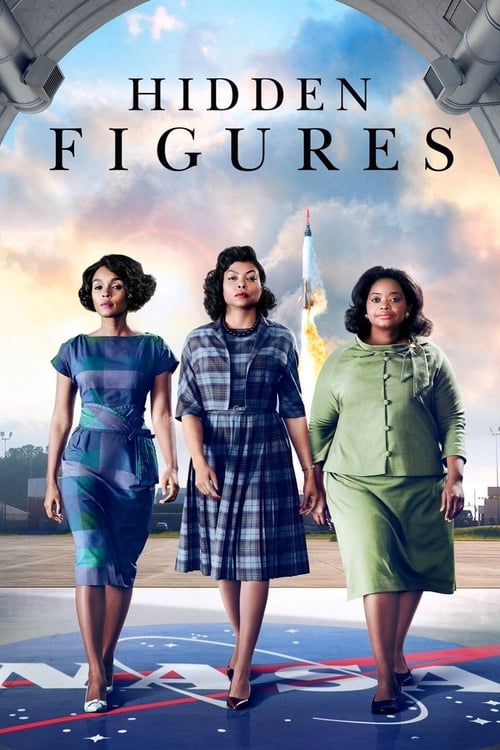
Hidden Figures
2016 · Theodore Melfi
For a night when you want to feel good and come away knowing something — an inspiring true story that works for the whole family, a movie night with kids, or anyone who needs their faith in persistence restored. Pure comfort with real history underneath.
What it's about
In the early 1960s, as America scrambles to put a man in orbit, three Black women mathematicians at NASA's Langley center in segregated Virginia do the work the space race secretly depends on. Katherine Johnson calculates trajectories for John Glenn's flight while being kept from meetings and even from the nearest bathroom; Dorothy Vaughan runs the segregated computing pool without the supervisor title, and teaches herself programming before the new IBM machine can make her obsolete; Mary Jackson fights for the credentials to become an engineer. It's drawn from the true story told in Margot Lee Shetterly's book.
The experience
A warm, briskly paced crowd-pleaser that runs on competence and quiet defiance — you get the satisfaction of watching brilliant people be proven right, scene after scene, against a system built to ignore them. It's rousing without being saccharine, and the countdown-to-launch tension genuinely grips.
Performances
Taraji P. Henson carries the film with a performance of contained brilliance that boils over in one unforgettable speech, while Octavia Spencer (Oscar-nominated for the role) and Janelle Monáe round out an ensemble with rare, easy chemistry.
The craft
Theodore Melfi braids three biographies into one clean ensemble arc, with sharp period production design — chalkboards, punch cards, mission control — and a score co-written by Pharrell Williams that gives the era real bounce. The math is staged so you always understand the stakes without needing to follow an equation.
Why it matters
A sleeper smash that out-grossed most of its Oscar-season rivals, earned a Best Picture nomination, and pushed the real women — Katherine Johnson above all — into overdue national recognition, including buildings named in their honor.
Snapshot
Hidden Figures is a mainstream historical drama that recovers a genuinely suppressed chapter of American technical history: the work of Black women mathematicians employed as "computers" at NASA's Langley Research Center in Hampton, Virginia, during the Mercury program. Adapted from Margot Lee Shetterly's nonfiction book of the same name — published in September 2016, only months before the film's release — Theodore Melfi's second feature braids three biographies into a single ensemble arc: Katherine Goble Johnson (Taraji P. Henson), the analytic geometry prodigy assigned to the Space Task Group; Dorothy Vaughan (Octavia Spencer), the de facto supervisor of the segregated West Area computing pool who teaches herself FORTRAN ahead of the IBM 7090's arrival; and Mary Jackson (Janelle Monáe), an aspiring engineer who must petition a Virginia court for permission to attend segregated night classes.
The film's shape is deliberately, almost architecturally conventional: parallel three-act uplift, obstacles staged as institutional signage, a climax pegged to John Glenn's February 1962 Friendship 7 orbital flight. What distinguishes it is the specificity of its milieu — chalk, slide rules, wind tunnels, IBM mainframes, the physical geography of Jim Crow inside a federal research campus — and the calibrated warmth of its three lead performances. It became one of the most commercially successful films of its release season and received Academy Award nominations for Best Picture, Best Adapted Screenplay, and Best Supporting Actress (Spencer). It also became, almost immediately, an object of scholarly argument about the ethics of historical compression: the film invents and reassigns events in ways that critics and historians have documented in detail, and those inventions are inseparable from its populist effectiveness.
Industry & production
Hidden Figures originated as a book proposal rather than a finished book. Shetterly — whose father worked at Langley, and who grew up in Hampton among the community the film depicts — had been researching the West Computers for years; the film rights were optioned before publication, with producer Donna Gigliotti (an Oscar winner for Shakespeare in Love) driving the project and Pharrell Williams joining as a producer and music supervisor. Allison Schroeder, a screenwriter who had grown up near Cape Canaveral and interned at NASA, wrote an early draft; Melfi rewrote and shares screenplay credit. Twentieth Century Fox backed the project at a mid-range budget by studio standards — a "specialty" scale production positioned for awards season rather than a tentpole.
Melfi came to the film with exactly one prior feature: St. Vincent (2014), a Bill Murray comedy-drama. He has said publicly that he turned down a Marvel offer to take this project, a decision that reads as characteristic of the film's positioning — a mid-budget, adult-audience, star-ensemble drama at precisely the moment the studio system was abandoning that category.
Principal photography took place largely in Atlanta, Georgia, rather than in Virginia, taking advantage of Georgia's tax incentives — one of the more consequential industrial facts about American production in the 2010s. Morehouse College and other Atlanta-area locations stood in for Langley; a decommissioned facility and constructed sets supplied the Space Task Group interiors. Fox opened the film in limited release in late December 2016 to qualify for awards, then expanded wide in January 2017, a platform strategy that turned out to be unusually effective: the film's word-of-mouth expansion produced box-office grosses well above its budget and it led the domestic weekend chart in January 2017. Precise figures vary by source and I won't assert specific numbers here, but the commercial outcome is undisputed — it was a genuine crossover hit and outgrossed most of its Best Picture competition.
The release timing was also political. The film opened between the November 2016 election and the January 2017 inauguration, and its story of federal institutions grudgingly expanding opportunity was received by many viewers as an argument about the present. The production could not have planned this; it nonetheless shaped the reception decisively.
Technology
Technology is not background in Hidden Figures — it is the film's central dramatic substance, and the screenplay is unusually literate about it. Three technological registers organize the plot.
First, human computation. The film takes seriously the fact that "computer" was a job title before it was a machine, and that the labor was heavily gendered and, at Langley, racially segregated into pools. The West Area Computers were real; the film's depiction of women working in rooms of desks with mechanical calculating machines, checking each other's arithmetic, and being assigned to engineering groups on a temporary basis is broadly accurate to the historical record Shetterly documents.
Second, the transition to electronic computation. The arrival of the IBM 7090 — physically staged as a machine too large to fit through the door, requiring a wall to be opened — is the film's most effective piece of technological dramaturgy. Dorothy Vaughan's decision to learn FORTRAN, and to train her staff in it, is presented as a survival strategy: she recognizes that the machine will eliminate her department and positions her women to become its programmers instead. This is one of the film's most historically grounded threads. Vaughan did become an expert FORTRAN programmer and a leading figure in Langley's transition to machine computing.
Third, orbital mechanics as narrative. The film stakes its climax on the problem of the reentry trajectory — the go/no-go computation for Friendship 7. Its most-cited technical detail, Katherine Johnson's use of Euler's method to bridge between analytic and numerical approaches, is dramatized at a blackboard. The famous request that Glenn have "the girl" check the machine's numbers before he flies is grounded in the historical record; Johnson recounted it in interviews for decades, though the film compresses the timeline (the verification was not a last-minute, launch-pad-adjacent event) and stages it for maximum suspense.
The production consulted with NASA, and the agency embraced the film — Langley later named a computational research facility for Johnson, and the film's release coincided with a broader institutional effort to publicize the West Computers' history.
Technique
Cinematography
Mandy Walker, ACS — an Australian cinematographer whose credits include Australia (2008) and, later, Mulan (2020) and Elvis (2022) — shot the film. Her approach is warm, legible, and classically composed rather than showy: sunlit Virginia exteriors, saturated period color in costume and set dressing, and interiors lit to preserve detail in dark skin tones against the fluorescent white of institutional spaces. That last point is a real craft achievement and not merely a technical footnote; the film's visual scheme depends on faces reading with full tonal range in rooms designed, both narratively and photographically, to make its protagonists conspicuous.
Walker's most characteristic device is the tracking shot that measures institutional distance — most famously the repeated runs Katherine makes across the Langley campus to the colored women's restroom, half a mile away. The camera stays with her; the space itself becomes the antagonist. Compositions in the Space Task Group room repeatedly place Henson small in wide frames dominated by white men in white shirts, then progressively close the distance as the film proceeds. It is straightforward visual rhetoric, executed cleanly.
Editing
Peter Teschner cut the film. The editing is transparent, rhythmically brisk, and organized around cross-cutting between the three women's parallel plots — a structure that risks fragmentation and largely avoids it by keeping each strand short and forward-moving. The film's most conspicuous editorial choices are its montage sequences: the running-to-the-restroom motif, built as an escalating repetition; the FORTRAN self-education passages; and the Friendship 7 launch and reentry, which intercuts mission control, the capsule, the Johnson family watching on television, and archival broadcast footage. That integration of period newsreel and television material into the fiction is the film's main formal gesture toward documentary authority.
Mise-en-scène / staging
Production designer Wynn Thomas — a significant figure in American cinema for his long collaboration with Spike Lee (Do the Right Thing, Malcolm X) — designed the film, and his contribution deserves emphasis. The Langley of Hidden Figures is a world of green chalkboards, glass-walled offices, punch cards, and above all signage: "Colored Computers," "Whites Only," the segregated coffee urn. Segregation is rendered as an environmental design problem, a set of physical objects and thresholds rather than an abstraction. The single most discussed staging decision in the film — Al Harrison (Kevin Costner) taking a crowbar to the "Colored Ladies Room" sign — is entirely fictional, and its critics have argued that by dramatizing desegregation as an act of white authority it inverts the historical dynamic. Costume designer Renée Ehrlich Kalfus dresses the three women in period-precise, brightly colored professional wear that reads instantly against the monochrome male ranks.
Sound
The score is credited jointly to Hans Zimmer, Pharrell Williams, and Benjamin Wallfisch, an unusual three-name arrangement reflecting Williams's dual role as producer and musical author. Williams also wrote and produced original songs for the soundtrack, of which "Runnin'" is the most prominent; his contemporary R&B and gospel-inflected material sits alongside period-appropriate source music. The result is a deliberately anachronistic soundscape — a 2016 pop sensibility applied to a 1961 setting — that some critics read as a bridge to younger audiences and others as a flattening of period texture. The orchestral underscore is Zimmer-idiomatic: pulsing ostinati under the launch material, restrained piano and strings under the domestic scenes.
Performance
The film rests on its three leads, and their registers are carefully differentiated. Taraji P. Henson plays Katherine as contained, watchful, and internally rapid — a performance built on suppression rather than display, which makes the one explosive scene (the restroom monologue, again fictional in its particulars) land as rupture. Octavia Spencer's Dorothy is dry, strategic, and institutionally shrewd; she earned the film's only acting nomination. Janelle Monáe, in a breakout year that also included Moonlight, plays Mary with the most overt charisma and comic timing of the three. Kevin Costner, Jim Parsons, and Kirsten Dunst occupy composite or invented roles — Harrison is explicitly a composite of several Space Task Group figures, and Parsons's and Dunst's characters are fictional embodiments of institutional resistance. Mahershala Ali plays Colonel Jim Johnson in the film's romance subplot; Glen Powell plays John Glenn.
Narrative & dramatic mode
The film's mode is the American institutional uplift drama, and it observes that form's conventions almost without deviation: three protagonists, three barriers, three breakthroughs, a shared external deadline supplying the third-act clock. Obstacles are personified (Dunst's supervisor, Parsons's engineer) or objectified (the sign, the courthouse, the locked library shelf), and each is overcome by a combination of individual excellence and a decisive concession from a sympathetic authority figure.
This is the film's central critical fault line. By routing structural change through personal virtue — Katherine's brilliance, Dorothy's initiative, Mary's eloquence before a judge — the screenplay makes desegregation legible as a series of individual triumphs rather than as the product of sustained collective and legal struggle. Historians have noted, and the film does not, that Langley's facilities were desegregated by federal order years before the events depicted, and that Katherine Johnson said she simply used the nearest restroom without incident. The film knowingly trades documentary accuracy for dramatic clarity; whether that trade is defensible is the question most serious writing about the film returns to.
Within its chosen mode, though, the construction is skillful. Three plots that could easily have starved each other are balanced; the technical material is made comprehensible without condescension; and the film resists the biopic's usual temptation to reduce an ensemble to one Great Individual.
Genre & cycle
Hidden Figures sits at the intersection of three cycles. It is a space-program film, descending from The Right Stuff (1983) and Apollo 13 (1995), sharing their procedural pleasure in mission control and their patriotic register — but explicitly reframing that heritage by putting Black women at its center, effectively writing a counter-history to the astronaut-hero canon.
It is a civil-rights-era prestige drama, part of a 2010s cluster including The Help (2011, also with Spencer and Dallas Bryce Howard-era casting logics), Selma (2014), 42 (2013), and Loving (2016) — a cycle marked by studio interest in Black historical subjects and by recurring criticism of white-savior framing and respectability politics.
And it is a workplace competence drama — the pleasure of watching skilled people do difficult work well, a form with roots in the newspaper picture and the procedural.
Its release also falls directly within the #OscarsSoWhite aftermath. The 2015 and 2016 Academy nomination slates had prompted institutional reform at AMPAS; the 2017 ceremony, at which Hidden Figures competed with Moonlight, Fences, and Lion, was widely read as a response. That context is part of the film's history, though it should not be used to explain away either its quality or its audience.
Authorship & method
Melfi is not an auteur in the strong sense, and the film is better understood as a producer- and ensemble-driven work. His contribution is tonal management: keeping a story about institutional racism buoyant enough for a family audience without becoming glib. Whether he fully succeeds is arguable — the crowbar scene suggests the pressure of that balancing act.
The more legible authorial signatures come from collaborators. Allison Schroeder's NASA-adjacent background shows in the screenplay's comfort with technical vocabulary; the script's willingness to let characters actually do math on screen is rare. Mandy Walker's cinematography supplies the film's warmth and its careful attention to lighting Black faces. Wynn Thomas's production design supplies its most eloquent argument, staging segregation as built environment. Peter Teschner's editing supplies pace. The Zimmer / Williams / Wallfisch score supplies the film's most divisive choice, its deliberate temporal hybridity.
Above all, Margot Lee Shetterly's research is the film's foundation, and it is worth separating the two works: the book is a substantial piece of social and institutional history covering decades and dozens of women, and it makes arguments about labor, wartime hiring, and the Black professional middle class that the film compresses nearly out of existence.
Movement / national cinema
The film belongs squarely to mainstream American studio production and makes no formal claim on any movement. Its meaningful placement is institutional rather than aesthetic: it is a late example of the mid-budget, adult-oriented studio drama at a moment when that category was contracting sharply, and its commercial success was cited repeatedly in the industry press as evidence that audiences for such films — and specifically Black audiences and female audiences underserved by tentpole programming — remained substantial and underestimated. In that sense it functioned as a market argument as much as a movie.
Era / period
The film depicts 1961–62 and was made in 2016. Both dates matter.
The depicted period is the Mercury program under Cold War pressure: the film opens on the anxiety following Sputnik and Gagarin, and stakes American prestige on Glenn's orbit. It is simultaneously the period of the sit-in movement, the Freedom Rides, and the run-up to the 1964 Civil Rights Act — a conjunction the film gestures toward (a televised protest, a police encounter on a roadside) without integrating.
The production period is the Black Lives Matter era and the immediate aftermath of #OscarsSoWhite. The film's optimism about federal institutions and about merit eventually being recognized is an argument specific to its moment of production, and reading it as such is more useful than reading it as a reconstruction of 1962.
Themes
Visibility and erasure. The title's operative word is hidden — not absent. The film's governing claim is that the labor was always there and was systematically unrecorded, and its own existence is offered as partial remedy.
Segregation as infrastructure. Distance, signage, thresholds, duplicate facilities: the film's most persuasive thematic work is showing that Jim Crow was a physical logistics system imposing a continuous tax of time and energy on Black workers.
Technical merit against social category. Mathematics is presented as an arena where correctness is objective and therefore where exclusion is exposed as arbitrary — a hopeful proposition the film never seriously tests against the possibility that institutions are indifferent to demonstrated merit.
Obsolescence and adaptation. The Dorothy Vaughan thread is a small, precise fable about anticipating automation and converting a threat into leverage. It is the film's most durable idea and has been widely cited in contexts far from film criticism.
Family and domestic life as ground. The film insists that its subjects had churches, husbands, children, and communities — a corrective to the isolated-genius biopic and one of the areas where it follows Shetterly closely.
Reception, canon & influence
Critical reception was broadly positive, with a consistent shape: praise for the performances (especially Henson and Spencer), for the recovery of the history, and for the film's clarity and warmth; reservation about its formal conventionality and its softening of the historical record. Reviewers frequently used some version of the phrase "old-fashioned crowd-pleaser," meant as both compliment and limit. The film received Academy Award nominations for Best Picture, Best Adapted Screenplay (Melfi and Schroeder), and Best Supporting Actress (Spencer), and the ensemble won the Screen Actors Guild Award for Outstanding Performance by a Cast in a Motion Picture — an award that captured the film's essential nature as a company piece.
The sharpest criticism has come from historians and from critics attentive to genre politics. The Harrison-and-crowbar invention has been widely discussed as a white-savior insertion into a story that did not require one; the compression of the restroom situation, the fictionalization of Katherine's supervisors and colleagues, and the telescoping of Mary Jackson's court petition have all been documented against the record. NASA historians and Shetterly herself have publicly noted divergences between book and film. This is not a case of hidden distortion — the departures are known and cataloged — but it does mean the film functions better as an act of public commemoration than as history.
Influences on the film (backward). The Right Stuff and Apollo 13 supply the procedural grammar of launch and mission control, and the film's intercutting of archival broadcast material echoes Philip Kaufman's documentary-adjacent texture. A Beautiful Mind (2001) supplies the convention of visualizing mathematics as chalk and revelation. The 2010s cycle of civil-rights prestige dramas — The Help most directly, given Spencer's presence and the shared studio calculus — supplies the tonal template of period racism rendered palatable for a broad audience.
Legacy (forward). The film's clearest effects are extra-cinematic. It made Katherine Johnson, Dorothy Vaughan, and Mary Jackson household names; Johnson had received the Presidential Medal of Freedom in 2015, before the film's release, but the film enormously amplified public awareness, and NASA subsequently named facilities in Hampton after both Johnson and Jackson. It became a fixture of STEM-education outreach and classroom use, and it is routinely cited in discussions of representation in science and engineering. Shetterly's book was reissued in a young-readers edition and the story entered school curricula.
Within the industry, the film's commercial performance became a standard citation in arguments that audiences for Black-led, female-led, mid-budget dramas were being systematically underestimated — an argument that ran alongside the reception of Get Out (2017), Girls Trip (2017), and Black Panther (2018). It also consolidated a career turn for Janelle Monáe from music into film and reinforced Spencer's position as one of the most reliably employed character actors of her generation. A television adaptation was reported in development, though I can't confirm its status.
Its final position is genuinely double. Hidden Figures is the most effective popular instrument yet made for transmitting a specific piece of suppressed history, and it is a film whose method — individual triumph, sympathetic authority, resolved conflict — belongs to a tradition that the history it recovers should arguably have unsettled. Both are true, and the film's continuing usefulness as a teaching object comes partly from that tension.
Reception
A sleeper smash in early 2017 — it out-grossed every other Best Picture nominee that year at the domestic box office — and it's since settled into beloved classroom-staple status, though later takes have picked at its feel-good smoothing of history.
How Hidden Figures was received, from release to now →
How to watch Hidden Figures: what to notice on a first viewing
- Notice every sign: 'Colored Computers,' 'Whites Only,' the separate coffee urn. Production designer Wynn Thomas turns segregation into a set of physical objects and thresholds scattered through Langley's offices and hallways. Segregation becomes something you can point at on screen, not an idea you have to be told about.
- Follow Katherine's long walk across campus to the colored women's restroom. Mandy Walker's camera tracks with her each time, holding the distance in real time rather than cutting past it. The empty space itself becomes an obstacle, a tax paid in minutes and miles.
- Notice how clearly faces read in the fluorescent-white office interiors. Walker lights dark skin tones to hold full detail against institutional white walls and white shirts. The lighting keeps the women visible on screen inside a system built to overlook them.
- Watch how differently the three women carry themselves at their desks. Henson stays contained and watchful, Spencer dry and strategic, Monáe openly charismatic; three registers for the same institution. Distinct performance styles show three separate strategies for working inside the same constraints.
The whole guide to watching Hidden Figures, with the keys for a rewatch →
Influences: the films it descends from and the films it influenced
- Desk Set (1957) — Stages the arrival of a room-sized IBM mainframe (EMERAC) as a direct threat to a floor of women whose job is human calculation — the exact dramatic engine of Dorothy Vaughan's 7090 subplot, down to the blocking of women watching technicians assemble the machine that will replace them.
- In the Heat of the Night (1967) — Haskell Wexler's deliberate re-metering and fill for Sidney Poitier's skin against hot Southern exteriors established the exposure practice Mandy Walker extends here — lighting for the darkest face in frame rather than the brightest, in rooms where segregation signage is part of the same shot.
- The Right Stuff (1983) — Supplies the procedural grammar of NASA-as-workplace — cutting between capsule, blockhouse, and the wives' living rooms — and the technique of splicing real period broadcast and launch footage into staged coverage so the archival grain reads as continuous with the drama.
- Stand and Deliver (1988) — Converts mathematics into dramatic action by staging a gatekeeping examination as the third-act obstacle for minority students, with the chalkboard as combat surface — the template for Mary Jackson's petition to attend night classes and for Katherine's Euler-method breakthrough.
- Malcolm X (1992) — Wynn Thomas's production design here — period signage, institutional interiors, and set dressing built to sit unremarked beside inserted newsreel material — is the same authorial hand that builds Langley's 'Colored Computers' door and the West Area bathroom geography in Hidden Figures.
- Apollo 13 (1995) — Invents the modern engineering set piece in which men with slide rules and a deadline are cut against a clock, and legitimizes the practice of shooting Mission Control as a rows-of-consoles ensemble whose glances carry exposition — the visual template for Hidden Figures' Space Task Group.
- October Sky (1999) — Establishes the Sputnik-era uplift structure in which self-taught calculation is the ladder out of a caste position, using period broadcast audio as an act-break device — the same use of Cronkite-style radio and TV bulletins to timestamp Hidden Figures' escalations.
- A Beautiful Mind (2001) — Double debt: Wynn Thomas again designs the scholarly interiors, and the film codifies the convention Melfi borrows wholesale of shooting a mathematician writing on a transparent or vertical surface with the camera pushing in as the equation resolves and the face lights.
- The Help (2011) — Supplies the tonal calibration — Jim Crow rendered as ensemble warmth with a sympathetic white intermediary and comic beats between humiliations — plus Octavia Spencer performing essentially the same register of withheld, tactical dignity.
- 42 (2013) — The Branch Rickey construction — a composite, gruff, ultimately enlightened white authority figure who removes the institutional barrier in a single decisive gesture — is precisely the Al Harrison/crowbar device, including its function as a release valve for audience discomfort.
- The Imitation Game (2014) — Melfi's film descends from The Imitation Game's rehabilitative-biographical-drama template, deploying social-exclusion blocking (bodies segregated within institutional space by race) and the heroic-inventor-myth narrative of suppressed exceptional contributions in direct formal succession.
- The Martian (2015) — The most direct inheritor of The Martian's NASA-procedural tonal register: collective human ingenuity as primary dramatic engine, institutional ensemble witnessing individual breakthrough, and an optimistic register where scientific competence is portrayed as intrinsically heroic.
- On the Basis of Sex (2018) — Inherits the historical-compression toolkit intact — years of litigation telescoped into one hearing, colleagues fused into composite antagonists, a domestic-supporter subplot — applied to the same 'woman argues her way through a credentialing institution' spine.
- The Banker (2020) — Directly copies the Hidden Figures machinery — Black professionals defeating segregation through demonstrated technical mastery, period signage as staging obstacle, mid-century office design as visual pleasure, and a math-tutorial montage that teaches the audience the discipline as it teaches a character.
- Elvis (2022) — Mandy Walker carries forward the Hidden Figures approach of saturated period palettes lit to hold Black and white faces at equal density in the same frame, now paired with the full-strength version of Hidden Figures' anachronistic-score tactic (Pharrell's modern production over 1961 becomes hip-hop over 1955).
- Rustin (2023) — Applies the Hidden Figures method of civil-rights recovery-through-competence — logistics and organizing rendered as procedural craft, a compressed countdown structure, and archival broadcast footage cut against staged coverage — to a figure the era's own movement had sidelined.
- Queen of Katwe (2016) — Same-year solution to the problem of filming cognition: intellectual work made visible through overlaid mental geometry and reaction-shot rhythm rather than dialogue, wedded to a Disney uplift arc and an anachronistically contemporary score over a period/place setting.
- The Post (2017) — Runs the same play of staging a woman's competence spatially — Streep repeatedly framed as the sole figure entering rooms of seated men — and dramatizes obsolete technology (linotype, hot metal) as loving process cinema the way Hidden Figures dramatizes FORTRAN punch cards.
- First Man (2018) — The negative image of the same material: identical Mercury/Gemini hardware and orbital-mechanics stakes, but shot 16mm handheld from inside the helmet and pointedly refusing the triumphal archival-broadcast montage that Hidden Figures uses to close its arcs.
- Ford v Ferrari (2019) — Extends the engineering-procedural aesthetic of Hidden Figures: physical calculation instruments (stopwatches, slide rules, chalked telemetry) shot as loving inserts, with the antagonist rendered as corporate process rather than a villain, and cross-cutting between the shop floor and the executive suite.
- Green Book (2018) — Segregation dismantled by a single demonstrative gesture from a white authority figure — the sledgehammered restroom sign — the same compression of structural racism into one convertible individual that Green Book performs with Tony's letters and fists.
Similar films
- Apollo 13 (1995) — influence & lineage
- First Man (2018) — influence & lineage
- The Help (2011) — influence & lineage
- 42 (2013) — influence & lineage
- The Right Stuff (1983) — influence & lineage
- A Beautiful Mind (2001) — influence & lineage
- Moonlight (2016) — shared sensibility
- Oppenheimer (2023) — shared sensibility