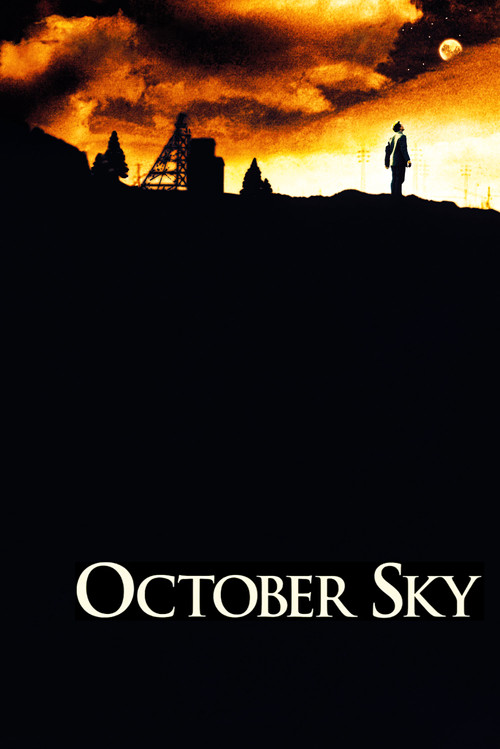
October Sky
1999 · Joe Johnston
For when you want to feel genuinely hopeful — an underdog story that restores your faith in trying hard at something. Pure comfort viewing, and safe to watch with parents, kids, or anyone who's ever wanted out of their hometown.
What it's about
In a West Virginia coal town in 1957, every boy's future runs straight down into the mine — until teenage Homer Hickam watches Sputnik cross the night sky and decides he's going to build rockets instead. With three friends, a supportive teacher, and a lot of scavenged materials, he teaches himself the math and chemistry of rocketry, launch by misfiring launch, aiming for the National Science Fair. Standing in his way is his father, the mine's superintendent, who can't understand a son who wants to leave. It's drawn from Hickam's own memoir, and the true-story bones show.
The experience
Warm, earnest, and quietly stirring — it earns its lump-in-the-throat moments through failure and stubbornness rather than shortcuts. The father-son friction gives it a real ache under the uplift, and every successful launch lands like a small victory you shared in.
Performances
A very young Jake Gyllenhaal carries the film with open-faced sincerity in one of his first lead roles, and Chris Cooper gives the mine-superintendent father real dignity — he's an obstacle you understand rather than a villain.
The craft
Joe Johnston shoots the coal town in grays and lamplight so that every rocket launch against the open sky feels like a jailbreak. The period detail is lived-in rather than nostalgic, and the film's patience with the boys' trial-and-error — the duds, the explosions, the slow math — is what makes the payoffs soar.
Why it matters
It became the gold standard of the based-on-a-true-story inspirational drama, a staple of classrooms and family movie nights, and it launched Jake Gyllenhaal toward leading-man status.
Snapshot
October Sky is a 1999 American coming-of-age drama directed by Joe Johnston, adapted from Homer Hickam's 1998 memoir Rocket Boys. Set in the coal-mining town of Coalwood, West Virginia, in the months following the Soviet launch of Sputnik in October 1957, it follows teenage Homer Hickam (Jake Gyllenhaal) as the sight of the satellite crossing the night sky ignites an obsession with rocketry that sets him against the foreclosed future of the mine — and against his father, the mine's superintendent. With three friends, Homer teaches himself the mathematics and chemistry of amateur rocketry, and the boys' improvised launches carry them, improbably, toward the National Science Fair. The film is notable as one of Gyllenhaal's first leading roles, as a vehicle for Chris Cooper in the years before his wider recognition, and as a tonal outlier in Johnston's career — an intimate, effects-light period drama from a director associated with blockbuster spectacle. Its title is an anagram of the source memoir's, Rocket Boys, a tidy emblem of the studio's reframing of an engineering story as inspirational Americana.
Industry & production
October Sky was produced and distributed by Universal Pictures, with Charles Gordon among the producing principals. It belongs to a late-1990s cycle of mid-budget, fact-based inspirational dramas — pictures pitched between prestige and broad family appeal, dependent on word of mouth and a redemptive emotional arc rather than franchise machinery. The source material was timely: Homer Hickam, by then a retired NASA engineer, published Rocket Boys in 1998, and the rights moved quickly into development, with Lewis Colick credited for the screenplay.
The production reconstructed 1950s Coalwood largely in Tennessee, around the towns of Oliver Springs and Petros and the Appalachian terrain near Knoxville, standing in for southern West Virginia. The choice reflected both practical access to period-appropriate mining landscapes and the economics of a film whose budget had to stretch across exteriors, mine sets, and the recurring set pieces of the rocket launches. By the standards of Johnston's filmography, this was a modest undertaking, and its restraint is part of its identity: the film foregrounds faces, weather, and coal dust rather than the optical-effects bravura of his earlier work.
Commercially, October Sky was a steady rather than spectacular performer, the kind of release that found its longest life in home video, television, and especially classroom use, where it became a durable fixture in science and history curricula. Precise budget and gross figures are not reproduced here, as the aim is a synthesized account rather than a financial record; what is well established is that the film's reputation outgrew its theatrical footprint.
Technology
The film is, by subject, a story about technology — the iterative, failure-driven craft of building rockets from scratch — but as a production it is technologically conservative. There is no reliance on the digital effects pipeline that defined Johnston's blockbuster work. The rockets, their launches, and their failures are realized chiefly through practical means: physical models, real pyrotechnics, and on-set staging, captured on 35mm film. This grounding is essential to the film's credibility. The boys' rockets behave like real objects — they misfire, explode, veer, and occasionally fly true — and the decision to keep the effects tactile rather than computer-generated reinforces the documentary texture the period setting demands.
Where the production's craft technology matters most is in the visualization of the launches themselves: the long, anxious beats of ignition and ascent, and the recurring motif of upturned faces tracking a point of light. These sequences depend on camera placement, timing, and editing far more than on post-production augmentation.
Technique
Cinematography
Fred Murphy's cinematography establishes the film's two opposed visual registers. Coalwood and the mine are rendered in a muted, soot-darkened palette — grays, browns, the perpetual grime of an industrial town hemmed in by mountains — and the mine interiors trade in oppressive, lamp-lit confinement. Against this, the film reserves its light and air for the sky: the launches open the frame upward, and the recurring image of Sputnik (and later the boys' own rockets) as a moving point of light against darkness is the picture's organizing visual idea. Murphy's camera tends toward the classical and unobtrusive, favoring clear, legible compositions that serve performance and landscape over stylistic display — a fitting approach for a film whose emotional claims rest on sincerity. The contrast between the downward pull of the mine and the upward reach of the sky is the cinematography's central, deliberately unsubtle argument.
Editing
Edited by Robert Dalva — a veteran whose credits include The Black Stallion — the film is cut for clarity and emotional accumulation rather than for pace or pattern. The launch sequences are the editorial showpieces: they build suspense through cross-cutting between the rocket, the boys, and the watching townspeople, and they pay off in collective reaction shots that bind the community to the boys' enterprise. The dramatic structure tracks a familiar rise-and-setback rhythm — each failure answered by recalculation and another attempt — and Dalva's cutting honors that iterative logic, letting the audience register the engineering as a process of trial and error rather than a montage of easy triumph.
Mise-en-scène / staging
The film's period design is one of its quieter strengths. Coalwood is staged as a company town in the most literal sense — a place where the mine owns the houses, the future, and the social hierarchy — and the production design renders this through the worn domestic interiors of the Hickam home, the union and management strata, and the looming presence of the tipple and headframe. Costuming and set dressing fix the late-1950s moment without fetishizing it. The staging consistently opposes enclosure and openness: the cramped kitchen confrontations between Homer and his father, the dark of the mine shaft, set against the open slack dumps and fields where the boys retreat to launch. That spatial vocabulary carries the film's thematic weight as much as any line of dialogue.
Sound
Mark Isham's score is central to the film's affect. Isham, a composer fluent in both jazz and lyrical orchestral idiom, supplies a warm, Americana-inflected score built around melodic uplift, swelling at the launches and the climactic science-fair sequence. The music is unabashedly emotional, and it does much of the work of converting an engineering procedural into an inspirational drama. The film also leans on period source music to anchor the 1957–60 setting. The sound design contrasts the industrial noise of the mine and town with the sudden, percussive events of ignition and explosion, and the long silences of watching the sky — the absence of sound becoming its own expressive tool in the launch beats.
Performance
The acting is the film's most durable asset. Jake Gyllenhaal, in an early leading role, plays Homer with an earnest, open-faced determination that grounds the film's sincerity; it was a performance that announced him as a young actor of unusual presence. Chris Cooper, as John Hickam, gives the film its gravity and its conflict: his mine superintendent is not a simple obstacle but a proud, limited man whose authority and disappointment are inseparable from his love, and Cooper's restraint keeps the father-son drama from collapsing into melodrama. Laura Dern brings warmth and quiet conviction to Miss Frieda Riley, the teacher who champions the boys — a role inflected with poignancy by the character's own circumscribed circumstances. Natalie Canerday, as Homer's mother, anchors the household, and the trio of friends — Roy Lee, O'Dell, and the brainy outsider Quentin — fill out the boys' camaraderie with unforced naturalism.
Narrative & dramatic mode
October Sky operates in the mode of the inspirational true-story bildungsroman: a young protagonist discovers a vocation, meets resistance from family and circumstance, perseveres through repeated failure, and is finally vindicated. Its dramatic engine is the father-son conflict, which the film treats with more nuance than the genre usually allows — John Hickam's opposition is rooted in a real economy of limited choices, and the film resists making him a villain. A secondary engine is the underdog procedural of the rocketry itself, with each launch functioning as a discrete test of progress. The narrative is structured around milestones — the first failed attempts, the building of "Cape Coalwood," the false accusation of starting a forest fire, the science fair — and it closes on documentary-style epilogue text that confirms the real Hickam's path to NASA, sealing the film's claim to truth and its uplift in a single gesture.
Genre & cycle
The film sits at the intersection of the coming-of-age drama, the historical biopic, and the inspirational sports-movie template transposed onto science. Its closest generic kin are underdog narratives in which a marginalized group masters a discipline against institutional resistance, and the late-1990s/early-2000s cycle of fact-based "true story" dramas aimed at family and educational audiences. Within that cycle, October Sky is distinguished by its subject — STEM achievement rather than athletics or war — which is precisely what gave it a long second life as a teaching text. It also belongs, more loosely, to the lineage of Appalachian and company-town narratives that treat the coal mine as both economic fact and metaphor for inherited fate.
Authorship & method
Joe Johnston came to October Sky from a background in visual effects — he began at Industrial Light & Magic, contributing to the original Star Wars films before moving into directing with effects-forward entertainments like Honey, I Shrunk the Kids, The Rocketeer, and Jumanji. October Sky is, in that context, a striking pivot: a character-driven period drama with almost none of the spectacle his résumé would predict. The continuity, if there is one, lies in a recurring fascination with flight, aspiration, and the romance of mid-century American technology — a thread that runs from The Rocketeer through this film and, later, to Captain America: The First Avenger. Johnston's direction here is notably self-effacing, trusting the material and the actors.
His key collaborators shaped the film's texture decisively. Screenwriter Lewis Colick distilled Hickam's memoir into a clean three-act arc, sharpening the father-son conflict and the science-fair climax. Cinematographer Fred Murphy supplied the mine-versus-sky visual scheme. Composer Mark Isham provided the emotional throughline. Editor Robert Dalva, a filmmaker attuned to stories of youth and aspiration, shaped the suspense of the launches. The result is a film whose authorship feels genuinely collaborative — and whose ultimate author, in a sense, is Homer Hickam himself, whose memoir supplies the voice, the incidents, and the documentary authority the film leans on.
Movement / national cinema
October Sky is firmly within mainstream American studio filmmaking and claims no allegiance to a formal movement. It can, however, be read within an American regional tradition — the cinema of Appalachia and the coal country — that treats the mining town as a site of economic determinism and cultural specificity. More broadly, it participates in a national mythology of upward mobility and the frontier of science: the Space Race as a democratic promise that even a coal miner's son might reach. The film's confidence in self-betterment through education and ingenuity is deeply rooted in an American narrative idiom.
Era / period
The film is doubly period-bound: it depicts 1957–1960 and was made in the late 1990s. Its diegetic moment is precisely chosen — the launch of Sputnik on October 4, 1957, which the film treats as the spark for both Homer's ambition and a national reckoning. That event placed the United States at a moment of technological anxiety and educational urgency, and the film registers the Space Race as it was experienced from the margins, in a town whose economy was already declining. The 1999 vantage adds another layer: made at the turn of the millennium, October Sky looks back on the postwar industrial order — and the optimism of the early Space Age — with a valedictory, slightly elegiac warmth, conscious that the coal economy it depicts was already passing into history.
Themes
The film's central theme is the conflict between inherited destiny and self-determination — the mine as a future assigned at birth, rocketry as a future chosen. Bound up with this is the father-son drama: the negotiation of pride, love, disappointment, and reconciliation between a man who knows only the mine and a son who refuses it. Education recurs as a redemptive force, embodied in Miss Riley and the science fair, and framed against a community that does not always value it. The film also dwells on community and class — the company town's rigid hierarchy, the dignity and danger of mining labor, and the way the boys' project gradually wins over a skeptical town. Finally, there is the theme of aspiration itself, literalized in the upward trajectory of the rockets: the image of looking up, against a landscape that pulls everything down.
Reception, canon & influence
October Sky was generally well received by critics, who praised its sincerity, its performances — particularly those of Cooper and Gyllenhaal — and its restraint in handling material that could easily have turned saccharine. The consensus positioned it as a modest, well-crafted, emotionally effective film that earned its uplift honestly; its limitations, where noted, were those of genre convention. It did not become a major awards contender, and its theatrical reception was respectable rather than triumphant.
Its influences run backward to the broad tradition of inspirational true-story dramas and underdog narratives, and to the coming-of-age film; its most direct source, of course, is Hickam's memoir, whose first-person authority the film preserves. Johnston's own The Rocketeer prefigures its romance with mid-century flight.
The film's forward legacy is unusual and substantial: it became a staple of American science and history classrooms, valued as an accessible dramatization of the scientific method, perseverance, and the Space Race. For Gyllenhaal it served as an early showcase that preceded his rise; for Cooper it was part of the run that built toward his wider recognition in the early 2000s. The real Homer Hickam's Rocket Boys spawned further memoirs, and the story was later adapted for the stage as a musical, extending the narrative's afterlife beyond the screen. If October Sky's theatrical moment was quiet, its cultural half-life — as a teaching text and a touchstone of STEM-inspiration storytelling — has proven remarkably long, arguably exceeding the influence of flashier films from the same year.
A Deleuzian reading
A boy stands on a slag heap at night, head tilted all the way back, watching a single point of light slide across the West Virginia sky.
The full Deleuzian reading of October Sky →
Reception
A modest earner in 1999 that critics liked more than audiences showed up for, it's since settled into beloved-staple status — the rare '90s inspirational drama whose reputation has only warmed, buoyed by rewatches and its ubiquity in classrooms.
How October Sky was received, from release to now →
Influences: the films it descends from and the films it influenced
- The Rocketeer (1991) — Johnston's own earlier romance of mid-century American flight, where practical model-and-rig effects serve aspiration rather than spectacle — the template he strips down for October Sky.
- The Black Stallion (1979) — Editor Robert Dalva's lyrical cutting of a boy's wordless physical aspiration — long passages of expressive silence built to a suspense climax — is the rhythm he reprises for the rocket launches.
- Hoosiers (1986) — Cinematographer Fred Murphy's same classical, unobtrusive scheme for a small regional town, plus the underdog three-act build to a single make-or-break public event.
- Breaking Away (1979) — The blueprint of a working-class quarry-town boy escaping a blue-collar destiny through one consuming passion, dramatizing class friction as a father-son standoff.
- Stand By Me (1986) — Memoir-derived first-person nostalgia preserving the writer's documentary authority, staging period boyhood as an ensemble set against an industrial town.
- Coal Miner's Daughter (1980) — Appalachian coal-country company-town authenticity and the escape-through-vocation arc, with the mine as the enclosing world the protagonist must transcend.
- The Right Stuff (1983) — Space-Race-era flight and rocketry shot with documentary texture, treating the iterative trial-and-failure of test engineering as dramatic procedural.
- Stand and Deliver (1988) — Founder of the STEM-classroom teaching-text mode October Sky inherited — dramatizing the scientific/academic method itself as the engine of uplift.
- The War (1994) — Continues the nostalgic working-class period boyhood with a golden palette and an uplifting score, dramatizing a son's struggle against a hard father in an impoverished company town.
- Billy Elliot (2000) — A mining-town boy defies his collier father to pursue a forbidden vocation amid a colliery strike — the company-town father-son aspiration structure transposed to dance.
- The Astronaut Farmer (2006) — DIY amateur rocket-building staged so the practical launch becomes the emotional climax, inheriting October Sky's faith in homemade hardware.
- Akeelah and the Bee (2006) — Reprises the inspirational competition-climax arc, substituting a national spelling bee for the science fair as the public proving ground that resolves the family conflict.
- Spare Parts (2015) — Underdog working-class kids win through an iterative engineering build toward a STEM competition — October Sky's procedural template for marginalized regional teens.
- Hidden Figures (2016) — Space-Race true-story STEM procedural told with classical, restrained craft, framing scientific labor and period struggle as honestly earned uplift.
- Apollo 13 (1995) — The launch built through cross-cutting suspense between control and craft, an iterative-engineering procedural, and practical rocket effects favored over optical spectacle.
- Matewan (1987) — Renders the coal company-town milieu with regional specificity, using the enclosure of the mine versus open ground as a spatial-political scheme.
- Fly Away Home (1996) — Mark Isham's score carrying a youth-and-flight aspiration through image-driven, near-wordless passages — the same emotional throughline he supplies October Sky.
- A River Runs Through It (1992) — Isham's nostalgic-Americana scoring idiom over a memoir voiceover and a father-son relationship mediated through a disciplined craft.
Similar films
- The Right Stuff (1983) — influence & lineage
- Apollo 13 (1995) — influence & lineage
- Stand by Me (1986) — influence & lineage
- mid90s (2018) — same viewing thread
- Like Stars on Earth (2007) — same viewing thread
- The Iron Giant (1999) — shared sensibility
- Donnie Darko (2001) — shared sensibility
- The Boy Who Harnessed the Wind (2019) — shared sensibility
All the films related to October Sky →
Watch it with: curated runs of related films
- Restless Youth, Rigid Walls — Watch these as one long walk through the school years — the teachers who crack you open, the friends who pull you off the sidelines, the first loves and the institutions you push against — where a beloved tearjerker and a surreal boarding-school revolt turn out to be cousins.