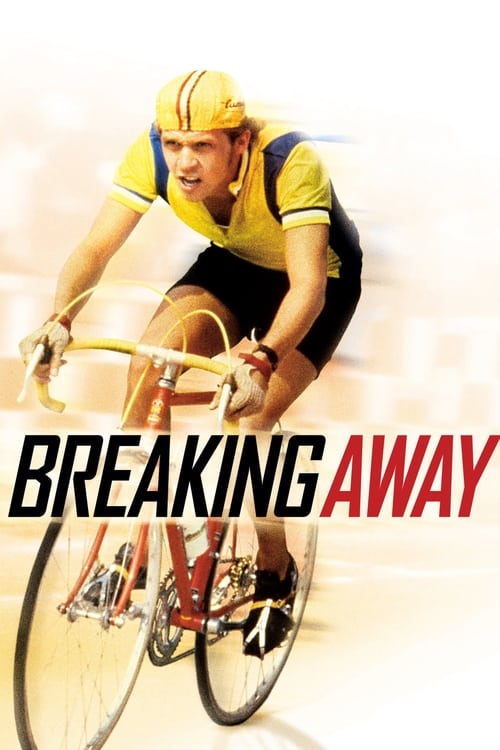
Breaking Away
1979 · Peter Yates
For when you want a feel-good film that isn't dumb — an underdog story with real warmth, perfect for a night when you need your faith in people (and in your own dumb dreams) topped up.
What it's about
Four working-class friends in Bloomington, Indiana drift through the summer after high school with no plan and no prospects, swimming in the old limestone quarries their fathers once worked. Dave, a gifted bicycle racer, has fallen so hard for Italian cycling culture that he speaks in an accent, sings opera at dinner, and renames the cat Fellini — driving his used-car-salesman father up the wall. The town's simmering resentment between the local 'cutter' kids and the affluent university students builds toward the annual Little 500 bike race.
The experience
Funny, generous, and quietly wise — it ambles like a summer afternoon, then tightens into genuinely thrilling race sequences. It leaves you grinning with a lump in your throat, the rare sports movie where the class anxiety and family comedy matter as much as the finish line.
Performances
Dennis Christopher is winningly committed as Dave, selling both the goofy fake-Italian shtick and the bruised kid underneath; Paul Dooley nearly steals the film as his exasperated father, and a young Dennis Quaid gives the group its restless, wounded edge.
The craft
Steve Tesich's screenplay is a model of the form — every joke carries character, every character carries the town's class fault lines — and Peter Yates directs the cycling with real speed and danger. The quarry swimming holes and Indiana limestone give it a strong sense of place; the race finale plays beautifully loud and big.
Why it matters
It won the Oscar for Best Original Screenplay and became the gold standard for the small-town coming-of-age sports film — the movie countless later underdog stories are measured against.
Snapshot
Breaking Away is a coming-of-age comedy-drama about four working-class friends in Bloomington, Indiana, adrift in the limbo between high-school graduation and whatever comes next. Its hero, Dave Stohler (Dennis Christopher), is a nineteen-year-old bicycle racer so besotted with Italian cycling culture that he adopts an Italian accent, sings opera at the dinner table, and renames the family cat Fellini — to the bewilderment of his gruff used-car-salesman father (Paul Dooley) and patient mother (Barbara Barrie). The film's engine is the class antagonism between the "cutters" — local kids, sons of the stonecutters who quarried the limestone that built the Indiana University campus — and the affluent students who occupy that campus each fall. That tension resolves in the annual Little 500 bicycle race, where the four townies enter a team against the fraternities. Directed by the British filmmaker Peter Yates from an Oscar-winning original screenplay by Steve Tesich, it became one of the defining sleeper successes of its year: a modest, regional, character-driven picture that earned five Academy Award nominations, including Best Picture, in a Hollywood then tilting toward the blockbuster.
Industry & production
Breaking Away was produced and released by Twentieth Century-Fox, with Yates serving as both director and producer. It belongs to a recognizable late-1970s category: the low-budget, adult, humanist picture greenlit in the interval before the Star Wars / Jaws logic fully consolidated the studio slate around tentpoles. The production was inexpensive by studio standards and shot substantially on location in and around Bloomington and on the Indiana University campus — the quarries, the town streets, and the university's Little 500 track (Bill Armstrong Stadium) — which gives the film an unforced documentary texture rare in studio comedy of the period. Precise budget and box-office figures I won't assert here beyond the well-established fact that it was made cheaply and returned a strong profit relative to its cost, making it a textbook "sleeper." Its commercial performance was buoyed by exceptional reviews and by an awards campaign that culminated in the Best Original Screenplay win. The film's success was durable enough that ABC mounted a short-lived Breaking Away television series in 1980–81, with a largely different cast, which did not replicate the film's reception.
Technology
There is little to claim here, and it is more honest to say so than to manufacture significance: Breaking Away is not a technically innovative film and made no notable contribution to filmmaking technology. It was shot on 35mm using conventional late-1970s equipment and lit for a naturalistic, sunlit look appropriate to its Midwestern-summer setting. The technical interest lies not in apparatus but in logistics — the staging and photographing of real bicycle racing, particularly the climactic Little 500, which required capturing speed, jostling pack riding, and crashes with clarity and geographic coherence. The achievement is one of coverage and cutting rather than of any new tool.
Technique
Cinematography
Matthew F. Leonetti's photography favors an open, legible naturalism. The Indiana light — hazy summer afternoons, the greenish depths of the flooded quarry where the boys swim and dive — is rendered warmly and without stylization, grounding the film's fable-like class comedy in a specific, humid place. Leonetti's most demanding work is the race sequences: the cycling is shot to preserve spatial orientation and the sensation of velocity, mixing tracking shots that ride alongside the pack with tighter inserts of feet, gears, and faces. The restraint elsewhere is deliberate; the camera serves performance and landscape rather than announcing itself.
Editing
The film's editing (by Cynthia Scheider) carries much of its tonal balancing act, modulating between loose, hangout-comedy rhythms in the boys' scenes and the accelerating, percussive cutting of the races. The Little 500 climax is a set piece of sports editing — sustaining suspense across many laps, tracking Dave's exhaustion and the handoffs to his less-experienced teammates, and building to a finish whose outcome must feel both earned and precarious. The looser passages, by contrast, let scenes breathe, trusting the actors and the dialogue.
Mise-en-scène / staging
The staging draws a persistent visual line between two worlds: the cutters' modest homes and the town's plain commercial streets against the collegiate-Gothic grandeur of the university — buildings raised from the very limestone the boys' fathers cut. That irony is architectural, present in the frame before it is ever spoken. Domestic staging in the Stohler kitchen and garage is a comic theater of its own, especially the father's exasperation at Dave's Italian affectations. The quarry functions as the film's pastoral counter-space, a place outside the class economy where the four friends are simply themselves.
Sound
The most distinctive sonic choice is musical (treated below), but the film's dialogue-driven design is worth noting: overlapping, colloquial, regionally inflected speech that lets the ensemble feel lived-in. Dave's Italian singing and accent are recurring sound gags that also carry the film's theme of self-invention.
Performance
Performance is where Breaking Away is richest. Dennis Christopher's Dave is the linchpin — sincere, absurd, and moving in his wholesale adoption of an imagined Italian self, so that his eventual disillusionment (when the visiting Italian team he idolizes cheats him) lands as a genuine loss of faith. Around him, the ensemble is finely differentiated: Dennis Quaid as Mike, the ex-quarterback whose peaked-too-soon bitterness masks fear of the future; Daniel Stern as the deadpan, self-deprecating Cyril; and Jackie Earle Haley as the short, combative Moocher. Barbara Barrie and Paul Dooley, as Dave's parents, supply the film's emotional ballast and much of its best comedy — Dooley's monologues about "-ini" foods and refunds are justly celebrated, and Barrie's warmth earned her a Best Supporting Actress nomination.
Narrative & dramatic mode
The film operates in the mode of the realist coming-of-age comedy, structured around a single transitional summer. Its dramatic question is less "will they win the race?" than "what becomes of young people whose town has no obvious place for them?" Tesich's screenplay braids three strands: Dave's Italian fantasy and its puncturing; the ensemble's collective drift and resentment of the students (crystallized in Mike's speeches about being a "cutter" forever); and a cross-class romance in which Dave, posing as an Italian exchange student, courts a sorority girl. The Little 500 provides classical three-act resolution — the underdogs' contest that lets private growth become public vindication — but the film is careful to keep its sports-movie catharsis in service of character rather than the reverse. The tone slides fluidly between farce and melancholy, and the ending's optimism is qualified and specific rather than triumphalist.
Genre & cycle
Breaking Away sits at the intersection of several genres: the coming-of-age film, the sports underdog picture, and the regional Americana comedy-drama. It arrived amid a late-1970s cycle of youth-and-nostalgia films (in the wake of American Graffiti, 1973) and adult, character-forward dramas that the industry still supported before the full blockbuster turn. Within the sports-film tradition it is unusual for treating athletic victory as almost incidental to a larger reckoning with class and adulthood. Its most direct generic descendants are the class-conscious youth films of the 1980s.
Authorship & method
The film is best understood as the meeting of two sensibilities. Steve Tesich (born Stoyan Tesich in Užice, in what was then Yugoslavia, and raised in East Chicago, Indiana, after emigrating as a teenager) wrote the screenplay from close personal knowledge: he attended Indiana University and competed in the Little 500. That autobiographical root gives the film its authenticity of place and its immigrant-inflected fascination with reinvention — Dave's longing to be Italian rhymes with the experience of a young man remaking his own identity in a new country. Tesich won the Academy Award for Best Original Screenplay; he went on to a career in playwriting and fiction (the novel Karoo), and is separately notable for popularizing the term "post-truth" in a 1992 essay.
Peter Yates, an English director whose reputation had been built on kinetic genre filmmaking — most famously the car chase in Bullitt (1968), as well as The Friends of Eddie Coyle (1973) — brought craftsmanship, a sure hand with actors, and, crucially, an outsider's clear eye for the American Midwest. The pairing of an immigrant screenwriter and a British director on this most American of subjects is part of the film's texture. Yates received Academy Award nominations both as director and, as producer, for Best Picture. His key collaborators included cinematographer Matthew F. Leonetti, editor Cynthia Scheider, and composer Patrick Williams, whose adaptation-based score earned an Oscar nomination. Williams' most memorable strategy was to score Dave's Italian reveries and the racing with adapted classical music — drawing on the nineteenth-century Italian and Italian-themed repertoire (Rossini, and Mendelssohn's "Italian" Symphony are the touchstones commonly cited) — so that the soundtrack becomes an extension of Dave's romantic self-mythology.
Movement / national cinema
Breaking Away is not a manifesto film and belongs to no formal movement, but it is a strong late example of American humanist regional cinema — the strain of studio filmmaking that located national character in specific, un-glamorous American places. It can be read as a coda to the more personal, director- and writer-driven "New Hollywood" ethos of the 1970s, applied to gentle comedy rather than to the era's characteristic darkness. Its Americanness is, tellingly, filtered through emigré perspective (Tesich, Yates), which is part of why it can look at Indiana with both affection and analytic clarity.
Era / period
The film is a product and portrait of a precise American moment. Made in 1979, it reflects the deindustrializing anxieties of the late 1970s: the quarry economy that once defined Bloomington is contracting, and the boys face a future without the stable working-class livelihoods their fathers had. That economic undertow gives the class comedy its stakes. Industrially, it stands at the hinge between the 1970s cinema of character and the 1980s cinema of high concept — one of the last of its kind to reach the Best Picture ballot on the strength of modesty and observation rather than spectacle.
Themes
The governing theme is class and belonging: the "town versus gown" divide, and the humiliations and solidarities it breeds, expressed most sharply in Mike's insistence that they will always be "just cutters." Braided with it is identity and self-invention — Dave's assumed Italianness as a way of imagining a self larger than the one Bloomington offers, and the painful, clarifying moment when his idols betray him and he must find a self that is genuinely his own. Fathers and sons run throughout, especially in the reconciliation between Dave and his father, who reveals unexpected pride in the campus his own hands helped build. And beneath all of it is the fear of the future shared by all four friends — the film's real subject is the vertigo of the threshold, the summer when childhood ends and nothing has yet replaced it.
Reception, canon & influence
Breaking Away was one of the best-reviewed American films of 1979 and a critical cause célèbre, praised for its warmth, its screenplay, and its ensemble. It received five Academy Award nominations — Best Picture, Best Director (Yates), Best Supporting Actress (Barrie), Best Adaptation Score (Williams), and Best Original Screenplay — winning for Tesich's screenplay; it also won the Golden Globe for Best Motion Picture (Musical or Comedy). Its canonical standing has held: it is regularly cited among the finest American coming-of-age and sports films, and the American Film Institute has recognized both the film and Tesich's screenplay in its retrospective lists.
The influences on the film are chiefly American Graffiti's template of the pivotal post-graduation summer and the long tradition of the underdog sports contest; more idiosyncratically, its texture owes to Tesich's lived experience of the Little 500 and to a genuine cinephile romance with Italian cinema and cycling. Its influence forward runs through the class-conscious youth films of the 1980s and the many sports underdog pictures that followed, and it left a real cultural imprint on its own subject: the film gave the term "cutters" national currency and permanently entwined the public image of Indiana University's Little 500 with its story. The 1980–81 television adaptation testifies to the property's reach even as it failed to match the original. More than four decades on, Breaking Away endures precisely for what it declined to be — a small, specific, generous film about a place and a moment, whose modesty is the source of its lasting authority.
A Deleuzian reading
The cat is named Fellini.
The full Deleuzian reading of Breaking Away →
Reception
A low-budget sleeper in 1979 that built on word of mouth into a Best Picture nominee and a screenplay Oscar for Steve Tesich; today it's routinely ranked among the great American sports movies and treated as pure comfort-classic material.
How Breaking Away was received, from release to now →
How to watch Breaking Away: what to notice on a first viewing
- Listen for Dave slipping into an Italian accent. Dave sings opera at the table, calls the cat Fellini, and drifts into an accent that is not his, all while his father waits for one plain word of English. The costume is constant and visible from the start, before the plot ever explains what it's for.
- Track the university buildings and the boys' houses sharing stone. The film keeps framing the collegiate-Gothic campus against the plain commercial streets and small houses of the cutters, the same limestone quarried by the boys' own fathers. The class divide is built into the architecture on screen before a single character talks about it.
- Notice how differently the boys act at the quarry. At the flooded quarry the four friends swim, dive, and joke without any of the class tension that follows them everywhere else in town. The quarry is the one space in the film where nobody has to perform anything for anybody.
- Follow the editing loosen in the hangout scenes. Scheider lets the boys' scenes breathe at an easy, conversational pace, then switches to tighter, faster cutting whenever the film gets near an actual race. You can feel which scenes the film considers urgent by how quickly it cuts through them.
- Watch the father's exasperation at the dinner table. Dooley plays Dave's father as a man perpetually startled by his own son, his complaints about 'ini' foods and refunds building into the film's funniest running bit. The comedy carries real tenderness underneath it, a father who doesn't understand his son but keeps showing up anyway.
The whole guide to watching Breaking Away, with the keys for a rewatch →
Influences: the films it descends from and the films it influenced
- American Graffiti (1973) — Supplies the template Breaking Away rebuilds: an episodic, single-post-graduation-summer structure in which an ensemble of small-town youths circle one another at the threshold of adulthood, cruising and stalling before scattering.
- The Last Picture Show (1971) — Models the naturalistic, on-location portrait of a declining American town where restless working-class kids have nothing to do but wait, using real regional geography rather than sets as the emotional register.
- Marty (1955) — Chayefsky's warm, overheard, working-class kitchen-and-stoop dialogue and the dignity granted to unremarkable lives is the naturalist screenwriting tradition Tesich extends to Bloomington's stonecutters.
- Rocky (1976) — Establishes the modern class-underdog blueprint Breaking Away follows: a working-class nobody trains toward a single public athletic contest, the film building to a race scored with swelling, motivic music.
- Bicycle Thieves (1948) — The Italian neorealist romance of the bicycle as an instrument of working-class dignity, shot in real streets, is precisely the cinema Dave's Italophile fantasy is reaching toward.
- Bullitt (1968) — Yates's own breakthrough in kinetic vehicular editing — cutting speed, POV, and mechanical rhythm into suspense — is repurposed from the car chase into the peloton and Little 500 racing sequences.
- Diner (1982) — Extends the post-adolescent male ensemble stalled at a regional crossroads, built from naturalistic hangout dialogue and a specific American city, unwilling to leave boyhood behind.
- The Karate Kid (1984) — Recycles the class-outsider-earns-dignity arc through a mentor and a culminating tournament, staging the same rich-kids-versus-newcomer social geography as sport.
- Vision Quest (1985) — A working-class teen reinvents himself through an obsessive, self-imposed athletic quest, using the sport (wrestling) as the crucible for self-definition rather than mere competition.
- Lucas (1986) — A small-town, class-crossed adolescent attempts to remake his identity and win belonging by improbably taking up a sport, in the same tender, naturalistic-regional key.
- Hoosiers (1986) — Carries the specifically Indiana regional-sports-underdog milieu forward, with location naturalism and a small town whose collective identity is invested in a David-versus-Goliath contest.
- Stand By Me (1986) — Continues the regional working-class boyhood-ensemble-at-a-threshold film, anchored in a precise sense of place and nostalgic naturalism about the summer everything changes.
- Rudy (1993) — Directly inherits Tesich's autobiographical class-outsider model: a working-class kid earns belonging at an institution that is not his by birth, staging town-and-blue-collar identity against university privilege.
- Friday Night Lights (2004) — Extends the deindustrialized-town-whose-identity-rides-on-its-youth-sport premise with heightened naturalistic, handheld location texture, treating regional economic decline as the ground beneath the game.
- Good Will Hunting (1997) — Stages townie-versus-college class friction through place and the cadences of male friendship, the social-mobility template GWH inherits.
- October Sky (1999) — The blueprint of a working-class quarry-town boy escaping a blue-collar destiny through one consuming passion, dramatizing class friction as a father-son standoff.
- Saturday Night Fever (1977) — A contemporaneous portrait of a trapped working-class youth who uses a single physical arena — there dance, here cycling — as the one place he can transcend the class fate the neighborhood assigns him.
- Chariots of Fire (1981) — Shares the exact town-versus-gown engine: amateur athletes run to prove class and outsider identity against an entrenched university establishment, with the race sequences fused to a memorable, self-mythologizing score.
Similar films
- Rocky (1976) — influence & lineage
- Marty (1955) — influence & lineage
- American Graffiti (1973) — influence & lineage
- National Class Category Up to 785ccm (1979) — shared sensibility
- The Outsiders (1983) — shared sensibility
- Children of Heaven (1997) — shared sensibility
- 8 Mile (2002) — shared sensibility
- Cinema Paradiso (1988) — shared sensibility