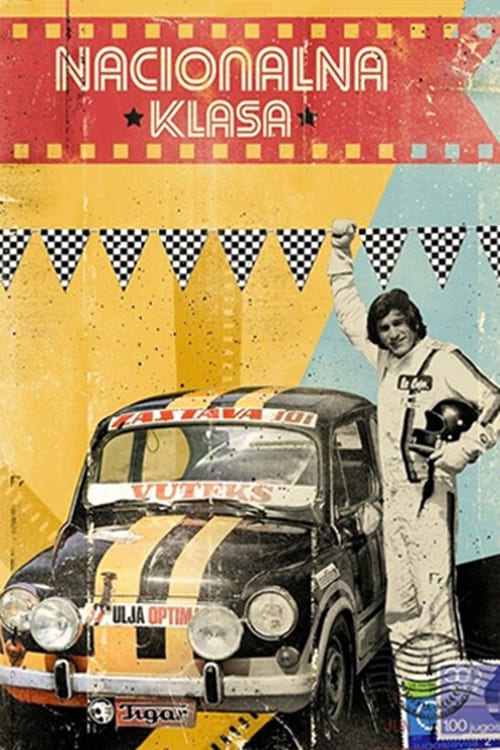
National Class Category Up to 785ccm
1979 · Goran Marković
For a relaxed evening when you want charm, humor, and a bit of ache — a hangout movie about avoiding your life that somehow makes you reflect on your own. Comfort viewing with a conscience.
What it's about
One week in the life of Floyd, a charming Belgrade slacker who races a tiny modified Zastava 750 in Yugoslavia's smallest amateur motorsport class and dreams of moving up a category. Everything else — his patient girlfriend, his debts, the army draft notices piling up unopened — he outruns or ignores, because the only thing that counts is Saturday's race.
The experience
Breezy and funny on the surface with a melancholy undertow — the comedy of a guy dodging adulthood, told with real affection and a sting of recognition. It's laid-back, quotable, and quietly wistful about the moment youth runs out of road.
The craft
Goran Marković builds the film from closely observed Belgrade street life — garages, cafés, racetracks — so the small-displacement racing world feels documentary-real under the comedy. The week-long structure gives it a lean shape: every scene tightens the squeeze between Floyd's escapes and the responsibilities closing in.
Why it matters
One of the most durable cult films of late-socialist Yugoslav cinema, endlessly rewatched and quoted, and a defining portrait of a generation's charming refusal to grow up.
Snapshot
Nacionalna klasa do 785 ccm — usually shortened to Nacionalna klasa (National Class) — is a Serbian-language Yugoslav comedy-drama and one of the most durable cult films of late-socialist Yugoslav cinema. Over the course of a single week, it tracks Branimir Mitrović, called "Floyd" (Flojd), a Belgrade dandy and amateur rally driver competing in the "national class" for cars up to 785 cubic centimeters — the amateur, small-displacement tier of Yugoslav motorsport, raced in modified versions of the domestically built Zastava 750 (the beloved "Fića," a licensed Fiat 600 derivative). Floyd is charming, feckless and permanently in flight: from his patient girlfriend, from a marriage he half-promised, from creditors and mechanics he owes, and above all from the army draft notices piling up unanswered. He cares about exactly one thing — Saturday's race. Directed by Goran Marković and anchored by a landmark performance from Dragan Nikolić, the film reads its title as a sly national allegory: the "national class" is a second-tier category by definition, a place where talent and bravado circle a track that leads nowhere near the top. It has become a canonical portrait of Belgrade's urban youth on the eve of the 1980s, and its dialogue and characters remain widely quoted in the region.
Industry & production
The film was made within the Yugoslav system of self-managed film enterprises, a decentralised model in which state-affiliated production houses operated with substantial creative latitude and public funding but real commercial exposure at the box office. It is a Belgrade production; the company most consistently associated with it is Centar Film, one of the Serbian capital's principal studios of the period. (Precise financing and budget figures are not something I can document reliably, and I will not invent them.)
By the late 1970s, Yugoslav cinema had settled into a productive middle register. The confrontational, censorship-baiting energy of the 1960s "Black Wave" (Crni talas) had been administratively suppressed earlier in the decade, and a younger generation — many of them trained abroad — was producing accessible, genre-inflected, socially observant films that could pass the censors while still saying a great deal about ordinary life. Nacionalna klasa is a model example: outwardly a light comedy about a lovable slacker, inwardly a fairly pointed diagnosis of drift, evasion and provincial limits. Marković's growing reputation, and the casting of Nikolić — already one of the country's biggest stars — gave the project marquee visibility. The film became a popular success and a festival presence; I associate it with strong showings at Pula, the flagship Yugoslav national festival, though I cannot confirm the specific prizes with confidence and will not fabricate an awards list.
Technology
This is a conventional 35mm color production of its moment, and no evidence suggests it pursued any technical novelty — nor did it need to. Its ambitions are behavioral and observational rather than spectacular. The one domain where craft and equipment genuinely matter is the racing material: the film had to render small-displacement rally cars convincingly on real roads and circuits, which meant location shooting with vehicle-mounted and trackside camera coverage rather than studio trickery. The period-authentic hardware — the modified Zastavas, the pit paraphernalia, the amateur-league infrastructure — functions as production design and as documentary texture simultaneously. Sound was post-synchronised in the standard practice of the industry and era.
Technique
Cinematography
The visual approach is functional realism keyed to Belgrade's streets, flats, cafés and racetracks: available-feeling light, unfussy framing, and a mobility that follows character rather than showing off. The photography's job is to keep Floyd legible as a social animal — to hold him in his habitat of bars, borrowed money and half-kept appointments — and then to shift register for the race, where the camera has to convey speed and jeopardy in humble little cars. I cannot reliably attribute the cinematography to a specific director of photography from memory, and rather than risk a false credit I will flag that as a gap in this account.
Editing
The film's structural spine is a countdown: a week compressed toward Saturday's race. The cutting sustains comic momentum through Floyd's serial encounters and dodges while quietly tightening the noose of consequences — unanswered draft papers, unpaid debts, a relationship curdling — so that the finale lands with more weight than a farce would earn. The rhythm is brisk in the social scenes and more kinetic in the racing, but the editing's real achievement is tonal control: it keeps a fundamentally sad story buoyant almost to the end.
Mise-en-scène / staging
Marković stages Belgrade as an ecosystem of small rooms and social performances. Floyd is always "on," playing to an audience of friends, women, rivals and hangers-on, and the staging emphasizes this theatricality — entrances, exits, the management of an image. The milieu is dense with period specifics: the dandy's wardrobe and swagger, the amateur-racing subculture, the domestic pressure of family and fiancée. The recurring motif of the racetrack — a closed loop you speed around without arriving anywhere — is the film's governing spatial metaphor, and the staging returns to it as both literal climax and symbol.
Sound
As with most Yugoslav features of the period, dialogue was recorded and post-synchronised in a controlled studio process, and the film leans heavily on talk — banter, boasts, evasions — as its primary texture. The engine noise and crowd atmosphere of the racing sequences provide the sonic contrast to the verbal comedy of the street scenes.
Performance
The film is, first and last, an actors' film, and Dragan Nikolić's Floyd is one of the defining performances of Yugoslav screen acting. Nikolić plays charm as both gift and disease: the roguish grin, the quicksilver deflection, the ability to talk his way out of any obligation, and underneath it a dawning hollowness he cannot quite outrun. It is a star turn that also functions as social critique, because the audience is invited to adore exactly the qualities that are ruining the man. The surrounding ensemble — friends, mechanics, family, the wronged girlfriend — supplies the naturalistic Belgrade texture against which Floyd's performance-of-self stands out. I recall a strong supporting cast typical of the Belgrade acting pool of the era, but I will not assign specific roles to specific performers where I am not certain of the credits.
Narrative & dramatic mode
The dramatic architecture is a comic week-in-the-life built on a ticking clock. Floyd moves through a picaresque series of encounters, each showing another obligation deferred, until the accumulated evasions converge on the race that is supposed to redeem him. The mode is tragicomedy in a specifically Central/Southeast European key: the laughs are constant, but the through-line is loss, and the film's intelligence lies in refusing to let its hero's charm resolve the story happily. The single decisive event (the Saturday race) organizes everything, giving a loose, episodic comedy the pull of a fable — Floyd stakes his whole evasive existence on one lap of a category that, by name, can never be first-rate.
Genre & cycle
Formally it is a comedy-drama with a sports-competition backbone, but its more meaningful generic home is the Yugoslav "urban youth" film — portraits of city kids, drifters and dandies negotiating socialist modernity, its consumer aspirations and its dead ends. Within that cycle Nacionalna klasa belongs to a strain of gently satirical, character-led films that used likeable protagonists to X-ray a society's malaise. The rally-racing frame also lets it flirt with the sports movie while systematically deflating the genre's uplift: this is a race film whose whole point is that winning the national class would settle nothing.
Authorship & method
Goran Marković (b. 1946, Belgrade) is a central figure of the so-called "Prague school" (Praška škola) — the cohort of Yugoslav directors who trained at FAMU, the Prague film academy, and returned to reshape the national cinema after the Black Wave's suppression. That group, which includes figures such as Srđan Karanović, Rajko Grlić, Lordan Zafranović and, slightly later, Emir Kusturica, favoured humane, well-crafted, often genre-adjacent storytelling with a sharp eye for social types and an allergy to didacticism. Nacionalna klasa, coming after Marković's feature debut Specijalno vaspitanje (Special Education, 1977), was his breakthrough and remains among his best-loved works; he would go on to make the psychiatric-hospital comedy Majstori, majstori (1980), the smallpox-outbreak thriller Variola vera (1982), Već viđeno (1987), Sabirni centar (1989) and the autobiographical Tito i ja (Tito and Me, 1992), a body of work distinguished by tonal range and social acuity.
The screenplay is credited to Marković, whose dialogue here has the epigrammatic snap associated with Belgrade's theatrical culture; I want to be careful, however, not to over-attribute co-writing credits I cannot verify. On music, the film's score belongs to the tradition of Zoran Simjanović, Marković's frequent and defining composer-collaborator across this period of his career; Simjanović was one of the most prolific and characterful film composers in Yugoslav cinema, and I attribute the score to him with reasonable but not absolute confidence. For the cinematographer and editor I do not have reliable credit information, and rather than guess I flag those as genuine gaps in this dossier.
Movement / national cinema
The film sits at the confluence of two currents in Serbian/Yugoslav cinema. Behind it lies the Black Wave, whose radical scrutiny of socialist reality it inherits in muted, more assimilable form — the critique is present but smuggled inside comedy and affection rather than delivered as provocation. Around it is the Prague school's project of a mature popular cinema: technically assured, character-driven, legible to a broad audience yet quietly serious. As Serbian national cinema, Nacionalna klasa is prized precisely for its specificity — a Belgrade of a particular class, generation and moment, rendered with enough fidelity that it now works as social memory.
Era / period
1979 is a hinge year. Josip Broz Tito, the federation's founding leader, was gravely ill and would die in May 1980; the film arrives on the very threshold of the post-Tito era and its slow-gathering anxieties. Its portrait of aimlessness, evasion and stalled promise — young men avoiding the army, avoiding commitment, avoiding the future — reads, with hindsight, as a barometer of a society whose forward motion was quietly running out. Materially it captures late-1970s Yugoslav consumer life: the small domestic cars, the café culture, the dandyism, the amateur leagues, a world of modest comforts and modest horizons.
Themes
The dominant theme is evasion of responsibility as a way of life — romantic, familial, civic (the draft) and existential. Interlocking with it is the theme of provincial limitation encoded in the title: the "national class" as a metaphor for a culture that produces charm, energy and talent but channels them into a second tier that can never win outright. Masculine self-mythology is dissected throughout: Floyd's whole identity is a performance of freedom that turns out to be a cage. Around these run motifs of stalled youth, the gap between image and substance, and the closed circuit — the racetrack you speed around endlessly without ever leaving. The film's lasting resonance in the region owes much to how legibly these private failures scale up into a portrait of a society idling in place.
Reception, canon & influence
Nacionalna klasa was a popular and critical success on release and has only grown in stature; it is routinely cited in Serbian and ex-Yugoslav contexts among the essential films of the national canon, and its lines and character types have passed into common cultural reference. Dragan Nikolić's Floyd is frequently invoked as an archetype of the Belgrade urban male, and the film is a touchstone for later regional cinema about drifters, dandies and the comedy of social decline. (Specific critical citations, review quotations and precise festival awards I cannot reproduce reliably from memory, and I decline to invent them.)
Looking backward, its influences are twofold: the socially critical inheritance of the Black Wave, decanted into a warmer and more genre-friendly form, and the Prague school's craft-forward, humane storytelling ethos absorbed at FAMU. Looking forward, its legacy lies in helping to consolidate the model of the popular-yet-serious Yugoslav character comedy — a tradition that runs on through Marković's own subsequent films and, more broadly, through the region's continuing appetite for tragicomedies in which a charismatic loser becomes the mirror of a whole society's predicament. As allegory, its wager — that a country could be diagnosed through an amateur car race in a category that can never come first — has proven unusually prescient, which is a large part of why the film endures.
Reception
A hit with Yugoslav audiences right from its 1979 release, it never needed rescuing — it simply hardened over the decades into one of the most beloved films of ex-Yugoslav cinema, still rewatched and re-aired as a generational touchstone.
How National Class Category Up to 785ccm was received, from release to now →
Influences: the films it descends from and the films it influenced
- Loves of a Blonde (1965) — The FAMU/Prague-school method the film inherits: semi-improvised behavioral naturalism and ensemble observation of provincial youth, where comic truth comes from watching social types behave rather than from plot mechanics.
- The Firemen's Ball (1967) — Diagnoses an entire society through one botched communal event staged with amateurish, self-performing types — the exact structural wager Marković reruns via an amateur car race in a category that can never come first.
- When I Am Dead and Gone (Kad budem mrtav i beo) (1967) — The Black Wave picaresque template of a feckless, charming provincial hustler drifting episodically toward ruin — the charismatic-loser-as-social-mirror that Floyd descends from directly.
- I Even Met Happy Gypsies (Skupljači perja) (1967) — Black Wave functional realism — rough, location-bound handheld shooting among marginal drifters — furnishing the unglamorous documentary texture Marković decants into warmer comedy.
- I Vitelloni (1953) — Establishes the idle-dandy archetype: charismatic young men loafing and posturing in a provincial milieu, aimless masculinity treated as tragicomedy rather than melodrama.
- Grand Prix (1966) — Pioneers the vehicle-mounted camera grammar — rigs bolted to the racing car to put the viewer inside the cockpit and wheel-level speed — the racing-cinematography vocabulary the film adapts for its amateur circuit.
- Special Education (Specijalno vaspitanje) (1977) — Marković's own immediate precursor, where he first fuses social-type observation with genre-friendly tragicomedy and a Zoran Simjanović score — the method Nacionalna klasa perfects.
- The Marathon Family (Maratonci trče počasni krug) (1982) — Extends the Belgrade theatrical epigrammatic dialogue and grotesque comedy-of-decline into farce, again riding a Simjanović score in the popular tragicomedy mold.
- Do You Remember Dolly Bell? (Sjećaš li se Dolly Bell?) (1981) — Prague-school coming-of-age centered on a small-time, self-performing urban youth, with a Simjanović score and late-socialist decline rendered as intimate, humane allegory.
- Variola vera (1982) — Turns the same ensemble-diagnosis method and ticking-clock structure toward genre (an outbreak thriller), proving the social-types apparatus portable across tone, again scored by Simjanović.
- Tito and Me (Tito i ja) (1992) — Extends the wager of diagnosing a whole country through one minor, non-heroic protagonist into an autobiographical, child's-eye register of late Yugoslav mythology.
- Wounds (Rane) (1998) — Pushes the Belgrade-urban-male archetype and the charismatic-loser-as-mirror into a violent generational reckoning, tracking social collapse through drifting young men who model the whole state's predicament.
- American Graffiti (1973) — Contemporary parallel: an ensemble of young men whose identities are defined through their cars across a single ticking span, carried on period-pop-scored nostalgic realism.
- Who's Singin' Over There? (Ko to tamo peva?) (1980) — Consolidates the same popular-yet-serious formula in parallel: a picaresque of vivid social types moving under a ticking clock toward catastrophe, the journey operating as compact national allegory.
- Petria's Wreath (Petrijin venac) (1980) — Prague-school craft-forward, anti-didactic storytelling that reads a whole socialist-era life through one ordinary, undramatic protagonist rather than through political thesis.
- You Only Love Once (Samo jednom se ljubi) (1981) — Fellow FAMU-cohort genre-adjacent storytelling built around a doomed charismatic male whose personal decline indexes the era's larger disillusion.
Similar films
- American Graffiti (1973) — influence & lineage
- Underground (1995) — shared sensibility
- Black Cat, White Cat (1998) — shared sensibility
- Redline (2009) — shared sensibility
- Barking at the Stars (1998) — shared sensibility
- Breaking Away (1979) — shared sensibility
- Courier (1986) — shared sensibility
- The Last One for the Road (2025) — shared sensibility
All the films related to National Class Category Up to 785ccm →