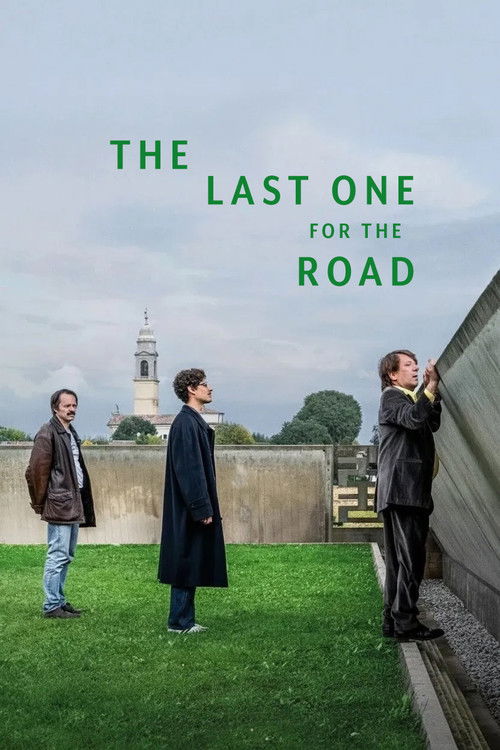
The Last One for the Road
2025 · Francesco Sossai
For a late-night watch when you're in the mood for something loose and human — laughter with an ache under it, good company over big drama. Comfort viewing for anyone who's ever loved a hopeless friend.
What it's about
In the foggy flatlands of the Veneto, two middle-aged lifelong drinkers, Carlobianchi and Doriano, pursue their nightly ritual of one more glass — and absorb into their orbit Giulio, a shy architecture student with his head full of theory and no idea how to live. The bar crawl folds itself around a half-serious hunt for buried treasure, and the trio wanders from pub to pub across a landscape of plains, sprawl, and neon signs in the dark.
The experience
Shaggy, funny, and unexpectedly melancholy — a nocturnal drift where the jokes and the sadness come from the same place. It ambles rather than plots, and by the end the amble is the point: you feel like you've been out all night with these people.
Performances
Sergio Romano and Pierpaolo Capovilla make the two drunkards a genuine double act — irritating, endearing, lived-in — while Filippo Scotti's watchful reserve gives the film its eyes.
The craft
Francesco Sossai shoots the Veneto hinterland — fog, plains, roadside bars, half-built sprawl — as a character in itself, letting the inherited landscape teach the young architect (and us) a new way of seeing. The film premiered in Cannes' Un Certain Regard, and its nighttime photography and roadside melancholy play best with the lights off.
Why it matters
One of the standout Italian discoveries of its Cannes year, announcing Sossai as a distinctive new voice in a long national tradition of comedies about wasted time and provincial life.
Snapshot
Released in Italy under its original title Le città di pianura ("Cities of the Plain") and circulated internationally as The Last One for the Road, Francesco Sossai's film is a nocturnal road comedy set in the flat, fog-prone hinterland of the Veneto. Its premise is deceptively slight: two aimless middle-aged drinkers, Carlobianchi (Sergio Romano) and Doriano (Pierpaolo Capovilla), pursue their nightly ritual of one more glass and, in the process, absorb into their orbit a shy young architecture student, Giulio (Filippo Scotti). What begins as a bar-crawl — later folded around a half-serious hunt for buried treasure — becomes a drifting meditation on friendship, provincial melancholy, and the way an inherited landscape teaches a person to see. The film premiered in the Un Certain Regard section of the 78th Cannes Film Festival on 21 May 2025, traveled to Toronto, New York, Vancouver and Montréal's Festival du nouveau cinéma, opened theatrically in Italy on 25 September 2025, and went on to a commanding presence at the David di Donatello awards, where it won eight prizes including Best Film. It arrived, in other words, as one of the most decorated Italian films of its year — a small, regional comedy that critics repeatedly described as "deeply local and surprisingly universal."
Industry & production
The Last One for the Road is an Italy–Germany co-production, produced by Vivo Film (the Rome company run by Marta Donzelli and Gregorio Paonessa, long associated with auteur-driven Italian cinema) together with the Munich-based Maze Pictures, and made with Rai Cinema. Regional support from the Veneto Film Commission underwrites the film's rootedness in its territory, and the production shot on real locations across the province — Sedico and Feltre in the Belluno foothills, Padua, the lagoon town of Chioggia, and, crucially, the Brion Memorial at San Vito d'Altivole. The 100-minute feature is the picture that carried Sossai — a director from the Belluno area who trained at Berlin's Deutsche Film- und Fernsehakademie (DFFB) — from the margins of Italian production to international festival visibility. The co-production structure is typical of contemporary European art cinema: German partners and public broadcaster money (Rai Cinema) de-risking a first-tier festival play built around non-marquee subject matter. The scale of its David di Donatello haul the following season suggests the film also found unusually broad domestic industry favour for a work this modest in budget and ambition of surface. Beyond the co-production partners, financing specifics and budget figures are not part of the verifiable public record, and I will not invent them.
Technology
The film's most conspicuous technical signature is its texture: a soft, grainy, slightly nostalgic image that reviewers singled out as central to its melancholy register. That grain reads as photochemical, and the picture's palette of overcast plains, sodium-lit bars and dusk interiors is consistent with an origination format chosen for warmth rather than clarity. I want to be careful here, though — the specific capture format (whether the film was shot on 16mm, on another film gauge, or on a digital system graded to emulate grain) and its finishing aspect ratio are not reliably documented in the sources I can verify, and I will not assert a stock or ratio I cannot confirm. What can be said with confidence is that the technology serves an aesthetic of memory: the image behaves less like a document of the present than like a recollection of a landscape already vanishing, an approach that aligns the film's tools with its themes of nostalgia and disappearance.
Technique
Cinematography
The photography is by Massimiliano Kuveiller, and it was among the film's most praised elements. The controlling subject is the pianura itself — the endless, horizonless Venetian plain — and Kuveiller shoots it as a place of enormous, becalming emptiness, where roads run straight to nothing and the sky sits low. Interiors are the plain's inverse: cramped, amber-lit bars and cars where the three men are boxed together. The compositional logic repeatedly sets the smallness of the human figures against the flatness of the terrain, a visual argument about provincial scale that the narrative never has to state aloud. Nell Minow, reviewing the film, called the cinematography simply "excellent," and its restraint — long-held frames, an unhurried eye — is what allows the picture's comedy to breathe and its sadness to accumulate.
Editing
The film was cut by Paolo Cottignola, an editor with deep roots in Italian art cinema. The editing is patient and accretive rather than propulsive: this is a picaresque built from encounters, and the rhythm mirrors the drinkers' own dilated sense of time, in which one more stop always follows the last. Several critics reached for Waiting for Godot to describe the structure — a circular, digressive, waiting-shaped drift rather than a goal-driven plot — and the cutting sustains that Beckettian stasis, letting scenes run to their natural exhaustion instead of clipping them to a thriller's tempo. The buried-treasure MacGuffin is edited as an excuse for motion, not as a suspense engine.
Mise-en-scène / staging
Sossai stages the film around thresholds: bar doors, car interiors, the seams between towns. The central staging idea is the trio as a shifting geometry — two older men who move through the world as a settled comic duo, and a younger third who is slowly drawn into their frame. The single most loaded location is deliberate: the Brion Memorial, Carlo Scarpa's masterwork of modern funerary architecture at Altivole. For a film whose youngest character is an architecture student, staging a sequence amid Scarpa's concrete geometries is a thematic keystone — it literalises the film's interest in "ways of seeing," setting a canonical work of Italian design against the anonymous provincial sprawl the drunkards inhabit.
Sound
The score is credited to the musician Krano, and reviewers found it well-judged to the film's bittersweet tone — neither ironising the comedy nor over-sentimentalising the sadness. The casting of Pierpaolo Capovilla, a well-known figure in Italian post-punk and experimental music, gives the film an off-screen musical lineage as well, though the film's use of him is as an actor. The broader soundscape belongs to the plain: bar chatter, engines, the acoustic flatness of open country at night. Detailed technical sound credits beyond the score are not something I can verify, and I won't embellish them.
Performance
The performances anchor the film. Sergio Romano and Pierpaolo Capovilla play the two "jovial lifelong drunkards" as a lived-in double act — men whose bonhomie is inseparable from their dead-endedness, and whose comedy carries an undertow of waste. Filippo Scotti, who drew international attention as the young lead of Paolo Sorrentino's The Hand of God (2021), plays Giulio, the reticent student, as the film's point of transformation: the outsider whose way of seeing is remade by exposure to these two. The supporting cast draws on strong regional and Italian talent, including Roberto Citran and Andrea Pennacchi, the latter a beloved Veneto stage and screen presence whose casting deepens the film's regional authenticity. The three-way chemistry — warm, digressive, faintly elegiac — is the film's true special effect.
Narrative & dramatic mode
The dramatic mode is picaresque comedy shading into existential fable. Structurally the film is an episodic road movie: a series of pub-to-pub encounters strung along the drinkers' pursuit of one last glass, loosely organized around the quest for a buried treasure that functions more as a shared fiction than a plot to be resolved. The mode is comic on its surface and melancholic underneath — a tonal doubleness critics kept describing as bittersweet. The repeated Godot comparison is apt: the narrative is built on waiting, repetition and deferral rather than escalation, and its "quest" is really a pretext for companionship and drift. The through-line that gives the wandering its shape is Giulio's transformation — the coming-of-age of a young man whose perception is altered by two people who, on paper, have nothing to teach him.
Genre & cycle
The film sits at the intersection of the road movie, the buddy comedy and the regional Italian commedia. Its DNA reaches back to the great Italian tradition of comedy that carries social weight — the commedia all'italiana lineage in which laughter is inseparable from portraits of national character and economic condition. But it also belongs to a contemporary European art-house cycle of slow, landscape-driven, tragicomic dramas about masculinity, aimlessness and provincial stasis. Within Italian cinema specifically, it participates in a persistent strain of films attentive to the country's overlooked margins — its plains, its small towns, its de-industrialised peripheries — rather than its metropolitan or picture-postcard centers.
Authorship & method
The film is authored by Francesco Sossai, who directed and co-wrote the screenplay with Adriano Candiago. Sossai's formation is telling: literary studies followed by directorial training at the DFFB in Berlin, a background that helps explain a sensibility both regionally grounded and cosmopolitan in reference (the Beckett scaffolding, the art-cinema patience). His method here is one of local specificity as a route to universality — building the film from a precisely observed Veneto and trusting that precision to travel, an approach vindicated by its international festival run and its domestic awards success.
His principal collaborators shape the film decisively. Co-writer Adriano Candiago shares credit for the script's digressive, character-first construction. Cinematographer Massimiliano Kuveiller supplies the film's celebrated visual melancholy. Editor Paolo Cottignola, a veteran of Italian art cinema, gives the picaresque its patient, waiting-shaped rhythm. Composer Krano provides the score that critics found so well-matched to the film's tone. Together the collaboration reads as a coherent authorial project rather than a director-for-hire assignment. (Sossai worked in shorter and independent forms before this feature; I'd rather flag that his earlier filmography is not something I can characterize precisely than misstate it.)
Movement / national cinema
This is firmly a work of contemporary Italian national cinema, produced within the Vivo Film / Rai Cinema ecosystem that has sustained much of the country's recent auteur output. It is not the product of a named movement, but it can be located within a live tendency in Italian film toward regional, minor-key realism — cinema attentive to the linguistic and geographic specificity of a particular territory (here the Veneto, its dialect-inflected culture, its flat interior) as against a homogenized national image. The German co-production dimension situates it additionally within the broader machinery of pan-European art cinema, where a small Italian film reaches Cannes and North American festivals through cross-border financing and festival curation.
Era / period
The film is a product of, and a commentary on, the long aftermath of the 2008 financial crisis. Its portrait of aimless, economically stranded middle-aged men is bound up with a specific Italian condition of post-crisis stagnation, precarity and diminished prospects — the sense of a generation and a region left idling. Set in an unglamorous present, the film nonetheless suffuses that present with nostalgia, treating the Veneto plain as a place already half-lost to change. Its release period — Cannes 2025, Italian theatrical release that autumn, David di Donatello recognition in the 2026 season — marks it as a defining Italian art film of the mid-2020s.
Themes
The governing themes are friendship, aimlessness, and perception. The two drinkers embody a companionship that is genuine and sustaining even as it is inseparable from waste and stasis; the film neither romanticizes nor condemns their arrested lives. Economic hardship and the residue of the 2008 crisis underwrite the whole, giving the comedy its melancholic ballast. Nostalgia — for a landscape, a way of life, a slower time — saturates the imagery. And threading through all of it is the film's most distinctive preoccupation: ways of seeing. Giulio, the architecture student, arrives with a trained, formal eye; the drunkards see the same plain through appetite, memory and habit. The film stages this collision most explicitly in Carlo Scarpa's Brion Memorial, where high architectural culture and the vernacular of the provinces are set literally in the same frame. The buried treasure, finally, works as a thematic figure: what these men are really excavating is meaning, memory and each other.
Reception, canon & influence
Critical reception was strongly favourable, both at Cannes and on the film's North American festival circuit, and the response coalesced around a shared observation — that a film so rooted in a specific corner of Italy achieved a surprising universality. Critic Alberto Crespi's formulation, "a deeply local and surprisingly universal film," captured the consensus; Nell Minow's comparison to Beckett's Waiting for Godot, her praise for the "excellent" cinematography, and her sense of a score attuned to the film's bittersweetness are representative of the international reviews. The clearest institutional measure of its standing is its David di Donatello record: eight awards, including Best Film, an extraordinary showing that effectively canonized it within Italian cinema of its moment.
The influences flowing into the film are legible. Its structural and philosophical debt to Beckett — the circular, waiting-shaped drift, the comedy of futility — is the one critics named most often. It draws on the Italian tradition of socially weighted comedy and on the road-movie and buddy-comedy forms. And in staging its meditation on seeing at the Brion Memorial, it explicitly invokes Carlo Scarpa and the legacy of Italian modernist architecture as a cultural touchstone.
Its forward influence is, by the nature of its recency, still unwritten. What can be said is that its festival trajectory and awards dominance position Sossai as a director to watch and offer a strong contemporary model for regionally specific, tonally bittersweet Italian filmmaking that reaches an international audience without diluting its locality. Any claim about a durable legacy or a school of imitators would be premature, and I'll leave it there rather than manufacture one.
Sources: Wikipedia — The Last One for the Road; Festival de Cannes — Le città di pianura; Festival de Cannes — Francesco Sossai; MSP Film; Filmhounds review; Veneto Film Commission; Letterboxd.
Reception
It slipped into Cannes 2025's Un Certain Regard as a modest Italian charmer — then a year later swept the 2026 David di Donatello with eight wins including Best Film and Best Director, turning a small pub-crawl movie into Italy's film of the year.
How The Last One for the Road was received, from release to now →
How to watch The Last One for the Road: what to notice on a first viewing
- Notice how small the men look against the flat plain. Kuveiller holds long shots of the horizonless Venetian countryside, roads running straight to nothing under a low sky, with the three men reduced to small figures inside it. The scale argument is entirely visual, the vastness of the place next to how small the men are in it.
- Notice the amber light in every cramped bar interior. Wherever the open plain gives way to a bar or a car, the film boxes the three men together in a warm, close, amber light. The light makes the company feel close exactly where the landscape outside feels endless and empty.
- Notice how long the film lets each stop run. The editing lets scenes exhaust themselves at their own pace rather than clipping toward the next plot point, so the treasure hunt drifts instead of building suspense. The rhythm mirrors the drinkers' own sense of time, in which one more stop always follows the last.
- Watch how the trio's shape shifts as they walk. Two older men move as a settled comic duo, and the staging keeps drawing the younger, quieter Giulio further into their frame with each new bar. You can watch the friendship form just by tracking where each man stands in the shot.
- Watch how easily the two older men finish each other's jokes. Sergio Romano and Pierpaolo Capovilla play their bond as a lived-in double act, bonhomie and dead-endedness folded into the same gesture. Their comedy carries an undertow of waste, so you laugh and feel the loss in the same beat.
The whole guide to watching The Last One for the Road, with the keys for a rewatch →
Influences: the films it descends from and the films it influenced
- I Vitelloni (1953) — Establishes the template of aimless provincial young men drifting through a Northern-Italian town in episodic, plotless vignettes — the coming-of-age-that-refuses-to-arrive that Sossai's picaresque accretion inherits.
- Il Sorpasso (1962) — The founding commedia-all'italiana road movie built on a mismatched double-act — a reckless older man and a passive younger one — whose car journey becomes a portrait of a stalled Italy, the exact buddy-drive geometry Sossai revives.
- Amici Miei (1975) — A group of middle-aged men strung together by pointless escapades in loosely accreting episodes with no destination — the futility-comedy-as-structure that shapes the film's Godot-like drift among aimless companions.
- I Soliti Ignoti (Big Deal on Madonna Street) (1958) — Canonizes the commedia-all'italiana comedy of failure, where the treasure/heist MacGuffin exists only to be botched — the same undercutting of the treasure motif that hollows Sossai's macguffin-treasure into pure pretext.
- L'Avventura (1960) — Pioneers the dissolving MacGuffin — a search whose object simply ceases to matter — sustained by long-held contemplative frames that redirect attention from plot to seeing, the formal engine behind the film's ways-of-seeing theme.
- Il Deserto Rosso (Red Desert) (1964) — Turns the flat, hazed, horizonless Po-valley industrial plain into an externalized emotional field through held wide compositions — the exact landscape grammar of Sossai's horizonless-plain cinematography.
- L'Albero degli Zoccoli (The Tree of Wooden Clogs) (1978) — Patient, observational realism of the Northern-Italian countryside shot with non-professional local performers and dialect — the regional-specificity-as-method that Sossai's Veneto-rooted realism descends from.
- Amarcord (1973) — Builds a whole film from accreting bittersweet provincial vignettes bound by memory rather than plot, modeling the tonally warm, episodic accretion Sossai uses to structure his Veneto drift.
- Im Lauf der Zeit (Kings of the Road) (1976) — The meandering two-man road movie of long silences and landscape drift from the German new-cinema tradition of Sossai's DFFB-Berlin formation — its patient, waiting-shaped rhythm is a direct formal parent.
- Stranger Than Paradise (1984) — Deadpan static long-take vignettes stitched into a road picaresque about people with nowhere to be — the comedy-of-aimlessness rendered in held frames that Sossai's long-held, waiting-shaped editing echoes.
- Down by Law (1986) — An explicitly Beckettian trio of men waiting and wandering with nothing to do, its three-body comic geometry and futility-in-deadpan closely mirroring Sossai's trio-geometry and Godot structure.
- È stata la mano di Dio (The Hand of God) (2021) — Shares lead actor Filippo Scotti in the same register — a watchful, lived-in coming-of-age presence — making the two films a direct performance lineage through the same collaborator's method.
- La Grande Bellezza (The Great Beauty) (2013) — Contemplative flânerie in which a wanderer's roving eye over a city becomes the subject, its ways-of-seeing gaze and bittersweet stagnation paralleling Sossai's meditation on looking.
- Lazzaro Felice (Happy as Lazzaro) (2018) — Deeply local, dialect-grounded regional Italian picaresque that reaches universality through a bittersweet fable of place — the same locality-as-route-to-universality method critics named in Sossai.
- Il Buco (2021) — Near-wordless, long-held contemplative frames that let Southern-Italian landscape and duration carry the film — a contemporary regional-realism sibling to Sossai's patient horizonless framing.
- Le Otto Montagne (The Eight Mountains) (2022) — A slow, bittersweet male double-act whose friendship is measured across held shots of Italian terrain — the lived-in two-hander over landscape that runs parallel to Sossai's buddy geometry.
Similar films
- I Vitelloni (1953) — influence & lineage · often watched together
- Il Sorpasso (1962) — influence & lineage
- Dry Leaf (2026) — shared sensibility
- The Eight Mountains (2022) — shared sensibility
- Father Mother Sister Brother (2025) — shared sensibility
- Nostalgia (1983) — shared sensibility
- Twinless (2025) — shared sensibility
- The Best of Youth (2003) — shared sensibility
All the films related to The Last One for the Road →
Watch it with: curated runs of related films
- Quiet Lives at the World's Edge — Watch these when you want a life pared down to essentials — someone walking out of society to start from zero, or simply living out their days at the margins.