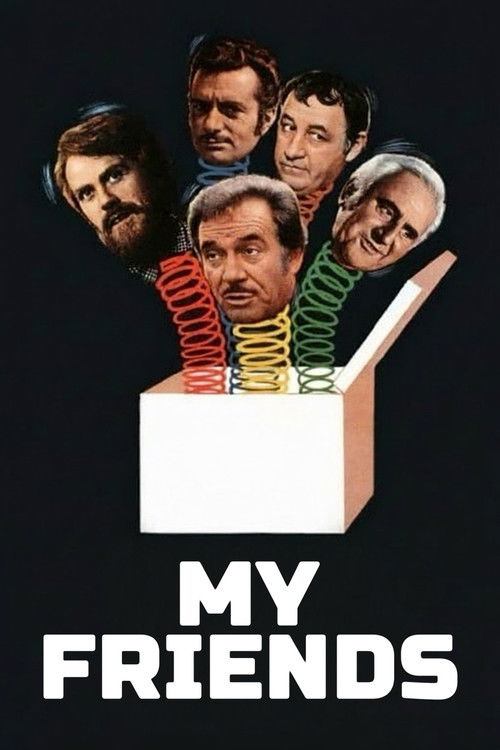
My Friends
1975 · Mario Monicelli
For a night when you want to laugh hard but don't mind the laughter catching in your throat — comedy for grown-ups who know the best jokes are partly about dodging despair.
What it's about
Five middle-aged friends in Florence — a journalist, a broke count, an architect, a café owner, and a surgeon — fend off mortality and domestic disappointment by staging elaborate pranks on everyone around them, including each other. Their escapades range from ingenious to genuinely cruel, and the film follows the gang as the bill for a lifetime of joking around slowly comes due.
The experience
Riotously funny and then, without warning, piercingly sad — the laughter has an undertow of loneliness and aging that sneaks up on you. It's episodic and unhurried, like being folded into a circle of old friends whose jokes you're only starting to decode.
Performances
A murderers' row of Italian and French character actors: Philippe Noiret, Ugo Tognazzi, Gastone Moschin, and Adolfo Celi play off each other with the ease of a real gang, with Tognazzi's ruined count delivering torrents of authoritative-sounding nonsense that became Italian folklore.
The craft
Monicelli conducts the ensemble like a jazz band, letting long comic set pieces build and then puncturing them with sudden melancholy. The writing is the marvel — pranks constructed with watchmaker precision, and invented gibberish so convincing it entered the Italian language.
Why it matters
A late masterpiece of Italian-style comedy that became a cultural phenomenon in Italy, spawning sequels and catchphrases still quoted today.
Snapshot
Amici miei (My Friends) is a late masterwork of commedia all'italiana — Italian-style comedy — following five middle-aged Florentine men who stave off mortality, boredom, and domestic failure by staging elaborate, often cruel pranks they call zingarate (roughly, "gypsy escapades"). The ensemble is anchored by Philippe Noiret as the journalist Giorgio Perozzi, who narrates from beyond his own death; Ugo Tognazzi as the ruined aristocrat Count Raffaello "Lello" Mascetti; Gastone Moschin as the lovelorn architect Rambaldo Melandri; Duilio Del Prete as the café-owner Guido Necchi; and Adolfo Celi as the surgeon Professor Sassaroli, who joins the pack partway through. The film is inseparable from a piece of Italian folklore it helped canonize: Mascetti's supercazzola, a torrent of authoritative-sounding nonsense syllables deployed to bewilder strangers and authority figures alike. Beneath the horseplay runs a genuinely bleak current — arrested men fleeing wives, work, aging, and death — which gives the picture its enduring double character as both a beloved laugh-machine and an elegy. It became one of the signal Italian commercial successes of its season and spawned two sequels.
Industry & production
The film's genesis is bound to the death of one director and the arrival of another. Amici miei was conceived and co-written by Pietro Germi, the director of Divorce Italian Style (1961) and Seduced and Abandoned (1964), who intended to direct it himself. Germi, gravely ill and dying (he died in December 1974), was unable to shoot the picture; Mario Monicelli took over the direction. The finished film honors Germi — it is presented as his project, "a film by Pietro Germi," with Monicelli realizing it — a gesture of homage rather than mere legal credit. This origin is unusually well documented in the film's own paratext and in Monicelli's later interviews; I flag it because the exact wording of the on-screen attribution is sometimes reported inconsistently, and I won't overstate its precise form.
The screenplay is credited to Germi together with the veteran team of Leonardo Benvenuti and Piero De Bernardi — among the most prolific writing partnerships in postwar Italian cinema — with Tullio Pinelli, best known as a longtime collaborator of Fellini. The production was mounted by Rizzoli Film and shot in and around Florence, whose piazzas, cafés, and Tuscan surroundings supply the film's specific regional texture; the Florentine setting, dialect coloring, and civic atmosphere are integral rather than incidental. Running roughly two and a quarter hours, the film is long for a comedy, a length that lets the episodic pranks accumulate into something like a life-portrait.
Commercially, Amici miei was among the biggest Italian hits of its release period and is frequently cited as a top domestic earner of the mid-1970s; I decline to attach a specific box-office figure, as the numbers in circulation vary and I cannot verify a single authoritative sum. Its popularity was durable enough to generate Amici miei atto II (1982), again directed by Monicelli, and Amici miei atto III (1985), directed by Nanni Loy.
Technology
Amici miei is a conventionally produced 35mm color feature of its era, and there is no evidence of technological innovation as a design goal — nor should there be, for a character comedy of this kind. Its craft interest lies in the seamless, unshowy application of mature commercial technique rather than in novel apparatus. The film uses live locations extensively, with the attendant challenges of shooting comedy in real Florentine streets and interiors, and relies on the standard Italian postwar practice of post-synchronized sound (dubbing in post-production) rather than location recording — a norm that had practical bearing on the leads, since an ensemble mixing Italian actors with the French Noiret was routinely reconciled in the dubbing studio. Beyond this, the honest assessment is that the picture's technology is invisible by design; its ambitions are dramaturgical and performative.
Technique
Cinematography
Photographed by Luigi Kuveiller, the film adopts a clean, legible, largely functional visual style appropriate to ensemble comedy, where clarity of who-is-doing-what to whom matters more than pictorial flourish. Kuveiller is a notable choice precisely because his reputation was built elsewhere: he shot Elio Petri's caustic political thrillers, including Investigation of a Citizen Above Suspicion (1970), and Dario Argento's Deep Red (1975). In Amici miei that command of framing serves the comedy's mechanics — staging the geometry of a prank so the audience reads the trap before the victim does. The Florentine exteriors are handled naturalistically, with the city as a lived-in stage rather than a postcard.
Editing
The editor was Ruggero Mastroianni, one of the great Italian cutters of the period (and brother of Marcello), long associated with Fellini and Visconti. His contribution is central to the film's comic timing. Amici miei is structured as a chain of set-piece escapades, and the editing must both sustain the internal rhythm of each gag — the build, the deadpan, the reveal — and stitch the episodes into a coherent emotional arc so that the accumulation of pranks quietly becomes a portrait of wasted lives. The film's most celebrated sequence, in which the friends stroll along a departing train slapping passengers who lean out the windows, depends entirely on cutting: rhythm, repetition, and the escalation of an absurd cruelty into helpless laughter.
Mise-en-scène / staging
Monicelli stages the film around the pack as a social organism. The recurring hub is Necchi's café, from which the men radiate outward on their improvisations; the staging repeatedly contrasts the closed male circle against the domestic and civic spaces — homes, hospitals, offices, streets — that they invade and disrupt. The supercazzola scenes are masterclasses in staging embarrassment: Mascetti advances into a stranger's personal space with total false confidence while the others hover, and the blocking makes the victim's confusion the visual punchline. The Florentine locations ground the escapades in a recognizable everyday world, which sharpens the comedy of intrusion — these are pranks played on ordinary citizens going about ordinary business.
Sound
As with most Italian cinema of the era, the soundtrack is built in post-production, and the film's aural signature is verbal. The supercazzola — Mascetti's stream of confidently intoned gibberish, delivered with the cadence of bureaucratic or technical authority — is fundamentally a sound effect made of language, and its comedy lives in delivery, rhythm, and the straight-faced music of nonsense. The invented word and its variants entered common Italian usage, a rare instance of a film gag becoming a durable idiom. The score (see below) supplies a jaunty recurring motif that functions almost as the pack's theme, tonally papering over the melancholy the plot keeps exposing.
Performance
Performance is the film's true medium. Tognazzi's Mascetti is the standout — an aristocrat reduced to poverty who preserves his dignity through sheer performative bravado, the supercazzola being the perfect vehicle for a man improvising a self he can no longer afford. Noiret, dubbed into Italian, gives Perozzi a weary, melancholic gravity as the narrator-observer whose death frames the story. Moschin's Melandri carries the film's romantic pathos; Del Prete's Necchi is its grounded center; Celi's Sassaroli brings a bluff, worldly menace. Crucially, the ensemble plays the cruelty straight: the men are charming and appalling at once, and the actors never solicit the audience's approval for the damage they do — which is what keeps the comedy morally alive.
Narrative & dramatic mode
The film is episodic and retrospective. Perozzi narrates in voice-over from a vantage that the ending reveals to be posthumous, lending the whole a valedictory frame — we are watching a life recounted by a dead man. Within that frame the structure is picaresque: a sequence of zingarate rather than a single causal plot, unified by character and by an intensifying sense of mortality. The dramatic mode is tragicomic in the specific key of commedia all'italiana: the laughter is real, but it is repeatedly undercut by cruelty, failure, and death. The climactic movement — Perozzi's fatal collapse and his inability, even on his deathbed, to stop performing the supercazzola — fuses the comic and the elegiac in a single image, and the friends' response to his death completes the film's argument that the escapades were always a way of not looking at the end.
Genre & cycle
Amici miei is a canonical entry in commedia all'italiana, the strain of Italian comedy that, from the late 1950s onward, married farce and satire to social observation and an undertow of bitterness. Within that tradition it belongs to the ensemble/buddy variant and to the episodic prank-comedy lineage. Its timing is significant: by the mid-1970s the genre was widely regarded as waning, and Amici miei is often read as one of its late, self-aware summits — a film that takes the genre's characteristic subject (Italian men evading responsibility and self-knowledge) to a darker, more autumnal register. That it was made by Monicelli, one of the genre's founding directors, and originated by Germi, another, gives it the quality of a capstone produced by the tradition's own architects.
Authorship & method
Mario Monicelli (1915–2010) was a principal author of commedia all'italiana, responsible for Big Deal on Madonna Street (1958), The Great War (1959), and For Love and Gold (L'armata Brancaleone, 1966), among many others. His method favored strong ensembles, a documentary attentiveness to Italian social types, and comedy that refused to flatter its characters or spare its audience the darkness underneath. Taking over Germi's project, Monicelli did not efface Germi's authorship but completed it, and the film sits credibly within both men's sensibilities — Germi's mordant view of Italian mores and Monicelli's ensemble craft.
The key collaborators reinforce the film's pedigree. The writing unites Germi with Benvenuti–De Bernardi and Pinelli, pooling several of the era's strongest comic and dramatic pens. Cinematographer Luigi Kuveiller and editor Ruggero Mastroianni bring technique honed on more overtly "serious" cinema to the service of comedy. The composer, Carlo Rustichelli, is a telling link: a prolific veteran who had scored Germi's films (including Divorce Italian Style), his contribution — a light, recurring, march-like theme — carries the project's continuity with Germi's world and lends the pranks a buoyant momentum that the drama repeatedly betrays.
Movement / national cinema
The film is thoroughly, specifically Italian — not only in genre but in its regional and social precision. Its Florentine setting, its rendering of provincial-bourgeois male sociability, its café-centered ritual life, and its satirical grasp of Italian institutions (medicine, the press, the church, the aristocracy in decline) situate it firmly in the national-cinema project that commedia all'italiana had pursued since the late 1950s: using comedy as a mirror for Italian society. It is a domestic film in the fullest sense — made for, about, and beloved by an Italian public, with a comic idiom (the supercazzola) that is nearly untranslatable and that became part of the national vernacular.
Era / period
Released in 1975, the film registers a particular moment. The anni di piombo (the "years of lead," Italy's period of political violence and social strain) form an unspoken backdrop against which the friends' willed frivolity reads as evasion. More directly, the film sits at the twilight of commedia all'italiana and of the postwar economic-miracle optimism the genre had both celebrated and skewered. Its characters are men of a certain age confronting the exhaustion of their youth against a country that has changed around them; the pranks are a refusal of the present as much as of aging. The film's melancholy is period-specific — the sense of a generation, and a comic tradition, running out of road.
Themes
The governing themes are arrested masculinity and the flight from mortality. The zingarate are a collective strategy for not growing up and not dying — a way of converting fear of the end into juvenile action. Male friendship is idealized and interrogated at once: the pack offers belonging and freedom, but it is also a closed, self-justifying world that licenses cruelty and excludes the women — wives, mistresses, victims — who bear the cost. The film is candid about that cruelty: many pranks are cutting, even sadistic, and Amici miei has drawn criticism for its treatment of women and for the callousness of its heroes, a reading the film arguably invites by refusing to sentimentalize them. Class and decline run through Mascetti's fallen aristocracy and the general portrait of a bourgeoisie with time to waste. And over everything hangs death — literalized in Perozzi's narration and demise, and figured throughout as the thing the laughter is meant to outrun.
Reception, canon & influence
Amici miei was a major popular success in Italy and has remained one of the most quoted and re-watched Italian comedies, its lines and gags — above all the supercazzola and the train-slapping escapade — passing into everyday cultural currency. Critically it is esteemed as a high point of late commedia all'italiana and as one of Monicelli's finest late works, though its reputation has always carried an asterisk regarding the moral status of its protagonists and its handling of women; that tension is now generally read as intrinsic to the film's design rather than a lapse.
Looking backward, the film draws on the whole apparatus of commedia all'italiana that Germi and Monicelli had themselves built — the ensemble structure, the satirical social gaze, the tragicomic undertow — and on Germi's specific vein of corrosive comedy about Italian mores. Looking forward, its most concrete legacy is franchise-shaped and linguistic: the two sequels (Atto II, 1982, Monicelli; Atto III, 1985, Nanni Loy) extended the characters and their world, while the supercazzola became a permanent fixture of Italian speech and comic reference. More broadly, Amici miei stands as a touchstone for the ensemble prank-comedy of male midlife regression and for the idea that comedy at its most durable can be, simultaneously, an unsparing meditation on death — an equilibrium later Italian comedies have often reached for and rarely matched.
Reception
A massive box-office smash in Italy — the hit of its 1975–76 season — even as some critics winced at its cruelty and cynicism; half a century on it's canonized as a late masterpiece of commedia all'italiana and sits on Italy's official list of '100 Italian films to be saved'.
How My Friends was received, from release to now →
How to watch My Friends: what to notice on a first viewing
- Listen for Mascetti's stream of confident sounding nonsense. Tognazzi delivers the supercazzola, a torrent of invented words spoken with the cadence of bureaucratic authority, to bewilder strangers and officials alike. The joke is entirely in the delivery; the words themselves mean nothing at all.
- Watch how the four friends move as one cluster through town. Monicelli stages the pack radiating outward from Necchi's café into homes, offices, and streets they invade together, always as a single unit rather than separate men. You're watching a closed circle that only works when all of them are in it.
- Watch how each prank builds to a slow, deadpan punchline. Ruggero Mastroianni's editing sustains the build, the deadpan, and the release of each escapade, letting a joke's timing breathe before cutting to the payoff. The comic rhythm is built entirely in the cutting, not just in what the actors say.
- Watch Tognazzi's bravado when a prank starts to slip. As Count Mascetti, Tognazzi preserves total confidence even when a scheme wobbles, a ruined aristocrat performing a self he can no longer afford. The bravado is a performance inside the performance, a man convincing himself as much as his victims.
- Watch how ordinary the streets and offices the men invade look. The film shoots real Florentine locations naturalistically, a lived-in city rather than a postcard, so the pranks land on recognizably ordinary citizens going about ordinary business. The ordinariness of the setting is what makes the intrusion into it feel sharper.
The whole guide to watching My Friends, with the keys for a rewatch →
Influences: the films it descends from and the films it influenced
- Big Deal on Madonna Street (1958) — Monicelli's own template of the male pack as a bumbling social organism whose elaborately staged scheme collapses into pathos — the ensemble choreography of losers is imported wholesale into the amici's prank-brotherhood.
- Divorce Italian Style (1961) — Germi's corrosive satire of Italian male self-delusion, scored by the same composer Carlo Rustichelli with a jaunty recurring theme that ironically undercuts the protagonist's schemes — the exact tonal machinery My Friends inherits from Germi's originated project.
- Seduced and Abandoned (1964) — Germi's mordant anatomy of Sicilian honor codes and male hypocrisy establishes the acidic view of Italian mores that underwrites the amici's amoral cruelty, the sensibility Germi carried into the film he conceived but never shot.
- The Great War (1959) — Monicelli's fusion of broad comic ensemble with an unflinching death that arrives mid-laugh — the tragicomic ambush that My Friends systematizes with its posthumous voiceover and funeral frame.
- I Vitelloni (1953) — The provincial idlers who refuse adulthood, drifting in a male clique through pranks and evasions — the arrested-masculinity archetype and episodic loitering structure My Friends ages into midlife.
- Il Sorpasso (1962) — Risi's picaresque of male flight — a road of gags propelled by a buoyant score that suddenly turns lethal — models the pleasure-then-mortality reversal and the charismatic-cad archetype Tognazzi's Mascetti extends.
- For Love and Gold (L'armata Brancaleone) (1966) — Monicelli's ragtag male band roaming an episodic quest, complete with invented mock-language, prefigures the amici's zerate and the supercazzola — comedy built on nonsense-glossolalia as social weapon.
- An Average Little Man (1977) — Monicelli immediately doubles down on the death-inside-comedy equilibrium, letting Sordi's petit-bourgeois grief curdle the comic register — the tragicomic tipping point My Friends had just perfected.
- My Friends Act II (1982) — The direct sequel extends the same characters, the prank-as-lifestyle structure, and Rustichelli-style march momentum, formalizing My Friends as a franchise built on repeatable zingarate and supercazzola gags.
- My Friends Act III (1985) — Loy inherits the ensemble prank architecture and the pack-as-organism staging, carrying the supercazzola verbal-gag apparatus forward under a different director while preserving the series' mortality undertow.
- Il Conte Max / late Tognazzi vehicles (1991) — Extends the Tognazzi-Mascetti mode of the aging aristocratic bluffer whose charm masks decay, the specific performance debt of the impoverished-nobleman con carried into later Italian comedy.
- Amici miei — Come tutto ebbe inizio (2011) — An explicit prequel that reverse-engineers the origins of the amici's pranks and the supercazzola, treating My Friends' gags and pack dynamics as canonical craft to be reconstructed.
- The Pool Boys / Italian midlife-pack comedies (2000) — Inherits the template of middle-aged male friends fleeing responsibility through collective mischief — the ensemble prank-comedy of regression that My Friends established as an Italian genre unto itself.
- The Last One for the Road (2025) — A group of middle-aged men strung together by pointless escapades in loosely accreting episodes with no destination — the futility-comedy-as-structure that shapes the film's Godot-like drift among aimless companions.
- Mafioso (1962) — Shares the commedia all'italiana pivot from comic Italian social portraiture into sudden moral horror, the genre's signature bait-and-switch that My Friends deploys via bedside and deathbed scenes.
- We All Loved Each Other So Much (1974) — Released a year earlier, Scola's elegy for a male friendship tracked across decades uses the same nostalgic-retrospective, tragicomic accounting of aging Italian men and posthumous stock-taking that frames My Friends.
- C'eravamo tanto amati successors — Splendor (1989) — Continues the commedia all'italiana strain of nostalgic male retrospection and the twilight-of-cinema elegy, using the same bittersweet accounting of lost time that gives My Friends its posthumous-voiceover frame.
Similar films
- We All Loved Each Other So Much (1974) — influence & lineage
- I Vitelloni (1953) — influence & lineage
- Big Deal on Madonna Street (1958) — influence & lineage
- Divorce Italian Style (1961) — influence & lineage
- The Great War (1959) — influence & lineage
- The Organizer (1963) — shared sensibility
- Cinema Paradiso (1988) — shared sensibility
- Amarcord (1973) — shared sensibility