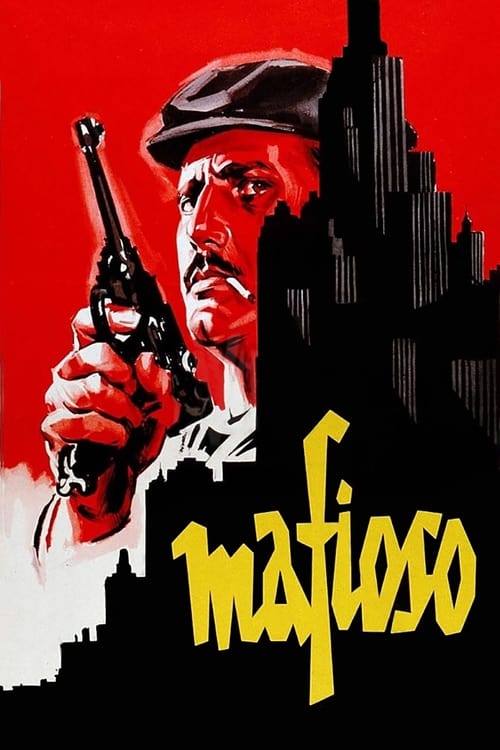
Mafioso
1962 · Alberto Lattuada
For when you want a film that pulls the rug out — start it expecting an Italian family comedy and let it become something darker. Best for viewers who like their laughter with an aftertaste.
What it's about
Nino is a model of the new Italy: a cheerful, punctilious factory foreman in Milan with a blonde Northern wife and two daughters, proud of his efficiency charts and his modern life. Then he takes the family home to Sicily on holiday, where the sun, the relatives, and the hospitality are effusive — and where an old debt to the local men of respect resurfaces, with a claim on him he never imagined.
The experience
It plays for a long stretch as a warm, very funny comedy of manners about a man showing off for the old neighborhood — and then the temperature drops, and the last act leaves you genuinely chilled. The whiplash is the point, and it's masterfully controlled.
Performances
Alberto Sordi is astonishing: his Nino is all beaming, eager-to-please energy, and watching that grin falter is the film — comic bravura curdling into tragedy within a single performance.
The craft
Lattuada shoots the Milan factory and the Sicilian village as two different planets in crisp black and white, and manages the film's daring tonal handbrake turn without a single seam showing. The observational detail — meals, rituals, courtesies — does the storytelling.
Why it matters
One of the earliest and sharpest films to treat the mafia not as gangster mythology but as a social system with roots in ordinary life, decades ahead of the crime sagas that followed; its international rediscovery in the 2000s restored it to classic status.
Snapshot
Mafioso is a black-and-white Italian tragicomedy that sends a cheerfully assimilated Sicilian—Antonio "Nino" Badalamenti, a punctilious Fiat-style factory foreman living in Milan with his Northern wife and two daughters—home to his native island for a holiday, only to have an archaic obligation close over him like a trap. What begins as a warm, observational comedy of manners about a Southerner showing off his modern Milanese family curdles, in its final third, into something genuinely chilling: Nino is crated up, shipped to America to carry out a mafia execution, and returned to his ordinary life as if nothing had happened. The film is a signature vehicle for Alberto Sordi, one of the defining performers of commedia all'italiana, and it is often singled out as one of the earliest and sharpest cinematic reckonings with the mafia and the code of silence—decades before the American gangster epics with which the subject is now associated. Long under-circulated, it was rediscovered through a restoration and international re-release in the mid-2000s, prompting a wave of critical reappraisal.
Industry & production
Mafioso was produced within the robust, commercially confident Italian studio system of the early 1960s, a moment when commedia all'italiana was a dominant and profitable genre and when producers like Dino De Laurentiis were mounting films built around bankable comic stars. Sordi was precisely such a star: by 1962 he was among the most popular actors in Italy, and a Lattuada–Sordi collaboration would have been understood as a mainstream, audience-facing production rather than an art-house gamble. The film pairs that commercial framework with a socially pointed script, a characteristic strategy of the period, in which broad comedy served as the delivery system for satire about class, region, and modernization.
The production trades on Italy's real geographic and industrial contrasts: the gleaming, regimented Northern factory floor and the sun-baked Sicilian town are set against each other as the film's central opposition. Specifics of the shooting schedule, budget, and box-office performance are not something I can document reliably here, and I will not invent figures; what is secure is that the film emerged from the same producer-driven, star-centered ecosystem that generated the era's most successful Italian comedies. It should also be noted that the film's commercial and critical afterlife was uneven—it was not treated as a canonical landmark on release and receded for decades before its later rediscovery.
Technology
Made in 1962, Mafioso is a black-and-white feature in the standard professional idiom of its moment: 35mm photography, studio-grade lighting, and post-synchronized sound, the latter being near-universal practice in Italian cinema of the period, where dialogue was routinely dubbed in post-production rather than recorded live on set. The choice of black and white, still common for Italian dramas and comedies in the early 1960s even as color was spreading, suits the film's tonal project—it lends the Sicilian material a documentary hardness and keeps the comedy from tipping into picturesque travelogue. The film relies on conventional technology of its day rather than any notable technical innovation; its interest lies in how those ordinary tools are deployed. I have no reliable record of unusual equipment or processes used on the production and will not speculate.
Technique
Cinematography
The photography, by Armando Nannuzzi, is built on the contrast between two visual worlds. The Milanese and factory material is clean, ordered, and modern; the Sicilian sequences are keyed to strong Southern light, dust, and the density of village life. Nannuzzi—an accomplished cinematographer who worked widely in Italian cinema—handles the tonal shift that the film demands, letting the early comedy read bright and open before the imagery tightens as Nino is drawn into the mafia's orbit. The American execution sequence, by contrast, is staged with a colder, more clinical detachment. The black-and-white palette is essential to this modulation, allowing the film to move from sunlit comedy to something closer to noir without changing its visual grammar.
Editing
The cutting, credited to Nino Baragli—one of the great Italian editors of the era, associated with a broad swath of the period's important films—is central to the picture's celebrated tonal control. The film's most discussed structural feature is the way it accelerates: a leisurely, digressive comic first movement gives way to a compressed, almost brutal final act. The crating-and-shipping passage and the execution are handled with an economy that heightens their horror, and the return to Milan is managed so that the ordinary rhythms of Nino's life resume with an unbearable smoothness. The editing's refusal to linger or moralize is a large part of why the ending lands as coldly as it does.
Mise-en-scène / staging
Lattuada stages the two halves of the film as opposed social choreographies. In the North, Nino inhabits a world of stopwatches, assembly-line order, and bourgeois domestic display; he arrives in Sicily eager to present his modern family as proof of his success. The Sicilian staging emphasizes ritual, hierarchy, and the physical presence of the community—meals, greetings, the deference owed to the local boss, Don Vincenzo. The mafia is not introduced as spectacle but as social texture: a matter of who defers to whom, of favors and unspoken debts embedded in ordinary hospitality. This staging is the film's argument—that the "obligation" is inseparable from the warmth and belonging Nino craves.
Sound
Like most Italian films of its time, Mafioso was post-synchronized, its dialogue and effects built in post-production. Piero Piccioni's score is a key expressive instrument, capable of underwriting the early comedy and then withdrawing or darkening as the film turns. Beyond the score, the film exploits the contrast between the industrial hum of the North and the ambient life of the Sicilian town. I do not have detailed documentation of the sound design's specific techniques and will not overstate them; what is clear is that music is used pointedly to manage the film's shifts in register.
Performance
The film belongs to Alberto Sordi, whose Nino is a masterclass in the commedia all'italiana archetype of the ingratiating, self-deceiving Italian everyman. Sordi plays the character's eager provincialism and his desperate wish to be seen as successful and modern, then tracks—largely through the face and body rather than dialogue—the man's dawning entrapment as the old codes reassert their claim. The performance's power comes from its restraint at the crucial moments: Nino does not rebel, he complies, and Sordi lets the comedy drain out of the character without ever breaking the surface of ordinariness. The supporting playing—the Northern wife, the Sicilian relatives, the local boss—is calibrated to keep the social comedy convincing so that its darkening feels earned. Specific casting details beyond Sordi I will not assert without confidence.
Narrative & dramatic mode
The film's structure is its thesis. It operates first as a genial fish-out-of-water comedy—the Milanese-married Sicilian returning home, his Northern wife regarded as an exotic curiosity, his own re-immersion in a world he thought he had left behind. This mode lulls the audience into the same complacency as Nino, who treats his homecoming as a triumphant social performance. The pivot comes when a seemingly innocuous favor—carried from his Milanese employer—reveals itself as the mechanism of an inherited obligation. The dramatic mode then shifts from comedy to something like nightmare, executed with deadpan literalism (the notorious crate). The ending completes the design by refusing catharsis: Nino resumes his Northern life, the horror sealed inside him, the machinery of both the factory and the mafia grinding on. It is a tragicomedy whose comedy is not a relief from the tragedy but its disguise.
Genre & cycle
Mafioso sits squarely within commedia all'italiana, the Italian-style comedy that flourished from the late 1950s through the 1960s and that characteristically fused broad humor with social critique, bitterness, and often bleak endings. Within that cycle it is distinguished by its subject: the mafia and the culture of omertà, treated not as genre thrills but as a satirical and moral problem rooted in Southern Italian society. This makes the film an important early entry in the cinematic treatment of organized crime as a specifically Italian social phenomenon, well before the theme was globalized by later American cinema. It also belongs to a strand of the period preoccupied with the North–South divide and the "Southern Question"—the persistence of archaic codes beneath the surface of a modernizing, industrializing nation.
Authorship & method
Lattuada was a director of the generation that helped shape postwar Italian cinema—he had co-directed Variety Lights (Luci del varietà, 1950) with Federico Fellini and built a reputation as a versatile, craftsmanlike filmmaker with a strong literary bent. His authorship here is expressed less through overt stylistic signature than through tonal command: the ability to sustain a comedy and then let it curdle without a false step. The screenplay draws on a story by Bruno Caruso and was developed by a formidable roster of Italian comedy writers, centrally the celebrated team of Age & Scarpelli (Agenore Incrocci and Furio Scarpelli), with contributions associated as well with Marco Ferreri and Rafael Azcona; these were among the most important comic screenwriters of the era, and their sensibility—satire sharpened into cruelty—is legible throughout. (The screenwriting credits on films of this kind are dense and collaborative, and I flag that the precise apportionment of contributions is not something I can adjudicate here.) The cinematography is by Armando Nannuzzi, the editing by Nino Baragli, and the score by Piero Piccioni—each a significant professional of the period. The decisive creative act is the collaboration between Lattuada's directorial control and Sordi's performance, which together hold the film's dangerous tonal balance.
Movement / national cinema
The film is a product of mainstream Italian commercial cinema at its most artistically ambitious. It is not neorealist in method, but it inherits neorealism's attention to social reality—region, class, labor, the texture of ordinary life—and channels it into the satirical framework of commedia all'italiana. Its concern with the modernization of Italy, the industrial North, internal migration, and the endurance of Southern traditions places it within a broader national conversation that Italian films of the late 1950s and 1960s conducted repeatedly. It stands as evidence that some of the era's most incisive social criticism came not from the art-house avant-garde but from popular comedy built around a star.
Era / period
Mafioso is very much a film of Italy's "economic miracle" years, the period of rapid industrialization and internal migration in which Southerners moved north to factory work and a modern consumer society took shape. Nino's stopwatch-timed factory job, his bourgeois domestic aspirations, and his pride in his modern family are all markers of that transformation. The film's force comes from setting this new, forward-facing Italy against the persistence of an older order that has not dissolved but merely gone quiet—waiting, as the plot reveals, to reassert its claims. It captures a nation in the act of modernizing while insisting that the past has not been left behind.
Reception, canon & influence
On release, Mafioso was received as a Sordi comedy within a crowded field of Italian comedies and did not immediately assume the canonical stature it would later acquire; for decades it was relatively under-circulated outside Italy. Its major critical reappraisal came with a restoration and international re-release in the mid-2000s, when the film reached English-language audiences and critics—drawing notably strong reviews—who praised its tonal daring and its prescient treatment of the mafia. This afterlife reframed the film as an overlooked masterpiece of commedia all'italiana rather than a minor star vehicle.
Looking backward, the film draws on the traditions of Italian social comedy and on the neorealist inheritance of attention to region and class, filtered through the satirical bite of its screenwriting team. Its treatment of omertà and the mafia as a social code rather than a crime spectacle is its most original contribution.
Looking forward, Mafioso is frequently cited as a significant early screen treatment of the mafia and of the ordinary man conscripted into its violence—a thematic template that later crime cinema would explore at epic scale. Its imagery, particularly the shipping of the reluctant assassin and the seamless return to ordinary life, has become a touchstone in discussions of how banality and horror coexist in mafia narratives. I would caution against overstating direct, documentable lines of influence on specific later films; the more defensible claim is that Mafioso anticipated, with unusual clarity and unusual coldness, a mode of mafia storytelling that would only later become globally familiar—and that its rediscovery secured its place as a durable, respected work of Italian cinema.
Reception
A hit in Italy in 1962 on the strength of Alberto Sordi's stardom, it was barely seen in America for decades — then Rialto Pictures' 2007 restoration and re-release had US critics hailing it as a rediscovered masterpiece and the great missing link of mafia cinema.
How Mafioso was received, from release to now →
Influences: the films it descends from and the films it influenced
- Variety Lights (1950) — Lattuada's own co-directed debut established his method of holding a warm ensemble comedy over a substratum of humiliation, the same tonal double-exposure he sustains in Mafioso by letting laughter and cruelty share the frame.
- Big Deal on Madonna Street (1958) — Scripted by Age & Scarpelli, it codified the commedia all'italiana move of treating crime through affectionate character comedy, the writers' template Lattuada inherits and then poisons.
- The Great War (1959) — Age & Scarpelli's structural trick of running broad comedy straight into an abrupt, uncushioned death—refusing catharsis at the cut—is exactly the tonal acceleration Mafioso deploys in its final act.
- An American in Rome (1954) — Built Alberto Sordi's signature everyman-braggart persona—the ingratiating provincial who performs assimilation—which Mafioso weaponizes by placing that same likability inside a man conscripted to kill.
- I Vitelloni (1953) — Fellini's use of Sordi as the vain provincial idler, exposed by his own bluster, supplies the performance grammar Sordi carries into Antonio's self-satisfied homecoming.
- The Day of the Owl (1968) — Extends Mafioso's central insight—omertà as a governing social code that renders the mafia invisible and ordinary citizens complicit—into the emerging Italian mafia-procedural.
- The Godfather (1972) — Realizes at epic scale the touchstone Mafioso pioneered: the seamless cut between domestic ritual and murder, staging horror as an extension of family banality rather than as spectacle.
- Once Upon a Time in America (1984) — Also edited by Nino Baragli, it carries forward his method of letting elegiac ordinary life and abrupt brutality coexist within one editorial continuum, a direct extension of his Mafioso craft.
- Goodfellas (1990) — Builds its whole thesis on Mafioso's discovery that the terror of the mafia lies in its domestic banality—the killer who commits murder and then calmly returns to ordinary routine.
- Donnie Brasco (1997) — Centers on Mafioso's archetype of the ordinary, sympathetic man drawn incrementally into performing violence he cannot refuse, dramatizing conscription-by-loyalty rather than criminal glamour.
- Gomorrah (2008) — Returns to Mafioso's coldest premise—the mafia as a banal, inescapable social system that absorbs ordinary people—stripping away even the comedy to leave the underlying sociology bare.
- Divorce Italian Style (1961) — Shares the exact satirical target—Sicilian codes of honor and omertà dissected through deadpan tragicomedy—treating a lethal social code as material for cold farce rather than melodrama.
- Il sorpasso (1962) — The definitive commedia all'italiana structure of a sunlit comic journey that snaps into sudden death at the last minute, the same withheld-then-detonated tonal reversal Mafioso engineers.
- A Difficult Life (1961) — Uses Sordi to let comedy curdle into disillusion across the arc of the economic miracle, the same actor-driven souring of tone that Lattuada tightens into horror.
- Salvatore Giuliano (1962) — Released the same year, it likewise treats the Sicilian mafia as an impersonal social structure and web of silence rather than a crime spectacle, the sociological approach Mafioso pursues through comedy instead of inquiry.
- The Good, the Bad and the Ugly (1966) — Cut by Mafioso's editor Nino Baragli, whose rhythmic control of tonal whiplash—stretching lulls then compressing violence—is the same cutting sensibility that accelerates Mafioso's final reel.
- My Friends (1975) — Shares the commedia all'italiana pivot from comic Italian social portraiture into sudden moral horror, the genre's signature bait-and-switch that My Friends deploys via bedside and deathbed scenes.
Similar films
- The Godfather (1972) — influence & lineage
- Divorce Italian Style (1961) — influence & lineage
- Il Sorpasso (1962) — influence & lineage
- Gomorrah (2008) — influence & lineage
- Salvatore Giuliano (1962) — influence & lineage
- I Vitelloni (1953) — influence & lineage
- GoodFellas (1990) — influence & lineage
- Big Deal on Madonna Street (1958) — influence & lineage