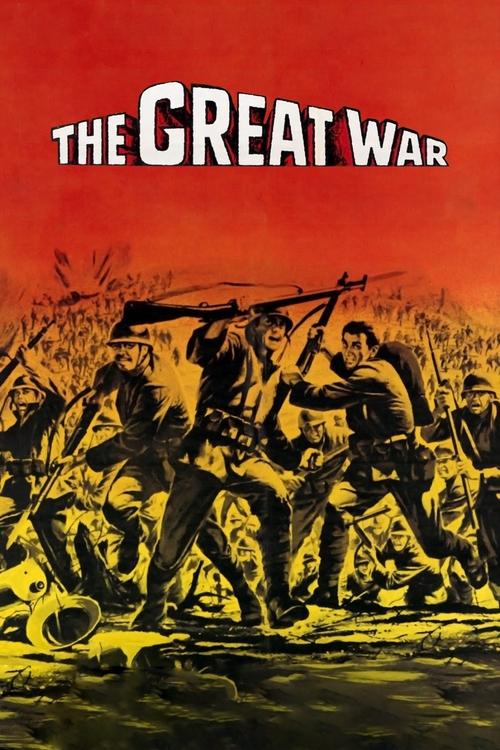
The Great War
1959 · Mario Monicelli
For when you want a war film that's actually funny, or a comedy that actually says something — satisfying on both counts. A great pick when you're in the mood for classic cinema with teeth.
What it's about
Italy, 1916. Oreste, a Roman schemer, and Giovanni, a Milanese braggart, are conscripted into the First World War and dedicate themselves to one mission: avoiding it. The film follows the two shirkers through the mud, boredom, hustles, and absurd bureaucracy of the Italian front, where their talent for self-preservation keeps colliding with a war that doesn't care.
The experience
It plays as a rowdy buddy comedy for long stretches — two con men outwitting the army — then lets the cold, the trenches, and the waste of it all seep in until the laughter has an ache under it. Few films pivot between farce and gravity this gracefully.
Performances
Alberto Sordi and Vittorio Gassman are a magnificent double act — Sordi all wheedling Roman self-interest, Gassman all Lombard bluster — and both let genuine humanity show through the cowardice.
The craft
Monicelli stages the front with startling scale and grime for a comedy, shooting trench life with a realist's eye while the script keeps its vaudeville rhythm. The tonal control — comedy and tragedy sharing single scenes — is the real virtuosity.
Why it matters
Co-winner of the Golden Lion at Venice in 1959, it proved Italian popular comedy could carry serious national reckoning, and stands as a peak of the commedia all'italiana movement.
Snapshot
La Grande Guerra is Mario Monicelli's WWI tragicomedy about two feckless, cowardly conscripts — the Roman schemer Oreste Jacovacci (Alberto Sordi) and the Lombard braggart Giovanni Busacca (Vittorio Gassman) — who drift through the Italian front of 1916–17 dodging duty, small-time hustling, and any hint of heroism, only to stumble into an unwanted martyrdom at the end. Made at the height of the commedia all'italiana wave that Monicelli had helped ignite a year earlier with I soliti ignoti (Big Deal on Madonna Street, 1958), the film shared the Golden Lion at the 1959 Venice Film Festival with Roberto Rossellini's Il generale Della Rovere — an unusually pointed pairing of two very different reckonings with Italian wartime cowardice and courage. It was a landmark for demonstrating that popular Italian comedy could absorb genuine tragedy, national self-criticism, and formal ambition without losing its box-office footing. Its enduring reputation rests on the pairing of Sordi and Gassman, on a screenplay of exceptional density, and on a final reel that remains one of the most admired tonal reversals in postwar Italian cinema.
Industry & production
The film was produced by Dino De Laurentiis, and its scale reflects his ambitions: large exterior battle and trench sequences, extensive location and studio work, crowd scenes, and a running time well over two hours. This was not a chamber comedy but a would-be national epic filtered through the sensibility of the comic. That ambition brought it into immediate conflict with Italy's cultural establishment. Before and around release, the project drew objections from nationalist and veterans' quarters on the grounds that portraying Italian soldiers of the Great War as shirkers and cowards insulted the memory of the fallen — the war being a foundational patriotic myth of the modern Italian state. Accounts of the period consistently describe pressure and controversy surrounding the film's depiction of the army; the precise administrative particulars of that dispute are recounted variously, so I will not assign specific bureaucratic acts to specific offices here. What is certain is that the eventual Golden Lion — awarded by a Venice jury and shared with Rossellini's film — functioned partly as institutional vindication against that pressure.
Commercially and critically, the film was a substantial success and cemented the viability of the emerging commedia all'italiana as a prestige as well as a popular form. I do not have reliable box-office figures to cite and will not invent them, but its standing as one of the notable Italian releases of its year is well established, reinforced by an Academy Award nomination for Best Foreign Language Film.
Technology
La Grande Guerra is a black-and-white film shot on 35mm in the standard sound-era manner of late-1950s Italian production, working in a widescreen frame consistent with the period's move toward broader aspect ratios for larger-scale subjects. The choice of monochrome is meaningful rather than merely economical: by 1959 color was available for prestige productions, and the decision to render the war in gray tonalities aligns the film with the documentary and newsreel imagery through which Italian audiences knew the 1915–18 conflict, and with the neorealist visual inheritance still strong in Italian filmmaking. Post-synchronized sound — the Italian industry's standard practice, in which dialogue was largely dubbed in post-production — governs the soundtrack, a technical condition that shaped performance and the film's dense verbal texture (see Sound). Beyond these general facts, I would be speculating about specific camera or laboratory equipment, and will not.
Technique
Cinematography
The photography works in a deliberately unglamorous register, matching the mud-and-fog world of the trenches with diffuse light, deep gray scales, and compositions that keep the two protagonists small within larger martial spaces. The film alternates between intimate two-shots — the essential grammar of a buddy comedy — and wider views of columns, encampments, and battle that lend the scale its epic weight and, by contrast, sharpen the smallness of Jacovacci and Busacca's schemes. The cinematography is credited to leading practitioners of the Italian industry of the era; I want to be careful not to misattribute the exact operator credits, as the record is reported inconsistently, but the visual approach is unmistakably that of the neorealist-descended school: available-feeling light, textured location surfaces, and a refusal of the burnished heroism that a color, studio-lit war film might have supplied.
Editing
The cutting sustains a difficult tonal balancing act across a long running time, shifting between the loose, digressive rhythm of episodic comedy — sketches of malingering, foraging, romancing, and petty fraud — and the tighter, more suspenseful construction of the battle and capture sequences. The film's most celebrated formal achievement is its management of the final movement, where the editing must pivot from farce to execution without the seam showing; that the tonal reversal lands as devastation rather than whiplash is substantially an achievement of pacing and cutting. The picture was edited within Monicelli's regular working circle; where I am not certain of an individual credit I will not assert one.
Mise-en-scène / staging
Monicelli stages the war as environment rather than spectacle. Trenches, dugouts, billets, and rear-area villages are dressed with a density of period detail that grounds the comedy in physical hardship: cold, wet, lice, bad food, and boredom are as present as combat. The staging repeatedly frames the two leads as intruders on history — bodies that would rather be anywhere else, wedged into a machinery indifferent to them. Crowd choreography in the marching and battle scenes is handled with the confidence of large-scale production, while the comic set-pieces are blocked for the interplay of the two central bodies and voices. The final confrontation is staged with sudden austerity — the clutter of war stripped back to an interrogation, two men, and an Austrian officer — so that the mise-en-scène itself signals the shift from comedy's fullness to tragedy's bareness.
Sound
Like nearly all Italian films of its moment, La Grande Guerra was post-synchronized, and its soundtrack is built for verbal density. Dialect and register are structuring devices: Sordi's Roman inflection and Gassman's northern, blustering delivery encode a whole geography of Italian regional character, and much of the comedy lives in the friction of their speech. The musical score is by Nino Rota, the composer most identified with Fellini but a ubiquitous presence across Italian cinema; his contribution modulates the film's tone, supplying comic lightness and, crucially, restraint at the close, where the film wisely declines to over-score its tragedy. Marching songs, bugle calls, and the ambient noise of the front build the sonic world of military routine punctuated by shelling.
Performance
The film is, above all, a two-hander, and its reputation is inseparable from the Sordi–Gassman pairing. Sordi's Jacovacci is a study in the self-preserving Italian arte di arrangiarsi — evasive, ingratiating, cowardly with a survivor's shrewdness — a variation on the everyman-opportunist Sordi had made his signature. Gassman, cast against his classically trained, matinée-idol grain, plays Busacca as a loudmouthed agitator whose bravado is mostly hot air; the role belongs to the run of comic performances through which Gassman remade himself in this period. The supporting ensemble — including Silvana Mangano as Costantina, the woman who briefly complicates the men's lives, and character actors such as Folco Lulli, Romolo Valli, and Bernard Blier populating the ranks — fills out a credibly weary army. The performances earn the ending: because the two leads have been so thoroughly established as cowards, their final refusal registers as astonishment rather than uplift.
Narrative & dramatic mode
Structurally the film is picaresque, following its two anti-heroes through a series of loosely linked episodes governed less by plot than by their unchanging project of avoiding danger and extracting small advantages. This episodic looseness is the engine of the comedy — it allows the war to be surveyed from below, as a sequence of indignities. The dramatic mode is tragicomic in the fullest sense: the film sustains genuine laughter for most of its length and then, in its final movement, converts the accumulated comic investment into tragedy. Captured by the Austrians and pressed for information about Italian positions, the two men — not out of ideological courage but out of stubbornness, insult, and a last flicker of dignity — refuse to talk, and are executed. The devastation of the ending lies in its irony: they die as heroes, but accidentally, and without their own side ever knowing. The film thus withholds the consolation of legible martyrdom, leaving the audience with courage that is real but unrecognized.
Genre & cycle
La Grande Guerra is a foundational text of commedia all'italiana, the cycle of Italian comedies from roughly the late 1950s through the 1970s that fused popular comic performance with social satire, moral seriousness, and often bitter or tragic endings. Coming directly after Monicelli's I soliti ignoti, it extended the mode's ambitions from the caper to the national-historical epic, proving the form could carry the weight of a founding trauma. As a war film it belongs to the international current of anti-heroic, war-skeptical filmmaking gathering force in the late 1950s, but it is distinctively Italian in routing its critique through comedy and regional character rather than through the tragic register more common elsewhere. Its hybridity — comedy, war, drama at once — is precisely the point of interest: it refuses the generic purity that would let audiences file the war safely under either laughter or lament.
Authorship & method
Monicelli is the presiding intelligence, but the film is a paradigm of the collaborative, writer-driven method of Italian popular cinema. The screenplay was the work of the celebrated writing team of Age & Scarpelli — Agenore Incrocci and Furio Scarpelli — together with Monicelli and Luciano Vincenzoni; Vincenzoni would go on to write for Sergio Leone, and Age & Scarpelli were the defining screenwriters of the commedia all'italiana. The density and structural control of the script — its ability to be very funny for two hours and then turn the knife — is central to the film's achievement and reflects this concentration of writing talent. Nino Rota's score supplies the musical authorship. On the visual and editorial side, Monicelli worked within his established production circle; I am flagging that some individual craft credits are reported inconsistently in the sources available to me, and I will not manufacture precise attributions to fill the gap. Monicelli's own authorial signature is visible in the humane, unsentimental attention to ordinary people under pressure and in the confidence to let comedy carry tragic freight — the hallmark of a director who insisted that Italian comedy was a serious art.
Movement / national cinema
The film sits at the hinge between neorealism and the commercial comedy that partly succeeded it. It inherits neorealism's attention to the poor, the ordinary, and the physically real — the war seen from the bottom of the social ladder — while channeling that attention into a popular entertainment form with stars and structured laughs. Within Italian national cinema it is a key demonstration that the country's most commercially vital genre could also be its most searching, using comedy to interrogate national myths — here, the sanctified memory of the Great War as the crucible of Italian nationhood. Its Golden Lion, shared with Rossellini, symbolically braided the popular-comic and the auteur-realist strands of Italian filmmaking together in a single verdict on wartime cowardice and courage.
Era / period
Released in 1959, the film belongs to the confident, expansive moment of the Italian economic miracle, when the industry could mount large productions and audiences were receptive to films that examined the national past. Its subject — the trauma of 1915–18 — was still within living memory for many viewers and remained ideologically charged, which is precisely why its irreverence provoked resistance. The picture also stands at the threshold of a decade in which Italian cinema would achieve extraordinary international prestige; it is an early signal that Italian popular film, not only the art cinema of Fellini, Antonioni, and Visconti, deserved to be taken seriously.
Themes
The film's governing theme is the gulf between official heroism and lived experience: the war as endured by men who have no stake in its rhetoric. Cowardice is examined without contempt — as a rational response to slaughter — and courage, when it finally comes, is stripped of glory and even of witness. Related themes include the arte di arrangiarsi, the improvisational survivalism of the Italian everyman; class, since it is the poor who fill the trenches; regional and linguistic difference as the texture of national identity; and the absurdity and waste of institutional violence. Above all the film advances an anti-monumental view of history, insisting that the Great War was lived by frightened, ordinary, unheroic people — and that this makes their eventual sacrifice more, not less, moving.
Reception, canon & influence
Critically and popularly, the film was a major success, crowned by the shared Golden Lion at Venice in 1959 and an Academy Award nomination for Best Foreign Language Film, even as it drew nationalist objection for its unflattering portrait of the wartime army. It has since settled firmly into the canon as one of the essential works of commedia all'italiana and one of Monicelli's finest films, routinely cited for its tonal daring and for the Sordi–Gassman partnership.
Looking backward, the film draws on the neorealist tradition of attention to ordinary life, on the international current of anti-war skepticism, and on the deep well of Italian regional comic performance and arte di arrangiarsi archetypes; Monicelli's own I soliti ignoti is its immediate creative precursor in method and ensemble sensibility. Looking forward, it helped establish the template that commedia all'italiana would follow through the 1960s and 1970s — comedy licensed to end in tragedy, popular entertainment as social and historical critique — a model visible across the subsequent work of Monicelli, Dino Risi, and their collaborators, and in the continued willingness of Italian popular cinema to puncture national pieties. Within Monicelli's own career it confirmed his stature as the leading director of the mode. Its most durable legacy is demonstrative: it proved that a war film could be genuinely funny and genuinely devastating at once, and that a nation's founding myths could be honored most truthfully by refusing to flatter them.
A Deleuzian reading
Mud, fog, and gray all the way to the back of the frame.
The full Deleuzian reading of The Great War →
Reception
Attacked sight-unseen by Italian conservatives who called it an insult to the memory of WWI and its fallen, it then won the Golden Lion at Venice 1959 (shared with Rossellini's Il generale Della Rovere) and is now enshrined as one of the summits of commedia all'italiana.
How The Great War was received, from release to now →
How to watch The Great War: what to notice on a first viewing
- Watch how Sordi and Gassman play cowardice without shame. Sordi's Jacovacci is evasive and ingratiating, Gassman's Busacca loud and blustering; both dodge duty and danger with a survivor's shrewdness rather than any guilt. Their cowardice plays as a rational, even likable response to a war that has nothing to offer them.
- Notice the mud, cold, lice, and bad food filling every scene. Monicelli dresses trenches, dugouts, and rear villages with dense period discomfort, so boredom and hardship sit right alongside the combat, not offscreen. The war shown here is mostly waiting, not fighting, and that waiting is the actual subject.
- Listen for how differently Sordi and Gassman's accents sound. Sordi's Roman inflection and Gassman's northern bluster mark two different regions of Italy meeting inside a single army, and much of the comic friction lives in that mismatch. The mismatched voices show a country that hasn't yet become one people, fifty years after it was declared a nation.
- Notice the film moving from one small hustle to the next. The two men drift through loosely linked episodes of dodging, foraging, and romancing, with no single plot pulling them forward, only their unchanging project of staying safe. The war gets surveyed from underneath, one small indignity at a time, instead of from a command tent.
The whole guide to watching The Great War, with the keys for a rewatch →
Influences: the films it descends from and the films it influenced
- I soliti ignoti (1958) — Monicelli's immediate precursor: the same method of assembling a ragtag ensemble of incompetent chancers and casting Gassman against his matinee-idol type as a mumbling bungler, perfecting the arte-di-arrangiarsi deadpan the war film inherits wholesale.
- Guardie e ladri (1951) — Established Monicelli's signature tonal reversal — a broad Totò/Fabrizi farce that curdles into genuine pathos — the mechanism by which The Great War lets two hours of comedy detonate into the execution finale.
- Roma città aperta (1945) — The neorealist template of war-as-environment with post-synchronized regional voices and ordinary people as protagonists, including the comic-then-devastating shift (Fabrizi's joking priest, then the wall) that Monicelli scales to feature length.
- Paisà (1946) — Supplies the picaresque-episodic war structure and documentary dialect texture, with each chapter ending in an anonymous death that punctures heroism rather than crowning it.
- Ladri di biciclette (1948) — Zavattini's neorealist doctrine of anti-monumental attention to the small, unremarkable man shot in monochrome location realism — the ethical eye Monicelli turns on his two shirking conscripts.
- La Grande Illusion (1937) — The foundational anti-monumental war film built on cross-class camaraderie among soldiers and POWs and a flat refusal of battlefield glory, the humanist anti-war grammar Monicelli's WWI reworks in a comic register.
- All Quiet on the Western Front (1930) — Fixed the convention of WWI trench realism told strictly from the common soldier's viewpoint and closing on a single ordinary, meaningless death — the exact rhetorical move of the film's ending.
- Paths of Glory (1957) — Contemporaneous WWI indictment of a high command that executes its own men to save face, sharing the anti-monumental accusation that the enemy of the ordinary soldier is his own generals.
- Tutti a casa (1960) — Directly extends the formula with Sordi as a soldier adrift in the 1943 armistice chaos, sustaining tragicomedy until comedy hardens into a doomed, belatedly heroic death.
- Una vita difficile (1961) — Refracts national history through one ordinary survivor in the commedia all'italiana mode, carrying Sordi from farce to bitter disillusion just as the war film weaponizes its comic lead.
- Il sorpasso (1962) — Perfects the Gassman-led two-hander and the abrupt lethal tonal reversal — hours of buoyant comedy annihilated by a sudden death in the final seconds — the structural gamble The Great War proved viable.
- I compagni (1963) — Monicelli and Age & Scarpelli reprise the monochrome collective ensemble and anti-monumental history, this time a workers' strike, again marching a comic group toward defeat and death.
- L'armata Brancaleone (1966) — Transposes the picaresque-episodic band of arrangiarsi rogues and Gassman's clownish leadership onto a medieval epic, complete with an invented mock-archaic dialect echoing the war film's dialect realism, to deflate national myth.
- C'eravamo tanto amati (1974) — The summa of the mode, again scripted by Age & Scarpelli and led by Gassman, using ordinary lives to carry the weight of national history and loading its comedy with elegiac loss — the tonal double-exposure The Great War pioneered.
- Life Is Beautiful (1997) — A foundational commedia all'italiana that fuses broad comic banter with an abrupt tragic death, the movement's tragicomic recipe Benigni's bifurcated structure inherits directly.
- No Man's Land (2001) — Demonstrates the tragicomic tonal control Tanović prizes — commedia-all'italiana gallows humor among frightened, ordinary infantrymen that pivots without warning into atrocity.
- Divorce Italian Style (1961) — Pioneered deflating a sacrosanct national institution through anti-heroic comedy scored mock-seriously, licensing Germi's use of laughter as a weapon against honor culture and law.
- My Friends (1975) — Monicelli's fusion of broad comic ensemble with an unflinching death that arrives mid-laugh — the tragicomic ambush that My Friends systematizes with its posthumous voiceover and funeral frame.
- Seven Beauties (1975) — Supplies the commedia all'italiana blueprint of the cowardly everyman who survives war by evasion and clowning until catharsis is abruptly denied — the picaresque-tragicomic anti-hero Giannini's Pasqualino descends from.
- Mafioso (1962) — Age & Scarpelli's structural trick of running broad comedy straight into an abrupt, uncushioned death—refusing catharsis at the cut—is exactly the tonal acceleration Mafioso deploys in its final act.
- La marcia su Roma (1962) — An Age & Scarpelli script pairing Gassman and Tognazzi as two hapless recruits to deflate a founding national (fascist) myth — the same writers applying the same anti-monumental two-hander to a different chapter of Italian history.
- Il buono, il brutto, il cattivo (1966) — Co-writer Luciano Vincenzoni carries the film's absurd, anti-monumental view of war directly into the Western's Civil War set-piece, where a pointless battle is staged as senseless waste rather than glory.
- M*A*S*H (1970) — Independently extends the same proof — that a war film can run as sustained ensemble comedy shot through with sudden death — trading Monicelli's tonal reversal for an anarchic overlapping texture but the identical anti-war wager.
Similar films
- Big Deal on Madonna Street (1958) — influence & lineage
- Grand Illusion (1937) — influence & lineage
- All Quiet on the Western Front (1930) — influence & lineage
- The Organizer (1963) — influence & lineage
- We All Loved Each Other So Much (1974) — influence & lineage
- Bicycle Thieves (1948) — influence & lineage
- Il Sorpasso (1962) — influence & lineage
- Rome, Open City (1945) — influence & lineage
All the films related to The Great War →
Watch it with: curated runs of related films
- The Futility of War — A run of films about ordinary men fed into war's machinery — from the trenches to the Casbah to the Warsaw sewers — where the futility and human cost rhyme across a century and a dozen conflicts.