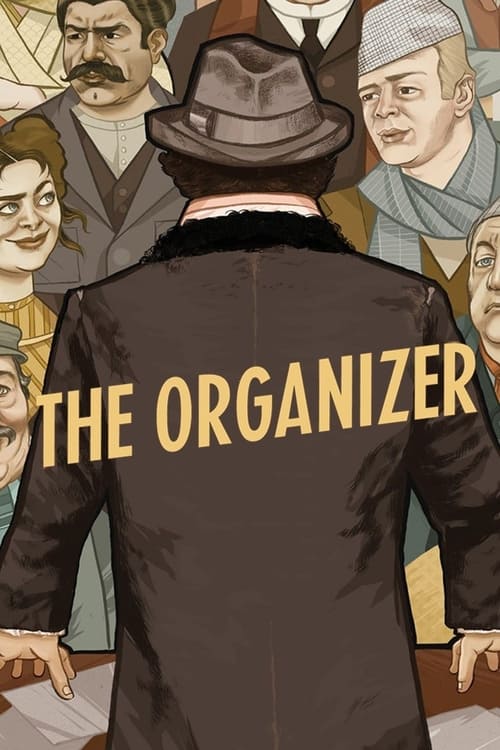
The Organizer
1963 · Mario Monicelli
For when you want a film with conscience — something warm and human that's also genuinely about work, dignity, and what solidarity costs. Comfort food for the first hour, a gut-punch by the last.
What it's about
In a Turin textile mill at the end of the nineteenth century, workers pulling fourteen-hour shifts begin to imagine saying no after a machine takes a colleague's hand. Into their half-formed anger walks a shabby fugitive professor — a socialist agitator who gives their grievance language and strategy — and leads them into one of Italy's first industrial strikes. It follows the whole community: the families, the doubters, the scabs, the man holding it all together.
The experience
Funny and devastating at once — the humor comes from real people being stubborn, hungry, and hopeful, and it never softens what a strike actually costs. You laugh, then the laughter gets heavier, and the ending sits with you.
Performances
Marcello Mastroianni, cast against his matinee-idol image as the rumpled, bespectacled professor, gives one of his finest performances — a man whose idealism is inseparable from his haplessness, funny and heartbreaking in the same breath.
The craft
Monicelli directs an enormous ensemble with total control, balancing comedy and tragedy scene by scene without ever tipping into either sentimentality or lecture. The wintry, smoke-gray recreation of industrial Turin is remarkably vivid — poverty here has texture, cold, and weight.
Why it matters
A high point of the Italian comedy tradition's most serious wing and one of cinema's great films about labor — proof that a comedy could carry the weight of social history without losing its humanity.
Snapshot
The Organizer — released in Italy as I compagni ("The Comrades") — is Mario Monicelli's grave, funny, and quietly devastating account of one of the first industrial strikes in the north of Italy. Set in Turin near the close of the nineteenth century, it follows the workers of a textile mill who, after a colleague loses a hand to a machine at the end of a fourteen-hour shift, drift toward the idea of collective action. Into this half-formed anger arrives Professor Sinigaglia (Marcello Mastroianni), a bedraggled, fugitive socialist agitator who gives their grievance shape, language, and strategy — and whose leadership carries the workers toward both dignity and catastrophe. Made at the height of the commedia all'italiana, the film belongs to that tradition's most serious wing: it uses comedy not to console but to measure the distance between human hope and social reality. It stands today as one of the signal films about labor ever made in Europe, and as evidence that Italian screen comedy in these years was capable of genuine historical tragedy.
Industry & production
The Organizer was produced within the robust Italian studio system of the early 1960s as an international co-production, drawing on Italian, French, and Yugoslav resources — a common financing structure of the period that pooled capital and locations across borders. The producer of record was Franco Cristaldi, whose Vides Cinematografica was among the most important production houses of the era and a repeated collaborator with Monicelli; the film's backing also involved Lux Film, long a pillar of postwar Italian cinema. French participation brought French players into the ensemble (Bernard Blier, François Périer, Annie Girardot), while Yugoslav facilities supplied both studio capacity and, crucially, the wintry exterior locations that stand in for a nineteenth-century Turin the modern city could no longer provide. This tripartite arrangement was typical of how ambitious, mid-budget European films were assembled at the time.
The film arrived on the crest of Monicelli's commercial and critical standing. Following the international success of Big Deal on Madonna Street (I soliti ignoti, 1958) and The Great War (La grande guerra, 1959), Monicelli had proven that comedies built around collective, working-class protagonists could travel. The Organizer extended that model into more openly political territory. Its most durable industry marker is its recognition by the American Academy: the screenplay by Age (Agenore Incrocci), Furio Scarpelli, and Monicelli was nominated for the Academy Award for Best Original Screenplay, a rare Hollywood acknowledgment for a subtitled labor drama and a sign of the international esteem the commedia all'italiana writing teams commanded.
Technology
The film was shot in black and white, a choice that by 1963 was increasingly an aesthetic and economic decision rather than a technical default, since color was well established. Monochrome here is period strategy: it aligns the image with the documentary and photographic record of the industrial nineteenth century and lends the smoke, snow, and grime of the mill town a hard, evidentiary texture. The production used the anamorphic/widescreen practices standard to Italian features of the moment to give the crowd scenes and factory interiors breadth, though the specific lens system is a technical detail I would not want to assert without the credits in front of me. What matters technologically is the deliberate refusal of glossy modern finish: the film's makers used the tools of a mature studio cinema to manufacture the look of an earlier, harsher world.
Technique
Cinematography
The photography is credited to Giuseppe Rotunno, one of the supreme Italian cinematographers of the century (later Fellini's and, in Hollywood, Bob Fosse's collaborator). Rotunno renders Turin as a landscape of soot and cold light — steam rising in unheated dawns, figures muffled against the wet, the factory floor a cavern of dust caught in shafts of window light. The grayscale is weighted toward the low end, so that faces and banners emerge from surrounding murk. Compositions repeatedly set the individual against the mass: the lone organizer framed within, or dwarfed by, ranks of workers. The camera is mobile when it needs to sweep a crowd or track a confrontation, but Rotunno favors a certain gravity of framing that keeps the human figure legible within the collective. The winter exteriors — reportedly shot in Yugoslavia — give the film an authentically punishing physical atmosphere that studio work could not fake.
Editing
The cutting is organized around the film's central formal problem: how to modulate between broad comedy and sudden violence without whiplash or false consolation. Sequences build through accumulation — small comic beats among the workers, the texture of banter and quarrel — before hardening into confrontation. The film's rhythm is patient early, allowing the ensemble to establish itself, then tightens as the strike escalates toward its lethal climax. I do not want to attribute the editing to a named craftsperson without confirming the credit, so I will leave the individual unnamed rather than risk a false attribution; the effect, however, is unmistakably controlled.
Mise-en-scène / staging
Staging is where the film most clearly announces its ambition. Monicelli works with genuinely large groups — the strike, the picket, the confrontation with strikebreakers and troops — and choreographs them so that we read both the collective surge and the individual hesitations within it. Interiors are dense with period detail: the boarding houses, taverns, and cramped domestic spaces where the workers live are furnished to convey poverty as a physical condition, not a backdrop. The factory itself is staged as an organism of noise and repetition, the machines an ever-present pressure. Monicelli's blocking consistently dramatizes the theme: whether bodies cohere into a line of solidarity or scatter in fear.
Sound
The soundscape counts the mill's oppressiveness in its machine noise and the crowd's power in its massed voices — chants, arguments, the roar and hush of a picket line. The score is by Carlo Rustichelli, a prolific and versatile Italian film composer, whose music underlines the film's tonal doubleness, capable of a marching, folk-inflected buoyancy and of elegy. Dialogue, in the Italian production practice of the era, was post-synchronized, and the polyglot ensemble was folded into a unified Italian track — a normal condition of the industry that does not diminish the vividness of the performances.
Performance
Performance is the film's great strength. Marcello Mastroianni, cast against his glamorous star image, plays Sinigaglia as a threadbare, bespectacled, faintly ridiculous intellectual — hungry, shabby, always one step ahead of the police — whose conviction is real but whose leadership is fallible. It is a deliberately unheroic star turn, and one of Mastroianni's finest. Around him, an ensemble of Italian and French players (Renato Salvatori, Folco Lulli, Bernard Salvatori's contemporaries; Bernard Blier, François Périer, Annie Girardot, Gabriella Giorgelli, and the young Raffaella Carrà among them) builds a community rather than a set of types. The acting is calibrated so that the comic and the tragic live in the same bodies — the same men who bicker for laughs are the men who face the soldiers.
Narrative & dramatic mode
The dramatic mode is tragicomedy in its most rigorous sense: the film invites laughter and then makes us account for it. Its structure is that of a collective saga rather than a single hero's arc — the true protagonist is the group of workers, with Sinigaglia as catalyst and conscience rather than sole subject. The narrative follows the classic shape of a strike: grievance, hesitation, organization, escalation, repression, and aftermath. But Monicelli and his writers refuse the uplift such a shape usually promises. The turn from comedy to violence is engineered so that the audience's earlier amusement becomes retrospectively uneasy. The film's most characteristic move is to let a scene be funny until it is suddenly not — and to end not on triumph but on a bleak, unresolved continuity, the sense that this is one early, costly episode in a struggle far from won.
Genre & cycle
The Organizer is a central example of the commedia all'italiana, the cycle of Italian comedies from roughly the late 1950s through the 1970s that fused satire, social observation, and often a bitter or tragic undertow. Within that cycle, it belongs specifically to the strain — inaugurated in Monicelli's own The Great War — in which comedy is turned toward historical trauma and the fate of ordinary Italians caught in large events. It also participates in a broader lineage of the collective-protagonist film (visible earlier in Big Deal on Madonna Street), and in the international tradition of the labor or strike film. Its distinction is to marry the genre comedy's ensemble craftsmanship and gift for character to a subject — the birth of the organized labor movement — usually reserved for solemn social realism.
Authorship & method
The film is the product of one of the most celebrated collaborations in Italian cinema. Mario Monicelli (1915–2010), often called a father of the commedia all'italiana, directs with his characteristic sympathy for the collective and his refusal of sentimentality. The screenplay is by the legendary team of Age (Agenore Incrocci) and Furio Scarpelli together with Monicelli — writers whose work defined the genre's tone across dozens of films and whose command of ensemble structure and tonal shading is on full display here; their script's Oscar nomination is the outward sign of that craft. The cinematography is by Giuseppe Rotunno, whose period monochrome is inseparable from the film's authority. The music is by Carlo Rustichelli. The editor and certain other technical credits I would rather leave unstated than misattribute, the honest limit of what I can confirm here. Monicelli's method throughout is to treat comedy as a means of moral seriousness: he builds a warm, funny world precisely so that its destruction will register as loss.
Movement / national cinema
The film sits at the meeting point of two currents in postwar Italian cinema. It inherits from neorealism a commitment to the working class as a legitimate and central subject, an interest in real social conditions, and a documentary-inflected surface. But it belongs institutionally and stylistically to the commedia all'italiana, the studio-based, star-driven, script-centered genre cinema that partly succeeded neorealism and channeled its social concerns into popular comedy. The Organizer can be read as the commedia all'italiana reaching back to reclaim neorealism's political seriousness within the resources of a mature, professionalized national industry. It is thoroughly a work of Italian national cinema, even as its co-production financing and international cast mark the increasingly transnational European film economy of the 1960s.
Era / period
The film is a period piece, set in the late nineteenth century during the early industrialization of northern Italy, and it takes that setting seriously as history rather than décor. Turin's textile industry, the fourteen-hour working day, the absence of legal protections, the use of soldiers and strikebreakers against workers, and the fragile, improvised beginnings of union organization are the film's real material. Made in 1963, it looks back across the arc of the Italian labor movement from the vantage of a postwar republic in which organized labor was a major force — an implicit dialogue between the origins depicted and the achievements the original audience could take for granted. The film honors the first, costly steps without flattering the present with easy triumphalism.
Themes
At its center is solidarity — its difficulty, its fragility, and its cost. The film dramatizes how self-interested, quarrelsome, frightened individuals become, briefly and imperfectly, a collective, and how easily that collective can fracture under pressure, hunger, and violence. A second theme is the ambivalent relationship between the intellectual and the masses: Sinigaglia brings indispensable clarity and courage, but also abstraction and a capacity to lead people into danger he will not fully share; the film neither idolizes nor dismisses the organizer. Third is the human cost of industrial modernity — bodies broken by machines and hours, poverty as physical fact. And fourth, threaded through all of it, is the film's insistence that sacrifice does not guarantee victory: the strike's aftermath refuses catharsis, offering instead the sober suggestion that dignity may be purchased at a terrible price with no assurance of immediate reward.
Reception, canon & influence
Critically, The Organizer has held a strong reputation as one of Monicelli's major achievements and among the most substantial films the commedia all'italiana produced, admired for its refusal to let comedy soften its politics and for Mastroianni's against-type performance. Its Academy Award nomination for Best Original Screenplay gave it unusual international visibility for a subtitled labor drama, and it has retained a place in retrospectives of Monicelli, of Italian genre cinema, and of the labor film as a form. I would not want to attach specific box-office figures or a full festival record to it without confirmation, so I will characterize its standing rather than quantify it.
Looking backward, the film draws on neorealism's social commitment and on Monicelli's own prior experiments in tragicomedy — above all The Great War, which had already shown that the commedia all'italiana could carry historical catastrophe. It also stands within the wider heritage of the strike narrative in cinema and literature. Looking forward, its influence lies less in a school of direct imitators than in its demonstration of the possible: that a popular comedic idiom could host serious political history without condescension. It remains a touchstone whenever the labor film, the collective-protagonist drama, or the tragicomic mode is discussed, and it is frequently cited as evidence of the artistic seriousness the Italian comedy of the 1960s could reach at its height. Its most lasting legacy may simply be its continued life as a film about work and solidarity that neither preaches nor consoles — a rare and durable achievement.
Reception
A modest performer in its day — even landing an Oscar nomination for its screenplay — it spent decades as 'the other Monicelli' behind Big Deal on Madonna Street, until a 2012 Criterion release rebranded it as the great labor-strike movie and a May Day viewing ritual.
How The Organizer was received, from release to now →
Influences: the films it descends from and the films it influenced
- Strike (1925) — Establishes the strike film's core device that Monicelli inherits — the factory workforce itself as an undivided collective protagonist, staged in mass choreographed movements rather than through individual heroes.
- Metropolis (1927) — Its geometric staging of laborers as an anonymous mass funneling through industrial architecture supplies the 'individual vs mass' compositional grammar Rotunno and Monicelli deploy in the mill and demonstration scenes.
- Modern Times (1936) — Pioneers the tragicomic worker — physical comedy wrung from a body ground down by the assembly line — the exact tonal fusion Monicelli uses so the factory's cruelty lands as both funny and unbearable.
- Bicycle Thieves (1948) — Supplies the neorealist commitment to the working man's concrete economic plight, shot in real streets, that grounds The Organizer's comedy in genuine material hardship rather than farce.
- La Terra Trema (1948) — The direct structural precursor: a community of exploited laborers who organize against their bosses and are defeated, with the collective — not a single fisherman — carried as the protagonist across an ensemble.
- Umberto D. (1952) — Its Zavattinian refusal of consoling resolution models the anti-catharsis Monicelli commits to — ending on loss and continuation rather than triumph or uplift.
- Big Deal on Madonna Street (1958) — Monicelli's own template for the commedia all'italiana ensemble of bumbling proletarians, and for casting a matinee star (Gassman there, Mastroianni here) against type inside a working-class group.
- The Great War (1959) — The proving ground for this exact craft — Age & Scarpelli's script letting broad comedy shoulder historical catastrophe and end on sudden death, the tragicomic method The Organizer refines onto the labor struggle.
- The Working Class Goes to Heaven (1971) — Carries forward the factory-floor labor film and the tragicomic worker portrait, using an against-type star (Volonté) inside the machinery of industrial exploitation as Monicelli did with Mastroianni.
- 1900 (1976) — Scales the collective-protagonist drama of peasant and worker solidarity into a historical epic, retaining the individual-vs-mass staging of organized labor confronting its owners.
- Norma Rae (1979) — Inherits the galvanizing-organizer structure — an outsider or catalyst who transforms scattered workers into a unified body — dramatizing solidarity's birth on the shop floor.
- Matewan (1987) — Directly extends The Organizer's plot engine: an outside organizer arrives in a company town, welds an ensemble mining community into collective action, and solidarity is answered with violent defeat.
- Germinal (1993) — A period coal-strike epic built on the same collective protagonist and anti-cathartic arc — mass crowd choreography of miners whose organized stand ends in dignified defeat rather than victory.
- Bread and Roses (2000) — Transposes the organizer-galvanizes-workers narrative into the contemporary service economy, keeping the ensemble focus and the refusal to let a clean win console the audience.
- Divorce Italian Style (1961) — A parallel commedia all'italiana experiment in weaponizing laughter for social critique, proving the popular comic idiom could carry serious institutional indictment without turning to sermon.
- Il Sorpasso (1962) — Contemporary sibling in the genre's darkest register, engineering the same trap Monicelli sets — a warm, funny world built expressly so a sudden tragic turn registers as devastating anti-catharsis.
- The Battle of Algiers (1966) — Extends the same craft into insurrection: black-and-white near-documentary monochrome and crowd choreography treating a mobilized mass, not a named leader, as the film's true agent.
Similar films
- 1900 (1976) — influence & lineage · same viewing thread
- Bicycle Thieves (1948) — influence & lineage · same viewing thread
- The Working Class Goes to Heaven (1971) — influence & lineage
- Big Deal on Madonna Street (1958) — influence & lineage
- The Great War (1959) — influence & lineage
- The Battle of Algiers (1966) — influence & lineage
- Umberto D. (1952) — influence & lineage · same viewing thread
- Rocco and His Brothers (1960) — same viewing thread
All the films related to The Organizer →
Watch it with: curated runs of related films
- Neorealism and Its Shadows — Watch these together to see Italy from the ground up — the unemployed, the sharecropped, the compromised — from neorealism's birth to its stylish, sinister heirs.