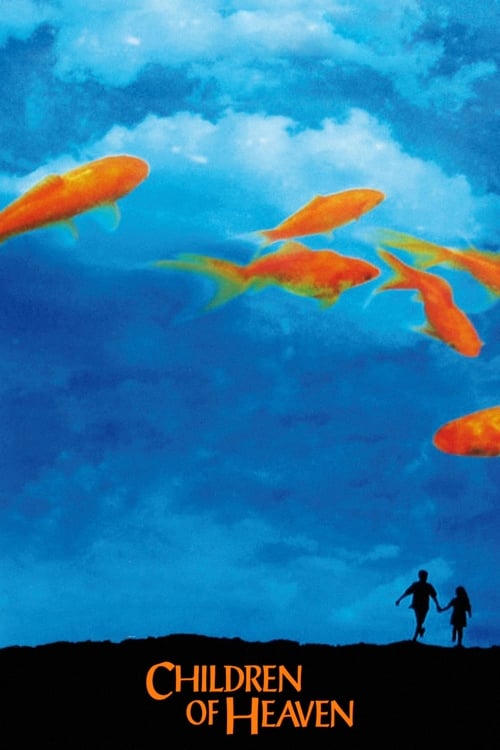
Children of Heaven
1997 · Majid Majidi
For when you want your heart worked on honestly — a film to watch with kids, or when the news has made you cynical and you need proof that small acts of loyalty matter. Pure comfort with real feeling underneath, no darkness required.
What it's about
In a poor neighborhood of Tehran, nine-year-old Ali loses his little sister Zohre's only pair of shoes on the way home from the cobbler. Their parents are buried in debt, so confessing is unthinkable — instead the siblings hatch a secret pact: they'll share Ali's battered sneakers, sprinting through the alleys to swap them between her morning school shift and his afternoon one. What begins as a cover-up becomes a daily race against the clock, and a citywide footrace with an unlikely prize offers Ali one shot at making things right.
The experience
Gentle and suspenseful at once — the stakes are tiny on paper and enormous in a child's eyes, so every late bell and every dash through the alleys tightens your chest. It's tender without ever turning syrupy, and it ends up somewhere quietly overwhelming.
Performances
Amir Farrokh Hashemian as Ali gives one of the great child performances — no cuteness, no mugging, just a boy's whole face flooded with worry, shame, and determination.
The craft
Majidi shoots at kid height, turning alleys, gutters, and schoolyards into a landscape of obstacles and small miracles, and builds real suspense from nothing but running feet and a ticking clock. The filmmaking is simple in the best sense: every shot earns its emotion instead of demanding it.
Why it matters
The first Iranian film nominated for the Best Foreign Language Film Oscar, it opened the door for Iranian cinema with international audiences and remains many viewers' entry point to it.
Snapshot
Children of Heaven (Bacheha-ye Aseman) is a small-scaled domestic drama built on a single lost object and the anxieties it sets in motion. Ali, a boy of perhaps nine, collects his younger sister Zahra's mended shoes from a cobbler and loses them on the way home; unable to admit the loss to parents already crushed by debt and rent, the two children conspire to share Ali's battered sneakers, trading them at midday in the alleys between her morning school shift and his afternoon one. The film's engine is thus almost absurdly modest — a relay race against the clock, conducted by two children keeping a secret — yet Majidi extracts from it a sustained study of poverty, sibling loyalty, shame, and grace. Its most famous movement, a citywide children's footrace in which Ali competes not to win but to place third (the prize for third being a pair of sneakers), and its closing image of his blistered feet lowered into a pond as goldfish circle them, are among the most widely reproduced sequences in 1990s Iranian cinema. The film became the first Iranian feature nominated for the Academy Award for Best Foreign Language Film, and remains, alongside the work of Abbas Kiarostami and Jafar Panahi, one of the international faces of the Iranian New Wave's "child's-eye" strand.
Industry & production
The film was produced under the aegis of the Institute for the Intellectual Development of Children and Young Adults, universally known by its Persian acronym Kanoon — the same state-affiliated cultural body that had incubated Kiarostami's early shorts and much of the New Wave's formative work from the late 1960s onward. Kanoon's remit, nominally the production of films for and about children, gave directors an institutional home and, crucially, a cover of respectability within the constraints of post-revolutionary cultural policy. Majidi came to Children of Heaven as an established figure: a former actor (he had appeared in Mohsen Makhmalbaf's Boycott) turned director, with the features Baduk (1992) and The Father (1996) behind him. Children of Heaven was his third feature and the one that carried him to global visibility.
Production was modest in budget and resources, shot on location in the older, poorer quarters of south Tehran — the warren of narrow alleys, courtyard houses, and open gutters that the film treats as both hardship and beauty. The picture's international breakthrough came through the festival and arthouse-distribution circuit; in the United States it was released by Miramax, which handled it through the awards season that culminated in the 1998 Oscar nomination (the award that year went to Life Is Beautiful). Precise budget and gross figures are not something I can state reliably, and I will not invent them; the salient industrial fact is that a low-cost, state-institution children's film reached the Academy and a substantial Western art-house audience — a trajectory that reshaped expectations for what Iranian cinema could achieve abroad.
Technology
Technologically the film is deliberately unassuming. It was shot photochemically on 35mm color stock, with an aesthetic that privileges available and naturalistic light over elaborate rigs — consistent with the resource-conscious, location-based practice of the Iranian New Wave, where technological restraint was as much an ethic as a budget line. There are no visual effects to speak of, no optical trickery; the film's "special effect" is the physical world — rain, mud, a rolling shoe carried off by a stream, the churn of a footrace. Any claims about specific camera bodies, lenses, or lab processes would be speculation on my part, so I leave them aside. What matters technologically is the choice of transparency: the apparatus is kept invisible so that the material texture of poverty — worn fabric, scuffed leather, wet pavement — reads without mediation.
Technique
Cinematography
The cinematography, credited to Parviz Malekzadeh, works close to the children and close to the ground. Majidi and his cameraman favour a low, child-height eyeline and tight framings on hands and feet — the shoes themselves become recurring compositional subjects, tracked as they are laced, mended, splashed, and lost. The camera is mobile in the film's setpieces of movement: the daily handoff of the sneakers is shot as breathless pursuit, Ali sprinting through alleys while the lens hurries to keep him in frame, and the climactic race is built from kinetic, sometimes hand-following coverage that binds the audience to Ali's mounting panic as he realizes he is winning. Against this urgency the film sets passages of quiet observation — courtyard light, the surface of the goldfish pond — so that the visual rhythm alternates between chase and stillness. Color is used with restraint but pointedly: the deep pinks and reds associated with Zahra's longing, and the closing shot's red goldfish nosing Ali's raw feet, give the naturalism a discreet symbolic charge.
Editing
Editorially the film, cut by Hassan Hassandoost, is organized around parallelism and the pressure of time. The central conceit — one pair of shoes, two schedules — is fundamentally an editing problem, and the film solves it through crosscutting: Zahra's morning class against the waiting Ali, then the frantic exchange, then Ali's late arrival at his own school. The race sequence is the film's editorial showpiece, accelerating its cutting rhythm to dramatize Ali's paradoxical desire to lose (to place third) even as his legs carry him to the front. Elsewhere the cutting is patient, holding on faces and small gestures, trusting the accumulation of domestic detail. The contrast between these registers — patient observation punctuated by tightly cut bursts of movement — is the film's basic dramatic pulse.
Mise-en-scène / staging
Majidi stages the film in real, cramped interiors and the labyrinth of south Tehran streets, and the staging draws its power from spatial constraint. The family's single-room home, the shared courtyard, the alley the children must cross daily — these confined spaces make the children's secret feel physically enclosed, and make the eventual excursion to the affluent northern hills of the city (where father and son go seeking gardening work) register as a genuine geographic and social rupture. The famous contrast of the family's poverty against the walled villas and intercom gates of the wealthy north is achieved almost entirely through location and blocking rather than dialogue. Objects are staged as narrative agents: the shoes, a pencil, a pair of goldfish, a bar of soap in the gutter. Majidi's mise-en-scène consistently loads the ordinary with moral weight.
Sound
The sound design leans on the ambient texture of the city and the domestic sphere — footsteps, water, schoolyard clamor, the mechanical intercom of a rich household — grounding the film in a dense acoustic realism. Against this, the score by Keivan Jahanshahi enters selectively, most memorably to lift the race and the film's moments of tenderness and yearning. Majidi tends to withhold music from the harshest passages and release it at moments of emotional crest, so that the score functions less as continuous accompaniment than as punctuation. The result keeps the film anchored in observed reality while permitting it, at chosen instants, to swell toward the lyrical.
Performance
The film rests almost entirely on its two child leads — Amir Farrokh Hashemian as Ali and Bahare Seddiqi as Zahra — and their performances are the ground of its credibility. Working within the New Wave tradition of non-professional and child performance, Majidi elicits from them a naturalism free of the cloying registers common to child acting: Ali's guilt and grim determination, Zahra's mixture of resentment and complicity, are conveyed through glances, hesitations, and the physical business of the shoe exchange rather than through declaimed emotion. Reza Naji, as the burdened father, anchors the adult world with a weathered dignity; his journey north to seek work is one of the film's few extended movements outside the children's perspective. The performances' refusal of sentimentality is precisely what allows the film's overtly sentimental premise to land as earned rather than manipulative.
Narrative & dramatic mode
Dramatically the film operates in a mode of realist parable. Its narrative is causally tight and almost fable-like in economy: a single inciting loss generates a chain of consequences governed by an implacable clock and a child's determination not to burden his parents. Majidi withholds the melodramatic escalations the premise invites — no villain, no catastrophe, no tidy windfall — and instead builds suspense from the smallest stakes imaginable, a pair of shoes, treated with the gravity of survival. The dramatic irony of the finale, in which Ali's triumph is precisely his defeat (he wins the race and so forfeits the third-place shoes he needed), is the film's structural masterstroke, converting a sports-movie climax into a study of thwarted good intent. The closing image resolves nothing at the plot level — the shoes remain unresolved — yet offers a benediction at the level of feeling, the goldfish gathering around the boy's wounded feet.
Genre & cycle
The film sits at the intersection of family drama and the specifically Iranian cycle of child-centred realism that defined the New Wave's international profile through the 1980s and 1990s. That cycle — Kiarostami's Where Is the Friend's House? (1987) with its own quest built on a schoolchild's misplaced notebook, Panahi's The White Balloon (1995, scripted by Kiarostami) with its single-object, real-time structure, and Majidi's own subsequent The Color of Paradise (1999) and Baran (2001) — shares a set of conventions: a child protagonist on a small but urgent moral errand, a quasi-real-time or tightly compressed timeframe, non-professional casting, location shooting, and the elevation of a trivial object into an ethical crucible. Children of Heaven is among the most fully realized and accessible entries in this cycle, and did much to fix its conventions in the mind of Western audiences.
Authorship & method
Children of Heaven is unmistakably an authored film: Majidi wrote and directed it, and its concerns — poverty, childhood, dignity, and a discreet spiritual undertow drawn from his own religious sensibility — recur across his subsequent work. His method is grounded in location shooting, close collaboration with child performers coaxed toward naturalism, and a patient, observational realism that nonetheless permits moments of frank lyricism and symbolism (the water, the fish, the recurrent reds). Among his key collaborators here: cinematographer Parviz Malekzadeh, whose ground-level, mobile camera realizes the child's-eye vantage; editor Hassan Hassandoost, whose crosscutting and accelerating race montage carry the film's temporal pressure; composer Keivan Jahanshahi, whose selective scoring supplies the emotional crests; and the child actors Hashemian and Seddiqi, whose unaffected playing is inseparable from the direction. Majidi's authorship is best understood as a synthesis of New Wave realist technique with a warmer, more openly emotional and spiritually inflected sensibility than the cooler, more self-reflexive Kiarostami.
Movement / national cinema
The film is a canonical work of the Iranian New Wave in its post-revolutionary phase — the internationally celebrated cinema that flowered in the late 1980s and 1990s under directors including Kiarostami, Makhmalbaf, Panahi, and Majidi. Several features of that movement converge here: the institutional patronage of Kanoon; the turn to children as protagonists, understood partly as a genuine humanist commitment and partly as a way of telling resonant human stories within the tight bounds of state censorship (children's material drew less scrutiny and permitted allegory to travel under cover of innocence); the reliance on non-professionals and real locations; and a realist aesthetic that repeatedly shades into ethical parable. Children of Heaven both exemplifies and popularized this national cinema abroad, and its Oscar nomination marked a threshold in that cinema's global recognition.
Era / period
Made in the mid-1990s, the film belongs to the high-water period of Iranian art cinema's international ascent, roughly bracketed by Where Is the Friend's House? and the early-2000s films of Panahi and Makhmalbaf's circle. This was a moment of relative, if fragile, cultural openness in the Islamic Republic, in which filmmakers negotiated a productive tension between censorship and expression, and in which Western festivals and distributors were increasingly attentive to Iranian work. Children of Heaven is very much a film of that instant: engaged with the lived economics of ordinary Tehran, indifferent to overt political statement, and legible to international audiences as a universal story of childhood while remaining specifically rooted in its place and time.
Themes
The film's governing themes are poverty and its quiet indignities; the loyalty and improvised solidarity of siblings; the acute childhood experience of shame and the wish to shield one's parents from further burden; and the disparity between rich and poor made concrete in the contrast between south Tehran's alleys and the north's walled villas. Running beneath these is a current of grace — a sense, never preached but repeatedly staged, that generosity and endurance carry their own reward even when material circumstances do not relent. The recurrent motifs of water, cleansing, and the goldfish give this current a gently spiritual coloration without tipping into doctrine. Crucially, the film locates virtue not in adults or institutions but in children, whose small acts of self-sacrifice constitute its moral center.
Reception, canon & influence
Critically, the film was widely embraced on its international release as a work of disarming emotional directness and formal control, praised for the authenticity of its child performances and for wringing profound feeling from a premise of almost comic slightness; some observers, then and since, have debated whether its emotional appeals verge on the sentimental, a debate that itself testifies to the film's affective power. Its landmark achievement — the first Academy Award nomination for an Iranian feature in the Best Foreign Language Film category — cemented its historical significance and widened the door for Iranian cinema in Western distribution.
Looking backward, the film's influences lie squarely in the Iranian New Wave that preceded it, above all Kiarostami's Where Is the Friend's House?, whose template of a child on an urgent moral errand built around a lost or misplaced school object Children of Heaven clearly inherits and refines; the broader realist lineage running back through Italian neorealism (the object-quest structure and location realism invite comparison with Bicycle Thieves, a lineage many critics have drawn) also informs its method, though I would frame that as affinity rather than documented direct citation. Looking forward, the film consolidated the international appetite for Iranian child-centred realism and helped set the terms by which such films were received; within Majidi's own career it opened the way to The Color of Paradise and Baran, extending his study of childhood, poverty, and grace. More diffusely, its success contributed to a global visibility for Iranian cinema that shaped the reception of the filmmakers who followed. Claims of specific, traceable influence on individual later directors outside Iran are harder to document with confidence, and I will not overstate them; what can be said securely is that Children of Heaven became one of the definitive, most-taught examples of its national cinema and its cycle, and remains a touchstone for the proposition that the smallest story, precisely told, can carry the largest feeling.
A Deleuzian reading
The shoes change feet in an alley at noon.
The full Deleuzian reading of Children of Heaven →
Reception
A festival darling on arrival — it won the Grand Prix at Montreal 1997 and became a genuine US arthouse hit — and it's only grown warmer with age, now a beloved comfort classic and the film countless people name as their gateway into Iranian cinema.
How Children of Heaven was received, from release to now →
How to watch Children of Heaven: what to notice on a first viewing
- Watch the camera stay low, near a child's height. Malekzadeh frames tight on hands and feet, tracking the shoes themselves as they're laced, mended, and lost, keeping the eyeline at a child's level throughout. You see the world exactly at the scale these two children actually live in.
- Track the cuts between Zahra's class and waiting Ali. Hassandoost crosscuts the morning shift against the sibling waiting to take his shoes back, building the whole daily handoff into a small, breathless relay race. The editing turns one pair of shoes into a genuine deadline.
- Notice how often the film returns to the shoes. The sneakers are laced, splashed, traded at noon, and tracked in close shots across the whole film, an ordinary object carrying real weight. One pair of shoes holds the entire story together without needing to be explained.
- Listen for the score enter only at a few moments. Jahanshahi withholds music from the harshest scenes and releases it only at instants of tenderness or yearning, so the score works like punctuation, not wallpaper. Silence carries most of the film's weight, so the music means more when it lands.
- Watch the children's faces during the shoe exchange. Hashemian and Seddiqi convey guilt, resentment, and complicity through glances and small physical business rather than through any declared, performed emotion. Nothing here is acted at you; you have to read it off their faces.
The whole guide to watching Children of Heaven, with the keys for a rewatch →
Influences: the films it descends from and the films it influenced
- Where Is the Friend's House? (1987) — Supplies the core template Majidi refines: a child on an urgent moral errand structured around a misplaced school object (a classmate's notebook), tracked at the boy's height through a landscape of thresholds and adult indifference.
- Bicycle Thieves (1948) — Establishes the object-quest engine — a lost necessity (bicycle/shoes) that reorganizes a poor family's whole day — shot on location with non-professionals and structured as a walking search through the working-class city.
- Umberto D. (1952) — Models the neorealist patience of wringing large feeling from tiny domestic incident, observing the shame of poverty through small transactions and everyday objects rather than plot.
- The 400 Blows (1959) — Prototypes the child-height eyeline and the film-ending sustained run — a boy fleeing across space toward an unresolved horizon — that Majidi converts into the accelerating race montage.
- Pather Panchali (1955) — Precedes it in rendering childhood poverty through a child's sensory-lyrical vantage, using non-professional siblings and natural light to find beauty (the running, the water imagery) inside deprivation.
- The Runner (1985) — Iranian New Wave forebear built on a poor boy in perpetual physical motion, whose handheld pursuit and running-as-endurance directly anticipate the film's race climax.
- Bashu, the Little Stranger (1989) — Carries the child-as-moral-lens and everyday-endurance humanism to the international breakout Bashu's template prepared, with regionally rooted young non-actors at its center.
- The Color of Paradise (1999) — Majidi extends his own method — non-professional child lead, ground-level handheld camera, and nature imagery (wind, water, touch) charged as spiritual motif — into a study of a blind boy and paternal shame.
- Baran (2001) — Carries forward the objects-as-narrative-agents grammar and grace-through-poverty theme, using labor, secret gifts, and selective scoring to reach the same emotional crests via restraint.
- The Song of Sparrows (2008) — Reprises the accelerating pursuit and the object-driven plot (a lost hearing aid, a scavenged blue door) within observational rural realism and a discreet spiritual undertow.
- Turtles Can Fly (2004) — Applies the Iranian child-realism model — casts of non-professional children, poverty seen at child height — to a Kurdish border setting, inheriting the cycle Children of Heaven helped internationalize.
- Osama (2003) — Afghan feature built on the same non-professional-child, realist-parable template and handheld observation that the Iranian child-cinema wave, popularized abroad by Majidi, set the terms for.
- Capernaum (2018) — Later heir that runs a non-professional child through handheld pursuit across an impoverished city, mining the same shame-and-dignity register at child height that Majidi's cycle codified for festival cinema.
- Like Stars on Earth (2007) — Demonstrates sustained child-eye-level subjectivity carried by a restrained young lead, staging enormous emotional stakes out of a small domestic problem, a tonal template Taare follows closely.
- The President's Cake (2026) — Loss of a mundane possession converted into a race against institutional shame, with the school and its authority figures as the ticking mechanism and a child's fear of exposure doing the work of a thriller's antagonist.
- The White Balloon (1995) — Kiarostami-scripted contemporary that likewise stakes an entire film on a child's near-real-time quest around a small object (a banknote and a goldfish) inside a tightly constrained neighborhood space.
- The Apple (1998) — Contemporaneous Iranian child-centered realism enacting a spare parable with non-professional children playing versions of themselves, staged in confined domestic thresholds.
- Nobody Knows (2004) — Parallel child-centered realism that observes poverty and shame at a child's eyeline through small objects and daily errands, coaxing unaffected performances from real children over patient duration.
- The Kid with a Bike (2011) — Shares the handheld-pursuit grammar built around a determined child in motion and a charged object (the bicycle), staging moral drama through physical chase rather than dialogue.
- Salaam Bombay! (1988) — Shares the child-scale framing and naturalist underplaying that build empathy through a poor child's small material stakes, observed at eye level without melodramatic scoring.
- Radical (2023) — Extracts unforced naturalism from child actors in a poverty setting, staging their agency and resourcefulness without adult sentimentality — the child-ensemble performance mode Radical works in.
Similar films
- Where Is The Friend's House? (1987) — influence & lineage
- Nobody Knows (2004) — influence & lineage
- Capernaum (2018) — influence & lineage
- Turtles Can Fly (2004) — influence & lineage
- The Kid with a Bike (2011) — influence & lineage
- Bicycle Thieves (1948) — influence & lineage
- The Mirror (1997) — shared sensibility
- Shoeshine (1946) — shared sensibility