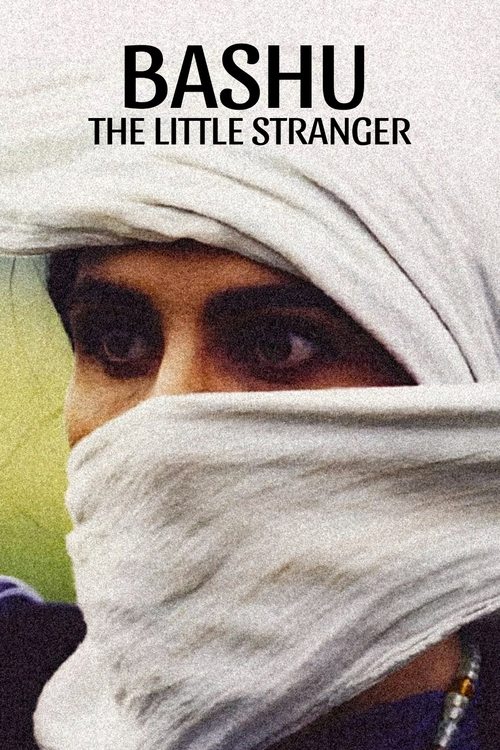
Bashu, the Little Stranger
1989 · Bahram Beyzai
For when you want a film about kindness that isn't sentimental — one that earns your tears honestly. A gentle, humane watch that still asks you to sit with loss and prejudice.
What it's about
During the Iran-Iraq War, a young boy from Iran's bombed-out south loses his home and family, stows away on a truck, and climbs out in the lush rice country of the Caspian north — a place where even the language is foreign to him. He's found by Naii, a farm woman raising two children alone while her husband is away, and the film follows the slow, halting process by which a grieving stranger and a wary household learn to belong to each other, against the suspicion of the whole village.
The experience
Quiet, earthy, and patient, with grief running under every scene — but it keeps opening into moments of startling warmth, humor, and beauty. It works on you gradually, through gestures and shared labor rather than speeches, and by the end it lands with real emotional weight.
Performances
Susan Taslimi is extraordinary as Naii — fierce, funny, and physical, communicating whole arguments through posture and glance across a language barrier, in one of the great maternal performances in Iranian cinema.
The craft
Bahram Beyzai, a playwright and scholar as much as a filmmaker, builds the story around the collision of languages and landscapes — the scorched south versus the emerald north — and lets images of fields, water, and work carry what words can't. The war stays mostly offscreen but haunts the frame, surfacing in the boy's memories with sudden, dreamlike force.
Why it matters
Made in the mid-1980s and held back from release for years, it became one of the most beloved Iranian films ever made — a landmark statement that national identity can stretch across ethnicity, color, and dialect, and a key work in bringing Iranian cinema to world attention.
Snapshot
Bashu, the Little Stranger (Bashu, gharibeye kuchak) is the story of a dark-skinned boy from Iran's war-scorched south who stows away on a truck and surfaces, dazed and mute with grief, in the emerald rice country of the Caspian north — a landscape, culture, and language so alien that the film effectively stages an internal exile within a single nation. Taken in over her own misgivings and her neighbors' hostility by Naii, a farm woman managing land and children while her husband is away, Bashu is slowly folded into a household through gestures, labor, and the shared refuge of a schoolbook Persian that neither his Arabic-inflected southern tongue nor her Gilaki dialect otherwise reaches. Directed by the playwright-scholar-filmmaker Bahram Beyzai and completed in the mid-1980s but withheld from release until 1989, the film is routinely named among the greatest works of Iranian cinema — a 1999 poll of Iranian critics conducted by Film magazine placed it first among Iranian films ever made. It is at once an anti-war lament, a plea for a pluralist idea of Iranian identity, and a portrait of maternal will anchored by one of the most celebrated performances in the national cinema.
Industry & production
The film was produced under the auspices of the Institute for the Intellectual Development of Children and Young Adults (Kanoon), the same state-affiliated cultural body that had nurtured Abbas Kiarostami and Amir Naderi and that treated films about children as a serious artistic and pedagogical project rather than juvenilia. This lineage matters: like much Kanoon work, Bashu uses a child protagonist to say things about the adult world — here, ethnic prejudice and the human cost of war — that were difficult to voice directly in the Islamic Republic's early years.
The production was shot largely on location in Gilan, in the humid rice-paddy country south of the Caspian, using the region's real textures — standing water, forest, thatched structures, livestock. The most consequential fact about the film's industrial life is its suppression: made in roughly 1985–86, it was shelved by the authorities and not released until 1989. The commonly cited reasons include its unusually assertive female lead, its frank staging of anti-Arab and intra-Iranian prejudice, and a humanist anti-war stance that sat awkwardly beside official narratives of the ongoing Iran–Iraq conflict. The precise bureaucratic rationale for the delay is not fully documented in the public record, and accounts differ; what is clear is that the film reached audiences only near the war's end, which gave its plea for unity a valedictory charge. Beyzai's broader career context is relevant here too: a figure repeatedly obstructed by censorship, he would eventually leave Iran for the United States around 2010.
Technology
Bashu was shot on 35mm color stock, and its technical character is inseparable from the decision to work on real locations in a difficult, wet environment rather than in controlled interiors. The film exploits the deep greens, mist, and water-heavy light of the Caspian littoral — a palette that stands in sharp, deliberate contrast to the sun-bleached, dust-and-fire imagery of the south that opens the film and recurs in Bashu's visions. Post-revolutionary production also imposed its own "technology" of constraints: the conventions governing the depiction of women (hijab even within domestic space, restrictions on physical contact) shaped how intimacy between Naii and Bashu, and between Naii and her absent husband, could be rendered — pushing the film toward gesture, proximity, and staging rather than touch. Sound was captured and constructed to foreground the natural world; the film leans on ambient sound design more than on musical scoring.
Technique
Cinematography
The photography, credited to Firooz Malekzadeh, treats the northern landscape as a co-protagonist. The rice fields, forest edges, and waterways are framed with a painterly attention that makes the environment feel both nurturing and encircling — a green enclosure into which the stranger is dropped. The film cuts between two visual registers: the saturated, teeming fecundity of the north and the harsh, apparitional imagery of the war-torn south, which erupts into Bashu's mind as heat, smoke, and the spectral figure of his lost mother. This contrast does much of the film's thematic work before a word is spoken. Compositions frequently isolate Bashu at the edge of the frame or behind foreground obstructions, visualizing his outsider status spatially.
Editing
Beyzai, unusually among directors, was also an accomplished editor and cut his own films, and Bashu bears the marks of an author controlling rhythm and juxtaposition directly. The editing binds the two geographies through associative cutting — present-tense northern reality interrupted by the intrusive flashes of the southern catastrophe — so that trauma is conveyed structurally rather than explained. The pacing is patient, built around the accretion of daily labor and small breakthroughs in understanding, allowing the relationship to develop at the tempo of trust rather than plot.
Mise-en-scène / staging
Beyzai's background as a theater director and a scholar of Iranian ritual performance is legible in the film's staging. Space is organized around thresholds — doorways, field edges, the boundary of the household — that dramatize inclusion and exclusion. The scarecrow that Naii dresses and addresses as a stand-in for her absent husband is a characteristically Beyzai'i object: part folk practice, part theatrical prop, part emblem of the missing patriarch whose absence structures the household. Domestic labor — planting, threshing, chasing birds and boar from the crops — is choreographed almost as ritual, culminating in the collective action that finally makes Bashu one of the family.
Sound
Sound is arguably the film's most radical formal element, because Bashu is fundamentally a film about language and its failures. It is effectively multilingual: Bashu speaks a southern, Arabic-inflected vernacular; Naii and her community speak Gilaki; and standard schoolbook Persian appears as a third, "official" register that becomes the improbable bridge between them. The decision to let characters remain mutually unintelligible for much of the running time — trusting the audience to read gesture, tone, and situation — was bold in a national cinema that prized clarity, and it makes the eventual moment when Bashu recites from his primer a genuine dramatic climax rather than a civics lesson. The score is sparse; the film relies heavily on the sounds of the natural environment. (I have not been able to confirm a definitive composer credit, and would rather flag that gap than assign one.)
Performance
The film is carried by Susan Taslimi as Naii, in what is widely regarded as one of the landmark performances of Iranian cinema. Taslimi — a leading stage and screen actress and a recurring Beyzai collaborator — plays Naii as active, stubborn, physically capable, and morally decisive, a woman who argues with her community, works the land, and chooses the boy against social pressure. In the context of post-revolutionary Iranian film, where women's screen presence was heavily circumscribed, this centering of a forceful female protagonist was itself a statement. Adnan Afravian, as Bashu, gives a largely non-verbal performance built on watchfulness and flinching wariness that gradually thaws; much of the film's emotional information passes through his face and posture rather than dialogue.
Narrative & dramatic mode
The film operates in a realist-humanist register shaded with lyricism and interludes of the visionary. Its dramatic engine is not conventional plot but the slow conversion of a relationship — hostility and incomprehension giving way to recognition and love. Structurally it is a fish-out-of-water story and a foundling narrative, but Beyzai complicates the mode with the recurring apparitions of Bashu's dead mother and the mirage-like eruptions of the south, which lend the naturalism an undercurrent of myth and trauma-memory. A framing device of correspondence — Naii dictating and composing a letter to her distant husband about the strange child she has taken in — externalizes the community's debate over whether Bashu belongs.
Genre & cycle
Nominally a drama and a war film, Bashu belongs more precisely to the strand of Iranian cinema that placed children at the center of morally and politically serious stories — a cycle that runs from Kanoon's productions through Naderi's The Runner (1985) to Kiarostami's and later Majid Majidi's internationally celebrated films. Within that cycle Bashu is distinctive for yoking the child-protagonist form to an explicit meditation on ethnicity and language, and for pairing the child with an unusually dominant adult woman. It can also be read within the small body of Iranian films that address the Iran–Iraq War obliquely, through displacement and aftermath rather than the front line.
Authorship & method
Bashu is a near-total expression of Bahram Beyzai's authorship: he wrote and directed it and, in keeping with his practice, took a controlling hand in its editing. Beyzai (b. 1938) is a genuine polymath — playwright, filmmaker, and one of the foremost scholars of Iranian theatrical tradition, including the passion-play form ta'zieh — and his cinema is saturated with ritual, archetype, and a concern for Iranian myth and identity. That intellectual formation explains the film's interest in language, belonging, and the symbolic household. His key on-screen collaborator was Susan Taslimi, who had already appeared in his Ballad of Tara and Death of Yazdgerd and whose Naii is inseparable from the film's power. The cinematography is credited to Firooz Malekzadeh. Beyzai's authorship also entails a career-long friction with authority: many of his works were delayed, altered, or banned, and Bashu's own shelving is part of that pattern.
Movement / national cinema
The film sits at a hinge in Iranian cinema. Beyzai was a founding figure of the pre-revolutionary Iranian New Wave of the late 1960s and 1970s — the movement of Downpour (his own 1972 debut feature), Mehrjui's The Cow, and Kiarostami's early work — and Bashu carries that movement's literary seriousness and social conscience into the post-revolutionary period. It is thus both a late New Wave work and an early monument of what the West would soon call the Iranian New Cinema, the art-cinema efflorescence that broke internationally in the 1990s. Its regionalism — its insistence on Gilan and the south as specific, non-interchangeable places with their own tongues — is central to its meaning and distinguishes it from a more placeless national imaginary.
Era / period
Made in the mid-1980s during the Iran–Iraq War and released in 1989 as that war concluded, Bashu is a document of its exact moment: a country exhausted by conflict, internally displaced populations, and a young Islamic Republic still defining what national belonging meant. The war is never depicted as spectacle; it is present as loss, as the reason for Bashu's flight, and as the wound the husband carries home. That the film could only reach audiences after years on the shelf makes it also a document of the era's cultural control.
Themes
The film's governing theme is pluralist national identity — the argument that "Iran" is constituted by its differences of ethnicity, color, and language rather than threatened by them. Bashu's darker skin and incomprehensible speech make him a target of prejudice, and the film's moral arc is the community's, and especially Naii's, movement from suspicion to embrace; the schoolbook Persian that finally lets Bashu declare himself a child of Iran is offered as a shared inheritance rather than an erasure of difference. Braided through this are motherhood and the feminine as civilizing, sustaining forces; the trauma of war and displacement, carried in Bashu's visions of his dead mother; the figure of the stranger and the ethics of hospitality; and a recurrent opposition between nature's fertility and war's destruction. The absent-then-wounded husband makes patriarchy's fragility part of the picture, leaving Naii as the true head of the household.
Reception, canon & influence
Critically, Bashu has come to be regarded as a summit of Iranian cinema: the widely cited 1999 Film magazine critics' poll ranked it the best Iranian film ever made, and it is a fixture on subsequent lists of the national canon. Taslimi's Naii is repeatedly singled out as one of the great performances in that cinema. Internationally the film's circulation was slower and more limited than its later reputation would suggest — it traveled the festival and specialist-distribution circuit rather than achieving the immediate global breakout of some 1990s Iranian titles — and I would flag that precise foreign-release and exhibition details are unevenly documented and best verified against distributor records rather than asserted here.
Looking backward, the film draws on Beyzai's own deep engagement with Iranian theatrical and mythic tradition, and it sits within the Kanoon-fostered, child-centered humanism that Naderi's The Runner had recently exemplified; the two films make an instructive pair, both routing large historical forces through a boy's body and endurance. Looking forward, Bashu helped consolidate the template — regional specificity, non-professional or regionally rooted casting, children as moral lenses, an anti-sentimental humanism — that the internationally acclaimed Iranian cinema of the 1990s would carry to the world's festivals, and its insistence on linguistic and ethnic multiplicity remains a touchstone for later Iranian filmmakers addressing the country's internal diversity. As a strong-woman-centered work by a chronically censored master, it also stands as a reference point in discussions of gender and authorship in post-revolutionary Iranian film.
Reception
Shot in the mid-80s during the Iran–Iraq war, it was shelved by censors for its pacifist gaze and only released in 1989 — then in 1999 a poll of Iranian critics and film professionals voted it the best Iranian film ever made.
How Bashu, the Little Stranger was received, from release to now →
Influences: the films it descends from and the films it influenced
- The Runner (1985) — Sets the Kanoon template of routing large historical and economic forces through a non-professional boy's raw physical endurance—running, heat, hunger, labor—the survival-through-the-body method Beyzai adopts for Bashu's flight across the land.
- The Cow (1969) — Founding Iranian New Wave film whose method of grounding drama in one specific rural village with regionally-rooted performers licenses Bashu's fidelity to a particular Gilan setting and its dialect.
- Downpour (1972) — Beyzai's own debut, where he blocks social inclusion and exclusion through doorways, courtyards, and thresholds—the same theatrical staging of who belongs that governs Naii's household in Bashu.
- Ballad of Tara (1979) — Earlier Beyzai–Taslimi collaboration that forged the archetypal land-rooted woman confronting an outsider from another time or place—the prototype Susan Taslimi refines into Naii.
- The House Is Black (1963) — Poetic-documentary precedent for constructing meaning from ambient natural sound and layered voice over landscape instead of conventional scoring, the sonic approach Bashu extends.
- Germany Year Zero (1948) — Neorealist model of the war-orphaned child used as an unsentimental moral lens onto a devastated society, transposed by Beyzai to an Iran–Iraq War refugee boy.
- Death of Yazdgerd (1982) — Extends the same Taslimi-centered apparatus and register-switching between dialects/languages, making the actor's shifting vocal identity the film's structural spine as it is in Yazdgerd.
- The White Balloon (1995) — Extends the non-professional child protagonist navigating an indifferent adult world in near-real-time, the child's-eye realism Bashu helped consolidate for the 1990s festival circuit.
- Children of Heaven (1997) — Carries the child-as-moral-lens and everyday-endurance humanism to the international breakout Bashu's template prepared, with regionally rooted young non-actors at its center.
- Gabbeh (1996) — Foregrounds saturated regional color and landscape as an active expressive protagonist, extending Beyzai's north/south color-contrast cinematography into pure chromatic storytelling.
- A Time for Drunken Horses (2000) — Pushes Bashu's regional specificity and children-carrying-history into the Kurdish borderland with locally-cast non-actors speaking their own dialect on real terrain.
- Blackboards (2000) — Builds its drama on mutual linguistic unintelligibility among Kurdish refugees, directly inheriting Bashu's device of characters who cannot understand one another's tongue.
- Baran (2001) — Continues the Afghan-refugee-in-Iran displacement theme through a near-silent outsider whose otherness must be read entirely through gesture, echoing Bashu's non-verbal foreigner.
- Turtles Can Fly (2004) — Directly inherits the war-displaced-child subject and a multilingual Kurdish/Arabic soundscape, mapping Iran–Iraq border trauma through children exactly as Bashu routed the war through a boy.
- Where Is the Friend's House? (1987) — Contemporary Kanoon film that makes a regionally-cast child's small ethical quest the entire drama, paralleling Bashu's reliance on a non-verbal child lead to carry moral weight.
- The Cyclist (1987) — Companion New-Cinema portrait of the displaced Afghan migrant enduring a hostile locale, extending the same anti-war attention to the uprooted stranger's precarious survival.
Similar films
- Where Is The Friend's House? (1987) — influence & lineage
- Ballad of Tara (1979) — influence & lineage
- Children of Heaven (1997) — influence & lineage
- The Cow (1969) — influence & lineage
- Turtles Can Fly (2004) — influence & lineage
- Le Havre (2011) — shared sensibility
- A Separation (2011) — shared sensibility
- Nobody Knows (2004) — shared sensibility