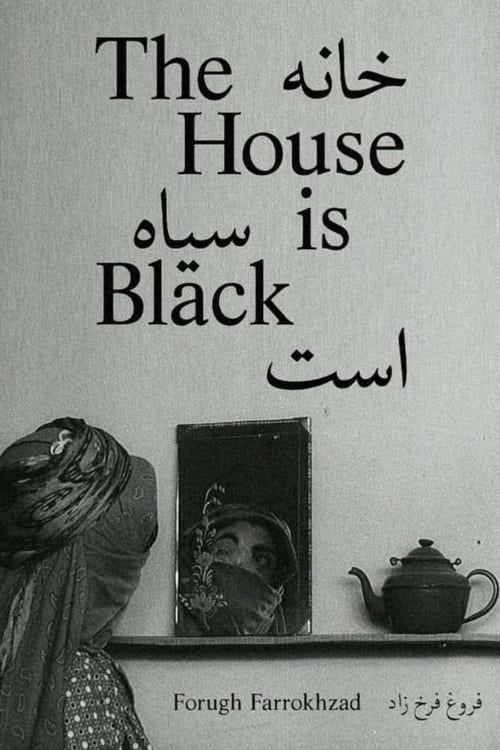
The House Is Black
1963 · Forugh Farrokhzad
For when you have twenty minutes and want them to count — a short film that will move you and stay lodged in your thinking for days. Emotionally serious but deeply humane; challenging subject, compassionate gaze.
What it's about
A twenty-minute documentary shot inside a leper colony in northern Iran, made by Forugh Farrokhzad — then the country's most famous and most scandalous poet, on her only completed film. It shows the daily life of the colony's residents — prayer, school, meals, treatment, play — while two voices carry the soundtrack: one clinical and factual, the other reciting poetry and scripture. The opening states its wager plainly: there is no shortage of ugliness in the world, and closing your eyes to it only makes more.
The experience
Brief but bottomless — tender and unflinching at once, holding faces the world refuses to look at and finding beauty, humor, and dignity in them. It moves like a poem rather than a report, and its final minutes land with a force out of all proportion to its length.
The craft
The editing is the marvel: images of the colony cut in rhythms that feel like verse, braided with a two-voice soundtrack that sets clinical medical fact against lament and praise drawn from scripture and Farrokhzad's own poetry. Made with a small crew from Ebrahim Golestan's film unit, it invents a form — the poetic documentary — nearly from scratch.
Why it matters
Widely regarded as a foundation stone of Iranian cinema, its blend of poetry and observation echoing through generations of filmmakers who came after; Farrokhzad died young, and this remains her only film.
Snapshot
Twenty-odd minutes long, shot in a leper colony in Iranian Azerbaijan, narrated in two voices, and made by a poet who would never complete another film: Khaneh siah ast is among the most consequential short films ever produced, and one of the strangest objects in documentary history. Forugh Farrokhzad — already the most notorious poet in Iran, a woman whose frank erotic lyric had made her a scandal — went to the Behkadeh Raji settlement near Tabriz with a small crew from Ebrahim Golestan's film unit and returned with a film that refuses every available register. It is not an exposé, not a charity appeal, not an ethnography, and not quite a poem, though it borrows the machinery of all four. Its images of disfigurement are unflinching; its soundtrack is a braid of clinical fact, Old Testament lament, Qur'anic praise, and Farrokhzad's own verse. The film's title comes from a sentence a schoolboy writes on a blackboard. Its influence on Iranian cinema is difficult to overstate and impossible to measure precisely, because it arrived years before there was a movement for it to belong to.
Industry & production
The film was produced by Golestan Film Studio (Golestan Film Unit), the Tehran production house founded by the writer, translator and filmmaker Ebrahim Golestan in the late 1950s. Golestan's operation was an anomaly in Iranian film culture: sustained largely by industrial and institutional commissions — most importantly documentary work connected to the oil sector — it was among the best-equipped private studios in the country, with its own camera, laboratory and cutting facilities, and it operated at a technical standard the commercial filmfarsi industry did not attempt. Golestan's own A Fire (Yek Atash, 1961), about a blowout at an Ahvaz oil well, had won international festival recognition and established the unit's credibility abroad.
Farrokhzad had joined the studio around 1958, initially in the cutting room, and learned the craft as an editor before directing. Her apprenticeship was practical rather than academic, though she had spent a period in England around 1959 studying film production. Golestan was her producer, her collaborator, and — this is well documented and inseparable from the film's history — her partner.
The House Is Black was made in connection with the Iranian Society for Assistance to Lepers, the charitable body that supported the Behkadeh Raji settlement; the commission was philanthropic in origin. The shoot is generally reported to have lasted about twelve days, with Farrokhzad living among the residents to earn their trust — an account repeated consistently in the literature, though the granular production record is thin. What is certain is the aftermath: Farrokhzad adopted a boy from the colony, Hossein Mansouri, and raised him.
Where the record is genuinely sparse is on budget, print runs, and domestic exhibition. Iranian short documentary of this period was not a commercial category; the film would have circulated through institutional and festival channels rather than theaters, and no reliable financial figures exist.
Technology
The film was shot on 35mm black-and-white stock, silent — that is, without synchronous sound recording, which was standard practice in Iran at the time and would remain so for decades. Iranian production of the 1960s was almost universally post-dubbed; dialogue, ambience and effects were constructed after the fact in a mixing studio. This is not a footnote but the film's central technical condition. Every voice you hear is a decision, applied to an image it was never physically attached to.
The consequence is that The House Is Black achieved its extraordinary intimacy without the tools that were, at that exact moment, redefining documentary elsewhere. In 1960–63, the lightweight sync rigs of American direct cinema and French cinéma vérité — portable cameras coupled to portable recorders — were producing a new grammar based on the accident of overheard speech. Farrokhzad had no access to that grammar and, on the evidence, no interest in it. Her intimacy is the intimacy of proximity and portraiture, not of eavesdropping. The camera is often hand-held and close, mobile enough to follow people through courtyards and doorways, and the film's ethical charge comes from where it stands rather than what it captures live.
The specific camera and lenses are not documented in the accessible record, and I won't guess. What the images demonstrate is a fast, portable body used in available and difficult light, and a filmmaker with a lab behind her.
Technique
Cinematography
The camerawork is by Soleiman Minasian, an Armenian-Iranian cameraman on the Golestan unit's staff. The film's visual method is fundamentally a method of the frontal portrait. Faces occupy the frame in tight, held compositions, sometimes looking directly into the lens, sometimes turned away; the film alternates these with wider views of the colony's architecture — walls, gates, corridors, courtyards — that establish enclosure without ever diagramming the place. There is no map of the colony, and the viewer never learns its layout, which is deliberate.
The contrast is high and often harsh, exploiting the strong Azerbaijani light and the plain plaster surfaces of the settlement. Bodies are photographed in fragments as well as wholes: hands manipulating objects, feet crossing thresholds, a stump, an eye. Two of the film's most reproduced images are near the beginning — a woman regarding herself in a mirror, and a face seen behind a veil of gauze or shadow. The camera moves when it needs to and holds when it needs to; there is no restlessness, no coverage, no reaching for the picturesque.
Editing
Farrokhzad cut the film herself, and the editing is where her poetic formation is most visible. The organizing principle is not chronology or argument but rhythm, refrain and juxtaposition. Sequences are built by accumulation — a series of faces, a series of hands, a series of feet — and then broken by a sudden return to a wider view or a change of register on the soundtrack. Passages of praise are cut against images of affliction; the litany of thanksgiving lands on bodies with no obvious cause for it.
The film's structure resembles a poem's more than an essay's: an address to the viewer, an expository middle giving medical information (leprosy is treatable; the colony is not a sentence of death), then a long lyric movement through daily life — meals, prayer, medical treatment, a wedding, a funeral, children at play, the schoolroom. It closes on the school, and on a gate shutting. The final movement earns its force entirely through placement.
Mise-en-scène / staging
The film occupies an unresolved space between observation and arrangement, and it is honest about it. Certain sequences are plainly found: people move through their day, indifferent to or aware of the camera in the ordinary way. Others are as plainly composed — the mirror shot, the classroom exchanges, the framing of the wedding. Farrokhzad does not pretend to invisibility, and the film's most quoted moments are the ones where staging is most evident.
The schoolroom is the clearest case. A teacher asks a boy to name beautiful things, and he answers with the moon, the sun, flowers, play; asked to name ugly things, he answers with hand, foot, head — his own body, itemized in the vocabulary of a lesson. Another boy, asked to use the word "house" in a sentence, writes: the house is black. Whether prompted or spontaneous, these are the film's thesis delivered by children who did not write it, and the ethical weight of that arrangement is something the film asks the viewer to sit with rather than resolve.
Sound
The soundtrack is the film's most radical element. Because nothing was recorded live, the entire aural world is constructed, and Farrokhzad builds it out of two narrating voices in counterpoint. A male voice — Golestan's — carries the expository register: the clinical facts of leprosy, its transmission, its treatability, the plain institutional language of a public-health film. A female voice — Farrokhzad's own — carries everything else: passages from the Hebrew Bible (Job, the Psalms, Ecclesiastes and the prophets are the recognizable sources), Qur'anic and devotional material, and her own poetry.
The film opens with a spoken warning that there is no shortage of ugliness in the world and that closing one's eyes to it would only increase it — a contract offered to the audience before a single image of a face. Thereafter the two voices never merge into a single authority. The clinical voice reassures; the poetic voice laments and praises, sometimes in the same breath. There is no conventional musical score; the film's music is liturgical recitation and the ambience of the colony, and no composer is credited in the ordinary sense.
Performance
There are no actors. The residents of Behkadeh Raji appear as themselves, and the register of their appearance ranges from complete unselfconsciousness — men playing a ball game, women combing hair, a bride at her wedding — to direct, sustained address to the lens. That look at the camera is the film's recurring performative event: it converts the spectator from observer to observed. Farrokhzad never asks her subjects to dramatize their condition, and the film contains no interviews in the modern sense. Whatever performance exists is the performance of ordinary life continued in the presence of a camera, and the children are the exception — they are the only participants asked, visibly, to say things.
Narrative & dramatic mode
The film has no protagonist, no arc, no problem posed and solved. Its dramatic mode is liturgical: statement and response, verse and antiphon. What replaces plot is a movement from the general to the particular and back — from the medical abstraction of a disease to the specific face of a woman at a mirror, from a wedding to a funeral, from the collective sound of prayer to a single boy's sentence on a blackboard.
The one structure that behaves like a story is the film's approach to the school, which it holds until late and then uses as a closing figure. The gate that shuts at the end is the nearest thing to a dramatic climax, and it works because nothing before it has resolved. The film ends where a documentary of advocacy would begin.
Genre & cycle
Formally, it belongs to the tradition of the poetic or lyric documentary — the line running from the city symphonies through Jean Vigo, Luis Buñuel's Land Without Bread (1933), Georges Franju's Blood of the Beasts (1949), and Alain Resnais's Night and Fog (1955), where measured narration is set against images that refuse to be measured. The Buñuel and Resnais comparisons are made constantly in the critical literature, and they are illuminating as affinities; direct documented influence is another matter, and I'd flag it as unproven rather than assert it.
Institutionally, it belongs to a much duller genre — the sponsored public-health short, commissioned by a charity to raise awareness and funds. Almost everything interesting about the film is a consequence of a poet being handed that brief and declining to fulfill it in the expected register while still, in fact, fulfilling it: the film does state that leprosy is curable, and it did serve its sponsor.
Authorship & method
Farrokhzad (1934–1967) came to cinema as an established literary figure. Her early collections had made her the most controversial poet of her generation — divorced, separated from her son by the custody law of the time, publicly attacked for the erotic candor of poems like "Sin." She was a leading voice in the modernist she'r-e now movement that followed Nima Yushij's break with classical prosody, and her major collection Another Birth (Tavallodi Digar) appeared in 1964, immediately after the film. The House Is Black is contemporaneous with the strongest phase of her writing, and reads as an extension of it by other means: the same use of catalog and refrain, the same collision of the sacred with the physical.
Her method as a director was, by every available account, one of immersion followed by construction — time spent with the residents, then a long, authorial process in the cutting room where the film's real composition occurred. She edited it herself. That combination of self-taught editing and literary formation explains most of what is distinctive here.
Her key collaborators: Ebrahim Golestan as producer and as the film's second voice, whose studio made it possible and whose own documentary practice set the technical standard; Soleiman Minasian as cinematographer, whose portraiture gives the film its steadiness. There is no credited composer and no separate screenwriter — the text is Farrokhzad's assembly of scripture, tradition and her own lines. The sound crew is poorly documented in English-language sources, and I won't attribute names I can't verify.
It was her only completed film as director. She died in a car accident near Tehran in February 1967, at thirty-two.
Movement / national cinema
The Iranian New Wave is conventionally dated to 1969, with Dariush Mehrjui's The Cow and Masoud Kimiai's Qeysar — the year the art film became visible as a domestic category against the commercial filmfarsi mainstream. The House Is Black precedes that by six years, alongside Golestan's own documentaries, Farrokh Ghaffari's work, and Fereydoun Rahnema's Siavash in Persepolis (1967). These are the New Wave's antecedents rather than its first films, and Farrokhzad's is the one that has traveled furthest.
Its national significance is double. It is a foundational text of Iranian art cinema, and it is the work of one of the first women to direct in Iran — a fact that has shaped its reception since the 1990s and made it a touchstone for a later generation of Iranian women filmmakers. After the 1979 revolution, Farrokhzad's literary work was reportedly subject to restriction for a period; her rehabilitation as a national figure and the film's international canonization happened largely in parallel, from the 1990s onward.
Era / period
1963 is not an incidental date. That January, Mohammad Reza Shah announced the White Revolution — land reform, literacy corps, enfranchisement, the whole modernization program; that June, the protests following Khomeini's arrest were suppressed. The state's self-image was of a country accelerating into the modern world. A film about a leper colony, made that year, is an image of what the acceleration left behind, though Farrokhzad makes no explicit political argument and names no policy. The film's politics are entirely in its attention.
Internationally, 1963 sits at the hinge between the classical sponsored documentary and the sync-sound observational cinema that would displace it. Farrokhzad's film belongs to neither, which is part of why it has aged so well.
Themes
The film's governing subject is the theological problem of the visible body — theodicy staged as montage. Voices praise God for the gifts of the senses over images of people deprived of them. The film does not read as an atheist provocation; the praise is sincere and the residents' faith is treated as real. But the juxtaposition is unrelieved, and Farrokhzad refuses to close it.
Beneath that sits a sustained argument about looking. The opening address makes the viewer complicit before the first face appears: ugliness exists, closing your eyes multiplies it, therefore watch. Vision, mirrors, eyes and blindness recur throughout, and the film's most disturbing images involve people looking back.
Third is the theme of enclosure and inheritance — the colony as a world with its own weddings, funerals, schools and children, and the closing gate that suggests the children will inherit it. Against that, the clinical voice's insistence that the disease is curable becomes an accusation: this enclosure is a social fact, not a medical necessity.
Reception, canon & influence
Contemporary reception was split along a familiar line. Internationally, the film was recognized quickly — it took a top prize at the Oberhausen Short Film Festival in 1963, the leading venue for short and documentary work in Europe. Domestically, it found little audience; reports of Iranian discomfort with the film's subject and its maker's notoriety are consistent across accounts, and there was no meaningful commercial exhibition. For roughly three decades it was more cited than seen, circulating in poor prints.
Its influences run backward into literature more clearly than into cinema. The Hebrew Bible's poetry of lament is the film's most demonstrable source, as is Farrokhzad's own modernist practice and Nima Yushij's break with classical form. Neorealism and the European lyric documentary were part of the general air she and Golestan breathed, and her time in Europe and England exposed her to it, but specific screen-by-screen influence is not documented and shouldn't be manufactured.
Forward, the record is much richer. The most concrete link is Abbas Kiarostami's The Wind Will Carry Us (1999), which takes its title from Farrokhzad's poem and has the poem recited within the film — an explicit act of homage from the filmmaker who did more than anyone to carry her method into world cinema. More broadly, the traits that define the Iranian films that conquered festivals in the 1990s are all present here in 1963: the hybrid of document and arrangement, the use of non-professionals, children as the moral center, the classroom as a site of truth-telling, poetry as structure rather than decoration.
Its canonization since the 1990s has been steady. Mark Cousins featured it in The Story of Film: An Odyssey (2011) and co-directed Life May Be (2014) with Mania Akbari, an extended engagement with Farrokhzad's legacy; the film is now a fixture of documentary syllabi and of critics' lists of the greatest nonfiction films, and it appears regularly in retrospectives of both Iranian cinema and women's filmmaking. I'd avoid citing specific poll rankings from memory.
What secures its position is not its firsts but its unresolved quality. Sixty years on, the film still has not been metabolized: it remains genuinely difficult to say whether it is an act of compassion or an act of exposure, and Farrokhzad appears to have known that, which is why she began by asking permission to show us.
A Deleuzian reading
A woman sits down in front of a mirror and looks at her face.
The full Deleuzian reading of The House Is Black →
Reception
A 22-minute documentary that screened at Oberhausen in the early '60s and then circulated mostly by reputation for decades, it's since been canonized as the seed of the Iranian New Wave — capped by cracking the Sight & Sound critics' top 100 in 2022.
How The House Is Black was received, from release to now →
How to watch The House Is Black: what to notice on a first viewing
- Watch faces held close and often looking straight at you. Minasian shoots the residents in tight frontal portraits, some looking directly into the lens rather than away from it as a documentary subject usually does. You become the one being looked at as much as the one looking.
- Listen for two different voices that never merge into one. A male voice gives clinical medical facts about leprosy while a female voice recites scripture and poetry, and the two never resolve into a single authority. You're left holding two separate registers at once instead of being handed one clear message.
- Notice you never get a map of the colony's layout. Walls, gates, corridors, and courtyards accumulate throughout the film without ever composing into a place you could actually navigate. The space reads as enclosure itself rather than as a location you could point to on a map.
- Watch the woman look at her own face in a mirror. Early in the film a woman sits before a mirror and simply looks at herself for longer than a conventional scene would allow. She isn't performing grief or acceptance for the camera; she is just looking, the way you would.
- Notice faces, then hands, then feet, gathered into short runs. Farrokhzad edits by accumulation, building sequences out of a series of faces or hands or feet before breaking to a wider view. The editing works like a poem's rhythm, not like an argument being made point by point.
The whole guide to watching The House Is Black, with the keys for a rewatch →
Influences: the films it descends from and the films it influenced
- Land Without Bread (1933) — Establishes the seed's core device — a flat, clinical post-dubbed commentary recited over a serial catalog of afflicted bodies (goiter, dwarfism, sores) filmed in frontal medical framing, so that the sponsored-survey voice and the image are permanently out of moral register with each other.
- Song of Ceylon (1934) — The founding case of a commissioned promotional film restructured as a four-movement poem, with its 'Voices of Commerce' section layering trade dispatches and radio chatter against sacred imagery — the exact contrapuntal sound strategy Farrokhzad uses to set clinical leprosy statistics against scripture.
- Aubervilliers (1946) — A municipal public-hygiene commission handed to a poet: Prévert's verse and sung refrain carry the narration while the camera accumulates frontal portraits of slum children, converting a sanitation survey into a lament — the same institutional-brief-into-elegy conversion.
- Le Sang des bêtes (1949) — Runs two narrators in alternation — a woman's lyrical voice and a man's matter-of-fact recitation of tonnage and procedure — over unwatchable bodily material; this male/female, clinical/poetic split is structurally identical to the Golestan–Farrokhzad dual-voice counterpoint.
- Hôtel des Invalides (1952) — A film commissioned by the institution it dismantles, using the docent's neutral guided-tour patter while the camera holds steadily on the faces of disfigured war veterans — the precedent for taking a sponsor's access and turning frontal portraiture of damaged bodies into an indictment.
- Night and Fog (1955) — Hands the commentary to a poet (Jean Cayrol) and has it delivered in a deliberately affectless post-dubbed register against atrocity footage, establishing the literary text — not reportage — as the documentary's authoring voice, which is precisely Farrokhzad's assembly of scripture and her own lines.
- A Fire (1961) — Golestan's own oil-well documentary set the studio's technical and rhetorical standard that made the seed possible: an industrial sponsor's footage cut to a rhythmic montage and overlaid with elevated declamatory Persian narration, the house style Farrokhzad learned in that cutting room and then turned against itself.
- The Runner (1985) — Structures itself on incantatory repetition — a non-professional boy shouting the alphabet at the surf, letters accumulating as refrain — and shoots him in sun-flared high-contrast frontal compositions, carrying Farrokhzad's serial accumulation and liturgical repetition into narrative form.
- Homework (1989) — Is the seed's classroom sequence expanded to feature length: schoolboys delivered one after another to a fixed frontal camera and answering directly into the lens, with the apparatus and the interviewer's coercion left audible — direct address, blackboard authority, and serial portraiture as the entire method.
- Close-Up (1990) — Formalizes the seed's acknowledged arrangement — real people restaging their own documented lives for the camera, with the director's requests audible inside the frame — so the hybrid of document and construction that Farrokhzad handled by asking permission on-screen becomes the film's declared subject.
- The Apple (1998) — Takes a social-welfare case file and has the actual family re-enact its own confinement days after the fact, non-professionals performing themselves inside a partly arranged scenario — the seed's residents-playing-residents ethics reproduced almost point for point.
- The Wind Will Carry Us (1999) — Takes its title from Farrokhzad's poem and has the verse recited aloud inside the film, in a cellar to a girl who never faces the camera — the most explicit transmission of the seed's method, poetry spoken over labor and image rather than illustrated by it.
- Life May Be (2014) — An epistolary two-voice essay built on the seed's dual-narration architecture — alternating male and female commentaries that answer each other antiphonally — and explicitly working through Farrokhzad's legacy, including the terms on which a woman's body may be shown.
- Even Dwarfs Started Small (1971) — Farrokhzad observes a non-professional cast of lepers in black-and-white with extended takes and diegetic sound, treating ritual ceremony through formal distance rather than sympathy — the closest formal precedent for Even Dwarfs' defamiliarization of atypical bodies without the redemptive frame that documentary convention usually imposes.
- Taste of Cherry (1997) — Farrokhzad's 22-minute documentary-poem fused observational handheld footage of a leper colony with lyrical voice-over structure, establishing an Iranian formal tradition of documentary-fiction blur that Kiarostami inherits as his primary mode and extends in the video coda's rupture into a different image-register.
- Where Is The Friend's House? (1987) — Founds the Kanun/Iranian lineage of welding recited Persian poetry to austere documentary image, the poetry-image undertone Kiarostami draws from Sepehri beneath a plain surface.
- The Cow (1969) — Founds the Iranian poetic-realist tradition of black-and-white observational stillness fused with literary voice, the formal ground the New Wave — and The Cow — grew from.
- Bashu, the Little Stranger (1989) — Poetic-documentary precedent for constructing meaning from ambient natural sound and layered voice over landscape instead of conventional scoring, the sonic approach Bashu extends.
- The Brick and the Mirror (1966) — Made by the same Golestan Film Unit with Golestan producing and shaping the cut, it fixed the unit's house method — 35mm available-light observation of an institution, fully post-synchronised sound built from ambient noise and recited text rather than location audio, and elliptical cutting that jumps across time without establishing coverage.
- Brick and Mirror (1965) — The companion work from the same studio and the same collaborators, sharing the literary-declamatory delivery and, in its orphanage sequence, the seed's serial accumulation of institutional faces — rows of abandoned children held in frontal shot after frontal shot until the count itself becomes the argument.
- Titicut Follies (1967) — The same ethical knife-edge worked with the opposite tool: permitted access to a closed institution, handheld proximity to inmates' bodies, and a performed recital bracketing the film — but with the poetic voice stripped out entirely, which isolates exactly what Farrokhzad's narration was doing to the images.
- The Color of Pomegranates (1969) — Builds the whole film from acknowledged frontal arrangements played to a flat plane, chaptered like a manuscript and carried by post-dubbed recitation of a poet's verse — poetry as the load-bearing structure rather than accompaniment, the seed's antiphonal principle extended to feature length.
- Land of Silence and Darkness (1971) — Films deaf-blind subjects through hands and body fragments in close handheld proximity, and puts authored poetic lines into the mouths of the non-professionals speaking their own condition — the same fusion of documentary subject and literary voice, with the same unresolved question of who is speaking.
- Sans Soleil (1983) — Splits authorship of the voice — a woman reads a man's letters over montage she did not shoot — inverting the seed's Farrokhzad/Golestan division of narration, and treats poetic commentary as the editing logic that assembles otherwise unrelated footage.
- Through the Olive Trees (1995) — Poetic Iranian documentary whose blend of observed reality and lyrical framing prefigures the withheld, contemplative long-shot ethic of Kiarostami's landscape.
Similar films
- The Color of Pomegranates (1969) — influence & lineage
- Close-Up (1990) — influence & lineage
- Titicut Follies (1967) — influence & lineage · often watched together
- The Mirror (1997) — often watched together
- Green Border (2023) — often watched together
- The Cow (1969) — shared sensibility
- Where Is The Friend's House? (1987) — shared sensibility
- Still Life (1974) — shared sensibility
All the films related to The House Is Black →
Watch it with: curated runs of related films
- Landmarks of the Avant-Garde — Watch these together when you want cinema stripped to its essentials — a life, a corpse, a color, a single camera move — each one testing what film can be without story.