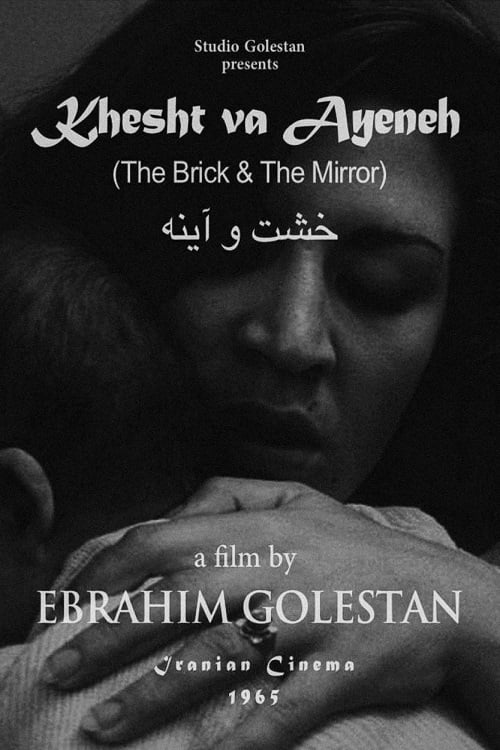
The Brick and the Mirror
1966 · Ebrahim Golestan
For when you're in the mood for a serious, grown-up drama about choosing — or refusing — responsibility, and you'd rather sit with a dilemma than watch it get solved. A challenging, rewarding late-night film.
What it's about
A Tehran cab driver named Hashem gives a young woman a ride one night and finds she has left an infant in his back seat. Over the following night and day he tries to hand the baby off to someone — anyone — while his girlfriend Taji begins to imagine keeping the child, and the disagreement quietly becomes a referendum on both their lives. The search leads through cafés at closing time, police stations, courtyards, and waiting rooms across a nocturnal, indifferent city.
The experience
Talky, brooding, and steeped in nighttime atmosphere — long conversations that circle fear, responsibility, and pride, punctuated by stretches of remarkable urban wandering. It's slow-burning and melancholy, with a moral pressure that tightens the longer no one will take the child.
The craft
Ebrahim Golestan, running one of the only independent production houses in pre-revolutionary Iran, shot Tehran's nights in stark, striking black and white, favoring real locations, thresholds, and institutional rooms that make the city itself a character. The film was built as a deliberate rebuke to the era's commercial melodramas, and its long dialogue scenes have a literary density that was radical for its time and place.
Why it matters
Now recognized as a foundational work of Iranian art cinema — a precursor whose seriousness and street-level realism opened the road for the Iranian New Wave that followed. Its rediscovery has steadily raised its standing among the great city films of the 1960s.
Snapshot
Khesht o Ayeneh — usually rendered in English as The Brick and the Mirror or Brick and Mirror — is a nocturnal, talk-driven feature about a Tehran cab driver who discovers an abandoned infant in his back seat and spends a night and a day trying to hand the problem to someone else. It is a film almost entirely composed of thresholds: doorways, courtyards, corridors, waiting rooms, a café at closing time, a police station where nobody has authority, an orphanage where the institutional answer arrives with a finality nobody in the film wanted. Golestan, a writer, translator and documentary producer whose Golestan Film Unit was one of the very few independent production houses in pre-revolutionary Iran, made it as a deliberate alternative to the film-farsi commercial product that dominated Iranian screens — melodramas, song-and-dance vehicles, tough-guy pictures.
Its historical importance is disproportionate to its visibility. Made in 1965 and released in 1966, it stands with Forough Farrokhzad's The House Is Black (1963) — a Golestan Film Unit production — and Fereydoun Rahnema's Siavash in Persepolis (1967) as the small cluster of works that precede and prepare the Iranian New Wave conventionally dated to 1969, the year of Dariush Mehrjui's The Cow and Masoud Kimiai's Qeysar. Where The Cow would find its subject in the village, The Brick and the Mirror is emphatically urban: a portrait of Tehran at night as a city of unfinished construction, blocked institutions and people who talk past one another. It was not a commercial success and its reputation was for decades sustained by scholarship, festival retrospectives and memory rather than by circulating prints; a restoration in the 2010s and subsequent programming (including at international festivals and archives) has brought it back into view for audiences who had only read about it.
The title is generally understood as drawing on a line attributed to the Persian poetic tradition — the idea that what the young see in a mirror, the old see in a brick — an image of vision and foresight that the film turns bitterly ironic: nobody here sees far enough. Attribution and precise wording of the source vary across accounts, and the film itself does not spell it out.
Industry & production
Iranian film production in the mid-1960s was dominated by a studio-adjacent commercial sector churning out low-budget genre entertainments for domestic exhibition, with foreign imports taking a large share of screens. There was no infrastructure for auteur cinema, no meaningful state art-film subsidy of the kind that would arrive later through the Ministry of Culture and Art and, crucially, through Kanoon (the Institute for the Intellectual Development of Children and Young Adults) at the end of the decade. What existed instead was industrial and institutional sponsorship — above all, oil.
Golestan's route to feature filmmaking ran through the documentary. He founded the Golestan Film Unit (Sazman-e Film-e Golestan) in the late 1950s, and it survived on commissioned industrial documentaries, most consequentially for the consortium operating Iran's oil industry. Those commissions financed equipment, a small permanent staff, and — critically — a working culture in which unusually literate people made films: Golestan himself was a translator of Hemingway and Faulkner and a writer of fiction; Farrokhzad, one of the major Persian poets of the century, worked in the unit as an editor and then directed The House Is Black under its banner. The Brick and the Mirror is a feature that comes out of a documentary shop, and the fact shows in every choice it makes.
Practically, this meant independence of an almost unrepeatable kind for the period: Golestan produced his own film, on his own terms, with equipment and personnel already on hand, and without needing to satisfy a distributor's expectations of stars, songs or fights. It also meant marginality. The film ran into the ordinary difficulties of a work with no genre handle for exhibitors and no audience appetite prepared for it, and it did not perform. Specific figures for budget, screen counts or receipts are not reliably documented in the accessible record, and I will not invent them.
The production's other well-known circumstance is personal and creative: Golestan and Farrokhzad's close association — professional and, by wide report, romantic — shaped the unit's output through the mid-1960s. Farrokhzad appears in the film in a small role, one of the few moving images of her that exist; she died in a car accident in February 1967, months after the film's release.
Technology
The film is 35mm black-and-white, in the Academy-adjacent ratio standard for non-widescreen Iranian production of the period, and it was shot with the resources of a documentary unit rather than a fiction studio. That inheritance is the technological story.
Two constraints define its look. The first is low-light shooting. A large fraction of the film takes place at night or in interiors lit by practical-seeming sources, and it embraces the grain, the crushed blacks and the pools of light that fast black-and-white stock under available or minimally augmented light produced in 1965. Streets are not filled in with the even, sourceless studio glow of contemporaneous commercial pictures; darkness is allowed to be dark, and figures repeatedly emerge from and dissolve into it. Tehran in this film is legible mostly as headlights, doorway spill, bare bulbs and the silhouettes of construction sites.
The second is sound. Iranian production of the era worked overwhelmingly in post-synchronised dubbing — dialogue replaced in a studio, a practice that in commercial cinema produced the characteristic flat, over-articulated, acoustically placeless voice track of film-farsi. The Brick and the Mirror is unusually attentive here: whatever the mix of location and post-recorded material, the film's soundtrack is built to hold long stretches of continuous talk with the rhythm and overlap of real speech, and to let ambient noise — traffic, radio, the din of a public room — carry dramatic weight rather than sit under dialogue as texture. For a 1960s Iranian film, the deliberateness of the sound design is one of its most distinguishing technical features.
Technique
Cinematography
The camera work is patient, observational and strongly architectural. Golestan and his camera team favour extended takes in which the frame holds still or moves minimally while action arranges and rearranges itself inside it, and they favour compositions organized by the built environment: door frames within the frame, corridors receding, staircases, courtyard walls, the vertical bars of scaffolding and window grilles. People are constantly seen through something, or boxed by something. The recurrent motif of a figure standing in an aperture — visible but not yet committed to entering — is the film's visual thesis about its characters, who are all on the threshold of a decision they will not make.
Night exteriors of Tehran give the film a documentary charge. The city is caught mid-transformation, half-built, and the film photographs construction and rubble with the same interest it gives faces. Interiors, by contrast, are dense and enclosed: the café, the apartment, the police station and the orphanage are shot as boxes with limited exits. Depth is used to keep secondary figures alive at the back of the frame — bystanders, other petitioners, other children — so that the protagonists' private crisis is continually relativised by the presence of everyone else's.
Editing
The film's most conspicuous formal decision is duration. Golestan builds long, uninterrupted scenes — the café sequence in particular is a set piece of accumulating talk — and refuses to cut them down to their plot function. Whole passages of the film consist of people theorizing, joking, moralizing and evading around the subject of the baby without advancing the story. That is the design: the editing rhythm enacts a society that generates commentary instead of action.
Against this, the cutting within scenes is unhurried and analytic rather than emphatic; there is little of the punched-in reaction shot or the melodramatic insert. Transitions between the night sequence and the following day are handled with an ellipsis that leaves the emotional pivot — the couple's shifting positions on keeping the child — to be inferred from behavior rather than dramatized. The consequence is a film that many first-time viewers find slow and that, on reflection, is precisely calibrated: its longueurs are the argument.
Mise-en-scène / staging
Staging is built on thresholds and on groups. Golestan repeatedly composes scenes as a single protagonist confronting an assembly — the café crowd, the police station's night staff, the orphanage's ranks of cots — and the assembly's collective inertia is the antagonist. Blocking within these scenes tends to be lateral and shallow-focused on the speaker while keeping the listeners' bodies in frame, so that we register indifference as a physical fact.
The apartment scenes between Hashem and Taji are staged with a claustrophobic domestic geography: a small set of rooms crossed and re-crossed, the child a fixed point around which the two orbit at different radii. The film's final movement into the orphanage is its most extreme staging gesture, replacing individual psychology with an environment — rows, corridors, the massed presence of children — that answers the film's question without anyone having to speak.
Sound
Talk is the film's primary material, and it is treated as such: overlapping, digressive, rhetorical, often very funny, and finally useless. The café sequence is essentially a symphony of opinions about a baby nobody will take. Radio and ambient sound are used to place characters in a public sphere of noise. Silence, when it comes — particularly in the film's closing movement — lands with real force precisely because the preceding two hours have been so verbally saturated.
The film is not scored in the manner of the commercial cinema of its moment, where songs and continuous underscore were structural. Music here is sparing and largely diegetic or environmental, which is itself a polemical choice against film-farsi convention.
Performance
Golestan draws non-declamatory, behaviorally specific work from his cast, at a distance from the broad playing typical of Iranian commercial features of the day. Zackaria Hashemi's Hashem is closed, evasive, physically restless — a man whose refusals are conveyed through where he puts his body rather than through speeches. Taji Ahmadi's Taji is the film's moral center and its most difficult performance, required to shift from reluctance to attachment to a grief that has no available expression; her final scenes carry the film. Around them, a large gallery of supporting players deliver the film's rhetorical set pieces with the loose, interruptive timing of people talking rather than acting.
Farrokhzad's brief appearance is of documentary as much as dramatic interest.
Narrative & dramatic mode
The structure is a night-and-a-day: an inciting accident (the woman, the ride, the abandoned infant), a nocturnal search for someone to take responsibility, a domestic morning in which a different possibility briefly opens, and an institutional resolution that closes it. It is a chase narrative in which nothing is chased — the driver's quest is not to find but to be rid of.
Golestan's dramatic mode is closer to the modernist European art cinema of the early 1960s than to any Iranian precedent: dedramatised, conversation-based, allergic to plot mechanics, willing to let scenes exceed their narrative necessity. The baby is the classic MacGuffin inverted into a moral object — it does nothing, wants nothing, and functions as an instrument for exposing everyone who encounters it.
Two registers coexist uneasily and productively. One is social-realist observation: the police station and orphanage sequences have the granularity of the documentary tradition Golestan came from. The other is allegory: the abandoned child, the couple who cannot become a family, the city under construction, the institutions that absorb people without helping them, all read as a diagnosis of a society in the middle of the Shah's modernization program — enriched, rebuilt, and morally unhoused. Golestan's own literary sensibility pushes the dialogue toward the aphoristic; several exchanges are essentially essays.
Genre & cycle
Formally the film sits inside 1960s international art cinema; commercially it belonged to no cycle at all, which was its problem. Iranian exhibition in 1966 was organized around film-farsi — melodrama, the luti/tough-guy picture, the song vehicle — and The Brick and the Mirror offers none of the pleasures those genres promised. It has a taxi driver but no action, a couple but no romance plot, a foundling but no melodramatic revelation of parentage, a city but no criminal underworld.
Retrospectively it can be filed with the small international genre of the abandoned-child film — from The Kid forward — but it withholds every consolation that genre normally delivers. It also anticipates a durable Iranian mode: the film in which an ordinary person must navigate an unyielding bureaucracy over a small object of dispute, a shape that recurs across Iranian cinema in later decades from Kanoon-era children's films through the moral-procedural dramas of the 1990s and 2000s.
Authorship & method
Golestan (born 1922, died 2023) is the rare case of a filmmaker whose authorship is genuinely literary. He was a novelist and short-story writer, a translator into Persian of Hemingway, Faulkner and Twain, a photographer, and a producer before he was a director. His method — a self-financed unit, documentary commissions subsidizing personal work, control of script, production and final cut — was an anomaly in Iranian film culture and gave him a freedom that the New Wave directors who followed generally lacked.
He wrote the screenplay himself, and the film's authorial signature is in the writing: talk as symptom, irony as structure, the refusal to resolve. His documentary practice supplies the other half — the willingness to observe institutions at length, the interest in the physical fabric of a modernizing Iran, the tolerance for scenes that end without a point.
Key collaborators are less exhaustively documented in accessible English-language sources than the director, and I will not fabricate credits. What is well established: Golestan produced through the Golestan Film Unit, whose personnel had been formed on oil-industry documentaries; Forough Farrokhzad was central to the unit's creative life, worked as an editor within it, directed The House Is Black under its auspices, and appears briefly in this film; Zackaria Hashemi (himself later a filmmaker and writer) plays Hashem; Taji Ahmadi plays Taji; Pari Saberi appears among the supporting cast. Cinematography, editing and music credits circulate in filmographies but with enough variation across sources that I would rather flag the thinness of the record than assert a name with false confidence.
Movement / national cinema
The film's position is foundational and slightly awkward: it is a precursor to a movement it is not quite part of. The Iranian New Wave (mowj-e now) is conventionally dated to 1969, when The Cow and Qeysar demonstrated that a different kind of Iranian film could exist and, in The Cow's case, that it could travel internationally. The Brick and the Mirror precedes that by three years, alongside The House Is Black (1963) and Siavash in Persepolis (1967), and shares with them the defining traits — literary authorship, documentary discipline, rejection of film-farsi, allegorical density — without having had the institutional or critical infrastructure to convert them into a movement at the time.
Its relation to Persian literary modernism matters as much as its relation to film. Golestan and Farrokhzad belonged to a generation of writers remaking Persian prose and poetry, and the film's ambitions — psychological interiority, social diagnosis, symbolic economy — come out of that milieu rather than out of cinema. This is the key to why Iranian art cinema developed as it did: its first practitioners were poets, novelists and translators.
Era / period
1966 in Iran sits in the middle of the White Revolution, the Shah's program of land reform, industrialization and social modernization launched in 1963, and in the middle of an oil-funded construction boom that was physically rebuilding Tehran. The film registers all of this without stating any of it: the half-built city, the money that pays for cabs and cafés, the proliferating institutions that don't work, the rural migrants arriving into an urban system with no place for them. The abandoned infant is the modernization program's remainder.
Internationally, 1966 is the high plateau of modernist art cinema — Antonioni, Bresson, the post-Rocco Italians, the Czech and Polish new waves, Satyajit Ray's urban turn. The Brick and the Mirror is legible within that field, and its long café sequence in particular belongs to the same moment as European cinema's fascination with talk as a form of paralysis.
Censorship under the Pahlavi state shaped what could be said. The film's method — allegory, indirection, diagnosis by omission — is partly an aesthetic preference and partly the technique of a filmmaker who could not make a direct political statement. That indirection became one of the deep habits of Iranian cinema across both the Pahlavi and post-revolutionary periods.
Reception, canon & influence
Contemporary reception was limited and unenthusiastic. The film found little domestic audience, and the critical apparatus that might have championed it barely existed in Iran in 1966. It has no significant record of first-run international festival success comparable to what The Cow achieved in 1971 at Venice. Golestan's own subsequent feature output was small — Secrets of the Treasure of the Jinn Valley (1974) is the other major title — and he left Iran for Britain in the mid-1970s, remaining there until his death in 2023, which further removed the film from circulation and from the narratives that Iranian cinema told about itself after 1979.
Its canonization is retrospective and scholarly. Historians of Iranian cinema — the standard reference works and survey histories that established the field in English from the 1980s onward — consistently identify it as a decisive precursor to the New Wave, and it appears in most serious accounts of the period. Renewed access via restoration in the 2010s, with programming at festivals and archives and appearances in retrospectives of Iranian cinema, produced a second wave of critical writing that has generally confirmed the scholarly verdict: a major film, more radical formally than its reputation as a "precursor" suggests, and considerably stranger than the plot summary implies.
Backward — what shaped it. The Golestan Film Unit's own documentary practice is the immediate source: the observational patience, the interest in institutions and infrastructure, the willingness to film a process rather than an event. Persian literary modernism supplies the film's irony and its sense of a society that talks itself into paralysis; Golestan's work as a translator of American fiction — Hemingway's compression, Faulkner's density — is visible in the dialogue's construction. Italian neorealism's premise (ordinary people, streets, an unsolvable small problem) is present, though the film's dedramatised, talk-saturated method belongs to the modernist cinema that followed neorealism rather than to neorealism itself. The House Is Black, produced by the same unit three years earlier, established the possibility of a film that was simultaneously poetry, document and moral argument.
Forward — what it shaped. The influence runs through the culture more than through direct citation. The film established, for Iranian cinema, a set of options that later became defining: the ordinary protagonist versus the unyielding institution; the small object of dispute as an ethical stress test; the long conversational scene as social diagnosis; the child as the figure through whom adult failure is measured; the refusal of melodramatic resolution. Those options are visible across the New Wave that followed and, later, across the internationally celebrated Iranian cinema of the 1980s–2000s — the Kanoon-formed generation, the moral-procedural dramas built around a single unresolvable problem, the urban films that use bureaucracy as antagonist. Naming any single later filmmaker as a direct inheritor risks a tidiness the record does not support; what is defensible is that The Brick and the Mirror is where several of Iranian cinema's most durable habits first appear together, in a film almost nobody saw at the time.
Its standing today is that of a rediscovered origin point — the film that proves the Iranian New Wave had a prehistory, and that the prehistory was, formally, more daring than what came after.
A Deleuzian reading
A man turns around in his cab and there is a baby on the back seat.
The full Deleuzian reading of The Brick and the Mirror →
Reception
Barely seen and coolly received in 1960s Iran — too long, too bleak, too talky for a market built on pop melodrama — it's now routinely called a founding stone of the Iranian New Wave, with 2010s restorations and screenings (Rotterdam, MoMA) finally giving it a global audience.
How The Brick and the Mirror was received, from release to now →
How to watch The Brick and the Mirror: what to notice on a first viewing
- Notice how often characters stand framed in a doorway. Golestan keeps composing shots through door frames, corridors, and window grilles, so people are constantly seen through or boxed by something rather than standing free in open space. The framing turns hesitation itself into the subject: a person visible in a threshold, not yet committed to crossing it.
- Watch how long Golestan holds a scene of people just talking. The café sequence and other long passages run far past their plot function, letting opinions, jokes, and moralizing accumulate without advancing the story at all. The refusal to cut is the argument: a society that talks instead of acting, shown by literally not acting.
- Listen for how much of the soundtrack is simply people arguing. The film treats talk as its main material, overlapping, digressive, often funny, and lets traffic and radio noise intrude on it rather than sitting underneath as polite texture. You realize the noise of opinions is doing the work a musical score would do in another film.
- Notice other people still visible at the back of the frame. Golestan keeps bystanders, other petitioners, and other children alive in the depth of each shot, so no private crisis ever gets to stay private. The crowded background keeps reminding you that this one man's problem belongs to a whole city.
The whole guide to watching The Brick and the Mirror, with the keys for a rewatch →
Influences: the films it descends from and the films it influenced
- The House Is Black (1963) — Made by the same Golestan Film Unit with Golestan producing and shaping the cut, it fixed the unit's house method — 35mm available-light observation of an institution, fully post-synchronised sound built from ambient noise and recited text rather than location audio, and elliptical cutting that jumps across time without establishing coverage.
- A Fire (1961) — Golestan's own oil-commissioned documentary of the Ahvaz well fire taught the feature its patience with process over event: long takes held on labor and machinery, roaring ambient sound carrying the drama in place of score, and figures staged small against an indifferent background.
- Bicycle Thieves (1948) — Supplies the structural engine Golestan inverts — an ordinary man dragging an unsolvable small problem through a real city's offices and streets, with a child positioned as the silent witness by whom the adult's failure is measured.
- Los Olvidados (1950) — Model for the nocturnal city shot on location as a moral topography, where an unclaimed child moves between adults who each refuse custody, and documentary street texture is punctured by non-naturalistic passages that break the realist contract.
- L'Avventura (1960) — Established the withheld resolution as a formal principle — the search object is never recovered, and the film substitutes deep-staged architecture and characters pushed to the edges of the frame for the plot payoff the genre promises.
- La Notte (1961) — Direct source for the night-exterior grammar of a modernizing capital: glass, doorways and stairwells used as frames-within-frames that quarantine each figure, and a couple's talk staged as a long dedramatised drift rather than as scene-by-scene conflict.
- Vivre sa vie (1962) — Precedent for the talk-saturated tableau — an extended café conversation played in sustained takes as social and philosophical diagnosis, with performers kept flat and non-declamatory and transitions made by abrupt block-to-block ellipsis.
- The South of the City (1958) — The first Iranian feature to shoot working-class Tehran on its own streets with non-star players against the film-farsi studio idiom, establishing the location-and-milieu practice (and the censorship risk) that Golestan's night Tehran extends.
- The Cow (1969) — Takes the small object of dispute as ethical stress test into the village — an absent animal instead of an unclaimed child — with available-light black-and-white, post-synced sound, non-declamatory playing, and the collective staged as an assembly that closes around the deviant individual.
- Downpour (1972) — Extends the deep-staging of background figures into crowded Tehran lanes, where an outsider's every move is watched by layered onlookers within the same take, and threshold compositions in doorways and shopfronts do the work of dramatic punctuation.
- Still Life (1974) — Pushes Golestan's dedramatisation to its limit — duration held on repeated small labor, ambient sound as the only score, dialogue reduced to functional exchange — proving that the long take of process, not plot, could carry an entire Iranian feature.
- Chess of the Wind (1976) — The most direct formal heir to the literary-auteur strand: frames-within-frames built from mirrors, doorways and lattice screens, deliberately paced camera moves through a single house, and stylized non-naturalistic delivery that treats speech as constructed text.
- The Runner (1985) — Inherits the child-as-measure device and the sound design that lets ambient noise — engines, wind, shouting docks — carry the drama with music kept sparing, shot in available light on real port locations with a non-professional lead.
- Where Is the Friend's House? (1987) — Rebuilds the film's core structure precisely: a small object nobody will take responsibility for, carried by a child through a chain of adults who deflect him with talk, staged repeatedly in doorways and thresholds and ending without the resolution the errand promised.
- A Separation (2011) — The mature form of the moral-procedural — one unresolvable problem routed through offices and hearings, overlapping non-declamatory dialogue as the primary dramatic material, figures framed through glass and doorways, and a child left to register the adults' failure.
- Night of the Hunchback (1965) — Its structure is the same machine one year earlier: an unwanted body is passed from hand to hand across a night city while each holder tries to offload responsibility, the object of transfer functioning as an ethical stress test rather than a mystery to solve.
- The Night It Rained (1967) — Turns a state-financed documentary commission against its sponsor exactly as Golestan turned oil money toward personal work, using officials' own long, self-justifying speech — collected and cut against itself — as the instrument of irony.
- Tranquility in the Presence of Others (1969) — Literary-source adaptation (Sa'edi) that keeps the same dedramatised, conversation-driven method — post-synced dialogue in cramped apartments, deep staging that leaves listeners visible behind the speaker, and a collapse enacted through talk rather than incident.
- Secrets of the Treasure of the Jinn Valley (1974) — Golestan's companion feature carries the same literary-auteur control of script, production and final cut, the same post-synchronised soundtrack used as commentary rather than realism, and the same staging of one individual against an absorbing bureaucratic assembly.
Similar films
- The Cow (1969) — influence & lineage
- Where Is The Friend's House? (1987) — influence & lineage
- A Separation (2011) — influence & lineage
- The House Is Black (1963) — influence & lineage
- Vivre Sa Vie (1962) — influence & lineage
- Bicycle Thieves (1948) — influence & lineage
- Still Life (1974) — influence & lineage
- Chess of the Wind (1976) — influence & lineage