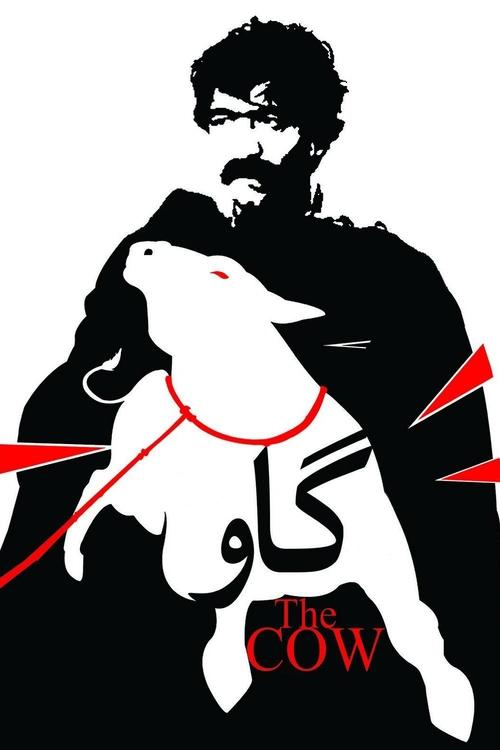
The Cow
1969 · Dariush Mehrjui
For when you want something elemental — a short, severe parable you'll be turning over for days. This is a challenge rather than a comfort watch, but a deeply rewarding one.
What it's about
In a poor, drought-worn Iranian village, an aging man's whole emotional life is bound up in his cow — the only one in the hamlet. While he's away in the city, the animal dies, and the frightened villagers, dreading what the news will do to him, bury it and agree to tell him it simply wandered off. What follows is a study of a community managing a lie and a man confronting a loss he cannot absorb.
The experience
Stark, hushed, and increasingly unnerving — village comedy of gossip and superstition slowly darkening into something closer to tragedy. It has the rhythm of a folk tale and the grip of a psychological drama, and its plainness is exactly what makes it haunting.
Performances
Ezzatolah Entezami's turn as Hassan is legendary in Iranian cinema — a portrait of grief pushed past its limits, played with a physical commitment that is genuinely hard to shake.
The craft
Dariush Mehrjui adapted the story with its original author, Gholam-Hossein Saedi, and shot it in spare black-and-white that gives mud walls, empty stables, and watching faces the weight of myth. The film trusts silence, repetition, and the texture of village life to do what dialogue won't.
Why it matters
Widely credited with launching the Iranian New Wave, it proved that a small, local, defiantly uncommercial film could stand with the best of world cinema — and generations of Iranian filmmakers have worked in its shadow.
Snapshot
Gaav (The Cow) is the film conventionally credited with inaugurating the Iranian New Wave, and it remains one of the pivotal works of twentieth-century world cinema for how completely it fused the plain textures of village life with a parable of psychological disintegration. Adapted by Dariush Mehrjui and the writer Gholam-Hossein Saedi from Saedi's own prose, it tells of Masht Hassan, a poor villager whose entire emotional world is bound up in his cow — the only cow in the drought-worn hamlet of Bayal. When Hassan travels away and the animal dies in his absence, the frightened villagers bury it and tell him it wandered off. Unable to absorb the loss, Hassan withdraws into the empty stable and gradually assumes the identity of the animal itself, eating hay, refusing his own name, insisting that he is the cow. From this spare, almost folkloric premise Mehrjui built a study of grief, poverty, and the fragility of selfhood that read, to audiences at the time, as both a rural fable and a coded diagnosis of a society under strain. Shot in stark black and white and anchored by Ezzatolah Entezami's celebrated central performance, the film was suppressed by state authorities on release, then smuggled abroad to unexpected international acclaim, and has since become a fixed point in every account of modern Iranian film.
Industry & production
The Cow was made inside a paradox that would define much of the New Wave: it was financed, in part, by the very state whose image of the nation it complicated. The Iranian commercial industry of the 1960s was dominated by filmfarsi — formulaic melodramas and musicals with song-and-dance numbers and stock heroes — and there was little native infrastructure for the kind of austere art cinema Mehrjui intended. Funding came through the Ministry of Culture and Arts (Vezarat-e Farhang va Honar), the cultural apparatus of the Pahlavi government, which supported the production as a prestige or artistic project. The result embarrassed the same officials once it existed: a film centered on rural destitution ran directly against the monarchy's carefully cultivated narrative of a modernizing, prosperous Iran. The government initially blocked its release, and when the film did surface it reportedly carried an inserted title card indicating that the events depicted belonged to an earlier time — a face-saving disclaimer distancing the state from the poverty on screen. Denied normal domestic exhibition, the film was taken abroad, where its festival reception effectively forced its reputation back home. This pattern — state money, state censorship, foreign vindication — is central to understanding how Iranian art cinema first established itself.
Technology
Technologically the film is deliberately unassuming, and that modesty is part of its argument. It was shot on black-and-white 35mm at a moment when color was increasingly the commercial norm; the monochrome choice reads as an aesthetic and economic decision that aligns the film with neorealist gravity rather than the gloss of filmfarsi. Production values are frugal — real village locations, natural or simple lighting setups, a small technical footprint — reflecting both a limited budget and a conscious rejection of studio artifice. Precise records of the camera and stock used are not something the available historical documentation reliably specifies, and it would be invention to name them; what is clear is that the film belongs to a lineage of low-resource, location-based filmmaking in which technical restraint is inseparable from meaning.
Technique
Cinematography
The cinematography, credited to Fereydoun Ghovanlou, favors a grave, observational stillness. The camera tends to hold on faces and on the geometry of the village — mud walls, low doorways, the dark interior of the stable — building a sense of an enclosed, watched community. The black-and-white photography emphasizes texture and shadow: the grain of adobe, the darkness of the byre where Hassan retreats, the exposed flatness of the surrounding land. Rather than dramatize through camera movement, the film often frames its subjects frontally or in confined interiors, so that space itself feels constricting. As Hassan's mind unravels, the visual world contracts with him, the stable becoming a claustrophobic stage for his transformation.
Editing
The film's rhythm is patient and accretive, built to let a psychological process unfold across time rather than through incident. Scenes are allowed to run to the point of discomfort, and the cutting privileges duration and observation over momentum — the slow tightening of a communal dread. The film also braids two anxieties in parallel: Hassan's private breakdown and the collective fear of the "Boluri," outsiders the villagers regard as a menace. The editing keeps these threads in tension, so that individual madness and communal paranoia comment on one another. Specific attribution of the editing craft is one area where the widely circulated record is thin, and I will not assign a name I cannot verify.
Mise-en-scène / staging
Mise-en-scène is where the film's power most visibly concentrates. Bayal is rendered as a near-hermetic world, and Mehrjui stages the community as a kind of chorus — clusters of villagers watching, whispering, gathering at thresholds — so that Hassan's descent is always framed by collective observation and helplessness. The stable is the film's charged center: the space of the beloved animal becomes the space of Hassan's regression, and the staging of him on all fours, at the trough, feeding on straw, converts a humble location into the site of a metaphysical event. The props are elemental — hay, rope, the cow's absence — and the compositions repeatedly set the vulnerable individual against the wall of the group.
Sound
The soundscape is sparse and atmospheric, weighted toward ambient village sound and silence, which heightens the sense of a world holding its breath. Hormoz Farhat's score is used with restraint, deployed to deepen unease rather than to underline emotion in the conventional melodramatic manner. The withholding of music across long stretches makes Hassan's animal sounds — his lowing, his refusal of human speech — all the more disturbing when they arrive. As with much filmmaking of this period and place, fine technical detail on the sound recording process is not securely documented, and I flag that rather than fill it in.
Performance
Performance is the film's engine, and Ezzatolah Entezami's Masht Hassan is one of the landmark screen portrayals of Iranian cinema. Entezami, a distinguished stage actor, charts the character's collapse without histrionics — from tender, almost comic devotion to his cow, through disbelief and grief, into a fully bodily assumption of the animal's identity. The role demanded a transformation that is physical as much as emotional, and Entezami's control over posture, voice, and gaze gives the metamorphosis a terrible plausibility. The surrounding ensemble, drawn substantially from theater performers, sustains the communal texture, playing the villagers as a frightened, well-meaning collective whose kindly deception precipitates the tragedy.
Narrative & dramatic mode
The film operates in a mode that hovers between neorealist observation and parable. On its surface it is a materially specific account of rural poverty — a village so poor that a single cow represents survival, dignity, and love. But the narrative arc bends toward allegory: the transfer of identity from man to dead animal turns the story into a fable about loss, denial, and the porousness of the self. The dramatic engine is not plot in the conventional sense but transformation and dread; tension accumulates from the community's inability to tell Hassan the truth and their growing terror at what he is becoming. The structure is essentially tragic and inexorable, a downward spiral in which each act of protective kindness deepens the catastrophe. That doubleness — concrete social realism carrying a mythic, psychological charge — is precisely what marked the film as new.
Genre & cycle
Nominally a drama, The Cow is better understood as the founding entry in a cycle: the Iranian New Wave (Mowj-e Now). It stands against the dominant filmfarsi commercial cinema and alongside other 1969 works — most often cited with Masoud Kimiai's Qeysar — as marking the arrival of a serious, author-driven Iranian art film. Within that cycle, The Cow represents the contemplative, allegorical, village-set strand, distinct from the urban tough-guy register of Qeysar. Its blend of social realism and parable established a template that later Iranian filmmakers would return to repeatedly: ordinary, often rural lives rendered with documentary plainness but pressed toward larger philosophical or ethical questions.
Authorship & method
The Cow is a genuinely collaborative authorship rooted in a literary partnership. Dariush Mehrjui — who had studied philosophy at UCLA before returning to Iran — directed and co-wrote, and his intellectual formation is legible in the film's fusion of concrete milieu and metaphysical inquiry. The decisive collaborator was Gholam-Hossein Saedi, the physician, playwright, and short-story writer whose work supplied the source. The film derives from Saedi's writing associated with the Bayal setting (his cycle Azadaran-e Bayal, "The Mourners of Bayal"), and Saedi worked on the screenplay, making the film a meeting of two major sensibilities: Saedi's socially engaged, psychologically acute literature and Mehrjui's cinematic patience. The cinematography is credited to Fereydoun Ghovanlou and the music to the composer and musicologist Hormoz Farhat. The presiding creative method is one of restraint and fidelity to milieu — real locations, theater-trained actors led by Entezami, monochrome austerity — in service of a text-driven, thematically dense vision. Where individual craft credits beyond these are inconsistently recorded, I have refrained from asserting them.
Movement / national cinema
The film's significance to Iranian national cinema is foundational. Before The Cow, Iranian screens were largely given over to commercial entertainment; after it, there existed a demonstrable, internationally legible tradition of Iranian art film. It helped legitimize a cinema of social observation and moral seriousness that would, over subsequent decades, make Iranian filmmaking one of the most respected national cinemas in the world. Notably, its stature persisted across the political rupture of 1979. In the post-revolutionary period, when the new Islamic Republic was hostile to much of the old film culture, The Cow was reportedly viewed favorably at the highest level — Ayatollah Khomeini is widely said to have praised it as an example of the kind of morally serious cinema the new order could countenance — a reputation that helped protect the space for Iranian art film to continue. That a single film could be embraced across such opposed regimes speaks to how deeply it was woven into the national self-understanding.
Era / period
The film sits at the end of the 1960s, within the later Pahlavi era of top-down modernization, oil-fueled ambition, and mounting social tension beneath the official narrative of progress. Its portrait of a village untouched by that prosperity implicitly interrogated the modernization project, which is why the state found it inconvenient. Internationally, it belongs to a global moment of new waves and politically conscious art cinema, and its neorealist inheritance connects it to the broader postwar current of location-based, socially attentive filmmaking. Coming a decade before the revolution, it now reads also as an artifact of a society under quiet pressure — a document of rural precarity in a nation officially telling itself a story of advancement.
Themes
At its core the film concerns identity and its dissolution: the frightening ease with which a self, deprived of the thing it loves, can migrate into another form. Grief and denial drive the story — both Hassan's refusal to accept death and the community's protective refusal to speak it. Poverty is not backdrop but subject: the cow's singular economic and emotional value in a destitute village makes its loss unsurvivable. Around these run the themes of communal fear and the outsider, embodied in the dreaded Boluri, and of the thin membrane between human and animal, sanity and madness. There is, too, a persistent concern with alienation and the failure of a community to save one of its own despite genuine care. These threads — read variously as existential parable, social critique, and psychological case study — account for the film's enduring interpretive richness.
Reception, canon & influence
Domestically the film's early life was defined by suppression: withheld by the authorities, then released in constrained circumstances with the reported distancing title card. Its reputation was made abroad. Taken to the Venice Film Festival — the account most consistently repeated holds that it was shown there in 1971, reportedly without subtitles — it won critical recognition, including the international critics' (FIPRESCI) prize, and this foreign acclaim rebounded to establish its domestic standing. From there it became a fixture of the canon of Iranian and world cinema and a touchstone in scholarship on the Iranian New Wave.
Looking backward, the film's influences are twofold. Cinematically it draws on the postwar tradition of neorealism and socially engaged art cinema, with its location shooting, non-glamorous milieu, and moral seriousness. Its deeper wellspring, though, is literary: Saedi's fiction, which supplied not only the plot but the distinctive tonal fusion of earthy specificity and allegory. Looking forward, The Cow is routinely identified as the film that opened the path for everything that followed in Iranian art cinema — the tradition later crowned internationally by figures such as Abbas Kiarostami and the humanist, ethically searching filmmaking associated with Iran. Its demonstration that a modest, austere, deeply local story could carry universal weight became a kind of founding proof for that national cinema. Mehrjui himself continued as a major director, but no single later work displaced The Cow's status as the origin point. Its legacy, in short, is nothing less than the emergence of modern Iranian cinema as a world tradition.
Reception
Banned at home by the Shah's censors — rural poverty didn't fit the image of a modernizing Iran — it was smuggled to the 1971 Venice Film Festival, won the FIPRESCI critics' prize, and is now routinely cited as the founding film of the Iranian New Wave.
How The Cow was received, from release to now →
Influences: the films it descends from and the films it influenced
- Bicycle Thieves (1948) — Supplies the model of the poverty-parable built around a single lost possession whose disappearance unravels a man's social identity, staged in real streets with non-glamorous milieu.
- La Terra Trema (1948) — Establishes the village-as-chorus method — a real fishing community filmed on location speaking its own dialect, the collective framed as moral witness to one household's ruin — which Mehrjui transposes to Bayal.
- Umberto D. (1952) — Pioneers the neorealist tactic of holding on dead time and small domestic gestures so that duration, not plot event, carries the ache of destitution — the 'duration-over-momentum' editing The Cow inherits.
- Au Hasard Balthazar (1966) — Provides the template of the animal as metaphysical vessel — a beast onto which a whole community's cruelty and grace are projected — anticipating the cow as the stable's 'metaphysical stage.'
- Diary of a Country Priest (1951) — Models the austere spiritual cinema of restrained score, sparse ambient sound, and monochrome self-denial in service of a text-driven inner drama, the tonal register Mehrjui adopts.
- The House Is Black (1963) — Founds the Iranian poetic-realist tradition of black-and-white observational stillness fused with literary voice, the formal ground the New Wave — and The Cow — grew from.
- The Brick and the Mirror (1965) — Establishes the Iranian art-feature's literary modernism — long observational takes and a writer's sensibility over melodrama — that made a text-driven film like The Cow conceivable at home.
- The Runner (1985) — Carries forward location-shot poverty realism with theater/non-professional performance and sparse sound, proving the modest local story could still carry universal weight post-revolution.
- Where Is the Friend's House? (1987) — Fulfills the path The Cow opened — an ethically searching, humanist rural parable built on observational patience and a small moral crisis rather than plot machinery.
- Bashu, the Little Stranger (1989) — Extends the community-as-chorus staging and neorealist location method to a village absorbing an outsider, sustaining the New Wave's allegory-through-milieu approach.
- Close-Up (1990) — Deepens the founding fusion of documentary austerity and literary-moral inquiry into identity, treating a real man's dissolution of self with the same observational restraint.
- Chess of the Wind (1976) — Founding Iranian New Wave chamber film whose sparse, allegorical village realism established the movement and production idiom Aslani works within.
- A Moment of Innocence (1997) — Founding Iranian New Wave work whose neorealist non-professional performance and village-location realism seed the national tradition Makhmalbaf's handheld naturalism grows from.
- Ballad of Tara (1979) — Established the New Wave grammar Beyzai works in: a closed northern village shot on location where the assembled villagers function as a reacting chorus in the frame rather than background, and a realist surface that tips into myth without any optical marker of the shift.
- Tranquility in the Presence of Others (1970) — Shares the exact authorship method — a faithful cinematic adaptation of Gholam-Hossein Saedi's fiction that fuses earthy specificity with psychological allegory.
- The Postman (1972) — Extends the same Mehrjui–Saedi partnership and Entezami-led theater-trained ensemble, dramatizing another impoverished man's psychic disintegration in an austere rural register.
- The Cycle (1978) — Continues the Saedi literary-source method and monochrome-inflected social realism, mapping systemic exploitation onto a single figure's bodily and moral decay.
- Still Life (1974) — Radicalizes the observational-stillness and duration-over-event grammar into near-static long takes of rural routine, the New Wave's purest extension of The Cow's patience.
- Downpour (1972) — Works the same neighborhood-as-chorus staging, orchestrating a tight local community whose collective gaze governs an outsider's fate.
- Prince Ehtejab (1974) — Applies the New Wave's literary-adaptation austerity — a dense prose source rendered in claustrophic, decay-obsessed monochrome interiors — to the theme of identity dissolution.
- Through the Olive Trees (1995) — Founding Iranian New Wave work whose village-set social realism and non-professional performance established the national tradition Kiarostami radicalized formally.
- The Wind Will Carry Us (1999) — The founding Iranian New Wave text whose village realism and non-professional ensemble establish the rural-community shooting tradition Kiarostami extends into a self-reflexive register.
Similar films
- Still Life (1974) — influence & lineage
- Bashu, the Little Stranger (1989) — influence & lineage
- Where Is The Friend's House? (1987) — influence & lineage
- Close-Up (1990) — influence & lineage
- The House Is Black (1963) — influence & lineage
- Au Hasard Balthazar (1966) — influence & lineage
- The Wind Will Carry Us (1999) — shared sensibility
- Ballad of Tara (1979) — shared sensibility