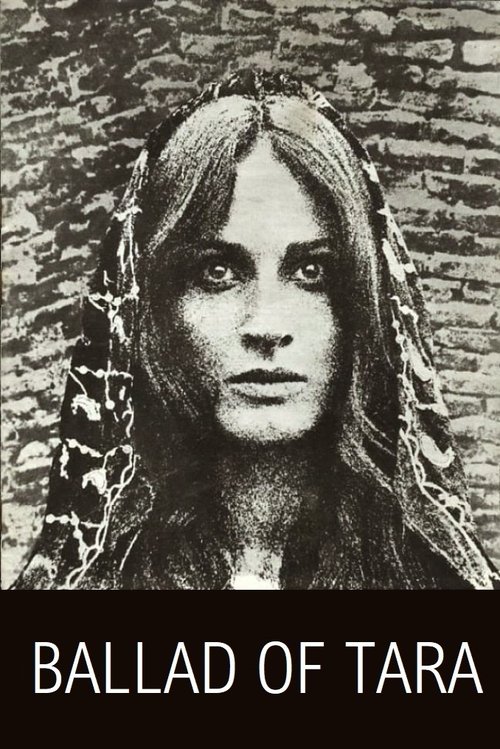
Ballad of Tara
1979 · Bahram Beyzai
For when you want something genuinely otherworldly — a ghost story that runs on legend and landscape instead of scares. Best met patiently, on its own rhythm.
What it's about
A young widow named Tara returns to her village near the Caspian shore with her two children and learns her grandfather has died. She gives away his belongings, but no one will accept one item: an old sword. Then a warrior from a defeated army of the deep past — visible to Tara and almost no one else — appears on the road, claiming his clan has sent him to take the sword back, and the living and the dead find themselves negotiating what one owes the other.
The experience
Strange and stately, like a folk ballad performed rather than a story filmed — wind, sea, ritual gestures, and sudden charges of feeling. It's mysterious without being obscure, and its images have a mythic pull that lingers.
Performances
Susan Taslimi's Tara is a force — defiant, earthy, and commanding — a heroine who faces the supernatural with her chin up, and one of the great performances of Iranian cinema.
The craft
Bahram Beyzai stages the film with the frontal compositions and choral movement of Iranian traditional theater, set against real coast, forest, and field, so myth and daily life share the same frame. The result is formally bold and visually ravishing — cinema built from ritual as much as from realism.
Why it matters
Completed at the hinge of the 1979 revolution and never released in its home country, it became a legendary near-invisible masterpiece of the Iranian New Wave — proof of a road Iranian cinema might have taken, and a key to Beyzai's lifelong project of putting national myth on screen.
Snapshot
A young widow returns to her village on the Caspian shore, learns her grandfather has died, and gives away his belongings to neighbors who take everything except an old sword. Nobody wants the sword. Then a man out of the deep past — a warrior from a defeated army, visible to Tara and to almost no one else — comes to take it back. Cherike-ye Tara (the title means something like Tara's ballad or folk-song) is Bahram Beyzai's fourth feature and one of the most formally audacious films of the Iranian New Wave: a pastoral, a ghost story, and an argument about what living people owe to history, staged with the frontality and choral movement of Iranian traditional theater rather than the grammar of realist cinema.
Its fate is inseparable from its meaning. The film was completed at the hinge of the 1979 revolution and was never granted public release in Iran; it has circulated abroad in festival, archival and diaspora contexts, and inside Iran largely by rumor, video and critical reputation. It is, in other words, a film about an inheritance nobody will accept that itself became an inheritance nobody in authority would accept. That irony has shaped almost everything written about it since.
Industry & production
Ballad of Tara was made in the terminal months of the Pahlavi-era film industry. That industry had two tiers: the commercial film-farsi trade — melodramas, tough-guy pictures, song-and-dance — and a small, chronically underfunded art sector that had emerged around 1969 with Dariush Mehrjui's The Cow, Masoud Kimiai's Qeysar, and, from 1972, Beyzai's own Downpour. State bodies (the Ministry of Culture and Arts, National Iranian Radio and Television, and the Kanoon children's institute where Kiarostami and Amir Naderi worked) financed much of the serious work, since private producers rarely would. Beyzai belonged squarely to this second tier, and had already learned that his films were commercially fragile: The Stranger and the Fog (1974), a comparably mythic village film, was a difficult, long, unprofitable object by trade standards.
By 1978 the ground was collapsing. Strikes, curfews and street violence shut down production and exhibition; cinemas were targeted as symbols of Pahlavi cultural policy, most catastrophically in the Cinema Rex fire in Abadan in August 1978, which killed hundreds and became a rallying event of the revolution. A number of Iranian films shot in 1977–79 were finished into a vacuum — no functioning distribution, and then a new cultural authority with no interest in releasing them. Beyzai's film is the emblematic case. The commonly given reasons for its suppression are its unveiled, physically expressive female lead, who dances, works, argues and is desired by two men across a boundary of death; and its frankly pre-Islamic, mythological register, which located Iranian identity in a lineage of warriors, ballads and land rather than in religion. Beyzai spent the following decades in a cycle of bans, delayed releases and abandoned projects, and left Iran for the United States in 2010, where he taught at Stanford.
Detailed production documentation for the film — budget, shooting schedule, exact festival itinerary, full technical credits — is thin and inconsistent in English-language sources, and this dossier does not reconstruct figures that the record does not support.
Technology
The film was shot on 35mm color negative and finished by the standard Tehran laboratory pipeline of the period, which meant a fairly narrow tolerance for the kind of low-light, weather-dependent exterior work the film depends on. Its palette — the saturated reds and greens of Tara's clothing against the gray-green of rice paddies, forest, and the Caspian — is a deliberate exploitation of color stock's response to overcast northern light, and it matters that the film is in color: Beyzai uses garment color as a semiotic system, marking the living against the drained, earth-toned figure who has come back from the dead.
Sound was post-synchronised, as essentially all Iranian features were until direct sound became normal in the 1990s. This was an industrial limitation with an aesthetic consequence, and Beyzai — a theater man — turned it into a resource. Dialogue in his films sits slightly forward of the image, more declaimed than overheard, closer to the acoustics of a recited tale than to documentary capture. The wind, the sea and the crowd are built rather than recorded, which is why the soundscape can slide between naturalism and something incantatory without a seam.
Preservation is a real issue for pre-revolutionary Iranian cinema generally: negatives were lost, confiscated or degraded, and several key New Wave titles have survived through single poor prints. Copies of Ballad of Tara in circulation have historically been of compromised quality, and readers should treat any assessment of its "look" as an assessment of the surviving materials as much as of the original photography.
Technique
Cinematography
The camera is patient and lateral. Beyzai builds in wide and medium-wide setups that hold the human figure whole within a landscape, and he prefers to move the actors rather than cut — figures cross the frame, arrive from off-screen, circle one another, and exit, so that a single shot can carry a whole scene's dramatic architecture. Depth is used socially: the village crowd occupies a middle ground behind Tara, watching, commenting, closing in, a chorus rendered spatially rather than by cutaway.
The landscape — paddy fields, the forest edge, the beach and the sea — is not backdrop but antagonist and archive. The sea in particular functions as the boundary of the visible world, the surface from which the past comes ashore and into which it withdraws. Beyzai frames it flat and horizonless, so that a figure entering it appears to be entering an idea.
Editing
Beyzai cut most of his own films, and the sensibility is unmistakable here: long, composed takes punctuated by abrupt, percussive joins that jolt rather than smooth. He is willing to break spatial continuity to produce a beat, and to let the ghost's appearances arrive as edits — a figure simply present in a shot where he was not, without optical effect. The fantastic in this film is achieved almost entirely by cutting and staging rather than by trickery, which keeps it inside the register of oral storytelling, where a listener accepts a revenant because the teller says so.
Mise-en-scène / staging
This is the film's center of gravity. Beyzai was a scholar of Iranian performance traditions before he was a filmmaker — his Namayesh dar Iran (Theater in Iran, 1965) remains a foundational study — and Ballad of Tara is built from those traditions rather than merely decorated with them. The ta'ziyeh, the Shi'i passion drama, contributes frontal address, symbolic props standing in for whole histories, and a mode of performance in which a figure can represent a time rather than a person. Naqqali and pardeh-khani — the storyteller's recitation before a painted curtain — contribute the film's episodic, balladic shape and its comfort with characters who narrate themselves. The ru-howzi comic tradition contributes the villagers' collective, slightly farcical mass movement.
The result is a village that behaves like a stage ensemble: crowds surge, retreat, form lines and rings, and speak in overlapping choral bursts. Objects are ritual objects. The sword is passed hand to hand and refused, a piece of stage business that carries the entire theme. Household goods distributed after a death become a liturgy of exchange.
Sound
Beyond the post-sync dialogue, the film leans on wind, surf, work sounds and communal noise, with music used sparingly and modally rather than as continuous underscore. Vocal delivery is the key expressive instrument: Beyzai's actors project, elongate and shape lines in a way that would read as excessive in a realist film and reads as correct here, because the film is asking to be heard as a sung tale. Detailed music credits for the film are among the particulars poorly recorded in accessible sources.
Performance
Susan Taslimi's Tara is the film's engine and its historical event. Taslimi — trained in theater, and Beyzai's essential collaborator across Death of Yazdgerd (1982), Bashu, the Little Stranger (1986) and Maybe Some Other Time (1988) — plays a woman who is never once a victim of the plot. She works, laughs, refuses, mourns, negotiates, and holds her ground against both a living suitor and a dead one. The performance is physical in a way Iranian cinema would shortly be forbidden to depict: stride, gesture, hair, the body in labor. It is the anchor of the entire "Beyzai heroine" — the woman who carries continuity while the men carry weapons and grievances — and it is the most cited reason the film was found intolerable.
The revenant warrior is played in an antithetical key: stiff, archaic, ceremonial, a man speaking a syntax a century out of date, comic in his obsolescence and then unbearably sad. English-language sources are unreliable on the full supporting cast, and no attributions are made here beyond Taslimi's.
Narrative & dramatic mode
The structure is that of a folk ballad rather than a three-act screenplay: a return, a death, a distribution of goods, an unclaimed object, an apparition, a courtship, a refusal, a departure into the sea. Causality is loose and repetition is structural — the sword is offered and refused more than once, the warrior appears and re-appears, the village re-assembles. The dramatic mode is what one might call mythic realism: the material texture of agrarian life is observed with ethnographic attention, while the supernatural is admitted without explanation or apology, and without the horror film's machinery of dread.
The central engine is a negotiation, not a threat. The dead man wants his sword; the living woman has it and will not simply hand it over, because she has begun to want him, and because the thing has become hers. The impasse is the film: a past that demands restitution and a present that has made other uses of what the past left behind. Beyzai declines both available resolutions — Tara cannot follow him into death, and he cannot stay among the living — and the film ends on withdrawal rather than reconciliation.
Genre & cycle
Nominally fantasy-drama; more usefully, it belongs to a small, distinctly Iranian cycle of mythic village films that Beyzai largely invented and mostly populated alone. The Stranger and the Fog (1974) is its direct predecessor — a man arrives by sea into a coastal village and is eventually reclaimed by the sea — and Ballad of Tara inverts the movement: the stranger arrives from time rather than geography, and it is the woman who stays. Death of Yazdgerd (1982) completes a loose trilogy of history-as-trial, staging a single chamber argument about a king's murder as overt theater.
The cycle sits adjacent to, but apart from, the New Wave's dominant realist strain (Shahid Saless's durational austerity, Naderi's street cinema) and to Kimiavi's more essayistic engagement with folklore. Beyzai's distinguishing move is to treat national performance traditions as a film language rather than as subject matter.
Authorship & method
Beyzai (b. 1938, Tehran) came to cinema from scholarship and playwriting, and his method reverses the usual order: the research precedes the story, the theatrical form precedes the shot list. He wrote his own screenplays and cut his own films, and his scripts read as literature — dense, rhythmic, archaising in diction. That verbal density is why his cinema resists dubbing and subtitling so badly, and part of why his international reputation lagged behind his domestic stature.
His collaborators are best understood as an ensemble he built and re-used, with Taslimi the central figure. As noted above, the technical credits for this particular title are inconsistently recorded in accessible English-language sources; rather than guess at cinematographer, composer and editor attributions, it is more honest to say that the authorial signature here is overwhelmingly Beyzai's own — writer, director, and the shaping intelligence of the cutting — and that this is consistent with his practice across his career.
Method-wise, three habits recur and are all visible here: location shooting in the north of Iran with non-professional crowds integrated into trained-actor ensembles; a refusal of psychological interiority in favour of gesture and ritual; and an insistence that Iranian identity is a layered thing, in which pre-Islamic myth, folk performance and contemporary rural labor occupy the same frame.
Movement / national cinema
The Iranian New Wave (Moj-e No) ran roughly from 1969 to 1979, and Ballad of Tara is one of its closing statements. Where the movement's realist wing pursued poverty, alienation and the rural-urban rupture, Beyzai pursued the same national questions through myth. He belongs to the New Wave by generation, funding structure, and audience, but his formal loyalty was always to the Iranian stage.
After 1979 the field was remade: a period of near-shutdown and purge, then the institutional reconstruction of cinema under the Farabi Cinema Foundation from 1983, and the eventual emergence of the internationally celebrated post-revolutionary art cinema of Kiarostami, Makhmalbaf, Panahi and Majidi. Ballad of Tara sits in the gap between these two Iranian cinemas — made under one regime, judged by the next, released by neither.
Era / period
1978–79 is the film's whole context. It was made as a monarchy dissolved, in a country arguing about which past was authentically its own: the Achaemenid-Sasanian imperial lineage the Shah had spent a decade promoting, or the Shi'i religious tradition the revolution would install. A film in which a pre-Islamic warrior comes back to demand his sword from a modern village — and is told, in effect, that his war is over and his people are gone — was a direct intervention in that argument, and its melancholy toward the returning past could satisfy neither side. Read today, the warrior's discovery that history has moved on without him plays as one of the more prescient images in Iranian cinema.
Themes
The unclaimed inheritance. The sword is the film's master symbol: a beautiful, useless, dangerous object that everyone in the village is happy to have exist and nobody will take responsibility for. It is heroic history offered to ordinary people, who correctly recognize it as a burden.
History as unfinished business. The dead soldier is not a monster but a creditor. He wants restitution and cannot be paid, because the debt was contracted in a world that no longer exists.
Woman as continuity. Tara works the land, raises children, buries the dead and mediates between epochs. Beyzai consistently assigns to women the labor of maintaining a world while men pursue honor, vengeance or memory — a pattern that culminates in Bashu, where Naii holds a farm and a war orphan together while the husband is absent.
The village as chorus and court. The community watches, judges, gossips and constrains. Its collective body is staged as an actual chorus, which makes social pressure visible rather than implied.
The sea as threshold. Water is the boundary of the knowable; things arrive from it and are surrendered to it. The final withdrawal into the sea is the film's most quoted image.
Reception, canon & influence
Contemporary reception in the ordinary sense barely exists: with no domestic release, the film had no reviews-and-box-office life at home. Its critical standing was built instead by Iranian critics who saw it in restricted or festival circumstances, by its circulation abroad, and by the retrospective consolidation of Beyzai's reputation. It has since become a fixture in Iranian critics' assessments of the best Iranian films, and a standing case study in scholarship on censorship and Iranian cinema — Hamid Naficy's multi-volume A Social History of Iranian Cinema and Hamid Dabashi's writing on Iranian film both situate Beyzai as a central and systematically obstructed figure. Precise festival dates and screening histories vary between sources and are not asserted here.
Backward. The film's ancestry is largely non-cinematic: ta'ziyeh, naqqali, ru-howzi, the Shahnameh and the wider corpus of Iranian epic and folk narrative, all of which Beyzai had studied as a scholar. Cinematically, it is in dialogue with the New Wave's turn to rural Iran after The Cow, and with his own The Stranger and the Fog, whose sea-borne stranger it answers. There is a broader affinity — convergent rather than demonstrably derived — with the mythic-folkloric strain of 1960s–70s art cinema elsewhere: Paradjanov's tableaux, Pasolini's archaic mode, the ghost-among-the-living tradition of Japanese kaidan cinema. Beyzai's own stated sources have consistently been Iranian performance traditions, and that is where the weight belongs.
Forward. A banned film cannot exert normal influence, and it is important not to overstate this. Its legacy traveled through three channels. First, through Beyzai himself: the collaboration with Taslimi, the choral village staging, the woman-as-survivor protagonist and the ghost-of-history motif all carry directly into Death of Yazdgerd and then into Bashu, the Little Stranger, which did reach audiences and became one of the most admired Iranian films ever made. Second, through Taslimi, whose screen persona — physically present, verbally combative, unsentimental — set a template for the strong female protagonist that post-revolutionary Iranian art cinema would have to negotiate around veiling rules and modesty codes, and who subsequently built a career in Swedish theater and film after leaving Iran. Third, through the film's status as a symbol: it is routinely cited in accounts of what Iranian cinema lost in 1979, and its suppression is part of the standard narrative of how a national cinema was reorganized.
Its influence, then, is real but oblique — the influence of a film more discussed than seen, whose central image of an obsolete warrior asking a working woman to return his sword has outlasted most of the films that were allowed to play.
A Deleuzian reading
Everything in the dead man's house finds a taker.
The full Deleuzian reading of Ballad of Tara →
Reception
Finished just as the 1979 revolution hit, it was banned in Iran and its Cannes 1980 Un Certain Regard slot was essentially its only official screening — for decades it survived on murky bootlegs. A 2022 restoration (shown at Il Cinema Ritrovato and touring rep cinemas) has finally turned a rumored masterpiece into a seeable one.
How Ballad of Tara was received, from release to now →
How to watch Ballad of Tara: what to notice on a first viewing
- Watch how rarely Beyzai cuts within a single scene. He holds wide, lateral shots and moves the actors instead, so figures cross the frame, circle each other, and exit inside one continuous take. A whole scene's drama plays out in one continuous space, not assembled afterward from separate pieces.
- Track the sword as it passes from hand to hand. After the grandfather's belongings are given away, everyone offered the sword hands it straight back to Tara. The village never argues about the past out loud; declining to hold the sword is the argument.
- Notice the crowd holding the middle ground behind Tara. Villagers gather in depth behind her, watching, commenting, closing in as a group, rather than being cut to in separate reaction shots. You can read the community's judgment of Tara without a single cutaway to a reacting face.
- Notice how vivid Tara's red and green clothing stays. Her costume stays saturated red and green against the gray-green paddies and the earth-toned stranger who has come from the past. Costume color alone tells you who is alive and who is a visitor from elsewhere.
- Listen for how actors elongate and project their lines. Beyzai's cast speaks in a heightened, declaimed register, shaping and stretching lines the way a reciter would, not the way people talk. The delivery asks you to hear the film as a chanted tale, not recorded conversation.
The whole guide to watching Ballad of Tara, with the keys for a rewatch →
Influences: the films it descends from and the films it influenced
- The Cow (1969) — Established the New Wave grammar Beyzai works in: a closed northern village shot on location where the assembled villagers function as a reacting chorus in the frame rather than background, and a realist surface that tips into myth without any optical marker of the shift.
- The Stranger and the Fog (1974) — Beyzai's own prior draft of the same device — a figure arriving from outside history into a coastal community, ritual combat blocked as choreographed ceremony rather than action, and an ending built on unresolved withdrawal (the boat into the fog) that Tara answers by having the stranger ask for the sword back and vanish.
- Downpour (1972) — First working-out of Beyzai's ru-howzi-derived blocking — characters played to a semicircle of onlookers who verbally answer the protagonist — and of his practice of writing and cutting his own material so that scene rhythm is built at the script's metrical level, not found in the edit.
- Prince Ehtejab (1974) — Iranian New Wave precedent for conjuring the historical dead by cut alone: ancestors materialize inside continuous domestic space with no dissolve, superimposition or lighting change, exactly the technique by which Tara's warrior enters the field.
- Shadows of Forgotten Ancestors (1964) — Model for treating folk costume as chromatic dramaturgy — one saturated hue per figure read against a desaturated landscape — and for filming ethnographic ritual as staged performance in real terrain rather than as documentary observation.
- The Color of Pomegranates (1969) — Frontal tableau grammar in which a performer faces the lens dead-on and presents a ritual object to camera, the shot organized like an illustrated storyteller's cloth — the same address Beyzai borrows from ta'ziyeh and pardeh-khani.
- Medea (1969) — Archaic-mode method Beyzai converges with: myth performed by non-professional crowds in unmodified landscape, with declamatory post-synchronized dialogue laid over the image so speech reads as recitation rather than location sound.
- Ugetsu (1953) — The lateral long take that reveals a ghost as an ordinary body already standing in the frame — the apparition produced by camera movement and staging depth instead of any effect — which is the exact economy of Tara's encounters with the armored dead.
- Onibaba (1964) — A woman who survives by stripping armor and weapons from dead warriors, filmed with the terrain itself (the grass) as the hostile agent that swallows and returns bodies — the closest prior formulation of Tara's found sword and her labor amid a landscape that will not release its history.
- Kwaidan (1964) — Built its ghosts through a constructed, non-naturalistic soundtrack — isolated struck sounds and silence used as spatial architecture rather than ambience — the same substitution of designed sound for recorded location sound that Beyzai's post-synchronized track performs.
- Death of Yazdgerd (1982) — Takes the ta'ziyeh frontality of Tara to its limit: one location, one night, the same actors re-performing contested versions of a killing directly to camera, with Taslimi again as the verbally combative female speaker who controls the reenactment.
- Bashu, the Little Stranger (1986) — Carries the whole Tara apparatus into a film that was actually seen — northern location shooting with non-professional villagers as chorus, Taslimi as a physically present working woman defending ground, and the dead husband appearing by straight cut into the rice fields.
- Travelers (1992) — Opens with characters announcing their own deaths straight to the lens and closes by returning them alive to a family ceremony — the ta'ziyeh contract of Tara made explicit, where the audience is addressed as congregation rather than concealed observer.
- Gabbeh (1996) — Builds figures out of a woven textile by cut — a character steps out of the carpet's pattern into the landscape with no transition — and codes each nomadic figure by a single dyed color set against terrain, extending Tara's costume-as-chromatic-signal and cut-conjured apparition.
- The White Meadows (2009) — Post-revolutionary continuation of the mythic-village mode: a ballad structure of ritual episodes gathered by a traveling figure carrying a single symbolic object, played by non-professionals in an unforgiving salt landscape — and, like Tara, withheld from Iranian audiences.
- Bashu, the Little Stranger (1989) — Earlier Beyzai–Taslimi collaboration that forged the archetypal land-rooted woman confronting an outsider from another time or place—the prototype Susan Taslimi refines into Naii.
- Chess of the Wind (1976) — Contemporary Iranian experiment in painterly frontal composition and slow lateral tracking through a fixed set, with a female protagonist held in the center of the frame — and, like Tara, a film whose craft argument was suppressed and only later recovered.
- The Sealed Soil (1977) — Rural Iranian woman refusing the marriage plot, staged in rigorously static frontal long takes where duration and the woman's physical labor carry the drama instead of cutting — the same wager on embodied female physicality made two years before Tara, and likewise banned.
- Tall Shadows of the Wind (1979) — Same-year village film in which an inanimate folk object (the scarecrow) is invested with agency by the villagers' collective behavior and by editing that never shows a transformation — mythic realism generated by the crowd's reaction shots rather than by effects.
Similar films
- Death of Yazdgerd (1982) — influence & lineage
- The Cow (1969) — influence & lineage
- Chess of the Wind (1976) — influence & lineage
- Bashu, the Little Stranger (1989) — shared sensibility
- The Wind Will Carry Us (1999) — shared sensibility
- The Turin Horse (2011) — shared sensibility
- Leila and the Wolves (1986) — shared sensibility
- Mirror (1975) — shared sensibility