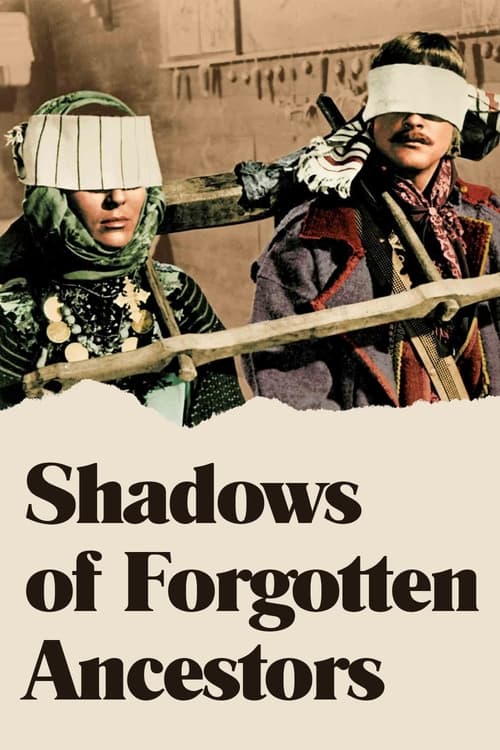
Shadows of Forgotten Ancestors
1965 · Sergei Parajanov
For when you want to be overwhelmed by pure image and music rather than followed a tidy plot — a film to surrender to. Choose it for an adventurous night when you're craving something ecstatic, strange, and heartbreaking.
What it's about
In the Carpathian Mountains of nineteenth-century Ukraine, a young Hutsul highlander named Ivan falls for Marichka, the daughter of the man who killed his father. Their forbidden love collides with fate, feuds, and the old rituals of a mountain world where sorcery, work, marriage, and death all run on ancient rhythms.
The experience
Delirious is the word — the camera whirls, colors blaze, and folk songs and rituals crowd every scene, so it feels less like watching a story than being swept into a fever dream of love and grief. It is rapturous and mournful by turns, and disorienting in the best way.
Performances
Ivan Mykolaichuk gives Ivan a haunted openness that anchors all the visual delirium — his face carries the film's long arc from young love into grief.
The craft
The camerawork is legendary: it spins, plunges, and races through forests as if possessed, while dye-saturated color, Hutsul costume and ritual, and a soundtrack thick with folk song turn ethnography into hallucination. It absolutely rewards the biggest screen and best sound you can give it.
Why it matters
It announced Parajanov overnight as one of world cinema's great originals and founded what became known as Ukrainian poetic cinema — a defiant assertion of national culture inside the Soviet system. Its influence on visually radical, folklore-steeped filmmaking runs deep to this day.
Snapshot
Shadows of Forgotten Ancestors (Ukrainian: Tini zabutykh predkiv) is the film with which Sergei Parajanov, then a journeyman director at the Dovzhenko Film Studios in Kyiv, abruptly became one of world cinema's major artists. Adapted from Mykhailo Kotsiubynsky's 1911 novella, it tells of Ivan, a young Hutsul highlander who loves Marichka, daughter of the man who killed his father; when Marichka drowns, Ivan sinks into grief, makes a loveless marriage to Palahna, and is finally destroyed by the pull of the dead beloved. But plot is almost the least of it. The film is celebrated as the founding work of "Ukrainian poetic cinema," a delirious fusion of ethnography, folk ritual, expressionist color, and a camera that seems possessed. It marked the end of Parajanov's decade of conventional Soviet filmmaking — work he would later dismiss — and the beginning of the visionary, persecuted late career that produced The Color of Pomegranates.
Industry & production
The film was produced by the Oleksandr Dovzhenko Film Studios in Kyiv, the flagship studio of the Ukrainian SSR, within the fully state-controlled Soviet system. Parajanov, born in Tbilisi to Armenian parents and trained at VGIK in Moscow, had by 1964 completed several forgettable features in the socialist-realist mode; Shadows was assigned and approved as a literary adaptation of a canonized Ukrainian author, Kotsiubynsky, whose centenary and secure classical status gave the project ideological cover. That literary respectability is important to understanding how so unorthodox a film cleared Goskino's approval process: an adaptation of a beloved national classic was a defensible undertaking in a way an original avant-garde script would not have been.
Production involved extensive location shooting in the Carpathian Mountains among the Hutsul people, whose real customs, dwellings, dress, and rituals the filmmakers studied and incorporated. Parajanov's method drew on ethnographic immersion, using authentic Hutsul artifacts, textiles, and settings rather than studio reconstruction. The result reads less like a costume drama than a document of a living culture heightened to the pitch of myth. Precise budget and box-office figures are not something I can reliably cite; the film's commercial performance within the USSR is less documented than its festival trajectory abroad.
Technology
Shadows was shot on 35mm in color, and color is central to its identity — this was not a film that could have existed in the monochrome idiom of earlier Soviet poetic cinema. Working within the constraints of Soviet color stock of the mid-1960s (Sovcolor/Agfa-derived processes), the filmmakers exploited rather than concealed the medium's saturated, sometimes unstable rendering, pushing reds, greens, and earth tones to expressionist intensity. One of the film's most discussed strategies is its modulation of the palette as an emotional register: passages surrounding death and grief drain toward desaturation and near-monochrome, while life and desire return the image to violent color. The technology of color film is thus not merely a recording medium but a dramaturgical instrument.
Technique
Cinematography
The cinematography, by Yuri Ilyenko — himself a significant director-to-be — is the film's most immediately astonishing feature and a large part of its historical importance. Ilyenko's camera is radically kinetic and subjective: it spins, tilts, races through forests, plunges, and adopts impossible vantage points, frequently identifying with a character's psychic state rather than any neutral observer. The celebrated sequence of Ivan's father's death sends the frame reeling, a red wash flooding the image; elsewhere the camera gallops with horses or whirls with dancers. This is a cinema of subjective, embodied vision, closer to the lyric first-person than to classical découpage. Ilyenko and Parajanov also compose in dense, iconographic tableaux — figures arranged against textiles, crosses, and Carpathian landscape as if in folk woodcuts — so that the film oscillates between frantic motion and hieratic stillness.
Editing
The editing serves this oscillation, cutting between the frenetic and the ceremonial. Where the camera does not itself supply movement, montage generates rhythm through rapid association of ritual gestures, faces, objects, and landscape, in a manner consciously descended from the Soviet montage tradition but redirected toward lyric and ethnographic ends rather than dialectical argument. The film is organized into titled chapters or episodes marking phases of Ivan's life, a structure that gives the editing a rhythm of discrete, almost liturgical movements. I would not want to overstate documented specifics about the editor's individual contribution, as that credit is less recorded in the standard literature than those of Parajanov and Ilyenko.
Mise-en-scène / staging
Mise-en-scène is arguably the true medium of Parajanov's art, here and forever after. The frame is saturated with Hutsul material culture — embroidered garments, woven blankets, carved wood, brass, icons, ritual bread, candles — arranged with a painter's and collagist's eye. Staging repeatedly favors frontal, tableau-like configurations in which human figures become elements of a decorative-symbolic surface. Ritual is the organizing principle of the staging: births, weddings, funerals, Christmas and folk-magic ceremonies are enacted at length and with ethnographic specificity, so that the human drama unfolds inside an unbroken cycle of communal rite. This subordination of individual psychology to the pattern of custom and season is the film's deepest structural idea.
Sound
The soundtrack is as dense and defamiliarizing as the image. It layers Hutsul folk music, ritual chant, and the sounds of traditional instruments — including the long alpine trembita horn — with ambient and diegetic noise, dialect speech, and moments of expressive silence. The music is associated with the Ukrainian composer Myroslav Skoryk, working with the region's folk idiom, though the film's aural fabric is as much montage of authentic folk sound as it is scored composition. The effect is immersive and ceremonial rather than illustrative; sound situates the viewer inside a specific, archaic soundscape rather than underscoring emotion in the Hollywood manner.
Performance
Ivan is played by Ivan Mykolaichuk, in a role that made him an emblem of Ukrainian cinema and national culture; his open, iconic face anchors the film's shifts between ecstasy and desolation. Larisa Kadochnikova plays Marichka with a luminous, folkloric grace, while Tatyana Bestayeva plays the earthier Palahna, Ivan's wife. Performance here is stylized toward the archetypal — figures in a myth more than psychologically individuated characters — consistent with the film's ritual staging. Much of the cast and surrounding presence draws on the Hutsul milieu itself, reinforcing the ethnographic texture.
Narrative & dramatic mode
The film's dramatic mode is lyrical and mythic rather than novelistic. Though it follows a legible tragic arc — forbidden love, loss, mourning, a failed second union, death — it relates that arc elliptically, through chaptered episodes, ellipses, and ritual set-pieces rather than continuous causal scene-building. Time is cyclical and seasonal; the individual life is framed as one turn of an immemorial wheel, exactly as the title's "forgotten ancestors" implies. Interior states are externalized through color, camera movement, and symbol rather than dialogue or exposition. The result is closer to sung folk epic or to visual poem than to conventional screen drama, and it demands a viewer willing to read association and image as narrative.
Genre & cycle
Nominally a drama and doomed romance, Shadows is better understood as the inaugural work of a distinct cycle: Ukrainian poetic cinema (also called Ukrainian poetic film school). Where mainstream Soviet cinema of the period trafficked in socialist realism and, increasingly, thaw-era humanist drama, this cycle foregrounded folklore, national ethnography, metaphor, and formal experiment. The film sits within the broader constellation of Soviet "poetic" and auteurist cinema of the 1960s — alongside Tarkovsky's early work — but is specifically national in its rootedness in Ukrainian, and particularly Hutsul, culture. It is a genre unto itself as much as a member of one, blending ethnographic film, tragic romance, and visionary art cinema.
Authorship & method
The film is inseparable from Sergei Parajanov (1924–1990), and it is where his authorial method crystallized. That method treats cinema as a species of decorative and ritual art — collage, icon, tapestry set in motion — privileging the frame's symbolic surface over narrative propulsion. Parajanov himself later drew a sharp line between his pre-1965 work and everything after, regarding Shadows as his true beginning.
But authorship here is genuinely collaborative, and the record is clear on several key partners. Cinematographer Yuri Ilyenko contributed the kinetic, subjective camera style so fully that he is rightly considered a co-author of the film's visual language; he soon became an important director in his own right within the same poetic school. The screenplay was written by Parajanov with the Ukrainian writer Ivan Chendej, adapting Kotsiubynsky. Musical direction is associated with Myroslav Skoryk. The Ukrainian graphic artist Georgi Yakutovich is generally credited with the film's artistic/production design, bringing a woodcut-like sensibility congruent with Parajanov's. Lead actor Ivan Mykolaichuk functioned almost as a co-creator of the film's national resonance. Where individual craft credits are less firmly documented — the precise division of labor in editing, for instance — I would rather flag the gap than assign it.
Movement / national cinema
This is, more than any single fact about it, the film that launched Ukrainian poetic cinema and reawakened a distinctly Ukrainian national cinema within the Soviet framework. It stands consciously in the lineage of Oleksandr Dovzhenko, whose silent lyric masterpieces (above all Earth, 1930) established a Ukrainian tradition of pantheist, folk-rooted, image-driven filmmaking; Parajanov's film revives and modernizes that inheritance in color. Its success opened space for a subsequent body of work by Ilyenko, Leonid Osyka, and others. That national assertion carried real political charge: the film appeared amid a mid-1960s stirring of Ukrainian cultural self-consciousness, and its Kyiv premiere in September 1965 became the occasion for a public protest — by intellectuals including Ivan Dzyuba, Vyacheslav Chornovil, and Vasyl Stus — against the arrests of Ukrainian dissidents then underway. The film thus entered history simultaneously as art and as a flashpoint of national feeling.
Era / period
Shadows belongs to the late Khrushchev "Thaw" and its immediate aftermath, a window in which Soviet cinema enjoyed relatively greater latitude for formal experiment and authorial voice. It is roughly contemporaneous with Tarkovsky's Ivan's Childhood (1962) and the making of Andrei Rublev (1966), and shares that moment's ambition to reclaim cinema as personal, poetic, and spiritually serious. Yet the era was closing: the Brezhnev period's tightening, and specifically the crackdown on Ukrainian intellectuals, formed the political weather around the film's release. Parajanov's own subsequent fate — official disfavor, the effective shelving and re-cutting of The Color of Pomegranates, and his later imprisonment — belongs to that darkening.
Themes
The film's governing theme is the persistence of the archaic — the "forgotten ancestors" whose customs, magic, and fatalities still shape the living. Love and death are bound together from the outset (Ivan loves the daughter of his father's killer), and the narrative treats desire as inseparable from mortality and vendetta. Nature is a pantheist presence, neither backdrop nor metaphor but an active force, in the Dovzhenko tradition. Ritual and the seasonal cycle structure human existence, dissolving the individual into the communal and the eternal. Folk belief — sorcery, omens, the porous boundary between the living and the dead — is presented not as superstition to be judged but as the very fabric of reality. Beneath these runs the film's implicit assertion of a specific cultural identity, a Ukrainian and Hutsul world rendered with such total conviction that the act of representation becomes itself a thematic claim about memory and belonging.
Reception, canon & influence
Critically, the film was a revelation, and it traveled: it won a number of international festival prizes in the mid-1960s and established Parajanov's reputation in the West as a major new voice, even as his standing at home grew more precarious. (I can affirm that it was widely honored on the festival circuit of 1965–66 without vouching for a full, exact ledger of every award and category.) Over the following decades it entered the canon as a landmark of both Soviet and world cinema, routinely cited in surveys of the era's great achievements alongside Tarkovsky.
Its influences ON the film run backward to Dovzhenko's Ukrainian poetic tradition; to Kotsiubynsky's source novella and, through it, to Hutsul folklore and oral culture; and to the Soviet montage heritage that Parajanov and Ilyenko inherited and transformed. Parajanov also absorbed the ethnographic and folk-art sensibility that would define all his later work.
Its legacy / forward influence is substantial. It founded the Ukrainian poetic cinema school, giving Ilyenko, Osyka, and others a model and a mandate. It reoriented Parajanov himself toward the tableau aesthetic he perfected in The Color of Pomegranates (1969). More broadly, its ecstatic subjective camera and its treatment of film as ritual and painterly collage fed into the wider current of world art cinema; the film is frequently invoked as an influence by later directors drawn to folkloric, image-first, non-narrative modes. Its fusion of ethnography with visionary form remains a reference point for filmmakers seeking to root cinematic poetry in a specific culture. And its history as both artwork and rallying point ensured that, especially within Ukrainian cultural memory, Shadows of Forgotten Ancestors is remembered not only as a masterpiece of style but as a moment when a national cinema declared itself.
A Deleuzian reading
A man dies and the picture bleeds.
The full Deleuzian reading of Shadows of Forgotten Ancestors →
Reception
Abroad it was an instant sensation — festival prizes and rapturous notices — while at home it made Parajanov a marked man: he refused to dub its Hutsul-dialect Ukrainian into Russian, and Soviet authorities never forgave him. Today it's canonized as the flagship of Ukrainian poetic cinema and a fixture on 'most beautiful films ever' lists.
How Shadows of Forgotten Ancestors was received, from release to now →
How to watch Shadows of Forgotten Ancestors: what to notice on a first viewing
- Watch for a scene where the whole frame floods red. At a moment of violence the entire image goes red, not just an object in it, so color itself becomes the feeling instead of just decorating the scene. A red frame has nowhere else to put its feeling, so the screen stops showing an event and becomes one.
- Watch the camera gallop, spin, and plunge with the action. Yuri Ilyenko's camera races through forests, whirls with dancers, and takes vantage points no observer could actually occupy, identifying with a character's state rather than watching from outside. You aren't just seeing what a character feels; the camera itself appears caught up in it.
- Notice how densely packed each frame is with objects. Embroidered garments, woven blankets, carved wood, brass, candles, and ritual bread fill the image like a page or an icon, arranged with a painter's eye rather than left as background. The film starts to feel like it's about a whole people rather than about one man.
- Watch weddings, funerals, and holidays performed at full length. Parajanov stages ritual at length and with ethnographic specificity, so births, weddings, and folk-magic ceremonies structure the film as much as the love story does. Custom does the work of explaining people here, more than any line of dialogue could.
The whole guide to watching Shadows of Forgotten Ancestors, with the keys for a rewatch →
Influences: the films it descends from and the films it influenced
- Earth (1930) — Establishes the Ukrainian poetic-cinema grammar Parajanov inherits: lyric montage that cuts between weathered peasant faces, fruit, and sky to build meaning by pictorial rhyme rather than plot causation.
- Zvenyhora (1928) — Models the mythic-lyric mode of folding folk legend and oral myth directly into rural material reality, the fusion of ethnography and vision that structures Shadows' Hutsul world.
- Ivan the Terrible, Part II (1958) — Provides the precedent of expressionist color deployed as an emotional/symbolic register and of the frozen painterly tableau, both of which Ilyenko and Parajanov push toward saturation-and-desaturation as feeling.
- The Cranes Are Flying (1957) — Sergei Urusevsky's whirling, vertiginous handheld camera bonded to a character's subjective emotion is the direct technical parent of Ilyenko's subjective-kinetic camera in Shadows.
- Letter Never Sent (1960) — Fuses the camera to fire, water, and forest so that landscape becomes an active dramatic agent, anticipating Shadows' animist treatment of nature as narrating force.
- A Spring for the Thirsty (1965) — Ilyenko, co-author of Shadows' camera, carries its subjective-kinetic and high-contrast desaturated imagery into his own directing debut, extending the poetic school from behind to in front of the film.
- The White Bird Marked with Black (1971) — Continues the Ukrainian poetic school with Mykolaichuk as archetypal-stylized lead, ethnographic Carpathian tableau, and folk-ritual set-pieces staged as living tapestry.
- The Stone Cross (1968) — Extends the school's ethnographic tableau and ritual gravity (the funeral/departure rites of a Galician village) as austere, near-static folk-icon staging descended from Shadows' mandate.
- The Color of Pomegranates (1969) — Parajanov's own next step, where Shadows' painterly-collage surface hardens into the frontal, near-motionless icon/tapestry tableau, privileging symbolic frame over movement.
- The Legend of Suram Fortress (1985) — Revives the Shadows method of narrating folk legend through ritual set-pieces and decorative-art staging, treating cinema as animated ethnographic collage.
- Ashik Kerib (1988) — Final elaboration of the archetypal-stylized performance and folk-soundscape-driven mythic mode first crystallized in Shadows, staging a Caucasian folktale as a procession of ceremonial images.
- Time of the Gypsies (1988) — Inherits the fusion of specific-culture ethnography with visionary folk-magical imagery and a wall-to-wall folk soundscape, rooting cinematic poetry in a bounded traditional community exactly as Parajanov modeled.
- Yeelen (1987) — Model for filming folk cosmology as ceremonial tableau — non-naturalistic performance and ritual incantation staged with formal frontality, the Soviet-trained approach to indigenous belief that shapes Yeelen's Komo sequences.
- The Lost Letter (1972) — Established the folk-baroque model the film inherits directly — whirling subjective camera, ethnographic ritual staged as spectacle, and saturated Hutsul color blocks — and cast the same Mykolaichuk as its folk-lyric lead.
- The Eccentrics (1974) — Fuses ethnographic folk material into a lyrical, ritualized cinema, the poetic-folk register the Georgian new wave drew on for its 'folk-tale-parable' construction and folk-lyrical scoring.
- Ballad of Tara (1979) — Model for treating folk costume as chromatic dramaturgy — one saturated hue per figure read against a desaturated landscape — and for filming ethnographic ritual as staged performance in real terrain rather than as documentary observation.
- November (2017) — Its ethnographic staging of Hutsul sorcery, love magic and funeral rites as stylised ritual set pieces is a model for November's spell-casting, its love-potion scenes and its All Souls' Day sequence.
- I Am Cuba (1964) — Contemporary apex of the ecstatic, gravity-defying unbroken mobile take that treats the camera as an autonomous roaming consciousness, the same impulse Ilyenko realizes through the Carpathian forest.
- Andrei Rublev (1966) — Shares the chaptered, titled episodic architecture and the reconstruction of archaic ritual set-pieces (pagan rites, folk craft) as immersive ethnographic tableau within a Thaw-era poetic register.
- Ivan's Childhood (1962) — Parallel Thaw breakthrough in image-first subjective cinema, where dream logic and lyric visual association override linear storytelling, the same license Parajanov claims.
- The Enchanted Desna (1964) — Solntseva's continuation of Dovzhenko's lyric-ethnographic tradition runs concurrently with Shadows, sharing the mythologized rural-Ukrainian tableau and voice-of-memory poetic mode.
- Marketa Lazarová (1967) — Whirling subjective handheld camera and folk-ritual ethnographic materiality organized by associative, non-linear construction.
Similar films
- The Color of Pomegranates (1969) — influence & lineage · same viewing thread
- Andrei Rublev (1966) — influence & lineage · same viewing thread
- Ivan's Childhood (1962) — influence & lineage
- The Cranes Are Flying (1957) — influence & lineage
- Earth (1930) — influence & lineage
- I Am Cuba (1964) — influence & lineage
- Mirror (1975) — same viewing thread
- Godland (2022) — same viewing thread
All the films related to Shadows of Forgotten Ancestors →
Watch it with: curated runs of related films
- Transcendental Style — A run for when you want cinema as prayer — faith, ritual, and the turning of seasons rendered in long takes and painterly stillness, where time itself becomes the subject rather than the story.