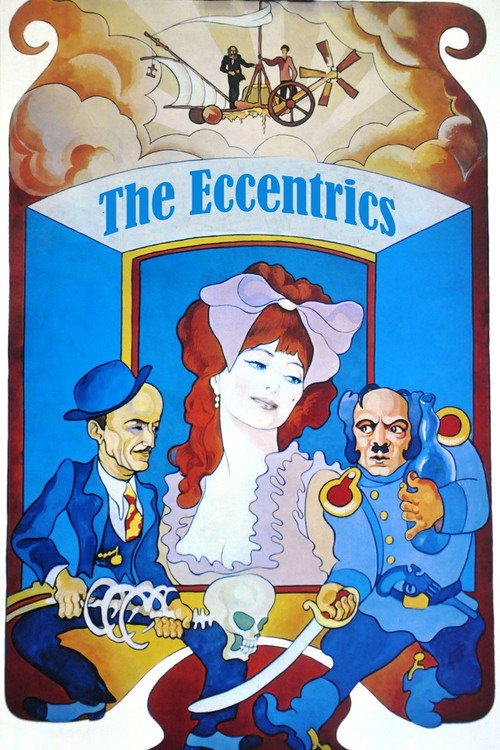
The Eccentrics
1974 · Eldar Shengelaia
For when you want something whimsical and strange — a film that makes you grin at its sheer nerve and reminds you why you root for hopeless romantics and crackpot inventors.
What it's about
A naïve Georgian villager named Ertaoz comes to the city to sell a chicken and pay his father's debts, promptly falls in love, and gets tangled in a farcical attempt to dispose of a body that turns out to be very much alive. Sentenced to ten years — his chicken gets seven — he lands in prison, where he meets an inventor building a flying machine powered by love. It's a folk tale run gloriously off the rails.
The experience
Playful, absurd, and secretly tender — the comedy has the deadpan logic of a fable, where every ridiculous turn carries a wink at authority. It's light on its feet but leaves a lingering sweetness about dreamers who refuse to be ground down.
The craft
Shengelaia stages the story as a string of absurdist episodes with the freedom of fantasy and the timing of silent comedy, using folk-tale logic to slip a defense of imagination past Soviet-era orthodoxy. The invention gags and flying-machine imagery give it a handmade, storybook charm.
Why it matters
A jewel of the golden age of Georgian cinema, part of the lyrical-allegorical current that made Tbilisi's studio a haven for poetic, subversive comedy inside the Soviet system.
Snapshot
The Eccentrics (Georgian: Sherekilebi, შერეკილები — variously rendered as "The Madcaps" or "The Cranks") is a comic fable from the golden age of Georgian cinema, directed by Eldar Shengelaia for the Gruziafilm studio in Tbilisi. Its picaresque plot — a naïve villager, Ertaoz, comes to the city to sell a chicken, falls in love, becomes entangled in a farcical corpse-disposal, is jailed alongside the bird, and there meets an inventor whose flying machine runs on the power of love — is less a story than a pretext: a strung series of absurdist episodes that use the logic of folk tale and the freedom of fantasy to smuggle a defense of dreamers past the gray pieties of Soviet realism. It belongs to the same lyrical-allegorical current as the work of Otar Iosseliani, Tengiz Abuladze, and the director's own brother Giorgi Shengelaia, in which whimsy is a moral and political posture rather than mere charm. The English-language scholarly record on this specific title is thin, and several production particulars below are flagged accordingly; what is secure is the film's place within one of the most distinctive national schools of the late-Soviet period.
Industry & production
The film was produced within the Soviet studio system at Gruziafilm (Kartuli Pilmi), the Georgian republic's state film enterprise, which by the early 1970s had become an unlikely engine of stylistic dissent. Georgian cinema enjoyed a semi-protected status inside the USSR: geographically and linguistically peripheral, its output was less closely policed than that produced in Moscow or Leningrad, and its filmmakers exploited the cover of "national folklore," comedy, and children's-fable idiom to make work that was formally adventurous and thematically sly. The Eccentrics is a characteristic product of that latitude. A comedy-fantasy that mocks petty officialdom, glorifies the impractical dreamer, and literally ends in flight from earthbound authority would have been difficult to mount in a more central studio; framed as a Georgian tall tale, it passed.
Eldar Shengelaia was by 1974 an established figure, and this standing mattered to the film's realization. Born in 1933 into film royalty — his father was the pioneering director Nikoloz (Nikolai) Shengelaia and his mother the silent-era star Nato Vachnadze — he had trained at VGIK in Moscow and already directed the well-regarded satire An Unusual Exhibition (1968). That reputation, and the institutional respectability of the Shengelaia name, gave him room to pursue a project whose commercial logic was, by design, eccentric.
Concrete production data for The Eccentrics — shooting schedule, budget, admissions — are not reliably documented in accessible English-language sources, and I will not invent figures. What can be stated with confidence is that it was a Gruziafilm feature of the mid-1970s, made in the Georgian language and circulated within the all-Union distribution network of the period.
Technology
The film was shot on 35mm photochemical film, the standard professional format of Soviet studio production in the era, and finished with optical rather than electronic post-production tools. Its most notable technical dimension is not hardware but the marriage of live-action photography with graphic and quasi-animated devices: painted backdrops, drawn interludes, and the design and puppet-like operation of the central conceit, the flying machine. This kind of hand-built, artisanal special-effects work — in-camera trickery, matte painting, mechanical contraption, and the naïve-art surface associated with Georgian visual culture — is more accurate to the film's method than any notion of an effects "pipeline." I do not have verified detail on the exact optical processes used for the flight sequences and will not fabricate them; the salient point is that the fantasy is achieved through evidently handmade, low-illusionist means, and that this visible artifice is itself part of the aesthetic.
Technique
Cinematography
The film's visual manner is bound up with the "primitivist" strain in Georgian art — the flattened, frontal, storybook compositions that recall the self-taught painter Niko Pirosmani, a touchstone for the whole national school. Rather than psychological realism, the camera favors tableau: characters arranged against painterly settings, staged with the deadpan symmetry of folk illustration. The identity of the director of photography is not something I can confirm from reliable sources, and I decline to attribute it. What the images consistently do is subordinate spatial "correctness" to graphic clarity and comic timing, so that the frame reads like an animated woodcut brought to life.
Editing
Structurally the film is episodic, built as a chain of self-contained comic set-pieces — the sale of the chicken, the courtship, the cemetery farce, the trial, the prison, the flight — linked by the through-line of Ertaoz's guilelessness. The cutting serves this vignette architecture: gags are allowed to complete, and the rhythm is closer to that of the tall tale, or of a sequence of painted panels, than to the propulsive continuity of a conventional narrative feature. The specific editor is not documented in sources available to me and is left unattributed here.
Mise-en-scène / staging
This is the film's richest register. Everything — costume, décor, the theatrical false-perspective of the sets, the puppet-mechanical flying apparatus — is pitched at a naïve, handcrafted key that refuses illusionism and embraces the look of folk art and fairground. The staging is frontal and presentational, actors posed like figures in a Pirosmani canvas or a shadow-play. Georgian cinema of this period repeatedly reached for such storybook stylization, and The Eccentrics is one of its purest comic instances: the "reality" of the world is openly a construction, which licenses the eruption of the impossible (a love-powered aircraft) as merely the next brushstroke.
Sound
The soundtrack pairs the film's visual whimsy with music of a folk-inflected, lyrical character, in keeping with the Georgian tradition of foregrounded, near-diegetic melody. I am not able to verify the composer's identity for this particular title from dependable sources — Georgian films of the era drew on figures such as Gia Kancheli and others in the Tbilisi musical world, but I will not assert an attribution I cannot confirm. The general point holds: music functions less as underscore than as an autonomous voice, coloring the comedy with warmth and, in the flight, with a note of genuine aspiration.
Performance
Performance is played in a broad, gestural, near-clownish idiom appropriate to the fable — the holy-fool sincerity of Ertaoz set against the comic pomposity of the policeman-bureaucrat and the mercantile bustle of the city. The style is closer to commedia type-playing and folk theater than to naturalism; characters are humors, embodiments of a trait, rendered with affection. I do not have verified casting information I can responsibly reproduce and therefore refrain from naming performers.
Narrative & dramatic mode
The dominant mode is the folk-tale-as-parable, executed as absurdist comedy. Cause and effect follow the dream-logic of the tall story: a chicken is co-defendant, a corpse revives to make an arrest, a man and a bird receive differentiated prison sentences, an inventor has literalized love as propulsion. These are not "twists" but the native grammar of a world that operates by wish and wit rather than physics. The narrative arc is one of ascent — social, spiritual, and finally literal — as the naïf and the dreamer, condemned by a petty order, escape it upward. The comedy is gentle rather than caustic; its satire lands not through anger but through the serene assertion that the eccentric's values (love, invention, guileless goodness) are simply truer than the state's (property, procedure, the ledger of debts with which the film opens).
Genre & cycle
The film sits at the intersection of comedy and fantasy, within the specifically Georgian cycle of lyrical-allegorical film-fables that flourished from the mid-1960s into the 1980s. This cycle — encompassing Iosseliani's ironies, Abuladze's parables, and Giorgi Shengelaia's Pirosmani (1969) — used national idiom, folklore, and stylized surfaces as both an aesthetic program and a means of speaking indirectly under censorship. The Eccentrics is a comic, fantastical node in that cycle, and also part of a smaller transnational lineage of "impossible flight" fables in which a homemade flying machine stands for freedom and the refusal of gravity's — and authority's — claims.
Authorship & method
Eldar Shengelaia is the governing authorial presence, and The Eccentrics is legible as a keystone of his sensibility: a filmmaker who repeatedly dramatized the collision between the free imagination and a philistine, bureaucratic order (An Unusual Exhibition had already staged the artist-versus-society theme; the later Blue Mountains, or Tale of a Sunday, 1983, would turn the same satirical eye on institutional inertia, and is often counted among his finest achievements). His method fuses the poetic-cinema instincts of his VGIK generation with a strong graphic-arts sensibility and a fabulist's tolerance for the impossible.
Regarding key collaborators, I will be explicit about the limits of the record. Georgian cinema of this period was a deeply collaborative culture, and the celebrated screenwriter Rezo (Revaz) Gabriadze — later world-famous as a puppet-theater artist and the co-author of scripts including Mimino and Kin-dza-dza! — worked repeatedly within exactly this whimsical register; it would be consonant with the film's spirit for such a writer to be involved. But I cannot confirm the screenplay, cinematography, editing, or music credits for The Eccentrics from reliable sources, and I therefore decline to attach names to those roles rather than risk fabrication. This is a genuine gap in the accessible English-language documentation, not a settled fact.
Movement / national cinema
The Eccentrics is a signal work of the Georgian New Wave — the remarkable efflorescence of Georgian filmmaking within the Soviet Union whose reputation rested on lyricism, allegory, folkloric texture, and a distinctive visual "primitivism." That movement's protective coloration — the pose of the harmless national fable — allowed a persistently individualist, even quietly dissident, vision of the human against the collective machinery of the state. Eldar Shengelaia, both as an artist and, in the post-Soviet period, as a public and political figure in independent Georgia, was one of its central personalities. The film's deep debt to Pirosmani and to Georgian folk art situates it firmly within a project of national-cultural self-assertion carried out through style.
Era / period
Made during the Brezhnev "stagnation," The Eccentrics is a document of how art negotiated that airless moment. Where official Soviet culture prized industrial optimism and legible ideological content, this film answered with a defense of impracticality, private feeling, and flight from the collective — values encoded safely inside comedy and fairy tale. Its very whimsy is period-specific: the fantastical and the folkloric were among the few registers in which imagination could move relatively unpoliced. The film thus reads doubly — as timeless fable and as a coded artifact of the mid-1970s Soviet cultural climate.
Themes
The organizing opposition is the dreamer versus the world of debts, property, and procedure. The film opens on an errand of debt-repayment and closes on an ascent powered by love — a trajectory from the ledger to the sky that states the theme with fable-like clarity. Love is not merely sentiment but a literal motive force, the fuel of invention and escape; the "eccentrics" of the title are the holy fools, inventors, and lovers whom a mercantile-bureaucratic society criminalizes and imprisons, and whom the film vindicates. Authority is embodied in the absurd figure of the reviving policeman, and satirized as petty, mechanical, and finally earthbound. Around these run the movement's recurring preoccupations: the dignity of the naïve, the moral seriousness hidden inside play, and freedom imagined — quite literally — as the ability to rise.
Reception, canon & influence
Within Georgian and Soviet film culture, Eldar Shengelaia's work of this period is held in high regard, and he is securely canonized as a major figure of Georgian cinema; The Eccentrics is one of the beloved titles associated with his fabulist mode. I want to be candid, however, that granular contemporary reception data for this specific film — reviews, festival results, admissions, awards — is not something I can reliably reconstruct from available sources, and I will not invent quotations, prizes, or figures to fill the gap.
Influences on the film (backward). The clearest debts are to Georgian folk narrative and to the naïve-primitivist visual tradition crowned by Niko Pirosmani, whose flattened, storybook painting is the film's aesthetic lodestar; to the broader poetic-cinema ethos of Shengelaia's VGIK generation; and to the perennial folk-utopian motif of the homemade flying machine as an emblem of freedom. The comic-theatrical, humors-based performance style draws on popular and folk-theater traditions rather than screen naturalism.
Legacy (forward). The film's durable contribution is as an exemplary specimen of Georgian lyrical comedy — proof of how much dissent, imagination, and tenderness could be carried on the back of a fairy tale under late-Soviet conditions. Its love-powered flying machine has become one of the memorable images of the national cinema, and the picture endures as a festival and retrospective staple whenever Georgian film of the Shengelaia generation is surveyed. Direct, documentable lines of influence on later filmmakers are harder to trace with rigor, and I will not overstate them; the safer and truer claim is that The Eccentrics helped consolidate a template — whimsy as resistance, the eccentric as hero, flight as freedom — that remained central to Georgian cinema's identity and to its international reputation for a singular, humane strangeness.
Reception
Soviet censors saw right through its whimsy: the release was held back and confined to small club screenings, and Shengelaia and co-writer Rezo Gabriadze were refused permission to show it abroad. Today it's cherished as one of the gems of 1970s Georgian cinema — the suppressed satire that outlived the system it needled.
How The Eccentrics was received, from release to now →
Influences: the films it descends from and the films it influenced
- A Trip to the Moon (1902) — Establishes the impossible-flight fable staged with proudly handmade in-camera trickery and painted flats, where the effect is meant to read as charmingly fabricated rather than convincing — the same 'handmade-effects' ethos behind the film's flying machine.
- The New Babylon (1929) — Product of FEKS (Factory of the Eccentric Actor), the grotesque, clownish 'eccentrism' acting mode and satiric caricature of officialdom that the very title 'The Eccentrics' invokes as its performance grammar.
- Seven Chances (1925) — The deadpan clown physically at war with unwieldy machines and crowds — the homemade-contraption gag and humors-based, non-naturalistic body comedy that the film's commedia-clownish performances descend from.
- À nous la liberté (1931) — Near-musical whimsical satire of regimented institutional order carried on a lyrical score, modeling how mechanized bureaucracy can be lampooned through song-like rhythm rather than realist drama.
- Zéro de conduite (1933) — Anarchic poetic revolt of dreamers against a philistine institution, prototyping the 'dreamer-versus-bureaucracy' plot engine and its lyrical, rule-breaking release.
- An Unusual Exhibition (1968) — Shengelaia's own earlier staging of the free artist crushed against a philistine, bureaucratic order — the direct authorial rehearsal of the theme and gentle satirical tone he refines here.
- Shadows of Forgotten Ancestors (1964) — Fuses ethnographic folk material into a lyrical, ritualized cinema, the poetic-folk register the Georgian new wave drew on for its 'folk-tale-parable' construction and folk-lyrical scoring.
- Blue Mountains, or Tale of a Sunday (1983) — Extends Shengelaia's deadpan satire of institutional inertia into a fully circular comic structure, refining the same absurdist bureaucracy-as-farce he practices here.
- Repentance (1984) — Georgian fabulist-allegorical mode using surreal parable and dream-logic to smuggle political dissent past censors — the mature form of 'whimsy as resistance' this film helped normalize.
- Brazil (1985) — Builds the dreamer's literal flight-fantasy as escape from a suffocating bureaucratic machine, rendered through retro, handmade fantastical effects rather than seamless illusion.
- Castle in the Sky (1986) — Makes the homemade flying machine the central emblem of freedom and love against militarized order — the same 'flight-as-freedom' iconography powering the fable.
- Kin-dza-dza! (1986) — Georgian absurdist fable of clownish outsiders in a philistine, bureaucratized world, built from deliberately lo-fi handmade props and co-written by Rezo Gabriadze in the same whimsy-as-dissent tradition.
- Underground (1995) — Balkan folk magical realism driven by a live brass-band lyrical score, sustaining the eccentric-as-hero and whimsy-as-resistance template across a fabulist national epic.
- The Color of Pomegranates (1969) — Flat, planar tableaux vivants composed from folk iconography, with figures arranged frontally like living primitivist paintings — the same storybook-tableau and frontal staging built from naïve-art sources.
- Pirosmani (1969) — The director's own brother translating Niko Pirosmani's flattened, frontal naïve-primitivist painting directly into cinematographic tableau — the exact visual lodestar this film adopts, made within the same family workshop.
- Mimino (1977) — Georgian lyrical comedy of a provincial dreamer chafing against institutional gray, co-written by Rezo Gabriadze in the same whimsical-tender register and shared screenwriting culture.
- Songs from the Second Floor (2000) — Rigorously frontal, static tableau staging of deadpan comic-existential vignettes — the pure descendant of frontal-tableau, episodic-vignette construction as a satire of a stalled society.
Similar films
- Brazil (1985) — influence & lineage
- Repentance (1987) — shared sensibility
- The Lost Letter (1972) — shared sensibility
- The Sheep Detectives (2026) — shared sensibility
- The King and the Mockingbird (1980) — shared sensibility
- Kaos (1984) — shared sensibility
- Courier (1986) — shared sensibility
- Tangerines (2013) — shared sensibility