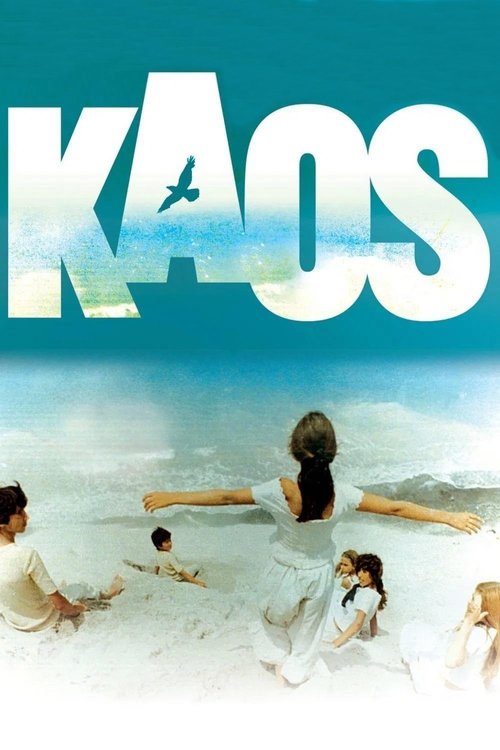
Kaos
1984 · Vittorio Taviani
For a long, contemplative evening when you want cinema as storytelling — episodes you can sink into one at a time, closer to reading a great book of tales than watching a plot unspool.
What it's about
An anthology of Sicilian tales drawn from the short stories of Luigi Pirandello, made by the Taviani brothers: a man afflicted by moonlit madness, a feudal landlord, peasants at odds with power, a jar, a mother and her sons, a haunting. The stories are bound together less by plot than by the island itself — its sun-bleached hills, villages, and sea.
The experience
Stately and story-like, moving between the earthy, the comic, the eerie, and the sorrowful as one tale gives way to the next. It has the rhythm of being told fables by firelight — unhurried, strange, and quietly profound.
The craft
Though credited here to Vittorio alone, the film was made jointly by Paolo and Vittorio Taviani, who worked as a single directing unit, and it shows their gift for turning landscape into myth — the Sicilian countryside is shot with a painter's eye and carried by a soaring score. The anthology form lets each tale find its own register, from folk comedy to ghostly lament.
Why it matters
A high point of the Taviani brothers' career and one of the great screen translations of Pirandello, it remains a model for how regional folklore and literary fiction can become epic cinema.
Snapshot
Kaos is a portmanteau film of Sicilian tales adapted from the short fiction of Luigi Pirandello. One point of record should be corrected at the outset, because the credit as filed here is incomplete: the film was directed jointly by Paolo and Vittorio Taviani, the fraternal directing team who worked as a single authorial unit throughout their careers. Attributing Kaos to Vittorio alone misstates a body of work that was, by the brothers' own lifelong practice, indivisible.
The title is not the Greek word for disorder but Càvusu — the Sicilian dialect name for the rural district near Agrigento where Pirandello was born, which the writer Italianized as "Caos" and adopted as a self-description ("figlio del Caos," son of Chaos). The film gathers several of Pirandello's Novelle per un anno into an anthology bound by landscape rather than plot: a raven with a bell tied to its neck flies over the sun-scoured Sicilian countryside in the prologue, linking the episodes as a wandering witness. The stories treat a man afflicted by lunar madness, a rich landowner and a broken oil jar, peasants who want their own burial ground, a mother estranged from her sons, and — in an epilogue — Pirandello himself returning to converse with his dead mother. It is at once one of the Tavianis' most beautiful films and one of their most explicitly literary.
Industry & production
Kaos arrived at the high-water mark of the Tavianis' international standing. They had won the Palme d'Or at Cannes in 1977 for Padre Padrone and the Grand Prix in 1982 for La notte di San Lorenzo (The Night of the Shooting Stars). Kaos followed as their next feature, an Italian production shot substantially on Sicilian locations. It was mounted as the kind of prestige literary adaptation that the Italian industry of the early 1980s could still support, though that industry was contracting sharply under the pressure of television and declining theatrical attendance.
The film's considerable length — running roughly three hours — signals its ambition as a compendium rather than a conventional feature, and it circulated in more than one form; catalog descriptions differ over how the segments are counted and which are included, and at least one episode has sometimes been dropped or restored across releases. I will not assert specific budget or box-office figures, because the reliable public record on the film's commercial performance is thin; what is clear is that Kaos was received as an art-cinema event on the strength of the directors' reputation rather than as a mass-market release.
Technology
Kaos is a conventionally photographed 35mm color film, and its interest lies not in any technical novelty but in the disciplined use of established tools. There is no optical trickery of note; the werewolf episode ("Mal di luna") achieves its horror through performance, sound, and light rather than through effects or transformation makeup of the creature-feature kind. The Tavianis' technological conservatism is itself characteristic: their cinema of the period trusted the camera, the cut, and the recorded voice, and reserved its inventiveness for composition and staging. Where the film feels heightened, the means are photographic and acoustic — the intensity of Sicilian sunlight, the scale of the landscape — not mechanical.
Technique
Cinematography
The photography is by Giuseppe Lanci, who had shot The Night of the Shooting Stars and would remain among the Tavianis' key collaborators. Lanci's work here is built on the Sicilian light: parched ochre hills, whitewashed walls, the hard blue of sea and sky. The images tend toward clarity and formal balance rather than restless movement, framing figures against expanses of land in a way that makes the human dramas feel small and elemental at once. The most celebrated passage is visual — the epilogue's memory of children sliding down a mountain of white pumice into the sea below, a sequence whose luminous whiteness has become the film's signature image. Lanci lights the anthology as a set of distinct moods held within one palette, so that the comic register of the jar story and the anguish of the werewolf tale still read as belonging to the same world.
Editing
Editing is by Roberto Perpignani, a longtime Taviani collaborator whose cutting shaped much of their major work. The central editorial problem of Kaos is architectural: how to make five discrete tales cohere. Perpignani and the directors solve it partly through the recurring raven, which functions as a connective device between episodes, and partly through a consistent rhythm within each story — measured, unhurried, allowing tableaux to hold. The cutting favors legibility and the completed gesture over fragmentation, in keeping with the Tavianis' fable-like mode.
Mise-en-scène / staging
Staging is where the Tavianis' distinctive sensibility is clearest. Their manner fuses a neorealist attention to peasant life and physical labor with a frankly theatrical, at times operatic, stylization — bodies arranged in friezes, crowds moving as choruses, moments of direct emotional declamation. "La giara" (The Jar) is staged almost as rustic comedy, its centerpiece the great terracotta oil jar that cracks and the mender who repairs it from within only to find himself trapped inside; the situation is blocked with the geometry of a stage farce. "Requiem," by contrast, stages a collective peasant action — a community's insistence on burying its own dead on contested land — with the choral gravity the Tavianis brought to political parable. Across the episodes, the staging keeps faith with Pirandello's origins in the theater while translating them into landscape.
Sound
The score is by Nicola Piovani, the composer most associated with the Tavianis in this period (and later widely known for his film work beyond them). Piovani's music is central to the film's tonal control: lyrical, folk-inflected, and capable of shifting between comedy and lament as the anthology requires. It carries much of the film's emotional through-line, especially in the elegiac epilogue. The soundscape otherwise leans on the natural acoustics of the Sicilian settings — wind, animals, the labor of bodies — and on the human voice, which the Tavianis treat as a primary expressive instrument.
Performance
The ensemble mixes established players with faces drawn toward the vernacular. Margarita Lozano anchors the story of the mother whose emigrant sons never write, a performance of weathered maternal grief. The jar episode draws on the physical-comic tradition of Sicilian performers; Ciccio Ingrassia — of the popular comic duo Franco e Ciccio — is associated with the role of the hunchbacked jar-mender, bringing a stylized, near-clownish physicality that the directors frame affectionately rather than mockingly. Omero Antonutti, the Tavianis' recurrent lead (the father in Padre Padrone), appears as Pirandello in the epilogue's dialogue with his mother. The acting register shifts by episode — broad and gestural in the comedy, restrained and interior in the elegy — and the film's coherence depends on the directors holding those registers within a single controlling voice.
Narrative & dramatic mode
Kaos is an anthology film, and its dramatic mode is that of the told tale — the novella in its literal sense of a story handed down. Rather than a single arc, it offers a series of self-contained fables, each with the shape of folk narrative: a premise, a reversal, a resolution that leaves a residue of irony or sorrow. The framing devices — the raven prologue and the autobiographical epilogue — convert the collection into a meditation on storytelling itself, and specifically on Pirandello's relation to the Sicilian ground that produced him. The epilogue, in which the writer speaks with his dead mother and receives from her the memory of the pumice-slide, is the film's interpretive key: it presents the preceding tales as issuing from a landscape and a maternal inheritance, and it reframes the whole as an act of filial and artistic homage. The mode is thus double — realist in texture, fabular in structure, and finally reflexive in its frame.
Genre & cycle
Assigning Kaos to genre is awkward, and the "Fantasy, Romance, Drama" tag flattens it. The fantastical element is real but circumscribed: the lunar affliction of "Mal di luna" belongs to folk belief and to Pirandello's interest in madness and the uncanny, not to horror-genre convention. More usefully, the film sits within two overlapping traditions: the literary-adaptation film — the mid-century-to-1980s Italian art cinema's habit of drawing on canonical national authors — and the episode/anthology film, a form with deep Italian roots (the multi-story film a episodi was a commercial and artistic staple). Within the Tavianis' own output it belongs to a cycle of Sicilian and rural-southern subjects, and it anticipates their later return to Pirandello.
Authorship & method
The governing fact of Kaos is co-authorship. Paolo and Vittorio Taviani directed as one, a partnership sustained across decades, and any account of the film's "vision" is an account of a shared method. Their approach to adaptation was not fidelity for its own sake but the discovery of a cinematic equivalent for a literary source — here, the translation of Pirandello's terse, ironic prose into landscape, tableau, and music. The key collaborators recur across their filmography and are integral to that method: cinematographer Giuseppe Lanci, composer Nicola Piovani, editor Roberto Perpignani, and, on screen, Omero Antonutti. The screenplay is the brothers' own adaptation of Pirandello. This continuity of personnel is why the Tavianis' films of the period feel of a piece: the authorship extends beyond the two directors to a stable workshop.
Movement / national cinema
The Tavianis emerged from the long aftermath of Italian neorealism. They belonged to the generation that came up in its shadow, absorbing Rossellini's example and the neorealist commitment to the peasantry, the land, and collective history, while rejecting pure documentary realism in favor of stylization. Their mature manner is often described as a blend of the realist and the Brechtian-operatic: fidelity to material life crossed with distancing devices, direct address, and lyric heightening. Kaos is a central document of that national-cinematic lineage — a film that returns to the Italian South, to peasant labor and emigration and death, subjects neorealism had claimed, but treats them through myth and memory. Its Sicilian setting also places it within the specifically Sicilian strand of Italian cinema and letters that runs through Pirandello himself.
Era / period
Kaos is a product of the early-to-mid 1980s, a period of crisis for Italian cinema as television eroded both audiences and production. In that climate, the survival of an ambitious, three-hour literary art film depended on directors of proven international prestige, which the Tavianis had. The film thus reads partly as a rearguard assertion of a certain cinema — patient, literary, regional, uncommercial — against the pressures of the decade. Its backward-looking subject (a turn-of-the-century writer's Sicily) and its stately form are of a piece with this position: a work consciously out of step with its moment's commercial tendencies.
Themes
The film's persistent themes are Pirandello's, refracted through the Tavianis' sensibility. Death and the dead recur across nearly every episode — the estranging distance of emigration that is a kind of living death, the peasants' demand to bury their own, the mother who returns from beyond. The land and belonging to it — the Sicilian soil as both burden and identity — runs throughout, culminating in the epilogue's explicit claim that art is born of a specific place. Madness and affliction appear in the lunar sickness, treated with compassion rather than sensation. Family, and above all the mother, forms the emotional spine: maternal grief, filial guilt, and inheritance bind the anthology and are resolved in the closing dialogue. And around all of these the film sets a reflexive theme of storytelling as inheritance — the idea, made literal in the frame, that tales are handed from the dead to the living, from mother to son, from Pirandello to the filmmakers who adapt him.
Reception, canon & influence
Kaos was received as a major work by the Tavianis and is generally regarded among their finest achievements alongside Padre Padrone and The Night of the Shooting Stars; the pumice-mountain epilogue in particular is frequently singled out as one of the most beautiful sequences in their cinema. I will refrain from citing specific awards or figures, as the precise competition record and commercial data are not something I can confirm here without risk of error; the durable claim is critical, not statistical — the film entered the canon of Italian literary adaptation and of the anthology film.
Its backward influences are legible and acknowledged: Pirandello's Novelle per un anno as the direct source; the theatrical inheritance of Pirandello's own dramaturgy; and behind the Tavianis, the neorealist tradition and the Italian episode-film form. Its forward legacy is most concrete within the directors' own careers: they returned to Pirandello for Tu ridi (You Laugh, 1998), extending the project Kaos had begun, and the film stands as a model for how canonical short fiction can be adapted cinematically without being either illustrated or betrayed. More diffusely, Kaos helped keep alive an idea of the literary art film — regional, elegiac, formally composed — at a moment when the conditions for such films were disappearing, and it remains a touchstone for the Tavianis' particular fusion of realism and fable.
Reception
Warmly received in 1984 as proof the Taviani brothers' hot streak (Padre Padrone, The Night of the Shooting Stars) was still going, it then drifted into art-house semi-obscurity — and has since climbed back as the film Letterboxd cinephiles quietly call their masterpiece.
How Kaos was received, from release to now →
Influences: the films it descends from and the films it influenced
- Paisà (1946) — Its six-episode portmanteau structure established the film-a-episodi as a vehicle for national portraiture, the model of knitting discrete regional tales into one geographic sweep that Kaos inherits and frames with a raven-messenger.
- The Flowers of St. Francis (1950) — Its chaptered episodes of saintly anecdote, staged with lay non-professionals in bare landscape, pioneered the neorealism-into-parable move — raw location realism tipped toward fable — that governs every Kaos episode.
- L'oro di Napoli (1954) — Built from Giuseppe Marotta's short-prose collection, each vignette a self-contained regional character study, it is the template for adapting a book of stories intact rather than novelizing it — exactly Kaos's treatment of Pirandello's Novelle per un anno.
- The Leopard (1963) — Its Sicilian light and operatic landscape tableaux — history rendered as elegy in wide, painterly composition — set the register for Lanci's staging of Sicilian sun and the mother-and-death lyricism of Kaos.
- The Decameron (1971) — It made anthology-adaptation of canonical Italian short fiction a matter of dialect-inflected, tableau-framed peasant faces rooted in one region — the same fidelity-through-regionalism strategy the Tavianis apply to Pirandello's Sicily.
- Padre Padrone (1977) — Their own template: a literary source (Ledda), Omero Antonutti as patriarch, and stylized peasant realism using landscape as a moral arena — the workshop method Kaos extends to the anthology form.
- The Night of the Shooting Stars (1982) — The immediate predecessor establishes the storytelling-frame (events narrated as remembered tale), the realism-and-fable fusion, and Piovani-scored operatic set-pieces that Kaos systematizes across four stories plus prologue and epilogue.
- Stromboli (1950) — Its volcanic Aeolian landscape treated as elemental, sublime force before which the human figure is dwarfed prefigures the pumice-mountain epilogue of Kaos, where geology itself becomes the emotional climax.
- Good Morning, Babylon (1987) — Extends the stable Taviani workshop (Lanci's compositions, Piovani's scoring) and the storytelling-as-inheritance theme, framing craft itself — cathedral artisans, then cinema — as a patrimony handed down.
- Fiorile (1993) — Built entirely on a frame-story of a family legend (the 'Maledetti' fortune) narrated across generations, it makes explicit the storytelling-as-inheritance device Kaos hangs on its Pirandello-mother prologue and epilogue.
- Tu ridi (1998) — The explicit continuation: a second return to Pirandello's Novelle per un anno in the identical anthology-adaptation method, seeking a cinematic equivalent for the terse ironic prose rather than illustrating it.
- Caesar Must Die (2012) — Foregrounds the Pirandellian theater-within — actors performing a text that bleeds into their own lives — extending the theatrical-dramaturgy inheritance and staged-recitation method latent in Kaos's frame.
- The Tree of Wooden Clogs (1978) — Contemporary regional peasant realism composed as elegiac, painterly tableau with a wholly non-professional cast — the same neorealist-operatic register and reverence for rural labor and land-and-belonging.
- Cinema Paradiso (1988) — Trades in the same Sicilian light and elegiac regional memory, structuring the film as an inheritance recalled — the mother-and-return and land-and-belonging chords Kaos strikes in its Colloquio epilogue.
- Life Is Beautiful (1997) — Carries forward Nicola Piovani's fable-tinged, tender orchestral voice — the same composer's method of scoring grief as lullaby — that lifts the Kaos episodes from realism into legend.
- Nuovomondo (Golden Door) (2006) — Renders Sicilian peasant emigration in operatic-realist tableau punctuated by folkloric fable inserts (giant vegetables, a river of milk) — the same tipping of documented hardship into dream-image that structures Kaos's 'Requiem' and 'La giara.'
Similar films
- Cinema Paradiso (1988) — influence & lineage
- The Decameron (1971) — influence & lineage
- From What Is Before (2014) — shared sensibility
- Satantango (1994) — shared sensibility
- Seven Samurai (1954) — shared sensibility
- Nostalgia (1983) — shared sensibility
- The Metamorphosis of Birds (2021) — shared sensibility
- La Terra Trema (1949) — shared sensibility