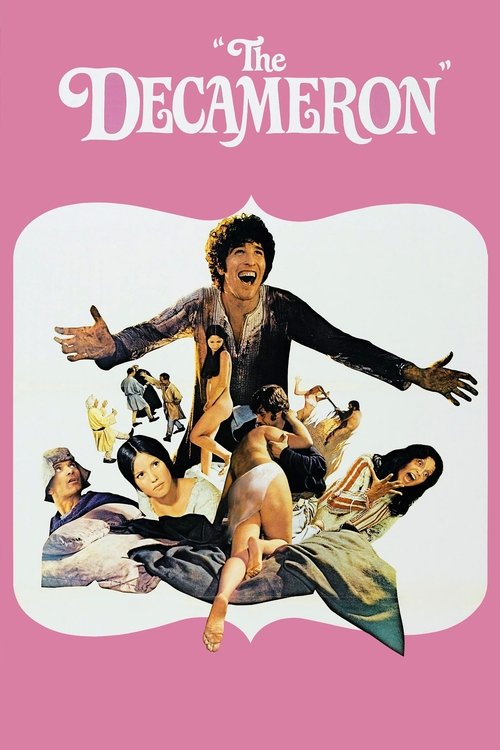
The Decameron
1971 · Pier Paolo Pasolini
When you want something lusty and alive that treats sex and death as comedy — a film to watch with a glass of wine and no prudishness. Playful rather than demanding, though its frankness isn't for every crowd.
What it's about
A rowdy anthology of medieval tales drawn from Boccaccio, set among the merchants, nuns, priests, and con men of fourteenth-century Naples. A young man gets swindled on his way to a fortune, a gardener poses as a deaf-mute in a convent of very curious nuns, lovers hide from husbands, a scoundrel charms his way through a deathbed confession — story after story of appetite, luck, and cheerful blasphemy.
The experience
Earthy, bawdy, and genuinely funny, with the loose, sun-baked feel of a folk festival rather than a costume drama. It's cheerfully explicit about bodies and desire, but the spirit is innocent — delight, not sleaze.
Performances
Franco Citti is wonderfully sly as the scoundrel Ciappelletto, Ninetto Davoli brings pure clownish joy to his swindled innocent, and Pasolini himself appears as a painter chasing inspiration — the mostly non-professional faces are half the film's texture.
The craft
Pasolini throws out polished period-movie beauty for something rougher and truer: real Neapolitan locations, dialect speech, and faces cast off the street, framed like figures in medieval painting. The tales flow into each other without a tidy frame, giving it the sprawl of oral storytelling.
Why it matters
The first panel of Pasolini's Trilogy of Life, it was a massive European hit that spawned a wave of imitations and marked one of cinema's boldest turns from austere art film toward popular, carnal comedy.
Snapshot
Il Decameron is the film in which Pasolini, after a decade of increasingly austere and theoretical work — the tragic myth of Medea, the allegorical abstractions of Teorema and Porcile — turned abruptly toward laughter, appetite, and the body. It is the first panel of what he would name the Trilogia della vita, completed by The Canterbury Tales (1972) and Arabian Nights (1974): three adaptations of medieval and pre-modern story-collections, all built around bawdy narrative, non-professional casts, and an unembarrassed display of naked bodies presented as innocent rather than transgressive.
Pasolini took roughly nine of Boccaccio's hundred tales and made two decisive alterations. He discarded the frame story entirely — no ten young Florentines fleeing plague, no garden, no orderly ten-days' cycle of storytelling — and he moved the world of the tales from Tuscany to Naples and the Campanian south, shooting in Neapolitan dialect with faces recruited from the streets. In place of Boccaccio's frame he installed two internal figures: Ser Ciappelletto (Franco Citti), the magnificent sinner who dies on a false confession and is canonized by the credulous, who anchors the first half; and, in the second, a pupil of Giotto played by Pasolini himself, a painter who arrives in Naples to fresco a church wall and who watches the surrounding world as though it were raw material for an altarpiece.
The film won the Silver Bear Special Jury Prize at the Berlin Film Festival in 1971 and became, by a wide margin, the greatest commercial success of Pasolini's career — successful enough to generate an entire disreputable Italian sub-industry of imitations. Four years later, in a public act nearly unique in the history of authorship, Pasolini repudiated the entire trilogy.
Industry & production
Il Decameron was produced by Alberto Grimaldi through PEA (Produzioni Europee Associate), as an Italian–French–West German co-production. Grimaldi, who had financed the Leone westerns and would produce the remainder of Pasolini's filmography through Salò, offers the key to the film's industrial position: this was European art cinema made inside the commercial system, with genuine budget and genuine distribution, not a marginal or subsidized object.
The commercial logic was sound and Pasolini knew it. He had spent the late 1960s making films of forbidding difficulty that were admired and unattended. Boccaccio offered a pre-sold literary property, an alibi of classical respectability, and a license for nudity at precisely the moment when Italian censorship was loosening and continental cinema was testing how much flesh the market would bear. The film delivered. It was among the biggest domestic hits of its season, and its success was consequential enough to fund the two sequels and to establish the trilogy as a commercially viable authorial project rather than an eccentricity.
Shooting took place largely on location in Naples and the surrounding Campanian countryside, with Pasolini's production team hunting for streets, courtyards, and stone interiors that had not been modernized. The casting followed the method he had used since Accattone (1961): non-professionals selected on the basis of physiognomy — faces with irregular teeth, weathered skin, bodies unshaped by gymnasiums — interspersed with the small permanent company of Pasolini regulars. Franco Citti, the sub-proletarian lead of Accattone and Oedipus in Edipo re, plays Ciappelletto. Ninetto Davoli, Pasolini's most enduring performer and companion, plays Andreuccio, the provincial horse-buyer swindled repeatedly on his first night in Naples. Silvana Mangano, the star of Teorema and Medea, appears in a single visionary tableau as the Madonna.
The film's release brought the legal harassment that shadowed Pasolini's whole career: obscenity complaints and prosecutions in Italy, and censorship difficulties in various markets. He was by 1971 an experienced defendant, and the trilogy's frank sexuality guaranteed further litigation. The precise procedural history varies between accounts and is not worth asserting with false exactness here.
Technology
Technologically the film is deliberately unassertive. It was shot on 35mm color stock by Tonino Delli Colli with equipment and procedures entirely standard for Italian production of the period, and Pasolini shows no interest in optical effect, elaborate camera machinery, or the zoom-driven modernism then fashionable. The most consequential technical fact is one that Italian cinema had normalized and that Pasolini exploited: post-synchronized sound. Italian features were routinely shot silent and dubbed afterward, which is what made it possible to cast Neapolitans off the street, direct them without regard for vocal performance, and then construct the soundtrack — dialect, songs, ambience — as a separate compositional layer in the studio.
This has an odd double effect. The film looks like an act of ethnographic capture and sounds like an assemblage. The Neapolitan of the dialogue is thick enough that Italian audiences outside the south needed help with it, which was part of the point: Pasolini wanted a language that registered as a surviving vernacular rather than as the flattened national Italian he believed television was manufacturing.
Equally important, and less often described as technology, is the film's relation to painting. Pasolini treats Trecento fresco as an image system with its own optics — flat gold-adjacent grounds, frontality, the absence of atmospheric perspective — and builds compositions that quote it. The film's technical ambition is not to advance the cinematic apparatus but to make it behave like an older one.
Technique
Cinematography
Delli Colli, who had shot Pasolini's films since Accattone and would shoot everything through Salò, works here in the register that defines the trilogy: available light where possible, earth and ochre tones, and above all the frontal close-up. Pasolini's most recognizable visual signature is the face held flat against the lens, centered, cut off at the shoulders, presented for contemplation rather than for narrative information — a grammar he derived explicitly from religious painting and had already used systematically in The Gospel According to St. Matthew (1964).
Camera movement is sparing and often functional; the film prefers to plant itself and look. Where Teorema had used a cool, glassy modernist framing, Il Decameron is grainy, warm, crowded, and physically close to its subjects. Landscape is used sparingly but decisively — bare hillsides, whitewashed walls, the mouth of a courtyard — with the same compositional flattening as the portraits. The nudity is photographed without eroticized lighting or glamorizing lens work, which is the visual argument in miniature: bodies as ordinary matter, comic and unashamed.
Editing
Nino Baragli, Pasolini's editor from the beginning of his career, cuts the film into an anthology rather than a plot. There is no through-line to sustain; the picture proceeds by accumulation, and the join between tales is the crucial editorial gesture. Pasolini frequently overlaps them — one story is still resolving as another's protagonist wanders through the frame — so the episodes read as simultaneous inhabitants of a single town rather than as discrete chapters.
Within tales the cutting is brisk and comic, timed to the reversal and the punchline, and unusually tolerant of ellipsis: Pasolini will drop whole connective passages and trust the tale's familiarity to carry the audience. The Ciappelletto material and the painter material function as editorial spine, returning at intervals to gather the loose stories under an organizing consciousness. The most formally elaborate passage is the painter's dream vision, where the cutting shifts from the film's demotic rhythm into a slow, tableau-based mode, image succeeding image with the deliberation of a fresco cycle read wall by wall.
Mise-en-scène / staging
Dante Ferretti's art direction and Danilo Donati's costumes — the pairing that would carry through the trilogy to Salò — establish the look that became, through imitation, a whole visual cliché of screen medievalism: coarse woven cloth, unstructured tunics, dirt under fingernails, interiors of bare plaster and stone. The refusal is pointed. Costume-picture convention offered a Middle Ages of heraldry, velvet, and clean laundry; Pasolini's is a world of manual labor and unheated rooms, closer to a Bruegel peasant scene than to a studio épopée.
Staging is anchored in real architecture — narrow streets, market squares, convent gardens, church interiors — and Pasolini blocks his scenes so that the community is always visible around the incident. Crowds watch. Children run through. The tales happen inside a populated world rather than on a cleared stage. Against this documentary density, the painter's sequences introduce a wholly different order of staging: symmetrical, hieratic, arranged in the flat layered planes of altarpiece composition, with figures posed rather than behaving.
Sound
The score is credited to Ennio Morricone, but his function here is closer to arrangement and curation than to original composition in the manner of his genre work: the soundtrack is built largely from Neapolitan popular song and folk material, sung and played in a manner meant to sound indigenous to the world onscreen rather than commentative upon it. Music tends to arrive as something the characters could plausibly be hearing.
The soundscape is otherwise dominated by voice — overlapping dialect chatter, shouting, laughter, prayer — and by the ambient noise of unmechanized life. Because the entire track is constructed in post-production, Pasolini can control its density precisely, thickening the market scenes into din and stripping the visionary passages nearly bare.
Performance
The acting divides along the film's two registers. The non-professionals are not directed toward psychological interiority; they are directed toward presence and gesture, and Pasolini uses them for what their faces and bodies mean rather than what they can express. Performance in the conventional sense is often minimal, and the dubbing removes vocal nuance from the actor's control entirely. This is a deliberate anti-naturalism: the characters are types out of a story-collection, not individuals with inner lives.
Against that, Franco Citti's Ciappelletto is a genuine performance — a study in relish, played with an ironic sanctimony that makes the deathbed confession the film's finest comic set-piece. Ninetto Davoli's Andreuccio works on pure physical comedy and an irrepressible, guileless grin that survives being robbed, dunked in filth, and sealed in a tomb; Davoli's screen persona, the joyful unreflective boy, is essentially the trilogy's presiding spirit. Pasolini's own turn as the Giotto pupil is quiet and watchful, a performance mostly of looking, which locates the author inside the film as an observer implicated in what he is observing.
Narrative & dramatic mode
The film's dramatic mode is anthology comedy in the pre-novelistic sense — tales rather than plots, exemplary rather than developmental. Nothing accumulates psychologically; characters do not change; consequences are comic or brutal but rarely moral in the way modern narrative expects. The mode's defining feature is its indifference to closure: a tale ends when its reversal has landed.
Pasolini's structural intervention is the substitution of one frame for another. Boccaccio's frame is a story about storytelling under the shadow of death — the plague outside, the ordered civility of narration within. Pasolini removes that safety and replaces it with two figures of making. Ciappelletto is a maker of fictions: his false confession is a piece of storytelling so accomplished that it produces a saint, and the film treats it as an artistic triumph rather than a sin. The Giotto pupil is a maker of images, and his fresco is explicitly analogized to the film we are watching — an assembly of local faces arranged into a composition.
The tonal range is wider than "bawdy comedy" suggests. Beside the farce of Peronella hiding her lover in a barrel or Masetto feigning muteness among the nuns sits the tale of Lisabetta and Lorenzo — three brothers murdering their sister's lover, the severed head buried in a pot of basil — played straight, with real grief. The abrupt shifts are structural, not lapses: the tale-collection admits atrocity and joke on identical terms, and Pasolini keeps that flatness.
Genre & cycle
Il Decameron sits at the intersection of the literary-adaptation prestige film, the European art film, and the sex comedy, and its historical importance is partly that it collapsed the distance between them. In the Italian market it functioned as a costume picture with nudity, and the industry read it accordingly: within months, producers launched a cycle of cheap imitations — the decamerotici — with titles cannibalizing Boccaccio, Chaucer, and the Arabian Nights, sometimes advertised in ways that implied Pasolini's involvement. Dozens of these films appeared across the early 1970s. They are the clearest evidence of the film's commercial impact and, for Pasolini, part of the evidence for his eventual repudiation: he had, in effect, invented a pornographic genre.
Within his own filmography the film opens the Trilogy of Life, a cycle defined by shared method (pre-modern story-collections, non-professional casts, episodic structure, unashamed sexuality, the director appearing or presiding) and shared thesis. Salò, or the 120 Days of Sodom (1975), made after the abjuration, is the trilogy's deliberate negation — the same bodies, the same directorial attention, converted into an anatomy of power and consumption.
Authorship & method
Pasolini wrote, adapted, and directed, and appears onscreen; this is authorship in the strongest available sense. His method by 1971 was fully formed and consistent: cast for face, shoot on location, treat the actor as material, build the soundtrack afterward, compose in quotation of painting. Behind it stood a body of theory — the essays collected around "Il cinema di poesia" (1965), the argument that cinema is the "written language of reality," the concept of free indirect subjectivity by which a director's vision saturates a character's point of view. The Giotto pupil is that theory personified: an author inside his own image-field, gathering faces.
The collaborators are, unusually, a stable company. Tonino Delli Colli photographed every Pasolini feature from Accattone to Salò. Nino Baragli cut them. Danilo Donati designed the costumes for the trilogy and Salò, and Dante Ferretti's art direction on these films launched a career that would run through Fellini, Scorsese, and beyond. Ennio Morricone supplied the music credit across the trilogy while working largely in the idiom of folk arrangement. Franco Citti and Ninetto Davoli were the recurring bodies. The continuity matters: Pasolini's films are not solo improvisations but the product of a small, long-trained crew that had internalized his grammar.
The Giotto conceit was originally to have been Giotto himself; Pasolini's decision to demote the character to a pupil is a characteristic gesture of self-placement — the artist as a disciple working in a borrowed manner, in a provincial city, on a wall that may not survive.
Movement / national cinema
The film belongs to Italian cinema's post-neorealist lineage, of which Pasolini was the most heterodox inheritor. He kept neorealism's technical commitments — non-professional actors, real locations, regional dialect, attention to the poor — and detached them from neorealism's humanist reformism, welding them instead to religious iconography, Marxist anthropology, and myth. Where De Sica and Zavattini looked at postwar poverty in order to indict a society, Pasolini looked at the sub-proletariat because he believed it preserved a form of life that industrial modernity was extinguishing.
The southern setting is the ideological core. Naples, for Pasolini, was not local color but evidence: a city he regarded as still culturally intact, whose people had not yet been assimilated into the consumerist, homogenized national culture he would attack in the Scritti corsari. Choosing Campania over Boccaccio's Florence converts an adaptation into an argument about which part of Italy the medieval past survives in.
Era / period
1971 places the film at the end of the European sexual liberalization of the 1960s and at the start of Italy's anni di piombo. Censorship regimes across Europe were retreating, and explicit content had become both commercially available and politically charged. Pasolini's position was contrarian from the start: he depicted sexuality not as liberation in the countercultural sense but as an archaic, pre-bourgeois innocence that modernity was in the process of destroying by permitting.
His own reversal came fast. In 1975, in the essay known as the "Abiura dalla Trilogia della vita," he publicly disowned the films — arguing that the innocent bodies he had filmed no longer existed, that the sexual freedom of the intervening years had proved to be a false tolerance granted by neocapitalism, and that his films had been retroactively corrupted by the culture that consumed them. He was murdered later that year, shortly before Salò opened. Almost no other major body of work carries so explicit a retraction from its own author, and any account of Il Decameron must read the film across that break.
Themes
The governing theme is the body as a site of innocence rather than sin. Pasolini's peasants and servants copulate, cheat, and scheme without shame or interiority, and the film withholds the moral apparatus — guilt, punishment, redemption — that a Christian framework would supply. Institutional religion, by contrast, is treated as pure comic machinery: the convent of curious nuns, the priest who talks a wife into a transformation, the canonization of Ciappelletto on the strength of a lie. The joke is never at faith's expense so much as at the Church's, and the film reserves genuine reverence for the images religion produced.
Second, art and its cost. The painter's plot advances a proposition about representation: he gathers the faces of a marketplace, arranges them into a Last Judgment, and then, in the film's closing beat, delivers a line that has become the trilogy's most quoted — a wondering question about why one should realize a work when it is so lovely merely to dream it. Coming from a director who had just made a hugely popular film out of other people's bodies, the note of ambivalence is not incidental.
Third, class and language. Dialect, non-professional casting, and the southern setting constitute a sustained claim that the culture worth filming is the one without institutional power — and, implicitly, that its liquidation was already underway.
Fourth, death, which is everywhere and unmourned. Boccaccio's tales were framed by plague; Pasolini removes the plague and lets mortality run loose through the episodes as farce, as horror, and as the object of a wager between two friends who agree that whichever dies first will report back.
Reception, canon & influence
Critical reception in 1971 was strong but divided. The Berlin jury's Special Jury Prize confirmed the film's festival standing, and many critics welcomed the warmth and accessibility after the forbidding abstractions of Porcile and Teorema. Others — including sympathetic readers of Pasolini's politics — found the turn to sexual comedy a retreat from ideological seriousness, or objected that a Marxist intellectual had made a hit out of nudity. In Italy the response was inseparable from the obscenity actions and from the tabloid weather that always surrounded him. Later criticism has largely rehabilitated the film, reading it not as a holiday from theory but as the theory practiced in a different key, and the Abiura has become one of the most-discussed documents in Pasolini scholarship precisely because it forces a rereading.
The influences running into the film are unusually legible. Boccaccio supplies the tales; Giotto and the Trecento supply the compositional grammar, with Bruegel and Masaccio commonly invoked for the peasant density. Neorealism supplies the production method. Pasolini's own earlier work supplies the rest: the Roman sub-proletarian world of his novels Ragazzi di vita and Una vita violenta, the frontal iconic framing of The Gospel According to St. Matthew, the picaresque comedy of Uccellacci e uccellini.
Running forward, the film's most immediate legacy is the least dignified: the decamerotici cycle, which industrialized its surface — grubby costumes, medieval bawdy, nudity — and discarded everything else. Its serious inheritance is a durable aesthetic of unglamorous historical filmmaking, the "dirty Middle Ages" that supplanted the varnished costume picture across European and eventually Anglophone cinema; the resemblance to the grime of Monty Python and the Holy Grail and Jabberwocky is frequently noticed, though direct causation is not established and shouldn't be claimed.
Within Italian cinema the line is clearer. The commitment to dialect, non-professional casts, and regional folk material runs through Ermanno Olmi's The Tree of Wooden Clogs (1978) and into contemporary work: Matteo Garrone's Gomorrah (2008) and his Neapolitan-Baroque Tale of Tales (2015), and Alice Rohrwacher's Happy as Lazzaro (2018) and La chimera, both routinely discussed as Pasolinian in method and in their attention to a rural world under erasure. The Taviani brothers returned directly to the source with Wondrous Boccaccio (2015), a film that necessarily defines itself against Pasolini's version — and restores the frame story he threw away.
The film's largest influence, however, is on Pasolini himself. Il Decameron set the terms — bodies, tales, faces, joy — that Salò would systematically invert four years later, which means the trilogy's opening panel is also the necessary precondition for the most devastating film of his career.
A Deleuzian reading
A dying swindler lies to a priest, and the film is on his side.
The full Deleuzian reading of The Decameron →
Reception
A scandal and a smash at once — it won the Silver Bear at Berlin in 1971 and became a huge box-office hit in Italy while drawing obscenity complaints; today it's cherished as the joyful opening of Pasolini's 'Trilogy of Life,' the sunlit counterpoint people reach for before the darkness of Salò.
How The Decameron was received, from release to now →
How to watch The Decameron: what to notice on a first viewing
- Watch faces held flat and centered, cut off at the shoulders. Pasolini keeps returning to this same shot, a face square to the lens with nothing behind it, borrowed from religious painting. You are asked to contemplate a face the way you would a painted saint, not just read a plot beat off it.
- Notice the coarse cloth, bare plaster, and dirt under fingernails. Ferretti and Donati build a medieval world of manual labor and unheated rooms, refusing the velvet and heraldry of costume-picture convention. The Middle Ages here looks like people who work, not like people who pose for a painting.
- Track the crowd watching from doorways during almost every scene. Pasolini blocks each tale inside real streets and squares, with children running through and neighbors always visible at the edges of the action. Every private scandal plays out inside a whole town that is watching, not on an empty stage.
- Listen for the thick Neapolitan dialect and the folk songs underneath it. Morricone arranges real Neapolitan popular song rather than composing a score, so the music sounds like something the characters could actually be hearing. The soundtrack claims to belong to this world instead of commenting on it from outside.
- Notice how plainly and unglamorously bodies are lit and framed. There is no soft focus, no flattering angle, no music cue turning a body into spectacle; nakedness is shot the same way a face or a wall is shot. The plainness is the point: bodies are treated as ordinary matter, not as something shameful or something sold.
The whole guide to watching The Decameron, with the keys for a rewatch →
Influences: the films it descends from and the films it influenced
- The Passion of Joan of Arc (1928) — The frontal, ground-flattening close-up that treats an untrained face as the entire compositional field — no depth cue, no eyeline reverse to soften it — is the device Pasolini adapts for his Boccaccian peasants, holding faces flat against wall and sky as Dreyer held them against blank plaster.
- La terra trema (1948) — Established that a regional dialect could be the film's primary sound material rather than local color — Sicilian spoken by actual Aci Trezza fishermen, unintelligible to a Milanese audience — the precedent for Pasolini casting Neapolitan speech as the film's linguistic ground and refusing to standardize it.
- The Flowers of St. Francis (1950) — The model for adapting a medieval tale-collection as discrete comic vignettes with no dramatic build between them, performed by real friars cast for physiognomy rather than actors — the same anthology-without-arc structure and face-casting protocol Pasolini applies to Boccaccio.
- Accattone (1961) — Founded the working company and the method: Tonino Delli Colli's hard frontal light on borgata faces, Nino Baragli's abrupt cuts that refuse establishing coverage, street-cast non-professionals dubbed in post — the exact production apparatus carried intact into the Neapolitan alleys of 1971.
- La ricotta (1963) — Rehearsed composing in direct quotation of painting — Pontormo and Rosso staged as living tableaux inside the frame — and put a director-figure inside his own image-field, the two devices the Giotto-pupil episode fuses when Pasolini himself steps in to compose a fresco.
- The Gospel According to St. Matthew (1964) — Perfected the iconic frontal portrait of the non-professional shot in Southern Italian locations standing in for the sacred past, with post-synchronized voices deliberately mismatched to bodies — the pictorial flatness and dubbing regime that structure The Decameron's face-gathering.
- The Hawks and the Sparrows (1966) — Supplied the picaresque chassis — a wandering pair strung between loosely linked comic episodes, with a medieval Franciscan tale embedded as a story-within-the-story — the mise-en-abyme and episodic drift Pasolini reuses once he strips Boccaccio's frame.
- Fellini Satyricon (1969) — Danilo Donati's costume work here — coarse, unvarnished, built to look worn rather than tailored — and the treatment of a classical text as deliberately broken fragments with a post-synced babel of mismatched voices, is the same craft Donati brings directly to the Trilogy of Life two years later.
- Salò, or the 120 Days of Sodom (1975) — Systematically inverts every device of The Decameron with the identical crew: the same frontal framing now used for clinical surveillance, the same anthology-of-tales structure now delivered by seated narrators in a closed villa, the same nudity now stripped of joy and rendered as commodity.
- Decameron No. 2: The Other Tales of Boccaccio (1972) — The founding entry of the decamerotici cycle, which industrialized the seed's surface — grubby period costume, bawdy medieval anecdote, casual nudity — while dropping the non-professional casting, dialect soundtrack and painterly framing that gave the surface its argument.
- The Tree of Wooden Clogs (1978) — Extends the method wholesale to Lombard peasants: an entirely non-professional cast of actual farmworkers speaking Bergamasque dialect, shot by the director himself on location in available light, with the story built as accumulated daily episodes rather than plot.
- The Name of the Rose (1986) — Carries the Pasolinian dirty Middle Ages into Anglophone production through Dante Ferretti's art direction — the same soot, damp stone and physiognomic casting of monks for faces that Ferretti developed on the Trilogy of Life, now applied to a bestselling adaptation.
- Gomorrah (2008) — Revives the seed's Neapolitan apparatus intact — street-cast non-professionals speaking a dialect subtitled for Italian audiences, shot in occupied real locations with the camera moving among the actual residents rather than clearing them from frame.
- Happy as Lazzaro (2018) — Shoots a vanishing peasant world on grainy 16mm with non-professionals cast for face, staging rural labor in dense populated blocking and quoting sacred painting for the protagonist's iconography — the Pasolinian package reassembled rather than merely referenced.
- Kaos (1984) — It made anthology-adaptation of canonical Italian short fiction a matter of dialect-inflected, tableau-framed peasant faces rooted in one region — the same fidelity-through-regionalism strategy the Tavianis apply to Pirandello's Sicily.
- The Canterbury Tales (1972) — The immediate methodological repeat — Delli Colli, Baragli, Donati and Ferretti transposed to England, with Pasolini again playing the author-figure inside the frame and the tales again cut into each other rather than sequenced by a narrator.
- Arabian Nights (1974) — Reverses the frame-story removal that defines The Decameron: here the nested-tale architecture is restored and elaborated into stories opening inside stories, testing the opposite formal solution to the same adaptation problem with the same crew and casting protocol.
- Monty Python and the Holy Grail (1975) — Shares the anti-varnish production design — mud-caked wool, rotten teeth, real weather on real stone, peasants photographed as laborers not extras — that displaced the studio-clean costume picture; a parallel arrival at the same visual regime rather than a documented borrowing.
- Roma (1972) — Shares Danilo Donati as designer and the identical Roman method — faces recruited off the street for physiognomy alone, every line rebuilt in post-synchronised dubbing — producing a world assembled from grotesque typage rather than performance.
Similar films
- Accattone (1961) — influence & lineage
- The Flowers of St. Francis (1950) — influence & lineage
- Satyricon (1969) — influence & lineage
- Salò, or the 120 Days of Sodom (1976) — shared sensibility
- La Dolce Vita (1960) — shared sensibility
- Love and Anarchy (1973) — shared sensibility
- Seven Beauties (1975) — shared sensibility
- Kaos (1984) — shared sensibility