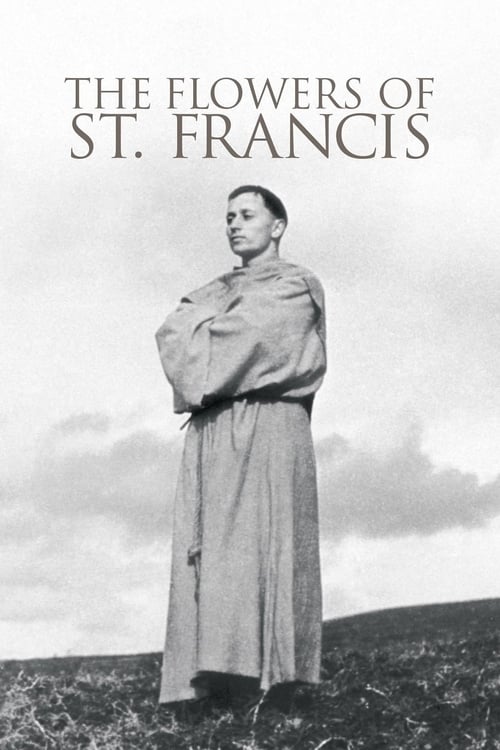
The Flowers of St. Francis
1950 · Roberto Rossellini
For a contemplative evening when you want stillness and grace instead of plot — a palate cleanser when the world feels loud. It's a comfort watch of an unusual kind: not cozy, but genuinely peaceful.
What it's about
Saint Francis of Assisi and his small band of early followers live out their faith in a series of simple, often comic vignettes — begging, preaching, botching good deeds, and greeting every humiliation with joy. There's no plot in the usual sense: just episodes of humility, compassion, and holy foolishness, drawn from a medieval anthology of stories about the saint, with the bumbling Brother Juniper supplying much of the comedy.
The experience
Gentle, funny, and quietly radiant — it treats sanctity not as solemn spectacle but as a kind of cheerful foolishness, and its lightness is disarming. It leaves you calm in a way few films do, whatever you believe.
Performances
The friars are played by real Franciscan monks rather than professional actors, and their unpolished sincerity is exactly the point — no performance, just presence.
The craft
Roberto Rossellini, co-writing with a young Federico Fellini, strips away conventional drama for a chain of short episodes photographed with a luminous simplicity that evokes medieval painting. The neorealist method — real people, real places, no gloss — is here turned from war and poverty toward joy, which makes it one of the movement's most surprising works.
Why it matters
Made at the hinge between Rossellini's postwar war films and his later spiritual work, it became a touchstone for filmmakers interested in portraying faith on screen, and is regularly cited among the greatest religious films ever made.
Snapshot
The Flowers of St. Francis (Italian: Francesco, giullare di Dio — literally "Francis, God's Jester") is Roberto Rossellini's episodic portrait of Saint Francis of Assisi and his early companions, drawn from the fourteenth-century devotional anthology I Fioretti di San Francesco ("The Little Flowers") and the associated Life of Brother Juniper. Made in 1950, at the hinge between Rossellini's celebrated postwar "war trilogy" and the more openly spiritual, essayistic work of his years with Ingrid Bergman, the film abandons conventional plot for a chain of nine short vignettes bracketed by a prologue. It was co-written with the young Federico Fellini and cast almost entirely with real Franciscan friars rather than professional actors. Understated, anti-heroic and often comic, it treats sanctity not as spectacle but as a series of small, humble gestures. Initially met with indifference or hostility, it has since become one of the most admired films of Rossellini's career, a touchstone for a humane, contemplative mode of religious cinema.
Industry & production
The film belongs to the fertile, precarious world of early-1950s Italian production, when Rossellini's international fame (from Rome, Open City and Paisà) coexisted with commercial uncertainty and the scandal surrounding his relationship with Bergman. It was produced within the Italian industry — the record commonly attaches the production to companies in Rossellini's orbit (Rizzoli/Cineriz is frequently cited in connection with his films of this period), though sources vary on the exact corporate credit and I would flag the precise financing arrangement as one of the thinner points in the documentary record. What is clear is the production's deliberately modest scale: shot largely on location in the countryside outside Rome, using natural settings, plain costumes and a cast of non-professionals. This economy was not merely budgetary but programmatic — the film's Franciscan subject and its aesthetic of poverty are of a piece. The involvement of Franciscan clergy as advisors and performers gave the production an unusual institutional character, closer to a collaboration with a religious community than a standard studio venture. The picture was presented at the Venice Film Festival in 1950, where its reception was cool.
Technology
Technologically the film is conservative and of its moment: black-and-white 35mm, standard Academy ratio, monophonic optical sound, post-synchronized dialogue in the normal Italian practice of the era. There are no technical novelties to report, and it would be false to claim any. The significant "technological" fact is a negative one — Rossellini's continued reliance on available light, real locations and lightweight, mobile shooting methods inherited from neorealism, in preference to the resources of the studio. As was typical of Italian production, sound was recorded and dubbed in post-production rather than captured live, which shaped the film's slightly abstracted, incantatory soundtrack. The English-language markets received a shortened, re-edited version, a common fate for Italian art films exported in this period; the fullest and most authoritative form of the film is the Italian original, and later restorations have worked to recover it.
Technique
Cinematography
The cinematography is by Otello Martelli, a major figure of the period who had photographed Rossellini's Paisà and Stromboli and would become a key collaborator of Fellini. His work here is restrained and luminous. The photography is frequently described as evoking the frescoes and panel paintings of Francis's own era — flattened, frontal compositions, figures set against sky and open ground, a plainness that reads as devotional rather than decorative. Martelli favors even, natural daylight and long-held framings that let action unfold within the shot. The camera observes rather than dramatizes; there is little of the expressive chiaroscuro one might expect from a "religious" film. The famous rain sequence, in which the friars are drenched, exemplifies the approach: physical weather, real bodies, and a documentary attention to discomfort and joy that keeps the sacred grounded in the material world.
Editing
Editing was by Jolanda Benvenuti, a frequent Rossellini collaborator. The film's most consequential formal decision is structural rather than shot-to-shot: the narrative is built as discrete episodes, each self-contained, without the causal chaining of classical dramaturgy. Within scenes the cutting is spare and unhurried, preserving duration and the integrity of the performers' actions. The refusal to build conventional tension through montage is itself the point — the editing enacts the Franciscan renunciation of worldly striving, letting incidents simply occur and pass. This episodic assembly, closer to an illuminated manuscript's sequence of exempla than to a three-act structure, is what most estranged early audiences and most attracts later admirers.
Mise-en-scène / staging
The staging is deliberately humble. Costumes are rough friar's habits; settings are fields, huts, a rudimentary chapel, muddy paths. Rossellini keeps his figures small within the landscape, emphasizing their smallness before nature and God. The direction of non-professional bodies — their real awkwardness, their unactorly stillness — is central to the mise-en-scène's authenticity. The one flamboyant set-piece, the encounter between Brother Juniper and the tyrant Nicolaio, introduces a grotesque, near-carnivalesque staging (an armored, bellowing warlord) that contrasts with the surrounding gentleness; this comic register is widely associated with Fellini's contribution.
Sound
The soundtrack combines post-synchronized dialogue with music by the director's brother, Renzo Rossellini, and liturgically inflected passages appropriate to the medieval subject. The overall sound design is sparse and clarifying rather than immersive; birdsong, rain and silence carry weight. Renzo Rossellini's score supports the film's serenity without underlining emotion in the manner of Hollywood scoring. The precise balance of original composition and adapted sacred/liturgical material is not something I can itemize with confidence, and I note that rather than guess.
Performance
The casting of actual Franciscan friars, reportedly from a monastery community (the grounding text names Nocera Inferiore), is the film's defining performative gamble. Nazario Gerardi plays Francis; the friars play the brothers. Their non-professionalism yields a transparency — gestures that feel found rather than performed — consistent with neorealist practice, but turned here toward the spiritual rather than the social. The notable professional presence is Aldo Fabrizi, the veteran actor of Rome, Open City, who plays the tyrant Nicolaio as broad comic caricature. The tension between Fabrizi's theatrical bravura and the friars' plainness is productive, dramatizing the gulf between worldly power and holy simplicity.
Narrative & dramatic mode
The film is essentially anti-dramatic. It offers no protagonist's arc, no rising conflict and resolution, no psychological interiority in the modern sense. Instead it presents a paratactic series of parables — Francis preaching, the brothers' encounters with a leper and with the poor, Juniper's literal-minded charity and comic misadventures, the community's exposure to weather and want. The organizing logic is spiritual exemplarity: each vignette illustrates a virtue (humility, obedience, joy in poverty, love of enemies) as the source Fioretti does. The closing image, in which the friars spin themselves dizzy and set off in the directions they fall — dispersing to preach — is the film's nearest thing to a "conclusion," and it resolves nothing narratively while completing the film thematically. This mode, narrative-as-litany, is precisely what distinguishes the film from both the biopic and the historical epic.
Genre & cycle
Nominally a historical-religious drama, the film sits athwart its genres. It rejects the pageantry of the Hollywood biblical/saint's-life spectacle and the sober prestige of the historical biopic. It is better understood within Rossellini's own developing cycle of postwar spiritual films — the arc running through Stromboli (also 1950), Europe '51 and Journey to Italy, in which grace, faith and redemption become explicit concerns. It also belongs to a broader lineage of "hagiographic" or humanist religious cinema that stretches back to silent depictions of saints and forward to later austere treatments of the sacred. Its comedy — especially the Juniper episodes — pulls it toward a folk-comic register unusual in the pious film, closer to the medieval giullare (jester) of its Italian title than to solemn devotion.
Authorship & method
The film is fully a Rossellini work in its method — location shooting, non-professional casting, ethical attention to the real, a preference for observation over manipulation — but it is a genuinely collaborative artifact. Roberto Rossellini directs and co-writes, extending the neorealist toolkit toward transcendence: the same means that documented war rubble now seek to render sanctity without idealization. Federico Fellini, then near the start of his career and already a key Rossellini screenwriter (on Rome, Open City and Paisà), co-wrote the film and is credited by many accounts with assistant-directing; the film's comic and grotesque strains, particularly around Brother Juniper and Nicolaio, are commonly read as anticipations of his own cinema. Otello Martelli (cinematography) supplies the painterly, plain-light image. Renzo Rossellini (music), the director's brother and habitual composer, provides a spare, devotional score. Jolanda Benvenuti (editing) executes the episodic assembly. The production was also shaped by Franciscan advisors — the names of clergy such as Father Félix Morlion and Father Antonio Lisandrini appear in connection with the film's religious grounding — whose participation guaranteed the fidelity of its Franciscan spirit; the exact division of their contributions is imperfectly documented and I flag it as such.
Movement / national cinema
The film is a product of Italian neorealism at the point of its transformation. Rossellini had been, with De Sica and Visconti, one of the movement's founders; The Flowers of St. Francis both continues neorealism (real places, real non-actors, an ethic of humility before the world) and departs from it (a medieval, spiritual subject rather than contemporary social hardship). Critics often describe this phase as "neorealism of the interior" or as the movement's turn from the social to the metaphysical. Within Italian national cinema it thus marks a pivotal moment: the documentary conscience of the postwar years redirected toward questions of faith and grace, a redirection that would prove decisive for later Italian directors — Fellini above all, and later Pasolini in his own confrontations with the sacred.
Era / period
Historically the film speaks from a specific postwar moment. Made five years after the war's end, in a Europe still rebuilding materially and morally, its images of a community that chooses poverty, endures hardship with joy and answers cruelty with love carry an unmistakable contemporary resonance. Critics have long read the friars' privations as refracting the recent experience of deprivation and the search for spiritual renewal amid ruin. The film's medieval setting is, in this sense, a mirror for 1950: an argument, made in a time of reconstruction and Cold War anxiety, for humility and charity as answers to a broken world. Its production also coincides with Rossellini's personal upheaval and the beginning of his most spiritually searching decade.
Themes
The governing themes are humility, poverty, joy, obedience, charity toward the outcast, and love of one's enemy — the core Franciscan virtues, dramatized as lived practice rather than doctrine. Simplicity is both subject and method: the film argues that holiness lies in small, unglamorous acts. Foolishness-as-wisdom recurs, most sharply in Brother Juniper, whose literal, guileless charity makes him a "fool for God" and links the sacred to the comic. The relation of the spiritual to the material — bodies in rain and mud, hunger, cold — insists that grace is found in, not above, the physical world. And the film meditates on non-violence and gentleness before power, staged in the confrontation with the tyrant. Underlying all is a vision of the created world (birds, weather, earth) as a site of communion, faithful to Francis's own sensibility.
Reception, canon & influence
Contemporary reception was, by most accounts, muted to unfavorable: presented at Venice in 1950, the film puzzled audiences and critics accustomed to stronger dramatic shape, and it did not perform as a popular success. Its reputation was rescued and then elevated chiefly by French criticism. The writers of Cahiers du Cinéma and the milieu around André Bazin — who was among Rossellini's most influential defenders — championed the film, and the young critics who became the New Wave (Truffaut, Rohmer and others) held it in high esteem; it has since appeared on serious lists of the greatest films and is routinely cited as one of Rossellini's finest achievements. Its restoration and reissue (notably via the Criterion Collection for English-speaking audiences) consolidated its canonical standing.
Looking backward, the film's influences are twofold: the literary source of I Fioretti and the Life of Brother Juniper, which supply its episodes and their moral shape; and the visual tradition of early Italian religious painting, which its compositions consciously evoke. Its method extends the neorealist practice Rossellini himself had helped create.
Looking forward, its influence is considerable and specific. It stands as a formative text for Fellini's own career. More broadly it helped legitimize a contemplative, anti-spectacular treatment of the sacred that resonates through later cinema — most directly in Pier Paolo Pasolini's The Gospel According to St. Matthew, with its non-professional cast and stark, reverent plainness, and in the wider lineage of humanist religious filmmaking. Its refusal of dramatic convention in favor of episodic, observational storytelling also anticipates strategies later directors would use to render inner and spiritual experience. Where precise lines of transmission to individual filmmakers are asserted, they should be read as critical consensus rather than documented statements of intent; but the film's status as a wellspring for serious cinema about faith is not seriously disputed.
A Deleuzian reading
Near the end, the friars stand in an open field and spin.
The full Deleuzian reading of The Flowers of St. Francis →
Reception
Dismissed by many Italian critics in 1950 as a slight, naive detour after Rossellini's war trilogy, it was later championed by Truffaut and Pasolini and is now widely ranked among Rossellini's greatest films.
How The Flowers of St. Francis was received, from release to now →
Influences: the films it descends from and the films it influenced
- Rome, Open City (1945) — Establishes the neorealist toolkit Francis inherits — actual-location shooting and non-professionals blended with a few pros — while its co-writer Fellini carries the same collaboration directly into St. Francis.
- Paisà (1946) — Its six loosely-linked vignette structure is the direct formal template for Francis's chapter-like, self-contained episodes drawn from I Fioretti, again co-scripted with Fellini.
- Germany Year Zero (1948) — Perfects Rossellini's observational, non-manipulative camera and non-professional lead, the same ethical attention-to-the-real Francis redirects from war rubble toward sanctity.
- The Passion of Joan of Arc (1928) — Pioneers rendering the sacred through austere, stripped compositions and unglamorized faces rather than spectacle, the transcendental-via-plainness strategy Francis adopts for hagiography.
- La Strada (1954) — Gelsomina's holy foolishness and the film's grotesque-clown pathos flower directly out of Fellini's comic Brother Juniper and Nicolaio episodes he co-wrote for Francis.
- Nights of Cabiria (1957) — Centers a naive, radiant innocent whose simplicity reads as grace, the holy-fool protagonist Fellini first developed writing Francis's Juniper.
- The Gospel According to St. Matthew (1964) — The most direct heir — a non-professional cast and stark, reverent plainness depicting a sacred figure without idealization, explicitly extending Rossellini's neorealist sanctity.
- Au hasard Balthazar (1966) — Frames innocent, uncomprehending suffering as saintliness across discrete episodes, extending Francis's linkage of holy-foolishness to a passive, Christ-like figure.
- Andrei Rublev (1966) — Structures the life of a holy man as discrete, semi-autonomous chapters and composes shots after period religious painting, both devices Francis models on I Fioretti and early Italian fresco.
- The Tree of Wooden Clogs (1978) — Uses an entirely non-professional peasant ensemble in humble rural mise-en-scène with painterly natural light, carrying Francis's neorealist depiction of unassuming piety forward.
- Brother Sun, Sister Moon (1972) — Takes up the same St. Francis material and the ideal of Franciscan poverty, defining itself against Rossellini's austere plainness by opting instead for lyrical spectacle.
- Of Gods and Men (2010) — Observes a monastic community's daily rhythms with anti-spectacular restraint and near-documentary attention, inheriting Francis's contemplative, event-refusing treatment of communal faith.
- Europa '51 (1952) — Rossellini's use of actual Franciscan monks as nonprofessional performers to embody a hagiographic narrative of radical charity — the found-environment staging of institutional rejection — establishes the mixed-cast template and the saint-as-social-inconvenience structure that Europa '51 transplants into secular-bourgeois milieu.
- Happy as Lazzaro (2018) — Franciscan model of sanctity through simplicity — real friars playing themselves in episodic beatitude — the template for Lazzaro's guileless, self-effacing holiness.
- Nazarín (1959) — Renders the holy fool through humble, discrete comic-devotional vignettes in a plain documentary register, the episodic sanctity structure Nazarín secularizes into ironic Quixotic wandering.
- Kaos (1984) — Its chaptered episodes of saintly anecdote, staged with lay non-professionals in bare landscape, pioneered the neorealism-into-parable move — raw location realism tipped toward fable — that governs every Kaos episode.
- La Terra Trema (1948) — Casts real Sicilian fishermen speaking their own dialect, the radical non-professional-ensemble practice Francis extends by using actual Franciscan friars as the monks.
- Bicycle Thieves (1948) — Builds an entire drama on a non-actor factory worker and street-level locations, sharing Francis's neorealist refusal of studio artifice and star performance.
- Diary of a Country Priest (1951) — Renders inner spiritual experience through anti-dramatic ellipsis and de-theatricalized performance, the contemplative, event-refusing treatment of faith Francis pioneered a year earlier.
- Ordet (1955) — Stages faith through long-take duration and the plain-spoken holy fool Johannes, sharing Francis's patient, undramatized register for the miraculous.
Similar films
- The Tree of Wooden Clogs (1978) — influence & lineage · often watched together
- Paisan (1946) — influence & lineage
- Rome, Open City (1945) — influence & lineage
- Diary of a Country Priest (1951) — influence & lineage
- Germany, Year Zero (1948) — influence & lineage
- Nights of Cabiria (1957) — influence & lineage
- Bicycle Thieves (1948) — influence & lineage
- Au Hasard Balthazar (1966) — influence & lineage