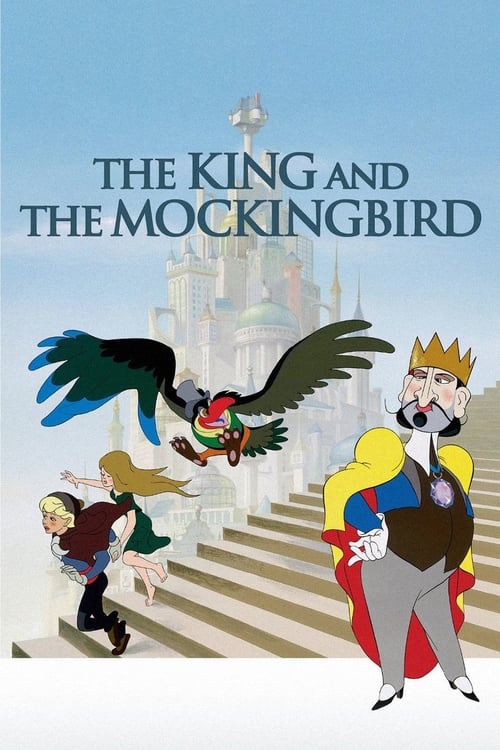
The King and the Mockingbird
1980 · Paul Grimault
For when you want animation with real soul — a fairy tale for a quiet evening that works whether you're eight or eighty, comforting on the surface with something darker humming underneath.
What it's about
In the vertiginous kingdom of Takicardie, a vain and tyrannical king falls for a shepherdess in a painting — but she loves the chimneysweep in the frame beside hers. The two step out of their pictures and flee across the castle's dizzying towers and depths, aided by a cheeky, fearless mockingbird who has old scores to settle with the king. What follows is a chase through a whole invented world, from palace heights to the forgotten city below.
The experience
It plays like a dream you half-remember: whimsical and funny one minute, eerie and melancholy the next, with images so strange and grand they stay with you. The pace is unhurried, closer to a poem than a cartoon.
The craft
Three decades in the making, and it shows in the best way: hand-drawn architecture of impossible elevators, endless staircases and looming statues, scripted with the poet Jacques Prévert so even the jokes have a lyric edge. The vertical design of the kingdom itself is the star — it rewards a screen big enough to feel the drop.
Why it matters
A touchstone of European animation whose fingerprints are all over later masters of the form, most famously the founders of Japan's greatest animation studio, who cited it as formative. Its troubled 30-year production is itself legend.
Snapshot
Le Roi et l'Oiseau is the culmination of one of the longest and most fraught production sagas in animation history: a film first begun in 1948, abandoned in a bitter rights dispute, and finally completed and released by its director more than three decades later. Loosely adapted from Hans Christian Andersen's tale "The Shepherdess and the Chimney Sweep," it follows two figures in paintings — a shepherdess and a chimneysweep — who step out of their frames to flee the tyrant who rules the vertiginous kingdom of Takicardie, aided by a sardonic, widowed mockingbird who is the king's sworn enemy. Directed by Paul Grimault and scripted with the poet Jacques Prévert, it is at once a children's fable, an anti-authoritarian parable, and a work of visual architecture whose influence on later animation — above all on the founders of Studio Ghibli — is difficult to overstate. It stands as the foundational monument of feature-length French animation.
Industry & production
The film's production is inseparable from its meaning, and it is the single most documented fact of its history. Grimault and Prévert, who had collaborated in the 1940s (notably on the short Le Petit Soldat, 1947), began an ambitious feature under the title La Bergère et le Ramoneur ("The Shepherdess and the Chimney Sweep") in 1948. The project ran aground amid a financial and creative conflict between Grimault and his producer, André Sarrut. In 1952 Sarrut released a version of the film that Grimault considered unfinished and compromised; Grimault disowned it. That 1952 cut nonetheless circulated internationally and is the version an entire generation, including young animators in Japan, first encountered.
Over the following two decades Grimault worked to regain the rights to the material, which he eventually did, and set about completing the film on his own terms — restoring, reanimating, and extending it, and reshaping the whole under the new title Le Roi et l'Oiseau. Prévert continued to work on the project into the 1970s but died in 1977, before the film was finished; the completed version is in part a memorial to that collaboration. The finished feature, running roughly 87 minutes, was released in France in 1980 through Grimault's own production entity in partnership with other French backers including the television broadcaster Antenne 2. Beyond this narrative arc, granular English-language documentation of budgets, schedules, and precise box-office figures is thin, and I will not invent numbers; the essential industrial fact is that this was an auteur's decades-long reclamation of his own film from commercial circumstance.
Technology
The film is traditional hand-drawn, cel-based animation, and its production straddles a remarkable technological and stylistic gulf: footage and design conceived in the late 1940s had to be integrated with animation produced in the 1970s. Part of the artistry of the finished film lies in reconciling these strata so that the seams are invisible, a task of matching line, palette, and movement across thirty years of evolving studio practice. There is no use of computer imagery; the film belongs wholly to the analog, photochemical tradition of drawn animation on painted backgrounds. Its ambitions lay not in any novel apparatus but in the sophistication of layout, perspective, and camera-move simulation achieved by conventional means.
Technique
Cinematography
In animation the "camera" is a constructed viewpoint, and here it is used with unusual architectural daring. The film repeatedly stages extreme verticality — plunging views down elevator shafts and tower stairwells, dizzying drops from the heights of the king's palace to the sunless lower city where the poor live. The "cinematography" favors deep, receding perspectives and long vertical compositions that dramatize a society organized by altitude, with the tyrant at the top and the powerless in the depths. Simulated camera movements — descents, sweeping reveals of the palace's scale — give the drawn spaces a sense of monumental depth.
Editing
The film's cutting balances lyrical, unhurried passages devoted to the fugitive couple and the bird against the accelerating pursuit set-pieces. Reliable, specific credit information for the editor is not something I can confirm from the readily established record, so I will not attribute it; what can be said is that the assembly integrates animation from widely separated production periods into a continuous whole, itself a feat of editorial and directorial control.
Mise-en-scène / staging
Staging is the film's supreme achievement. Takicardie is a fully imagined world: a colossal palace of impossible height, secret apartments, hidden passages, a hunting gallery, and a subterranean city below. The design tradition is emphatically un-Disneyish — cleaner, flatter, more graphic and modernist, with an emphasis on architecture and negative space rather than rounded naturalism. The king's private world is cluttered with the apparatus of narcissism and surveillance (portraits, trapdoors, a secret elevator); the lower city is drab and lightless. Presiding over everything is a giant robot, a towering automaton that the king commands and that becomes, in the finale, the instrument of the tyranny's undoing.
Sound
The score is by the Polish composer Wojciech Kilar (later internationally known for Bram Stoker's Dracula and The Pianist), and it is one of the film's glories — by turns romantic, menacing, and melancholic, lending the fable both tenderness and grandeur. The sound design supports the world's mechanized menace: the tramp of the automaton, the machinery of the palace, the birdsong and human bustle of the lower city.
Performance
Voice performance carries the film's tonal register, split between the lyrical (the shepherdess, the chimneysweep) and the comic-satirical (the bird, whose wry running commentary shapes the film's point of view). The king is a study in vanity and cruelty. I am not able to confirm the complete voice cast of the 1980 French version with the certainty required to attribute specific roles here, and I will not guess; the salient point is dramaturgical — the bird functions as narrator, trickster, and moral conscience, and the vocal characterization of that role is central to the film's sardonic warmth.
Narrative & dramatic mode
The narrative mode is the literary fairy tale reworked into political allegory. Its inciting conceit is a surrealist coup: the portraits in the king's palace are alive, and when the painted shepherdess and chimneysweep escape their frames to be together, the king's own painted double steps out, destroys the real king, and assumes his throne, pursuing the lovers with redoubled vindictiveness. The story thus doubles the tyrant — replacing a bad king with his idealized self-image, an even more absolute despot. The dramatic engine is a chase, but the mode is fabulist and poetic rather than realist, threaded throughout with Prévert's characteristic irony, wordplay, and sympathy for the humble against the powerful. The tone modulates freely between whimsy, romance, satire, and, at the climax, something close to apocalyptic spectacle.
Genre & cycle
As genre it is animated fantasy and family film, but it sits athwart the dominant animated cycle of its era. Where the postwar feature-animation landscape was defined internationally by the Disney model of naturalistic character animation and musical sentiment, Le Roi et l'Oiseau belongs to a European, literary, art-cinema strain — closer in spirit to illustrated fable and to the surrealist and poetic traditions of French culture. It is a fantasy of tyranny and liberation in the lineage of the political fairy tale, and its release in 1980 made it a singular object with few contemporaneous peers in its own national cinema.
Authorship & method
The film is, above all, an authorial project sustained across a lifetime. Paul Grimault (1905–1994) is its guiding intelligence — a pioneer of French animation whose method here was one of patient reclamation and completion, imposing a unified vision on material accreted over decades. His authorship is visible in the graphic clarity of the design and the architectural imagination of the staging.
His essential collaborator was the poet and screenwriter Jacques Prévert (1900–1977), one of the towering figures of twentieth-century French letters and cinema, celebrated for his screenplays for Marcel Carné (Les Enfants du Paradis, Le Jour se lève) and for his popular poetry. Prévert brought to the film its anti-authoritarian tenderness, its verbal wit, and its solidarity with the downtrodden; his death before completion casts the finished film as a posthumous collaboration.
The score by Wojciech Kilar is the third pillar of the film's authorship, giving the fable its emotional and dramatic scale. For other key below-the-line collaborators — editor, and the animation and background artists who executed the layouts — the specific, verifiable credits are not something I can state reliably from the established English-language record, and I decline to invent attributions.
Movement / national cinema
The film is the landmark of French feature animation and a keystone of any account of that national tradition. It defines an alternative to the American studio aesthetic — graphic, literary, adult in its intelligence even while addressed to children. Through Prévert, it also carries a direct genealogical link to French poetic realism and to the surrealist current in French art, translating those sensibilities into the medium of drawn animation. Grimault is routinely positioned as the founding master of the French animated feature, and this film as the tradition's defining work.
Era / period
Le Roi et l'Oiseau is a film out of time. Conceived in the immediate postwar years, when questions of authority, resistance, and mechanized power were freshly urgent, it reached completion only in 1980, into a very different cinematic and political climate. This temporal doubling is not incidental: the finished film reads simultaneously as a 1940s fable and as a 1980 reflection upon that fable, its themes of tyranny and automation having lost none of their resonance in the interval. It belongs to no single moment but bridges the postwar and the modern.
Themes
Its central theme is tyranny and its overthrow — the concentration of power at the literal and figurative top of society, and the aspiration to freedom of those below. Class is inscribed into the very geography of Takicardie, with luxury in the heights and the sunless poor in the depths. Surveillance, vanity, and the cult of the leader's self-image drive the plot's uncanny doubling of the king. Automation and mechanized force are embodied in the giant robot, an ambivalent figure of destructive power that can serve tyranny or, turned against it, liberation. Set against these are love, artistic creation (the living paintings), and the yearning for flight — the bird as the recurring emblem of freedom. The film's closing image, in which the great automaton, having razed the palace, crushes an empty birdcage, distills the whole into a single gesture: the machinery of oppression made, at last, an instrument of release.
Reception, canon & influence
Critically, the completed 1980 film was received as a major work and a vindication of Grimault's decades-long struggle; it is widely reported to have won France's Prix Louis Delluc for 1979, a rare and significant honor for an animated feature, and it has since been enshrined as a classic of the medium. Later restoration and international re-release (including a subtitled North American release in the 2010s through Rialto Pictures) renewed critical attention and confirmed its standing among the greatest of all animated films.
Influences on the film (backward): Its literary source is Andersen's "The Shepherdess and the Chimney Sweep," transformed almost beyond recognition. Its sensibility draws on French surrealism and on the poetic-realist tradition Prévert helped define in 1930s–40s French cinema, and on a European graphic-art tradition distinct from the Disney model against which it implicitly defines itself.
Legacy (forward): The film's most celebrated legacy is its formative impact on the founders of Studio Ghibli. Isao Takahata and Hayao Miyazaki have credited the film (encountered in its earlier form) as a decisive influence, and Ghibli was involved in its Japanese distribution — Takahata in particular championed it. The kinship is legible on screen: the melancholy, powerful robots of Miyazaki's Castle in the Sky (1986) echo Grimault's towering automaton, and the film's marriage of architectural fantasy, anti-authoritarian politics, and lyrical humanism prefigures much of Ghibli's ethos. More broadly, Le Roi et l'Oiseau remains the touchstone and origin point for the French animation tradition that later produced filmmakers such as Sylvain Chomet, and it is regularly cited by scholars and animators as one of the essential works of the art form — a fable whose long journey to completion became part of the legend it now carries.
A Deleuzian reading
A painted shepherdess lifts one foot over the bottom edge of her own picture frame and steps down into the room.
The full Deleuzian reading of The King and the Mockingbird →
Reception
Its unfinished 1952 version was released by the producer against Grimault's wishes and disowned by him; when he finally finished it in 1980 it won the Prix Louis-Delluc and is now enshrined as the masterpiece of French animation.
How The King and the Mockingbird was received, from release to now →
How to watch The King and the Mockingbird: what to notice on a first viewing
- Watch the film plunge down stairwells and elevator shafts. The animation repeatedly stages extreme vertical drops from the palace heights to the lightless lower city, dramatizing a world organized by altitude. Height itself becomes the film's map of power, without a word of dialogue needed to explain who rules whom.
- Notice the design's flat, clean lines over rounded softness. The graphic style favors architecture and negative space over the rounded, naturalistic look you might expect from an animated fairy tale. The cleaner, more modernist look keeps the film feeling closer to a diagram than a storybook.
- Listen for the score shift between tenderness and menace. Wojciech Kilar's music moves between romantic warmth and something more threatening, often within the same sequence. The shifting score is doing the emotional labor a fairy tale usually leaves to narration.
- Notice the towering automaton the king commands. A giant robot looms over the kingdom throughout, presented as an instrument of the king's will rather than a separate character. The robot's size makes the king's power feel enormous.
The whole guide to watching The King and the Mockingbird, with the keys for a rewatch →
Influences: the films it descends from and the films it influenced
- La Bergère et le Ramoneur (1952) — Its own truncated first version — Grimault physically reclaimed the surviving 1940s cels and layouts and re-integrated them with new footage, the literal source of the film's cross-decade hand-drawn-cel continuity.
- Le Petit Soldat (1947) — The first Grimault–Prévert animated collaboration, establishing their anti-militarist toy-fable idiom of automatons and mechanical figures set against a lyrical human tenderness.
- Les Enfants du Paradis (1945) — Prévert's screenwriting method — verbal wit, solidarity with the downtrodden, and a tiered social theater — carried directly into the film's dialogue and its stratified world of masters and servants.
- Le Jour se lève (1939) — Poetic-realist verticality: Prévert traps his hero high in a garret above the crowd, prefiguring the film's mapping of class onto architectural height and the doomed figure aloft.
- Metropolis (1927) — Extreme architectural verticality as political diagram — an oppressive towering megastructure with rulers up top and the exploited below — the exact spatial grammar of the King's tiered palace.
- The Adventures of Prince Achmed (1926) — Founding European feature-animation tradition built on flat graphic silhouette and design rather than Disney volumetric naturalism, the lineage Grimault's graphic modernism extends.
- Snow White and the Seven Dwarfs (1937) — The cel-animated feature template Grimault defines himself against — his flat, poster-like graphic design and cool palette are a deliberate anti-Disney refusal of rounded naturalism.
- Nausicaä of the Valley of the Wind (1984) — Miyazaki's anti-authoritarian humanism and lyrical staging of vast machines against fragile life derive from the Grimault film he credited as decisive.
- Castle in the Sky (1986) — Its melancholy, protective giant robot is a near-direct homage to Grimault's towering automaton, and its floating tiered city extends the architectural-fantasy verticality.
- Grave of the Fireflies (1988) — Takahata — the film's champion and Japanese distributor — carries forward its Prévert-derived tenderness toward the powerless within a rigorously composed, non-cartoon dramatic register.
- Kirikou and the Sorceress (1998) — Revives the French feature-animation political fable through deliberately flat, graphic-poster staging descended from Grimault's anti-Disney design ethic.
- The Triplets of Belleville (2003) — Chomet inherits Grimault's line of French caricatural graphic design and near-wordless, architecturally exaggerated cityscapes as expressive character in their own right.
- Persepolis (2007) — French hand-drawn animation deploying stark graphic flatness in service of political allegory and anti-tyranny fable, the tradition Grimault originated.
- The Illusionist (2010) — Sustains the melancholy poetic-realist mood and Prévert-adjacent lyricism (from a Tati script) in painterly hand-drawn cityscapes built on architectural staging.
- The Secret of Kells (2009) — Extends the anti-Disney graphic-modernist wing of European animation, building space from flat decorative pattern and vertical architectural stylization rather than illusionistic depth.
- Spirited Away (2001) — Grimault's vast vertical architecture and tyrant-in-a-tower staging gave Miyazaki and Takahata their model for reading a whole moral world through built space — directly echoed in Yubaba's stacked bathhouse.
- Azur & Asmar: The Princes' Quest (2006) — The founding work of French auteur animation, whose ornate hand-designed architecture and pictorial care establish the national craft tradition of decorative background-as-authorship that Ocelot continues.
- The Tale of The Princess Kaguya (2013) — The European poetic-animation model Takahata openly cited as founding Ghibli's ethos — literate, painterly, unhurried — a direct lineage to Kaguya's hand-drawn lyricism.
- Wolfwalkers (2020) — Opposes the towering rigid architectural verticals of tyranny to organic, rounded freedom, the 'rigid verticals vs rounded lines' compositional grammar Wolfwalkers uses for walled town against wild wood.
- Gulliver's Travels (1939) — Contemporary non-Disney feature animation that likewise stages a scale-contrast fable of a giant among tiny townsfolk, a graphic tradition parallel to Grimault's automaton-versus-populace staging.
- Fantastic Planet (1973) — French surrealist feature animation sharing the poetic-realist/surrealist inheritance and a political allegory of automated domination rendered through eerie graphic-design flatness.
Similar films
- Castle in the Sky (1986) — influence & lineage
- Grave of the Fireflies (1988) — influence & lineage
- Princes and Princesses (2000) — shared sensibility
- The Tale of The Princess Kaguya (2013) — shared sensibility
- Spirited Away (2001) — shared sensibility
- Ratatouille (2007) — shared sensibility
- Beauty and the Beast (1991) — shared sensibility
- Azur & Asmar: The Princes' Quest (2006) — shared sensibility