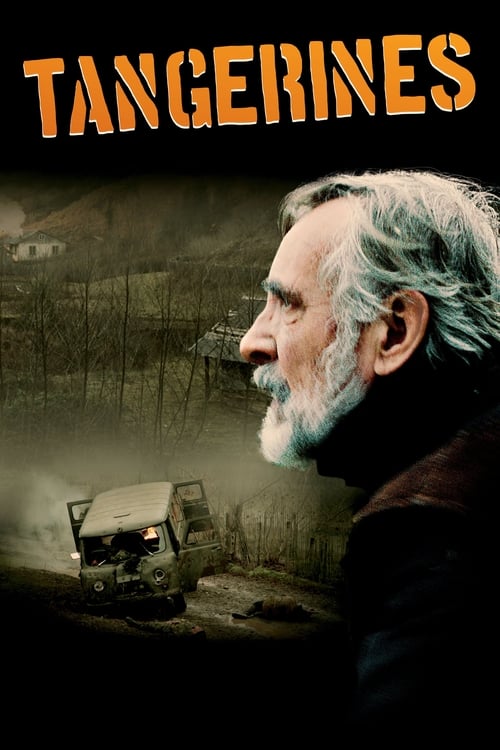
Tangerines
2013 · Zaza Urushadze
When you want a film to chew on for days — a humane, sobering chamber piece about decency under fire. A challenge in subject but not in form: it's short, clear, and completely gripping.
What it's about
Abkhazia, 1992, as war between Georgian forces and Abkhaz separatists closes in. Ivo, an aging Estonian carpenter, has stayed behind in a nearly abandoned settlement to help his neighbor bring in one last crop of tangerines. When a firefight erupts outside his house, he takes in two wounded survivors from opposite sides — a Chechen mercenary and a Georgian soldier — who each swear to kill the other the moment they're healed, held in check only by their debt to the man who saved them.
The experience
Spare, quiet, and coiled tight — most of it unfolds in one house, where every shared meal is a negotiation and the war rumbles closer outside. It's contemplative rather than action-driven, and it builds to real moral weight; the ending stays with you.
Performances
Lembit Ulfsak's Ivo is the film's moral center — a performance of weathered calm and quiet authority that makes the household's fragile truce believable.
The craft
The filmmaking is deliberately unadorned: a handful of rooms, an orchard, long unhurried scenes that let hostility thaw by degrees. The restraint is the point — with no spectacle to hide behind, every glance and silence carries the tension.
Why it matters
An Estonian-Georgian co-production that earned Academy Award and Golden Globe nominations for best foreign-language film, bringing a little-known corner of post-Soviet conflict to world audiences and becoming a modern touchstone of humanist anti-war cinema.
Snapshot
Tangerines (Estonian: Mandariinid; Georgian: მანდარინები) is a chamber war drama built on one of the oldest dramatic engines in cinema: enemies trapped under a single roof, bound by a host's law against killing. Set in Abkhazia in 1992, during the war between Georgia and Abkhaz separatists backed by North Caucasian volunteers, it follows Ivo, an aging Estonian carpenter who has stayed behind in a near-emptied Estonian settlement to help his neighbor Margus harvest a crop of tangerines before the front reaches them. When a firefight erupts at his door, Ivo takes in two mortally opposed survivors — a Chechen mercenary fighting for the Abkhaz, Ahmed, and a Georgian soldier, Niko — each of whom vows to kill the other once healed, and each of whom is held, for now, by their debt to the man who saved them. The film is compact, quiet, and unabashedly humanist, and it became a landmark for Estonian cinema as the first Estonian production nominated for the Academy Award for Best Foreign Language Film. It is a small movie with a large moral aim, and its reputation rests on the clarity of that aim as much as on its craft.
Industry & production
Tangerines is an Estonian–Georgian co-production, a pairing that is itself part of the film's meaning: an Estonian director of photography and largely Estonian financing brought to bear on a story about the vanished Estonian diaspora of Abkhazia, told by a Georgian writer-director. The Estonian communities of Abkhazia were real — villages founded by nineteenth-century settlers on the Black Sea coast — and most of that population left during and after the 1992–93 war, a historical erasure that gives the film's premise (Estonians packing to leave, tangerines rotting unharvested) its documentary undertow.
The production was modest by design: a handful of principal actors, a single primary location built around Ivo's house and Margus's orchard, and a short shooting scale appropriate to a contained drama. Reliable, verified budget and box-office figures for the film are not something I can state with confidence, and I will not invent them; what is well established is that the film's economics were those of a small European art-house co-production rather than a large-scale war picture, and that its commercial afterlife was driven by its awards run. That awards trajectory — a nomination at the 87th Academy Awards and a nomination for the Golden Globe for Best Foreign Language Film — did far more for the film's distribution and international visibility than any theatrical launch, and it is the reason a low-budget Estonian–Georgian chamber piece reached audiences well beyond either country.
Technology
There is nothing exhibitionist about the film's technology, and that restraint is the point. Tangerines was made in the register of contemporary naturalistic drama: available and motivated light, a controlled color world dominated by wood interiors, muted greens, and the recurring orange of the fruit, and a shooting approach that keeps the apparatus invisible. I would not want to assert specific camera or lens packages without documentation I can verify, so I'll leave the hardware unspecified rather than guess. What matters technologically is the aesthetic decision it serves: the film deliberately withholds spectacle. The war is heard and glimpsed — a truck, a checkpoint, gunfire off-screen — far more than it is staged, and the production's resources are concentrated on faces, a room, and the orchard, not on pyrotechnics. This is a film whose technical ambition is measured in intimacy rather than scale.
Technique
Cinematography
The photography, by the Estonian cinematographer Rein Kotov — one of Estonian cinema's most prominent DPs and a frequent presence on the country's international titles — is patient and legible. The camera favors stable framing, medium and close shots that hold characters in the same enclosed space, and a compositional logic organized around the geography of a single house: the table, the two sickbeds, the doorway, the yard. The tangerine orchard supplies the film's few open vistas and its dominant motif of color, the fruit's warm orange set against overcast coastal light and the grays of soldiers and rubble. Kotov's work is not showy; it is architectural, using the house as a pressure chamber and the orchard as the fragile pastoral that the war is about to consume.
Editing
Cut by Alexander Kuranov, the film moves at the unhurried tempo of a stage play opened just wide enough for cinema. Scenes are allowed to run on conversation and silence; the editing builds tension not through rapid cross-cutting but through duration — the accumulating hours in which two men who have sworn to kill each other must eat at the same table. The few eruptions of violence are brief and abrupt, and their editorial suddenness is calibrated against the surrounding calm so that they land as ruptures rather than set pieces.
Mise-en-scène / staging
This is essentially a single-set drama, and its staging is theatrical in the best sense. The house is the world: a wooden interior of workbenches, beds, and a shared table, with the orchard and road as the only exterior stage. The blocking is organized around proximity and threshold — who is allowed to move, who is bedridden, who crosses the doorway — so that physical space becomes moral space. Ivo's authority is spatial: it is his house, his rules, and the film keeps returning to the table as the arena where hostility is suspended by the etiquette of hospitality. The props do quiet thematic work, above all the tangerines themselves, a perishable crop standing for everything ordinary and life-sustaining that the war renders absurd.
Sound
The sound design privileges the off-screen war. Much of the conflict is delivered as sound — engines, distant fire, voices at the gate — which keeps violence perpetually adjacent without dominating the frame. The score by Niaz Diasamidze is spare and folk-inflected, using a small palette rather than orchestral swell; it underlines the film's elegiac register without pushing sentiment past what the images can bear. Silence is used as deliberately as music: the long quiets of the house are where the drama's tension actually lives.
Performance
The film rests almost entirely on its small ensemble, and the performances are its greatest strength. Lembit Ulfsak, a major Estonian actor, plays Ivo with a weathered, understated gravity — a man whose calm is a form of resistance, and whose grief (the reasons he has stayed behind) is disclosed slowly rather than declaimed. Elmo Nüganen brings a plainer, more pragmatic warmth to Margus, the neighbor fixated on his crop. The two combatants — Giorgi Nakashidze as the Chechen mercenary Ahmed and Mikheil Meskhi as the Georgian fighter Niko — carry the film's argument in their bodies, moving from raw hostility to a wary, grudging recognition of each other's humanity. The acting is naturalistic and restrained; the film asks the actors to enact reconciliation through small shifts of tone rather than speeches, and they largely deliver it.
Narrative & dramatic mode
Structurally, Tangerines is a classical enclosed drama with strong unities of place and action. Its mode is the moral fable staged as realism: a deliberately schematic situation — a neutral host, two enemies, a vow of restraint — worked through with enough behavioral specificity to keep it from collapsing into allegory. The narrative engine is the sworn oath not to kill under Ivo's roof, which converts the film into a slow negotiation between hatred and obligation. The dramaturgy is essentially theatrical: entrances and exits, a confined cast, dialogue-driven scenes, and a rising pressure toward a violent reckoning that the film both anticipates and, in its final movement, complicates. It is a story that knows it is a parable and mostly earns the mode by grounding it in exhausted, ordinary human beings rather than symbols.
Genre & cycle
The film sits at the intersection of the anti-war drama and the "enemies forced together" tradition — a lineage that runs through prisoner-of-war and no-man's-land stories where opposed soldiers are made to see one another as men. It belongs to the post-Soviet cycle of films reckoning with the wars that erupted across the Caucasus and the former Soviet space in the 1990s, a body of work preoccupied with fratricidal conflict, ethnic violence, and the small communities caught between armies. Within that cycle Tangerines is notable for its miniaturist scale and its explicitly pacifist thesis: rather than reconstruct a battle, it stages the war as an intrusion into a domestic space, aligning it with chamber anti-war dramas more than with combat cinema.
Authorship & method
The film is unmistakably the work of Zaza Urushadze (1965–2019), who wrote and directed it and whose sensibility — humanist, morally direct, formally restrained — governs every choice. Urushadze belonged to a generation of Georgian filmmakers working to rebuild a national cinema after the collapse of the Soviet industry, and Tangerines is his best-known international achievement. His method here is one of concentration: strip the war to a single house, reduce the cast to a handful, and let a clear ethical premise play out with minimal directorial intrusion. That directness is both the film's signature and, for some critics, its limit — the fable is legible almost to a fault.
The authorship is genuinely collaborative across the two national industries. Rein Kotov's cinematography supplies the film's restrained visual grammar; Alexander Kuranov's editing sets its patient rhythm; Niaz Diasamidze's music provides its folk-elegiac coloring; and the Estonian actors Lembit Ulfsak and Elmo Nüganen anchor its emotional center opposite the Georgian performers. It is worth stating plainly that the film is a co-authored object in the deepest sense: a Georgian director's script realized largely through Estonian craft and Estonian faces, about a shared Soviet-era history now torn apart by war.
Movement / national cinema
Tangerines is a hinge point for two national cinemas at once. For Estonia, it became the country's most internationally decorated film of its moment, the first Estonian production nominated for the Best Foreign Language Film Oscar — a genuine milestone for a small national industry with limited output and modest resources. For Georgia, it belongs to the revival of Georgian filmmaking in the 2000s and 2010s, a wave that carried directors and films onto the festival circuit after the lean post-Soviet years. The film's co-production status is not incidental to this: it exemplifies the pooling of resources across small European and post-Soviet industries that made ambitious festival cinema possible for countries that could not finance it alone. It is, appropriately, a film about a lost Estonian community in Georgian territory, made by Georgians and Estonians together.
Era / period
Made and released in 2013, the film is a product of the 2010s European festival ecosystem, in which national submissions to the Academy's foreign-language category function as a crucial visibility mechanism for small cinemas. Its diegetic period, though, is 1992 — the first year of the War in Abkhazia — and the film is a work of historical reckoning aimed at a conflict two decades in the past. That temporal distance matters: Tangerines addresses the 1990s Caucasus wars from the vantage of a later, more reflective moment, and its pacifism carries the retrospective weariness of a region that has lived with the consequences. In a period when new conflicts across the post-Soviet space kept the questions of ethnicity, borders, and fratricide urgently alive, the film's backward glance read as anything but antiquarian.
Themes
The film's governing theme is shared humanity across enemy lines — the recognition that the men trained to kill one another are, stripped of uniform and cause, indistinguishable in their fear, pain, and capacity for decency. Around that center cluster several others: hospitality as a moral and quasi-sacred law, embodied in Ivo's insistence that no blood be shed under his roof; the absurdity and waste of war, crystallized in the image of tangerines left to rot while men die over them; and grief and rootedness, in Ivo's reasons for staying behind when his community has fled. The Estonian setting adds a theme of exile and vanishing communities — a whole diaspora quietly erased by a war that is not even its own. Above all the film argues, without much irony, for the priority of the ordinary human bond over the abstractions of nation and ethnicity, and it is willing to pay for that argument in the currency of tragedy.
Reception, canon & influence
Critically, Tangerines was received as a sincere, well-crafted, morally transparent anti-war film — praised for its performances (Ulfsak's Ivo especially), its restraint, and its emotional clarity, and gently faulted by some reviewers for the schematic legibility of its parable. Its decisive canonizing event was its awards run: nomination for the Academy Award for Best Foreign Language Film at the 87th ceremony and nomination for the Golden Globe in the same category, alongside recognition on the festival circuit. That Oscar nomination, historic for Estonia, is the single fact most responsible for the film's durable international profile.
Looking backward, the influences on the film are less a matter of specific citation than of tradition: the enclosed anti-war drama of enemies compelled to coexist, the theatrical unities of the chamber play, and the post-Soviet cinema of Caucasus conflict. Its humanist directness places it in a long line of pacifist filmmaking that stages reconciliation between opposed soldiers as the ultimate rebuke to war — a lineage older than cinema itself but continuously renewed in it.
Looking forward, the film's most tangible legacy is institutional and national rather than stylistic. For Estonian cinema it functioned as a proof of concept — evidence that a small national industry could reach the Academy's shortlist — and it raised the international ceiling for Estonian–Georgian co-production. For Zaza Urushadze it became the defining title of a career cut short by his death in 2019, and it remains the primary reference point through which international audiences encounter both his work and the tragedy of Abkhazia's Estonian villages. I would be overstating the record to claim a wide school of imitators; its influence is better described as exemplary — a small, exportable model of how a modest, morally focused chamber film can carry a national cinema onto the world stage.
A Deleuzian reading
A table gets set.
The full Deleuzian reading of Tangerines →
Reception
A small Estonian–Georgian co-production that few saw on release, it stunned everyone by landing a 2015 Oscar nomination for Best Foreign Language Film — Estonia's first ever — in a murderers'-row year (Ida, Leviathan, Wild Tales), and has since grown into a word-of-mouth favorite far bigger than its original footprint.
How Tangerines was received, from release to now →
How to watch Tangerines: what to notice on a first viewing
- Notice how often the camera returns to the same table. Kotov organizes almost every shot around the house's few fixed points: the table, the two sickbeds, the doorway, the yard. You learn the geography quickly because the film keeps returning to it. The house becomes a small, readable world, and everything that matters happens inside its fixed points.
- Listen for the war as engines and gunfire past the gate. Much of the fighting arrives only as sound from beyond the house: distant fire, engines, voices at the gate. The camera almost never leaves the yard to show you the front directly. The war stays constantly close without ever fully entering the frame, which keeps you as uneasy as the men inside.
- Track how long scenes run without a single cut. Kuranov lets conversation and silence play out at length instead of cutting rapidly between the two wounded men. The tension builds from the accumulating hours, not from editing tricks. Sitting through the silence with them is the point. The film asks you to feel time pass the way they do.
- Spot the orange tangerines against the gray, overcast light. The fruit is the film's one strong color, set against muted greens, wood, and the grays of soldiers and rubble. The orchard keeps appearing as the film's only open, bright space. The tangerines carry the one note of ordinary, growing life in a story about men waiting to kill each other.
- Watch how small the shifts are between the two soldiers. Nakashidze and Meskhi play Ahmed and Niko with tight, restrained hostility that eases only in small gestures, a glance, a shared task, rather than any speech of reconciliation. You have to watch closely for the change, because the actors never announce it.
The whole guide to watching Tangerines, with the keys for a rewatch →
Influences: the films it descends from and the films it influenced
- Grand Illusion (1937) — Establishes the enclosed prisoner-chamber grammar in which enemy soldiers, kept from the front, are humanized through shared confinement and courtesy, with the war held almost entirely off-screen.
- Hell in the Pacific (1968) — Reduces war to two enemy combatants with no common language forced to share one confined space, the reconciliation-of-adversaries premise stripped to its minimal two-hander unit that Tangerines expands to a household.
- The Ascent (1977) — Soviet moral-fable war cinema staged as a spiritual reckoning between captor and captive, using austere framing and ethical legibility rather than combat spectacle — the parable-under-pressure mode Urushadze inherits.
- Merry Christmas Mr. Lawrence (1983) — Confines opposed nationalities to a single POW compound where hospitality, ritual, and forced proximity dissolve enmity, the chamber-play unity applied to wartime antagonists.
- Repentance (1984) — The founding text of the Georgian moral-allegory tradition, whose schematic, transparent parable structure — ethics dramatized almost to the point of legend — is the national mode Tangerines works in.
- Come and See (1985) — Pioneers rendering war as an off-screen aural presence pressing on an enclosed space, the sound-of-violence-beyond-the-frame technique Urushadze uses to keep combat outside Ivo's house.
- No Man's Land (2001) — Traps enemy soldiers in a single set (a trench) as an anti-war chamber piece from the post-socialist Balkan conflicts, sharing the confined-adversaries-and-off-screen-war construction and the same Oscar-foreign-film pathway.
- 1944 (2015) — Directed by Tangerines' own co-star, it converts the film's proof-of-concept — that Estonian craft could reach the world stage — into a national WWII drama about Estonians conscripted onto both sides.
- The Fencer (2015) — An Estonian-led co-production that rides the international ceiling Tangerines raised, deploying the same restrained, morally focused chamber approach on the Oscar-foreign-film circuit.
- The Cuckoo (2002) — Nearly the identical premise — soldiers of opposing armies with no shared language compelled to coexist at a rural homestead under a code of hospitality, with folk-elegiac scoring and naturalistic restraint.
- Joyeux Noël (2005) — Stages the fraternization of opposed soldiers as the film's central humanist rebuke to war, the reconciliation-of-enemies set piece that is Tangerines' entire dramatic engine.
- The Other Bank (2009) — From the same Georgian revival and the same Georgian–Abkhaz war, using patient long-take duration and naturalistic non-professional performance to treat the conflict's displaced civilians.
- In Bloom (2013) — Contemporaneous flagship of the Georgian revival built on long-take observational duration and understated, naturalistic performance, sharing the movement's restrained visual grammar of post-Soviet Georgia.
- Corn Island (2014) — A near-wordless single-set chamber film on one river island in the Abkhaz conflict zone, with war kept off-screen and rhythm carried by folk-inflected duration — the closest formal twin to Tangerines' method.
- Land of Mine (2015) — Confines captor and enemy captives to a single stretch of beach in the war's aftermath, extracting moral drama through restrained performance and enforced coexistence rather than combat.
Similar films
- No Man's Land (2001) — influence & lineage
- Land of Mine (2015) — influence & lineage
- Turtles Can Fly (2004) — shared sensibility
- A Separation (2011) — shared sensibility
- Sentimental Value (2025) — shared sensibility
- Mars One (2022) — shared sensibility
- Goodbye Julia (2023) — shared sensibility
- Minari (2021) — shared sensibility